Adhyaya 367
Chapter 367 — नित्यनैमीत्तिकप्राकृतप्रलयाः (The Nitya, Naimittika, and Prākṛta Dissolutions)
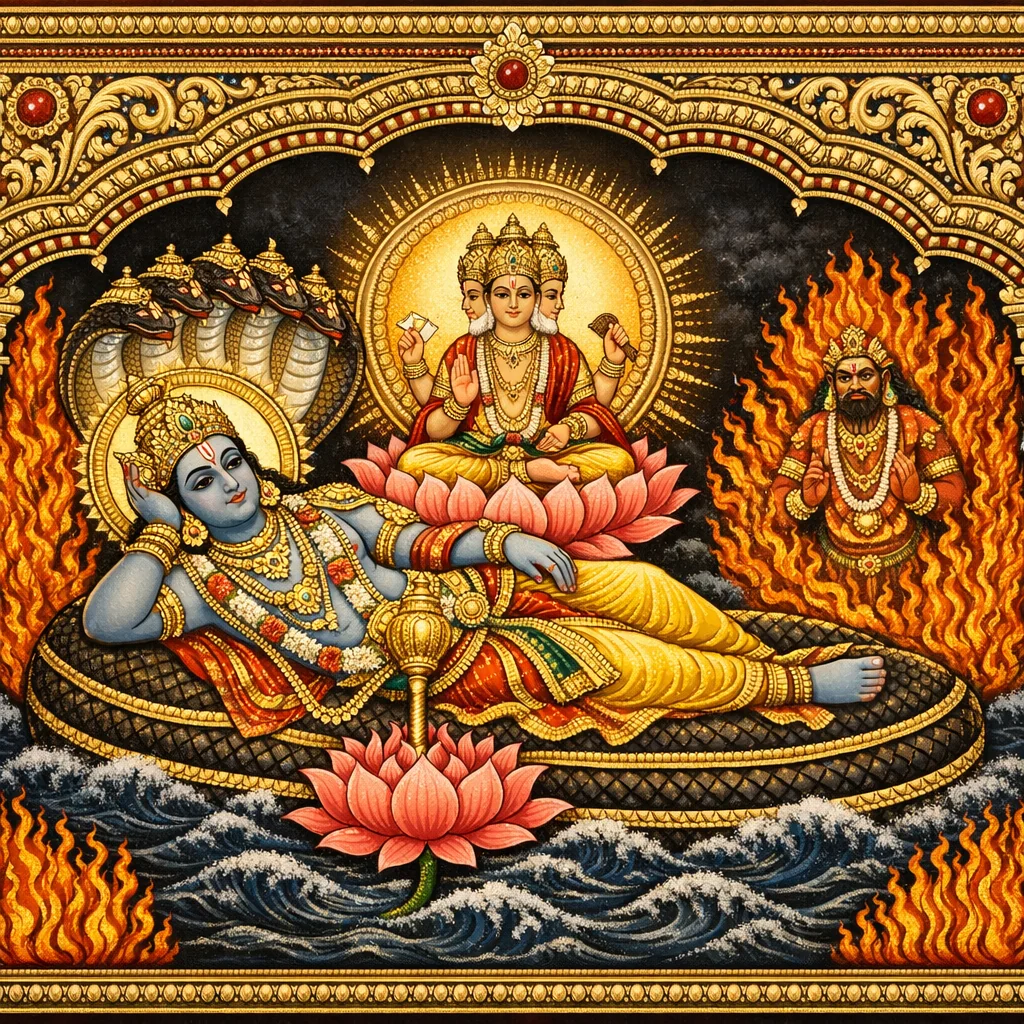
Lord Agni systematizes pralaya into four kinds: nitya (the continual perishing of beings), naimittika (periodic dissolution tied to Brahmā’s cycle), prākṛta (cosmic reabsorption at the end of vast yuga cycles), and ātyantika (final dissolution through liberating knowledge, wherein the self merges into Paramātman). He narrates the naimittika sequence in vivid cosmography: prolonged drought; the Sun absorbing the waters through seven rays; the arising of seven solar forms; a universal conflagration culminating in Kālāgni-Rudra, burning from netherworlds to heaven; and beings migrating to higher lokas. Then rains quench the fire, winds disperse the clouds, and Hari rests on Śeṣa in the single ocean, entering yoganidrā and recreating as Brahmā. The prākṛta pralaya is framed as a precise Sāṃkhya involution: earth into water, water into fire, fire into wind, wind into ether, ether into ahaṃkāra, then into mahat and finally into prakṛti; ultimately both prakṛti and puruṣa dissolve into the Supreme, beyond name and class. The chapter closes by affirming that in the Supreme all conceptual constructions cease.
Shlokas
Verse 1
इत्य् आग्नेये महापुराणे सामान्यनामलिङ्गानि नाम षट्षष्ट्यधिकत्रिशततमो ऽध्यायः अथ सप्तषष्ट्यधिकत्रिशततमो ऽध्यायः नित्यनैमीत्तिकप्राकृतप्रलयाः अग्निर् उवाच चतुर्विधस्तु प्रलयो नित्यो यः प्राणिनां लयः सदा विनाशो जातानां ब्राह्मो नैमित्तिको लयः
Thus, in the Agni Mahāpurāṇa, the chapter entitled “Common Nouns and Their Genders” is the three-hundred-and-sixty-sixth. Now begins the three-hundred-and-sixty-seventh chapter, “The Nitya, Naimittika, and Prākṛta Dissolutions.” Agni said: “Dissolution (pralaya) is of four kinds. The ‘nitya’ dissolution is the constant passing-away of living beings—the continual destruction of those who are born. The ‘naimittika’ dissolution is the Brahmā-related, periodic dissolution.”
Verse 2
चतुर्युगसहस्रान्ते प्राकृतः प्राकृतो लयः लय आत्यन्तिको ज्ञानादात्मनः परमात्मनि
At the end of a thousand cycles of the four yugas occurs the natural (prākṛta) dissolution of the manifested cosmos; but the absolute (ātyantika) dissolution is the merging of the individual self into the Supreme Self through liberating knowledge.
Verse 3
नैमित्तिकस्य कल्पान्ते वक्ष्ये रूपं लयस्य ते चतुर्युगसहस्रान्ते क्षीणप्राये महीतले
At the end of the kalpa, I shall describe to you the form of the naimittika (occasional) dissolution—when, at the close of a thousand cycles of the four yugas, the earth’s surface is almost exhausted and depleted.
Verse 4
अनावृष्टिरतीवोग्रा जायते शतवार्षिकी ततः सत्त्वक्षयः स्याच्च ततो विष्णुर्जगत्पतिः
A most dreadful absence of rain arises for a hundred years; from that, the living beings’ vitality is depleted—and then Viṣṇu, the Lord of the world, (brings about the next cosmic turn).
Verse 5
स्थितो जलानि पिवति भानोः सप्तसु रश्मिषु भूपातालसमुद्रादितोयं नयति संक्षयं
Stationed within the Sun’s seven rays, he (the Sun) drinks up the waters; from the earth, the netherworlds (pātālas), and the oceans he draws the water and brings it to diminution (that is, causes its evaporation).
Verse 6
ततस्तस्यानुभावेन तोयाहारोपवृंहिताः त एव रश्मयः सप्त जायन्ते सप्त भास्कराः
Then, by his power, those very rays—nourished by water as their sustenance—become sevenfold; thus are born the seven Bhāskaras (solar forms).
Verse 7
दहन्त्य् अशेषं त्रैलोक्यं सपातालतलं द्विज कूर्मपृष्ठसमा भूः स्यात्ततः कालाग्निरुद्रकः
O twice-born one, it burns up the entire threefold world, together with the subterranean regions; the earth becomes level like the back of a tortoise—then there arises Kālāgni-Rudra.
Verse 8
शेषाहिश्वाससम्पातात् पातालानि दहत्यधः पातालेभ्यो भुवं विष्णुर्भुवः स्वर्गं दहत्यतः
By the forceful rush of the breaths of Śeṣa (the cosmic serpent), the netherworlds below are burned; from the netherworlds onward, Viṣṇu burns the earth, and from the earth onward he burns heaven.
Verse 9
अम्बरीषमिवाभाति त्रैलोक्यमखिलं तथा ततस्तापरीतास्तु लोकद्वयनिवासिनः
Thus the entire threefold world appeared like a blazing furnace; then the inhabitants of the two worlds were overcome by scorching heat.
Verse 10
गाचन्ति ते महर्लोकं महर्लोकाज्जनं ततः रुद्ररूपी जगद्दग्ध्वा मुखनिश्वासतो हरेः
They proceed to Maharloka; from Maharloka, then to Janaloka. Assuming the form of Rudra, Hari burns the universe by the out-breath issuing from his mouth.
Verse 11
उत्तिष्टन्ति ततो मेधा नानारूपाः सविद्युतः शतं वर्षाणि वर्षन्तः शमयन्त्यग्निमुत्थितम्
Then storm-clouds arise in diverse forms, flashing with lightning; pouring rain for a hundred years, they quell the fire that has flared up.
Verse 12
सप्तर्षिस्थानमाक्रम्य स्थिते ऽम्भसि शतं मरुत् मुखनिश्वासतो विष्णोर्नाशं नयति तान्घनान्
When the waters occupy the region of the Seven Sages (Saptarṣi-mandala), a hundred Maruts—arising from the exhalation of Viṣṇu’s mouth—bring those clouds to destruction.
Verse 13
वायुं पीत्वा हरिः शेषे शेते चैकार्णवे प्रभुः ब्रह्मरूपधरः सिद्धैर् जलगैर् मुनिभिस्तुतः
Having absorbed the vital airs (vāyu), the Lord Hari lies upon Śeṣa in the single, all-encompassing ocean; assuming the form of Brahmā, the sovereign is praised by the Siddhas and by water-dwelling sages.
Verse 14
आत्ममायामयीं दिव्यां योगनिद्रां समास्थितः आत्मानं वसिदेवाख्यं चिन्तयन्मधुसूदनः
Madhusūdana, having entered the divine Yogic Sleep (Yoga-nidrā) that consists of His own māyā, contemplated His own Self, known as Vāsudeva.
Verse 15
कल्पं शेते प्रबुद्धो ऽथ ब्रह्मरूपी सृजत्य् असौ द्विपरार्धन्ततो व्यक्तं प्रकृतौ लीयते द्विज
He lies in yogic repose throughout a kalpa; then, upon awakening, assuming the form of Brahmā, he brings forth creation. At the completion of two parārdhas, the manifested world dissolves back into Prakṛti, O twice-born one.
Verse 16
स्थानात् स्थानं दशगुणमेकस्माद्गुण्यते स्थले ततो ऽष्टादशमे भागे परार्धमभिधीयते
From one place-value to the next, the quantity is multiplied tenfold at each position; and at the eighteenth division from that, the unit called “parārdha” is declared.
Verse 17
परार्धं द्विगुणं यत्तु प्राकृतः प्रलयः स्मृतः अनावृष्ट्याग्निसम्पर्कात् कृते संज्वलने द्विज
That which is twice a parārdha is remembered as the Prākṛta (primordial) dissolution. O twice-born one, when through the absence of rain (drought) and the contact of fire a conflagration is kindled, that dissolution occurs.
Verse 18
महदादेर्विकारस्य विशेषान्तस्य संक्षये कृष्णेच्छाकारिते तस्मिन् सम्प्राप्ते प्रतिसञ्चरे
When the modification (vikāra) beginning with Mahat and ending in the particularized elements (viśeṣas) comes to dissolution—at that counter-current reabsorption (pratisañcara) which occurs by Kṛṣṇa’s will—
Verse 19
आपो ग्रसन्ति वै पूर्वं भूमिर्गन्धादिकं गुणं आत्मगन्धात्ततो भूमिः प्रलयत्वाय कल्पते
First indeed the waters swallow up the earth’s quality beginning with smell; then, deprived of its own smell, the earth becomes fit to pass into dissolution.
Verse 20
रसात्मिकाश् च तिष्ठन्ति ह्य् आपस्तासां रसो गुणः पीयते ज्योतिषा तासु नष्टास्वग्निश् च दीप्यते
Waters indeed abide as constituted of rasa (sap/essence); their defining quality is ‘rasa’. That rasa is ‘drunk up’ by the inner light (tejas); and when those waters are depleted, Agni (fire) blazes forth.
Verse 21
ज्योतिषो ऽपि गुणं रूपं वायुर्ग्रसति भास्करं नष्टे ज्योतिषि वायुश् चबली दोधूयते महान्
Even the qualities and visible form of light are swallowed by the Wind; the Sun is engulfed. When the light has perished, that mighty Wind, grown exceedingly powerful, surges and whirls about.
Verse 22
वायोरपि गुणं स्पर्शमाकाशं ग्रसते ततः वायौ नष्टे तु चाकाशन्नीरवं तिष्ठति द्विज
Then ether (ākāśa) absorbs even the quality of air—touch (sparśa). And when air has perished, ether remains, soundless, O twice-born.
Verse 23
आकाशस्याथ वै शब्दं भूतादिर्ग्रसते च खं अभिमानात्मकं खञ्च भूतादिं ग्रसते महान्
Then, from ether (ākāśa), the quality ‘sound’ is absorbed by the primordial source of the elements (bhūtādi); and bhūtādi also absorbs ether itself. Thereafter the great principle—egoity (ahaṃkāra), whose nature is self-identification (abhimāna)—absorbs that ether, and in turn the Great (mahat) absorbs bhūtādi.
Verse 24
भूमिर्याति लयञ्चाप्सु आपो ज्योतिषि तद्ब्रजेत् वायौ वायुश् च खे खञ्च अहङ्कारे लयं स च
Earth attains dissolution into the waters; the waters then pass into fire (radiance). Fire dissolves into wind; wind into space (ether); and space itself attains dissolution into egoity (ahaṅkāra).
Verse 25
महात्तत्वे महान्तञ्च प्रकृतिर्ग्रसते द्विज व्यक्ताव्यक्ता च प्रकृतिर्व्यक्तस्याव्यक्तके लयः
O twice-born one, Prakṛti absorbs both the Mahat-tattva and the (cosmic) Great Principle; and that Prakṛti—being both the manifest and the unmanifest—is the locus where the manifest dissolves into the unmanifest.
Verse 26
पुमाने काक्षरः शुद्धः सो ऽप्यंशः परमात्मनः प्रकृतिः पुरुषश् चैतौ लीयेते परमात्मनि
Puruṣa (the conscious being) is imperishable and pure; he too is a portion of the Supreme Self (Paramātman). Both Prakṛti (primordial Nature) and Puruṣa ultimately dissolve into the Paramātman.
Verse 27
न सन्ति यत्र सर्वेशे नामजात्यादिकल्पनाः सत्तामात्रात्मके ज्ञेये ज्ञानात्मन्यात्महः परे
In the Supreme Lord of all, there are no conceptual constructions such as name, class, and the like. What is to be known is of the nature of mere Being; in that Supreme—whose essence is pure Knowledge—those who destroy the Self through ignorance do not abide.
Frequently Asked Questions
A rigorous taxonomy of dissolution and a stepwise tattva-involution (earth→water→fire→wind→ether→ahaṃkāra→mahat→prakṛti→Paramātman), integrating cosmological narrative with philosophical mechanics.
It reframes cosmic endings as instruction in detachment and discernment, culminating in ātyantika pralaya—liberation through knowledge—where the seeker transcends name-and-form conceptuality and abides in the Supreme.