
Shloka 35
Vibhuti Yoga — Vibhuti Yoga
बृहत्साम तथा साम्नां गायत्री छन्दसामहम् । मासानां मार्गशीर्षोऽहमृतूनां कुसुमाकरः ॥ १०.३५ ॥
bṛhatsāma tathā sāmnāṃ gāyatrī chandasām aham | māsānāṃ mārgaśīrṣo 'ham ṛtūnāṃ kusumākaraḥ || 10.35 ||

Unter den Sāma-Hymnen bin Ich der Bṛhat-sāman; unter den Versmaßen bin Ich die Gāyatrī. Unter den Monaten bin Ich Mārgaśīrṣa; unter den Jahreszeiten bin Ich der Frühling, die Quelle der Blüten.
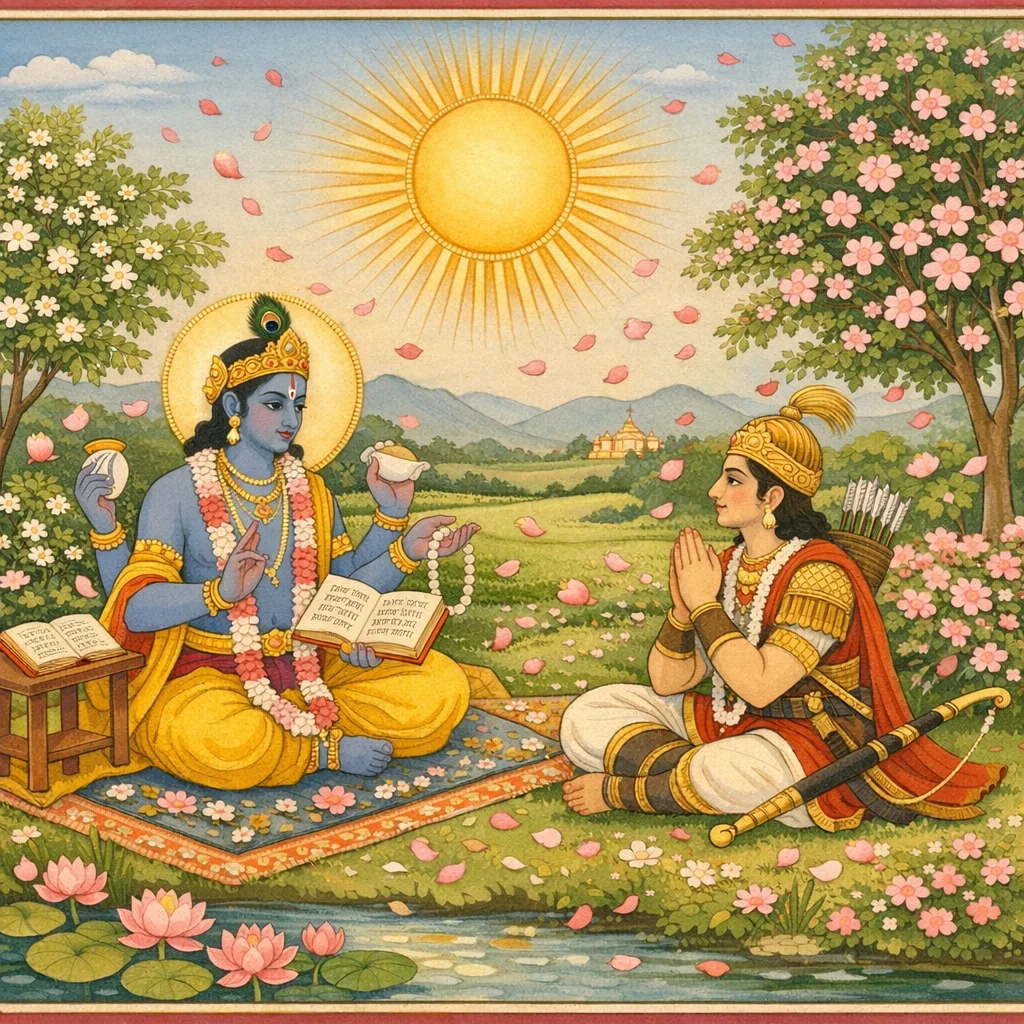
Among Sāma hymns I am the Bṛhat-sāman; among metres I am the Gāyatrī. Among months I am Mārgaśīrṣa; among seasons I am spring, the source of flowers.
Among Sāman chants I am Bṛhat-sāman; among poetic metres I am Gāyatrī; among months I am Mārgaśīrṣa; among seasons I am kusumākara (flower-maker; spring).
kusumākara is a poetic epithet for spring. Mārgaśīrṣa corresponds roughly to Nov–Dec in many lunar calendars; translations vary by regional calendrical conventions.
FAQs
Metre and seasonal cycles can be read as stabilizing rhythms; attending to such rhythms supports attention, gratitude, and emotional regulation.
The verse links the sacred to patterned order—chant, metre, calendrical time—implying that intelligible form and harmony are expressions of the ultimate.
References to Sāman chants and Gāyatrī reflect the prestige of Vedic recitation and prosody in classical education and ritual life.
It can encourage mindful engagement with music/poetry and with seasonal change, using them as contemplative supports rather than as mere entertainment.