
Shloka 34
Vibhuti Yoga — Vibhuti Yoga
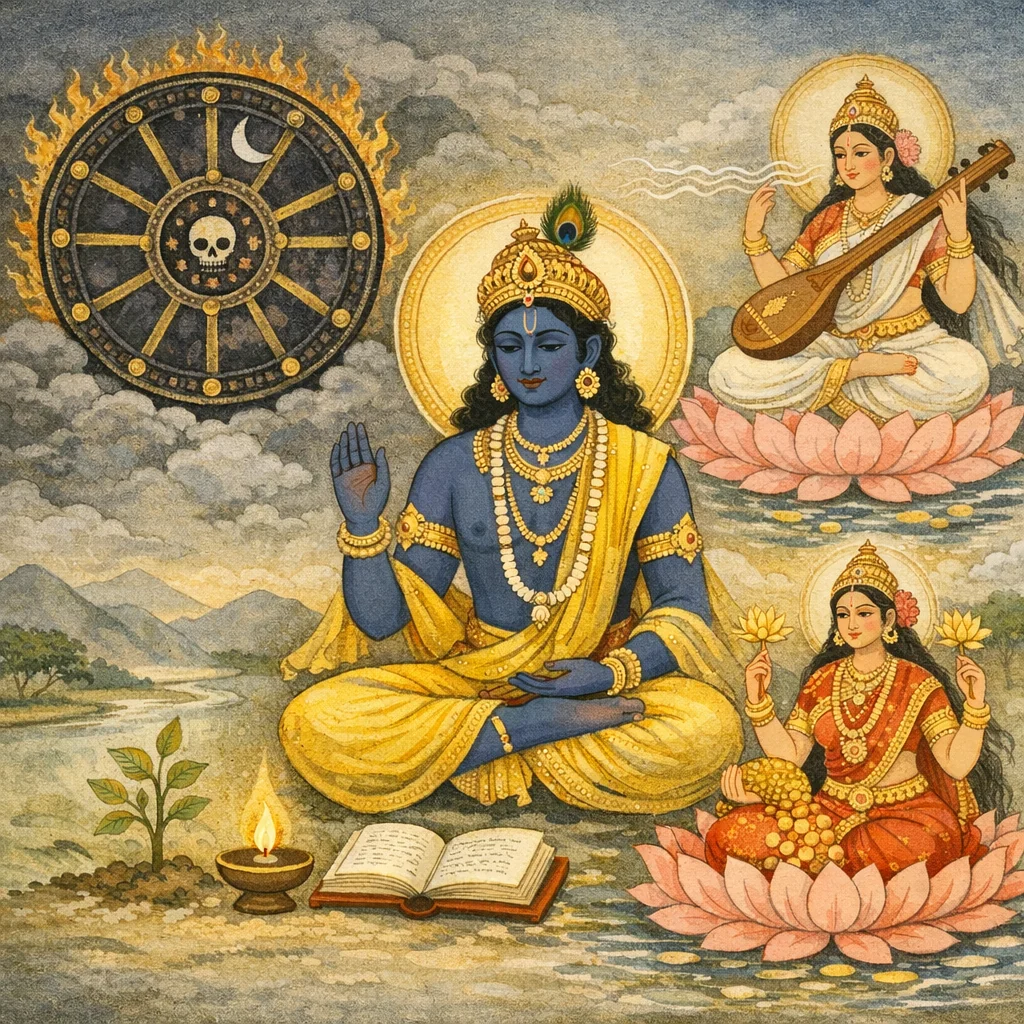
मृत्युः सर्वहरश्चाहमुद्भवश्च भविष्यताम् । कीर्तिः श्रीर्वाक्च नारीणां स्मृतिर्मेधा धृतिः क्षमा ॥ १०.३४ ॥
mṛtyuḥ sarvaharaś cāham udbhavaś ca bhaviṣyatām | kīrtiḥ śrīr vāk ca nārīṇāṃ smṛtir medhā dhṛtiḥ kṣamā || 10.34 ||

Ich bin der Tod, der alles hinwegraubt; und Ich bin das Hervorgehen dessen, was noch werden soll. Unter den Frauen bin Ich Ruhm, Glück und Gedeihen, Rede, Erinnerung, Einsicht, Standhaftigkeit und Nachsicht.
I am death that takes away all; and the arising of those who are to be. Among women I am fame, prosperity, speech, memory, intelligence, steadfastness, and forbearance.
I am death, the all-removing; and I am the emergence of what is to come. Among women: renown, fortune/splendor, speech, memory, understanding, resolve, and patience/forgiveness.
The line ‘among women’ is commonly interpreted as listing valued qualities personified in feminine grammatical forms (many are abstract nouns in Sanskrit). Some modern readers take it as ‘among feminine qualities’ rather than as a sociological claim about women.
FAQs
Acknowledging mortality can clarify priorities and reduce trivial anxieties; the listed virtues (memory, resolve, patience) describe capacities that stabilize the mind.
The verse pairs dissolution (death as ‘all-removing’) with emergence (udbhava), presenting reality as a continuous cycle of ending and arising within a larger ground.
Abstract qualities are often grammatically feminine in Sanskrit and are culturally personified; the verse uses that idiom to list ideals recognized in the tradition.
It invites reflection on cultivating communication, resilience, and forgiveness, while holding change and loss as universal features of life rather than personal affronts.