
Bhagavad Gita — Raja Vidya Raja Guhya Yoga, Shloka 28
Raja Vidya Raja Guhya Yoga
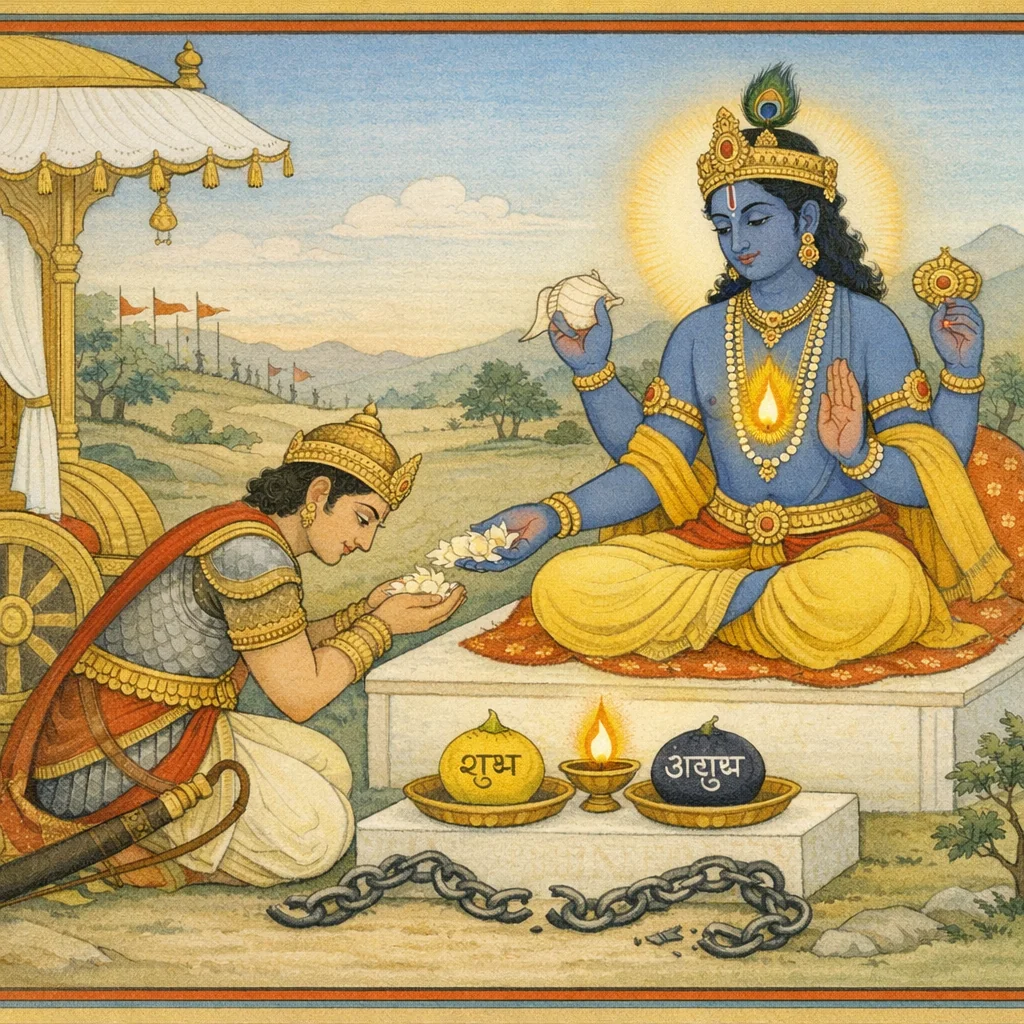
शुभाशुभफलैरेवं मोक्ष्यसे कर्मबन्धनैः । संन्यासयोगयुक्तात्मा विमुक्तो मामुपैष्यसि ॥ ९.२८ ॥
śubhāśubha-phalair evaṁ mokṣyase karma-bandhanaiḥ | saṁnyāsa-yoga-yuktātmā vimukto mām upaiṣyasi || 9.28 ||

So wirst du von den Fesseln des Handelns, das gute und schlechte Früchte trägt, befreit. Mit dem Geist im Yoga der Entsagung gefestigt, erlöst, wirst du zu Mir gelangen.
Thus you shall be freed from the bondage of actions yielding good and bad results; with your mind established in the yoga of renunciation, liberated, you shall come to Me.
Thus you will be released from the bonds of action consisting in auspicious and inauspicious results; joined to the yoga of renunciation, freed, you will attain Me.
Key terms are ‘śubha/aśubha-phala’ (pleasant/unpleasant or meritorious/demeritorious results) and ‘saṁnyāsa-yoga’ (renunciatory discipline). Some interpret this as inner renunciation while remaining active; others emphasize a formal renunciant ideal, though the immediate context favors inner detachment through dedication.
FAQs
It points to freedom from being emotionally governed by success/failure or praise/blame, cultivating stability through relinquishing claim over outcomes.
The verse articulates release from karmic causality tied to result-bearing action, with ‘attaining Me’ indicating the highest state in the text’s theistic framework.
It follows the instruction to offer all acts to the divine (9.27), presenting the promised consequence: loosening the binding force of karma.
Practically, it supports acting responsibly while reducing fixation on reward, thereby improving ethical consistency and resilience.