
Shloka 38
Vishwarupa Darshana Yoga — Vishwarupa Darshana Yoga
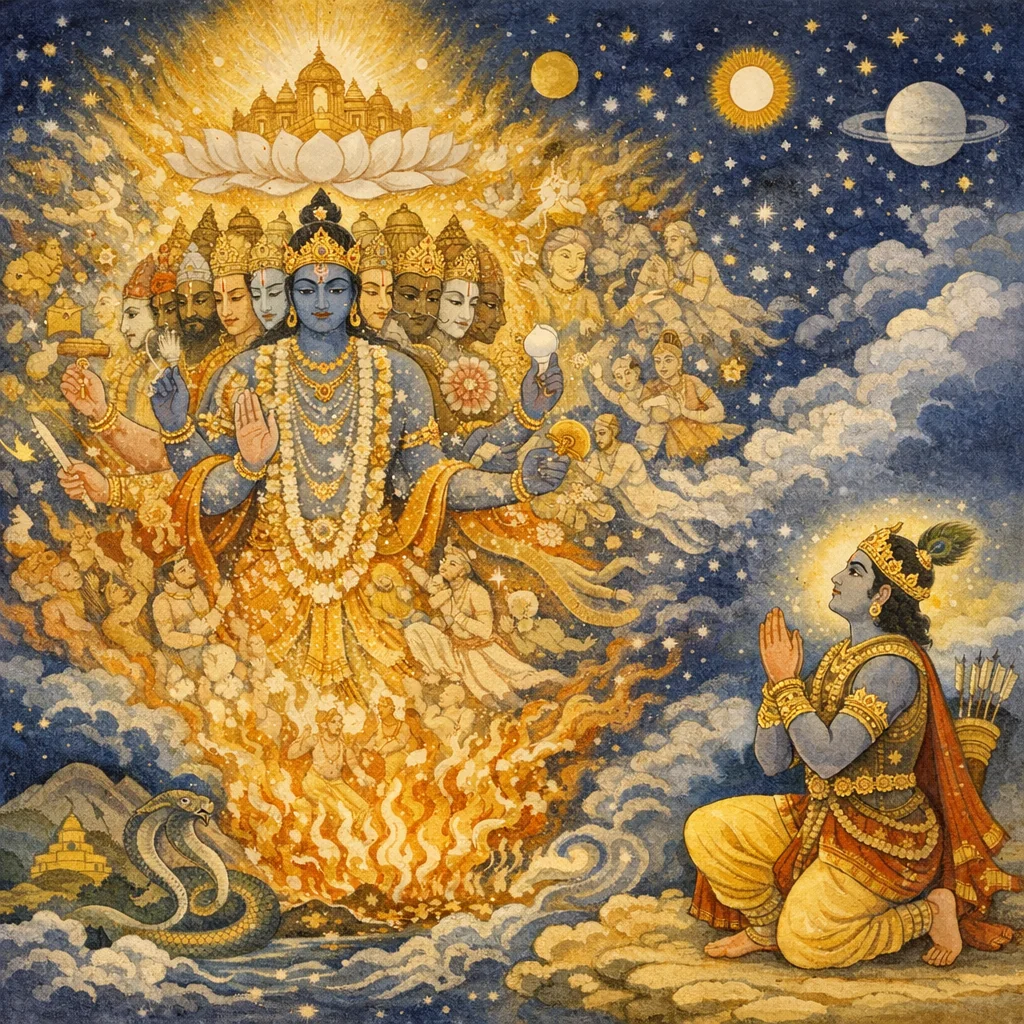
त्वमादिदेवः पुरुषः पुराणस्
त्वमस्य विश्वस्य परं निधानम् ।
वेत्तासि वेद्यं च परं च धाम
त्वया ततं विश्वमनन्तरूप ॥
tvam ādi-devaḥ puruṣaḥ purāṇas
tvam asya viśvasya paraṁ nidhānam |
vetāsi vedyaṁ ca paraṁ ca dhāma
tvayā tataṁ viśvam ananta-rūpa ||

আপনি আদিদেব, পুরাতন পুরুষ; এই বিশ্বজগতের পরম নिधान ও আশ্রয়স্থান আপনি। জ্ঞাতা আপনি, এবং যা জ্ঞেয় সেই পরম তত্ত্বও আপনি; পরম ধামও আপনি। হে অনন্তরূপ, আপনার দ্বারাই এই সমগ্র বিশ্ব ব্যাপ্ত।
You are the primal God, the ancient Person; you are the supreme resting-place of this universe. You are the knower and that which is to be known; you are the highest abode. O you of infinite forms, by you this whole universe is pervaded.
You are the original deity, the primordial Person; you are the ultimate repository/support of this universe. You are the knowing subject and also the highest object of knowledge; you are the supreme abode. O infinite-formed one, by you the entire universe is pervaded.
Most recensions are stable here. Interpretive differences typically concern (a) whether "paraṁ nidhānam" is rendered as “treasure/storehouse” or “final ground/support,” and (b) whether "vetāsi vedyaṁ ca" is read theologically (God as omniscient and as the goal of knowledge) or metaphysically (ultimate reality as both subject and object of knowledge).
FAQs
The verse articulates a cognitive shift in Arjuna: from seeing the divine as an external agent to recognizing an all-pervasive reality that also functions as the ultimate object of understanding. Psychologically, it models an integrative experience in which meaning, knowledge, and existential security (“supreme abode/support”) converge.
It presents the divine as both transcendent (“supreme abode,” “primordial person”) and immanent (“the universe is pervaded by you”). The phrase “knower and known” gestures toward a non-dual or near-non-dual horizon: ultimate reality is not merely one entity among others but the condition of possibility for knowing and for what is known.
Within the Viśvarūpa (cosmic form) revelation, Arjuna responds by identifying Krishna with foundational Vedic-philosophical categories (ādi-deva, puruṣa, paraṁ dhāma). The verse functions as a doctrinal summary of what the vision implies: the divine is the ground, goal, and pervasive presence of the cosmos.
Read non-sectarianly, it can be used as a contemplative framework: treat the pursuit of knowledge as ethically and existentially oriented toward a unifying principle (truth, reality, or the highest good), and cultivate a sense of connectedness by reflecting on “pervasion” as interdependence and shared ground of experience.