
Shloka 37
Vishwarupa Darshana Yoga — Vishwarupa Darshana Yoga
कस्माच्च ते न नमेरन्महात्मन् गरीयसे ब्रह्मणोऽप्यादिकर्त्रे ।
अनन्त देवेश जगन्निवास त्वमक्षरं सदसत्तत्परं यत् ॥
kasmācca te na nameran mahātman garīyase brahmaṇo 'py ādikartre |
ananta deveśa jagannivāsa tvam akṣaraṃ sadasat tat paraṃ yat ||

হে মহাত্মন! তারা কেন আপনাকে নমস্কার করবে না? আপনি ব্রহ্মার থেকেও মহান এবং আদিকর্তা। হে অনন্ত! হে দেবেশ! হে জগন্নিবাস! আপনি অক্ষর (অবিনাশী); আপনি সৎ ও অসৎ, এবং তাদেরও পরের যে পরম তত্ত্ব—সেই আপনি।
हे महात्मन्! वे (सब) आपको क्यों न नमस्कार करें? आप ब्रह्मा से भी महान हैं और आदि-कर्ता हैं। हे अनन्त! हे देवेश! हे जगन्निवास! आप अक्षर (अविनाशी) हैं; आप सत् और असत् तथा उनसे परे जो परम तत्त्व है, वही हैं।
O great-souled one, why should they not bow to you? You are greater than Brahmā and the primal maker. O Endless One, Lord of gods, abode of the world: you are the imperishable; you are being and non-being, and that which is beyond them.
Most recensions agree closely in sense: Arjuna offers a doxological rationale for universal reverence toward the cosmic form. Traditional renderings often identify “sat/asat” with manifest/unmanifest or existent/non-existent, and “tat paraṃ” with the supreme principle (often read theologically as the highest Brahman). Academic-literal translation keeps the triad (sat, asat, and beyond) without committing to a single later doctrinal mapping.
FAQs
The verse reflects a shift from ordinary perception to awe and humility: Arjuna’s mind reorients from personal agency and doubt toward reverent acceptance of a larger, transpersonal reality. In psychological terms, it depicts the stabilizing effect of recognizing a frame of meaning that exceeds the ego.
Arjuna characterizes the divine as (1) the source of creation (“primal maker”), (2) the imperishable ground (“akṣara”), and (3) encompassing both being and non-being while also transcending them. This compresses several strands of Indian metaphysics: the absolute as ontological foundation, the world as dependent manifestation, and the ultimate as beyond conceptual binaries.
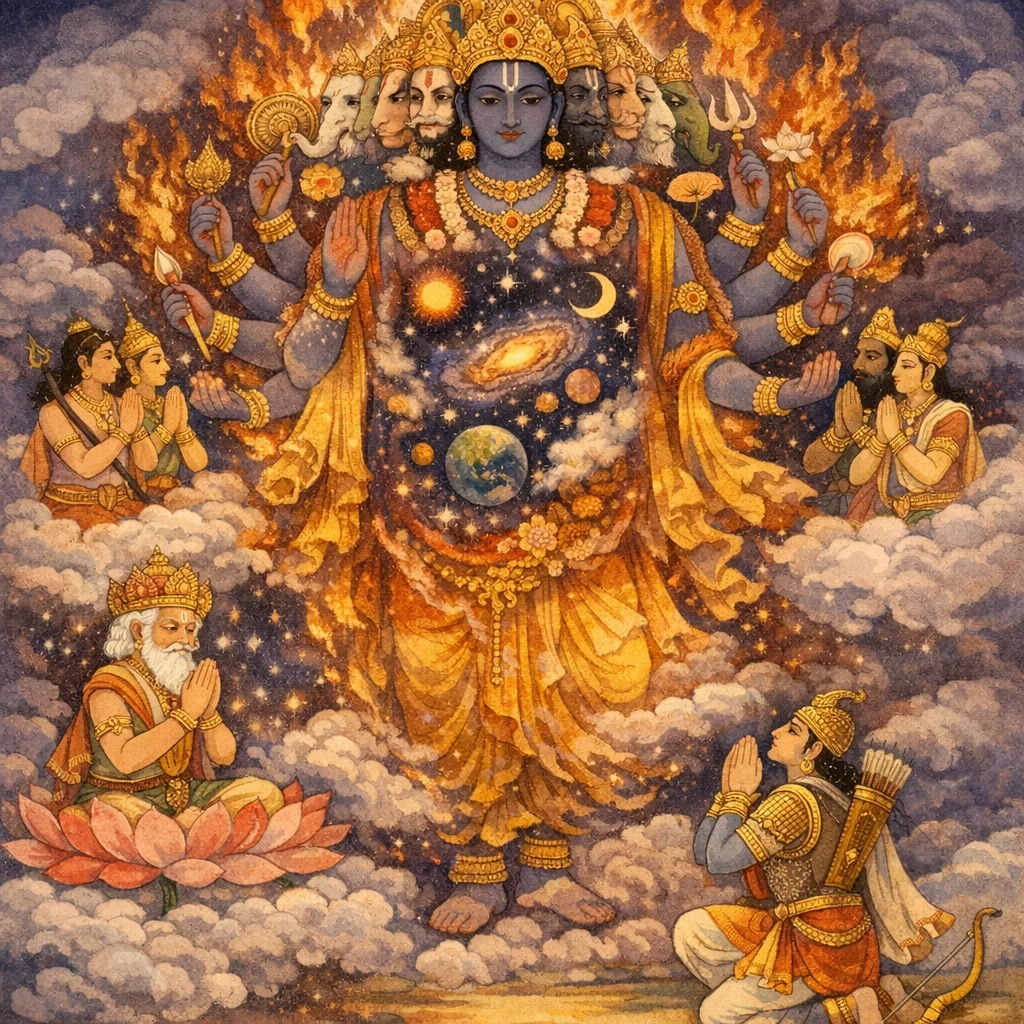
Placed within the Viśvarūpa episode, the verse is part of Arjuna’s verbal response to the theophany. It functions as a theological-ontological justification for why all beings would naturally bow to the revealed cosmic form, reinforcing the narrative’s emphasis on the divine as universal dwelling and source.
As a reflective practice, the verse can be read as encouraging intellectual humility and ethical restraint: recognizing that one’s standpoint is partial can reduce reactive certainty and widen responsibility toward a larger whole (community, ecology, or shared human values), without requiring adherence to a specific sectarian theology.