
Bhagavad Gita — Moksha Sannyasa Yoga, Shloka 31
Moksha Sannyasa Yoga
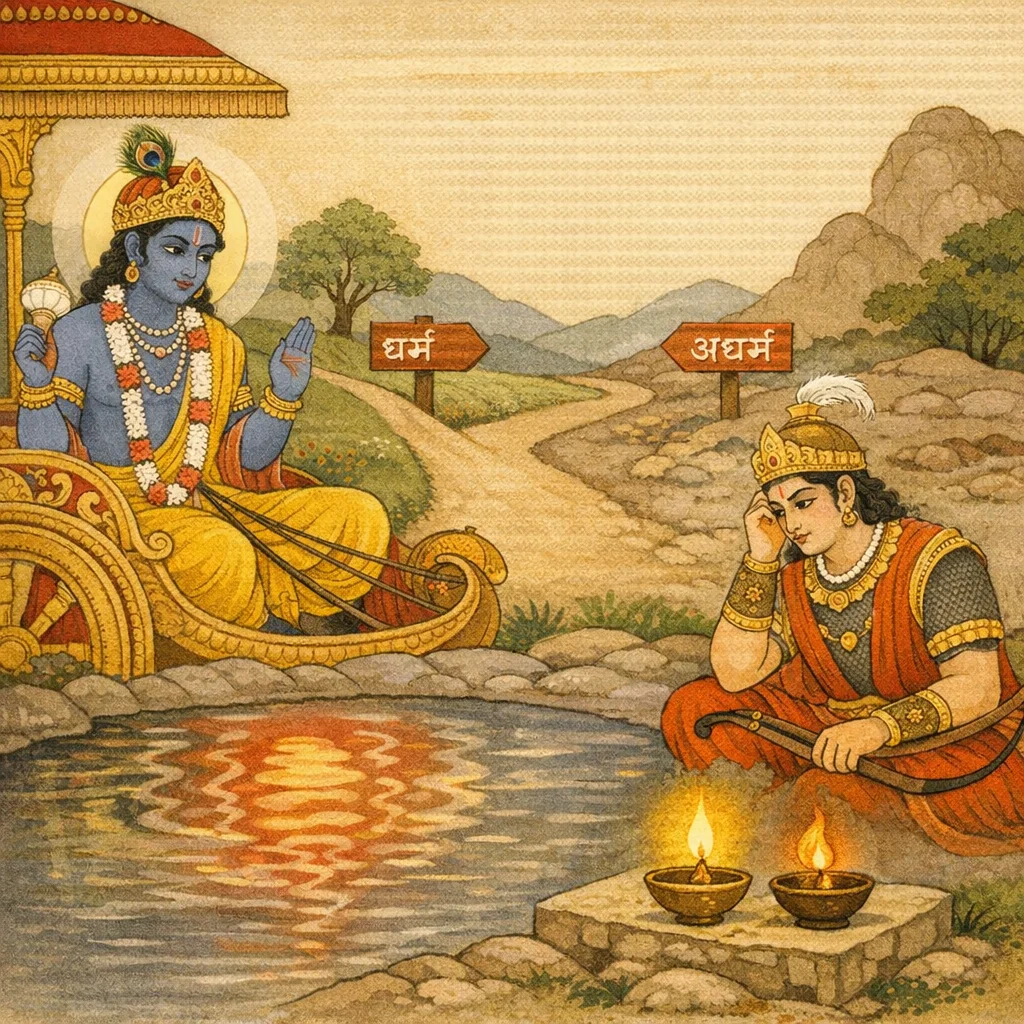
यया धर्ममधर्मं च कार्यं चाकार्यमेव च । अयथावत्प्रजानाति बुद्धिः सा पार्थ राजसी ॥ १८.३१ ॥
yayā dharmam adharmaṃ ca kāryaṃ cākāryam eva ca | ayathāvat prajānāti buddhiḥ sā pārtha rājasī || 18.31 ||

হে পার্থ, যে বুদ্ধি ধর্ম-অধর্ম এবং কার্য-অকার্যকে অযথার্থভাবে বোঝে—সেই বুদ্ধি রাজসিক।
That intellect is rajasic, O Pārtha, by which one understands dharma and adharma, and what should and should not be done, incorrectly.
Rajasic is that intellect, O Pārtha, which apprehends dharma and non-dharma, and the to-be-done and not-to-be-done, in a distorted/incorrect manner.
ayathāvat emphasizes misapprehension rather than total ignorance: rajasic buddhi is active and evaluative but biased—often read as driven by preference, attachment, or self-interest.
FAQs
Rajasic intellect is not passive; it evaluates but is prone to bias, rationalization, and preference-driven distortion—seeing duties through the lens of gain, status, or attachment.
Because rajas is linked with agitation and desire, the verse implies that metaphysical insight and ethical clarity are hindered when cognition is dominated by restless striving.
It contrasts with sattvic buddhi by showing a middle condition: not fully obscured like tamas, but unreliable due to miscalibration of values.
It can be read as a warning about motivated reasoning: decisions may appear “principled” while subtly serving cravings or anxieties; reflective practices can test whether judgments are consistent and evidence-based.