Here is a question that has confused readers for centuries, and honestly, the Ramayana itself seems to enjoy the confusion.
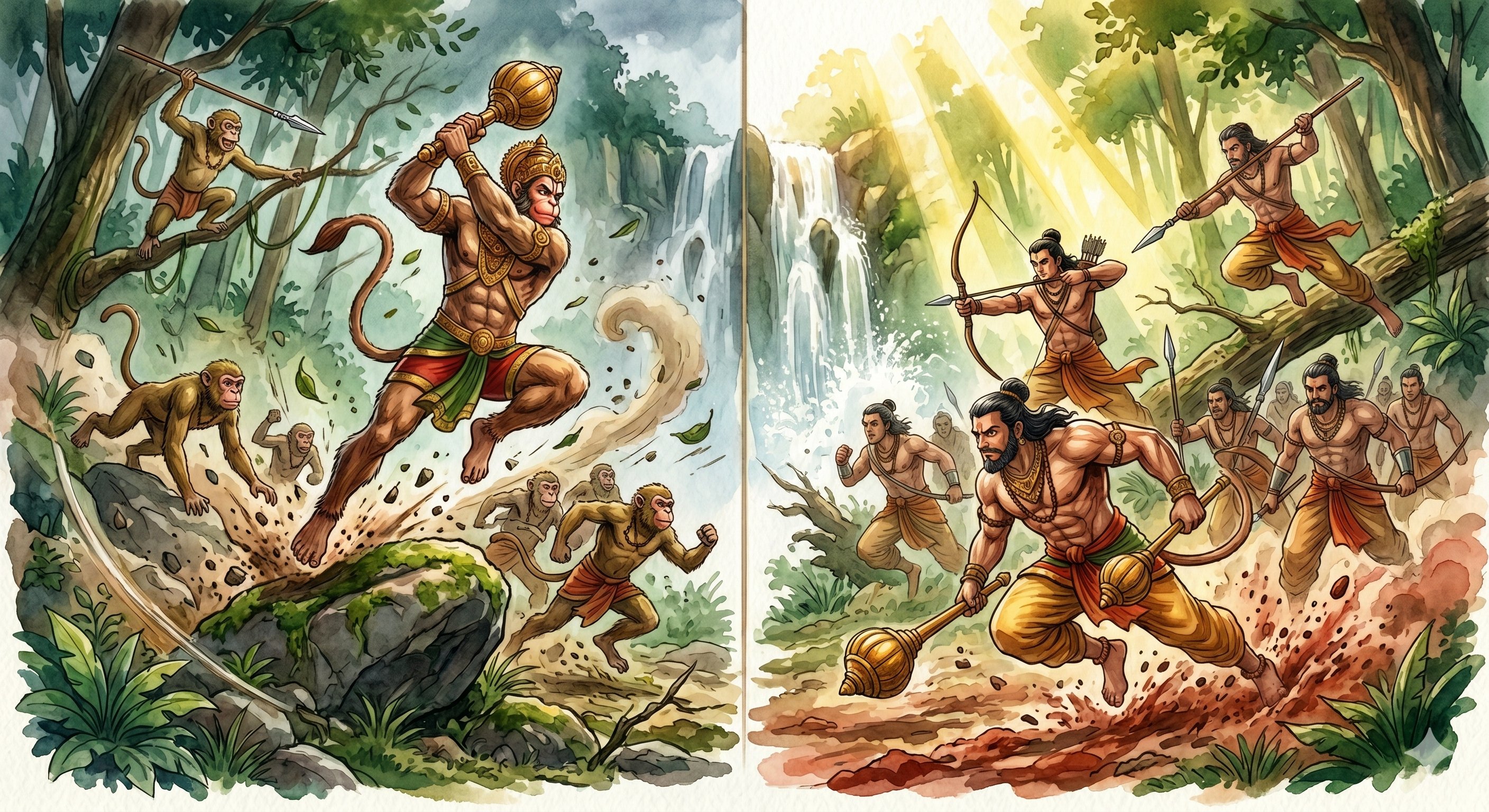
The Vanaras the race of Hanuman, Sugriva, Vali, Angada, Jambavan, and Nala are described in the text as having tails, fur, and simian faces. They leap between mountains, uproot trees as weapons, and are explicitly called kapi (monkey) in dozens of verses.
And yet these same beings run a constitutional monarchy in Kishkindha with a king, a crown prince, ministers, and a formal coronation ceremony. They conduct diplomatic missions Hanuman's embassy to Lanka is one of the most sophisticated acts of intelligence gathering in ancient literature. They perform Vedic rites, observe marriage and funeral customs, wear clothing, and debate ethics and statecraft with the eloquence of trained scholars.
So what were they? Literal monkeys who happened to build kingdoms? Humans who were called monkeys as a literary device? Something else entirely?
The answer, like most things in the Ramayana, is more layered than any single theory can capture.
The Word Itself: What Does "Vanara" Actually Mean?
The first clue and the first controversy lies in the etymology of the word Vanara (वानर).
The most common modern translation is simply "monkey." But Sanskrit scholars have long pointed out that the word breaks down into two roots:
| Root | Meaning |
|---|---|
| Vana (वन) | Forest |
| Nara (नर) | Man, human being |
If taken as a compound Vana + Nara the word literally means "forest man" or "forest-dwelling person." Not monkey. Not ape. A human who lives in the forest.
There is a third, more playful etymology that some commentators have proposed: "Vā Nara?" meaning "Is he a man?" a rhetorical question capturing the ambiguity of creatures who look partly human and partly animal, as if the language itself is shrugging: we're not sure what to call them either.
This etymological debate is not a modern invention. Classical Sanskrit commentators including Govindaraja and other medieval scholars who wrote tīkā (commentaries) on the Valmiki Ramayana acknowledged the "forest-man" reading. The ambiguity is baked into the language from the beginning.
The Case for "They Were Monkeys" - What the Text Actually Says
Let's be honest about what the Valmiki Ramayana explicitly describes. If you read the text without any interpretive lens, the Vanaras have unmistakably animal characteristics.
Physical Descriptions
The Ramayana uses the word kapi (कपि) which unambiguously means "monkey" to describe Hanuman and his kin throughout the text. In the Kishkindha Kanda and Sundara Kanda, the physical descriptions are vivid:
- Tails - Hanuman's tail is not a metaphor. It is set on fire by Ravana's soldiers and used to burn Lanka. The tail is a plot device.
- Fur and simian faces - Multiple verses describe Vanaras as having hari (tawny/golden) fur and monkey-like features.
- Leaping and bounding - The Vanaras move through trees, leap vast distances, and fight by hurling rocks and uprooting trees behaviors the text links to their monkey nature.
- Sugriva's roar - When Sugriva challenges Vali, the description of their combat reads like two enormous primates fighting, not two human kings in a duel.
Rama's Own Words
When Rama first encounters the Vanaras in the Kishkindha Kanda, he describes them in terms that distinguish them from humans. He recognises them as a different kind of being not demons (rakshasas), not celestials (devas), but vanaras a category unto themselves.
If the Vanaras were simply a human tribe, the text's insistence on describing their physical appearance as non-human requires an explanation. And the "they were monkeys" camp has the simplest explanation: the text means what it says.
The Case for "They Were Humans" - The Evidence That Doesn't Fit
But here's the problem. If the Vanaras were literal monkeys, then the Ramayana is describing monkeys who do things that no animal in any tradition, in any text has ever done. The list is staggering.
Political Systems
The Vanaras don't just have a king. They have a functioning state.
| Feature | Evidence in the Ramayana |
|---|---|
| Monarchy with succession rules | Vali is king; when he is believed dead, Sugriva is crowned. When Vali returns, there is a legitimacy crisis not a pack dominance fight, but a political dispute over rightful succession. |
| Council of ministers | Sugriva has advisors. Hanuman serves as a minister and diplomat before he is ever a warrior. |
| Formal coronation | After Vali's death, Sugriva's coronation is a ceremony with rituals, not a biological takeover. |
| Treaties and alliances | Sugriva enters a formal alliance with Rama with conditions, mutual obligations, and accountability. This is statecraft. |
Language, Rites, and Culture
The Vanaras speak fluent Sanskrit. Hanuman's first conversation with Rama (Kishkindha Kanda, Sarga 3) is so grammatically polished and rhetorically sophisticated that Rama turns to Lakshmana and says:
"One who has not mastered the Rig Veda, the Yajur Veda, and the Sama Veda could not speak this way. He must have studied grammar thoroughly there is not a single error in his speech."
Rama is analyzing Hanuman's grammar. He notes the correct use of sentence structure, the absence of redundancy, and the measured pace of delivery. This is not a description of a monkey. This is a description of a classically trained scholar.
Beyond Hanuman, the Vanaras as a group:
- Perform funeral rites (for Vali, in strict Vedic tradition)
- Observe marriage customs (Vali and Tara, Sugriva and Ruma)
- Wear clothing and ornaments (described in multiple passages)
- Discuss dharma and ethics (Tara's lament after Vali's death is one of the most philosophically rich passages in the entire Ramayana)
Architecture and Engineering
Nala, a Vanara engineer, designs and supervises the construction of Rama Setu, the bridge to Lanka. The text describes him as the son of Vishwakarma (the divine architect) and details the engineering process: gathering stones, measuring distances, coordinating labor across a massive workforce. This is a civil engineering project, not animal behavior.
The Tribal Theory - Forest-Dwelling Clans With Monkey Totems
The most historically grounded theory proposes that the Vanaras were indigenous forest-dwelling tribes of southern and central India who were later mythologized in the epic.
How the Theory Works
In many ancient cultures and specifically in pre-classical India tribes adopted animal totems as their clan symbols. A tribe that identified with the monkey would:
- Use monkey insignias on their flags and standards
- Wear ceremonial tails or animal skins during rituals and warfare
- Be called by their totem name by outsiders "the monkey people" in the same way that clans were called "the eagle clan" or "the serpent clan"
Under this interpretation, the Vanaras were a human tribal confederation that used the monkey as their totem. Their "tails" were ceremonial adornments. Their "fur" was a description of their appearance to the urbanized Aryan societies of the northern plains darker-skinned, forest-dwelling, unfamiliar, and therefore described in terms that emphasized their "otherness."
The Kishkindha Evidence
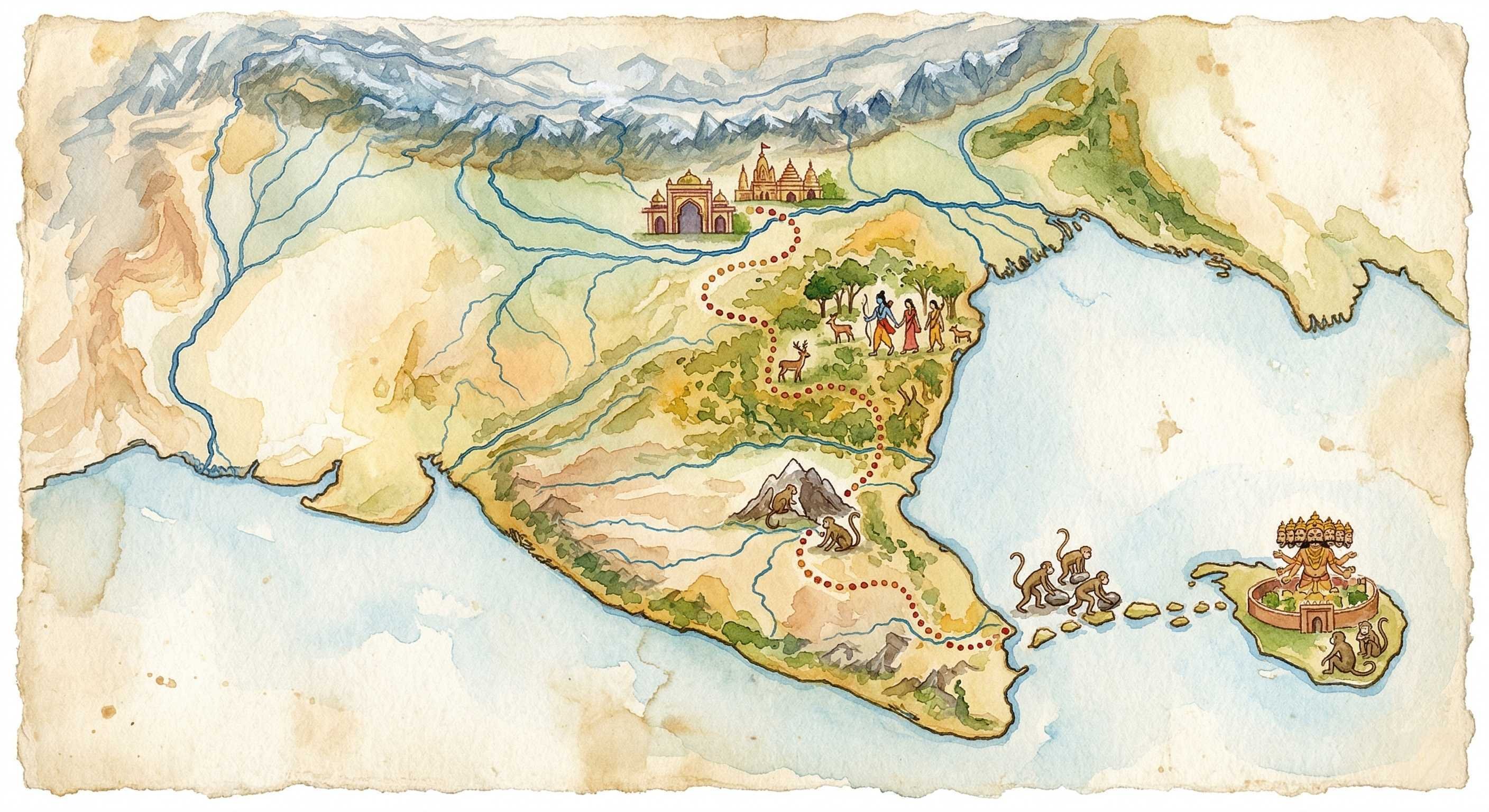
Kishkindha the Vanara capital has been historically associated with the region around Hampi in modern-day Karnataka. Archaeological remains in this area include:
- Extensive cave systems that could have served as dwellings
- Rock formations and boulders consistent with the Ramayana's description of the terrain
- Proximity to the Tungabhadra River, which matches textual geography
If the Vanaras were a tribal people living in these cave-dotted, boulder-strewn landscapes, their characterisation as "mountain-leaping, rock-hurling forest dwellers" becomes a plausible if exaggerated, description of guerrilla fighters who used terrain to their advantage.
The Jain Evidence
The Jain versions of the Ramayana particularly the Paumachariya (Padmacharita) by Vimalasuri (approximately 1st-2nd century CE) explicitly state that the Vanaras were not monkeys. In the Jain telling, they are a clan of Vidyadharas (supernatural or highly accomplished beings) who used a monkey emblem on their flag.
This is significant because the Jain Ramayana traditions are independent of the Valmiki tradition and represent a separate literary and religious lineage. If two unrelated traditions preserve the same story but one explicitly says "they weren't monkeys they just used monkey symbols," it suggests the monkey characterization may have been a later literary development rather than a core historical fact.
The Hybrid Theory - Neither Fully Human Nor Fully Animal
There is a third possibility that the text itself seems to favor: the Vanaras were something that doesn't map onto modern categories at all.
Divine Origins
The Ramayana states that the Vanaras were created by the gods specifically to assist Rama in his mission against Ravana. According to the Kishkindha Kanda, Brahma commanded the gods, Gandharvas, and celestial beings to take birth in Vanara form:
The gods begot sons in the form of Vanaras mighty, capable of changing form at will, equal to the gods themselves in power.
This divine-birth narrative positions the Vanaras not as natural animals or ordinary humans, but as a special category of being divine souls in animal-adjacent bodies, sent for a cosmic purpose.
Kamarupa - The Power to Change Form
The text repeatedly attributes kamarupa (the ability to assume any form at will) to the Vanaras. Hanuman can become as small as a fly or as large as a mountain. Sugriva is described as taking different forms. This shapeshifting ability means that asking "were they monkeys or humans?" may be the wrong question, because the text suggests they could be both, neither, or anything in between, depending on the moment.
When Hanuman approaches Sita in the Ashoka Vatika, he deliberately shrinks himself and assumes a non-threatening form. When he enters Lanka as a spy, he changes his appearance. The Vanaras' physical form is described as fluid, not fixed which makes categorical identification impossible.
The "Middle Beings" Interpretation
Some scholars have proposed that the Vanaras represent a deliberate literary creation beings who exist in a "middle space" between the human world (Rama's Ayodhya) and the demonic world (Ravana's Lanka). They are:
- More natural than humans (living in forests, connected to the earth)
- More ethical than demons (loyal, dharmic, self-sacrificing)
- More powerful than either in specific ways (Hanuman's strength, Jambavan's wisdom)
In this reading, Valmiki created the Vanaras as a narrative bridge a race that could credibly inhabit both the human world and the mythic world, making the transition from Rama's realistic exile to his cosmic war against Ravana feel organic rather than jarring.
What the Ramayana Never Does - And Why That Matters
Here is perhaps the most telling detail in the entire debate: the Ramayana never treats the Vanaras as animals.
Not once does Rama or Lakshmana speak to a Vanara the way a human speaks to a pet or a beast of burden. Every interaction is peer-to-peer. Rama enters a treaty with Sugriva, an agreement between equals, with mutual obligations. He treats Hanuman as a trusted minister and friend. He mourns the Vanara casualties at Lanka as he would mourn human soldiers.
When Lakshmana is struck down on the battlefield and appears dead, Hanuman flies to the Himalayas to retrieve the Sanjeevani herb a mission requiring geographical knowledge, botanical expertise, and independent decision-making under extreme pressure. When he cannot identify the specific herb, he uproots the entire mountain and brings it back. This is not the behavior of an animal following orders. This is a field commander improvising under crisis conditions.
The Ramayana gives the Vanaras emotions, moral agency, philosophical depth, and individual personalities that are indistinguishable from its human characters. Whatever Valmiki intended the Vanaras to be, he clearly intended them to be persons not animals.
For those who want to read the original Sanskrit descriptions of the Vanaras particularly Hanuman's first meeting with Rama, where the question of identity is most vivid Vedapath offers the complete Valmiki Ramayana with word-by-word breakdowns in Scholar Mode, making it possible to see exactly how the text navigates the line between kapi and nara.
The Five Theories - Side by Side
| Theory | Core Argument | Strongest Evidence | Biggest Problem |
|---|---|---|---|
| Literal Monkeys | The text says kapi (monkey), describes tails, fur, and simian features | Explicit physical descriptions throughout the text; Hanuman's tail set on fire is a plot point | Monkeys don't have kings, ministers, marriages, Vedic rites, Sanskrit grammar, or engineering skills |
| Human Tribes | Vanara = Vana + Nara = "forest man"; they were indigenous forest people | Etymology; human-like social systems; Kishkindha's real-world geography near Hampi | Doesn't explain why the text insists on physical monkey features, tails are not metaphors in the narrative |
| Totemic Clans | Human tribes with monkey totems, wearing ceremonial tails and animal emblems | Jain Ramayana explicitly states this; consistent with tribal totemism practices across cultures | Requires treating significant portions of the physical descriptions as exaggeration or misunderstanding |
| Divine Hybrid Beings | Gods took birth in Vanara form; they are a special cosmic category | Text explicitly states divine creation; shapeshifting (kamarupa) explains dual nature | Unfalsifiable a "divine beings" explanation can absorb any contradiction |
| Literary Construct | Valmiki created a "middle race" as a narrative device bridging human and mythic worlds | Elegant literary function; explains why they're exactly as human or animal as any given scene requires | Reduces sacred scripture to literary technique, which many traditions reject |
Why This Question Keeps Coming Back
The Vanara identity question has persisted for thousands of years because it touches something deeper than zoology or anthropology. It asks: how do we read sacred texts?
If the Vanaras were literal monkeys, the Ramayana is a story about divine beings and supernatural events that exist outside normal reality and should be read as sacred mythology.
If the Vanaras were human tribes, the Ramayana is a historical epic a record of real events, real alliances, and real wars that took place in ancient India and should be read as history wrapped in poetic exaggeration.
If the Vanaras were divine hybrids or literary constructs, the Ramayana is something more complex than either pure history or pure mythology, a text that operates on multiple levels simultaneously, where physical descriptions, symbolic meanings, and cosmic truths coexist without contradicting each other.
The Ramayana, characteristically, doesn't choose one answer. It gives you a monkey who quotes the Vedas, a king who has a tail, and an army of animals who build bridges and asks you to hold all of it at once.
Frequently Asked Questions
Q: Were Vanaras in the Ramayana monkeys or humans? A: The Ramayana describes Vanaras with both monkey-like physical traits (tails, fur, simian faces) and human-level cultural characteristics (kingship, diplomacy, Vedic rituals, Sanskrit speech). The Sanskrit word Vanara can be etymologically read as "forest man" (Vana + Nara). Scholars are divided interpretations range from literal monkeys, to forest-dwelling human tribes, to divinely created hybrid beings. The text itself resists a single category.
Q: What does the word Vanara mean in Sanskrit? A: The word Vanara (वानर) has multiple possible etymologies. The most common scholarly reading breaks it into Vana (forest) + Nara (man), meaning "forest-dwelling person." Another interpretation derives it from Vane Carati ("one who moves in the forest"). A third playful reading Vā Nara? ("Is he a man?") captures the deliberate ambiguity of beings who appear partly human and partly animal. In common modern usage, Vanara simply means "monkey."
Q: Was Hanuman a monkey or a human? A: Hanuman is described in the Valmiki Ramayana as a Vanara with divine parentage (son of Vayu, the wind god). He has physical monkey characteristics most notably a tail but also demonstrates scholarship, multilingualism, diplomatic skill, and philosophical depth that surpass most human characters. Rama himself comments on Hanuman's mastery of Sanskrit grammar and Vedic knowledge. The Jain tradition explicitly describes Hanuman as a Vidyadhara (a type of celestial being) from a clan that used a monkey emblem, not a literal monkey.
Q: Do Jain texts say Vanaras were not monkeys? A: Yes. The Paumachariya (also called Padmacharita), a Jain Ramayana written by Vimalasuri around the 1st-2nd century CE, explicitly states that the Vanaras were a clan of Vidyadharas supernatural or highly accomplished beings who used a monkey emblem on their flag. In this tradition, the "monkey" association comes from their clan symbol, not their biology.
Q: Where was the Vanara kingdom of Kishkindha? A: Kishkindha is traditionally identified with the area around modern-day Hampi in Karnataka, India, near the Tungabhadra River. The region's boulder-strewn landscapes, extensive cave systems, and rock formations closely match the Ramayana's geographical descriptions of the Vanara capital. The hill of Rishyamukha, where Sugriva was living in exile when he first met Rama, has also been identified with real locations in this area.
Key Takeaways
- The Sanskrit word Vanara can mean both "monkey" and "forest-dwelling man" (Vana + Nara) the ambiguity is built into the language itself.
- The Valmiki Ramayana describes Vanaras with explicit monkey-like physical traits (tails, fur, simian faces) but also attributes to them human-level civilization monarchy, diplomacy, Vedic rites, Sanskrit scholarship, engineering, and moral philosophy.
- The tribal totemism theory that the Vanaras were human clans using monkey emblems is supported by the Jain Ramayana, which explicitly states they were not literal monkeys.
- The Ramayana also presents a divine origin for the Vanaras, describing them as gods who took birth in Vanara form with the power of shapeshifting (kamarupa), suggesting a category that transcends the human-animal binary entirely.
- The text never treats Vanaras as animals. Every interaction between Rama and the Vanaras is peer-to-peer treaties, friendships, mourning, and mutual respect suggesting that whatever they were biologically, the Ramayana considered them persons.
📖 Read the Ramayana's Vanara Passages in the Original
The question of what the Vanaras truly were becomes most vivid when you read the original text where Valmiki's descriptions oscillate between animal imagery and human complexity, sometimes within the same verse.
With the Vedapath app, you can explore the complete Valmiki Ramayana in 16 languages, with AI-powered search that lets you find every reference to Vanaras across all seven Kandas. Use Scholar Mode to see word-by-word Sanskrit breakdowns of the passages that describe Hanuman's speech, Sugriva's kingdom, and the construction of Rama Setu and decide for yourself whether these sound like monkeys, men, or something the language hasn't yet named.
Comments
Sign in to join the discussion