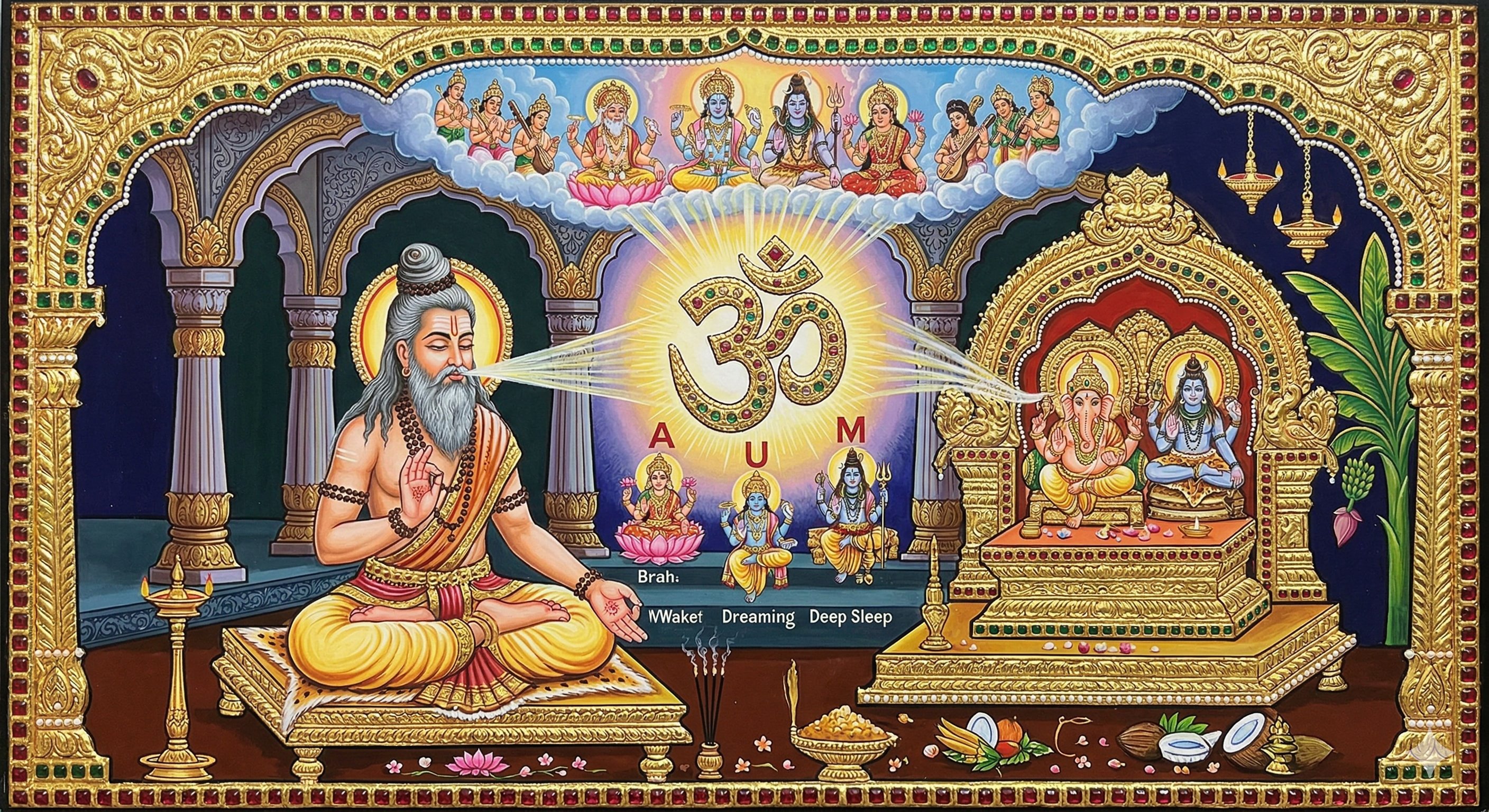

Om is the most recognised sound in spiritual history and one of the most mispronounced.
Most people treat it as a single syllable: "Ohhhhhmmmm." One note, one vibration, done. But Om is actually three distinct sounds layered into one, and the way you produce each sound, where it resonates in your body, and how long you sustain each phase changes the entire experience. The ancient texts are surprisingly specific about this and modern voice and neuroscience research is catching up to explain why.
Whether you've been chanting for decades or you're trying it for the first time, this is the complete breakdown: what Om actually is, how to produce it correctly, what it means across different philosophical traditions, and what peer-reviewed research says about its effects on the brain and body.
What Is Om? More Than a Sound
Om (also written as Aum) is considered the pranava, the primordial vibration from which all existence emerged. It's not a word in the conventional sense. It doesn't "mean" something the way "tree" means tree. It is something. According to the Mandukya Upanishad, a text entirely devoted to explaining Om it is the sound of reality itself.
Mandukya Upanishad, Verse 1: Om ity etad aksharam idam sarvam / Tasyopavyakhyanam bhutam bhavad bhavishyad iti sarvam omkaraeva
"Om is the imperishable word. Om is the universe. Everything that was, is, and will be is Om. And everything beyond past, present, and future is also Om."
That's a bold claim. But across Hinduism, Buddhism, Jainism, and Sikhism, Om holds a foundational position. It opens prayers, begins meditation, and is carved into temples, manuscripts, and sacred objects across South and Southeast Asia.
The Three Sounds of Om - A-U-M Breakdown
This is where most people get it wrong. Om is not "oh" + "mm." It's A + U + M three phonemes that merge into one continuous sound. Each has a specific articulation point and a specific resonance in the body.
Sound 1: "A" (Ah)
How to produce it: Open your mouth wide. The sound begins deep in the throat and belly. Think of the "a" in "father." It's an open, expansive sound.
Where it resonates: Lower chest and abdomen. You should feel a vibration in your lower body.
Duration: Approximately one-third of the total chant.
What it represents:
- State of consciousness: Waking state (Jagrat)
- World: The physical, material world
- Deity association: Brahma (creation)
- Time: Past
- Guna: Rajas (activity, passion)
Sound 2: "U" (Oo)
How to produce it: The lips begin to close. The sound moves from the back of the throat toward the middle of the mouth. It's the "oo" as in "pool", a rounded channeled sound.
Where it resonates: Mid-chest and throat. The vibration rises from the belly to the chest.
Duration: Approximately one-third of the total chant.
What it represents:
- State of consciousness: Dream state (Svapna)
- World: The subtle, mental world
- Deity association: Vishnu (preservation)
- Time: Present
- Guna: Sattva (harmony, clarity)
Sound 3: "M" (Mmm)
How to produce it: The lips close completely. The sound is produced entirely through the nasal passage. It's a humming vibration. The jaw is relaxed, teeth slightly apart behind closed lips.
Where it resonates: Head, sinuses, and the top of the skull. You should feel the vibration behind your forehead and in your nasal cavity.
Duration: Approximately one-third of the total chant though many traditions extend the "M" slightly longer.
What it represents:
- State of consciousness: Deep sleep state (Sushupti)
- World: The causal, unmanifest world
- Deity association: Shiva (dissolution)
- Time: Future
- Guna: Tamas (rest, inertia)
The Fourth Element: Silence
The Mandukya Upanishad identifies a fourth component most people miss entirely: the silence after the M fades.
This silence represents Turiya, the fourth state of consciousness, beyond waking, dreaming, and deep sleep. It's pure awareness itself. The moment the "M" vibration dissolves into nothing and you sit in the stillness that is the most important part of Om.
| Phase | Sound | Mouth Position | Resonance | Consciousness State | Duration |
|---|---|---|---|---|---|
| 1 | A (Ah) | Wide open | Abdomen, lower chest | Waking (Jagrat) | 1/3 |
| 2 | U (Oo) | Lips rounding | Mid-chest, throat | Dream (Svapna) | 1/3 |
| 3 | M (Mmm) | Lips closed | Head, sinuses, skull | Deep sleep (Sushupti) | 1/3 |
| 4 | Silence | — | Entire being | Pure awareness (Turiya) | Natural fade |
Step-by-Step: How to Chant Om Correctly
Preparation
- Sit comfortably. Cross-legged on the floor, on a cushion, or in a chair with feet flat. Spine straight but not rigid. Shoulders relaxed.
- Close your eyes. This reduces external stimulation and helps you focus on the internal vibration.
- Take 3-5 deep breaths. Inhale through the nose, exhale slowly through the mouth. This settles the nervous system before you begin.
The Chant
- Inhale deeply - fill the lungs completely but without strain. Use diaphragmatic breathing (belly expands first, then chest).
- Begin "Ahhh" - mouth wide open, sound emerging from the belly and throat. Feel the vibration in your lower body. Hold for about 3-4 seconds.
- Transition to "Oooo" - smoothly, without breaking the sound. Lips begin to round. The vibration moves upward to the chest and throat. Hold for 3-4 seconds.
- Close with "Mmmm" - lips seal gently. The sound moves entirely into the nasal passage and skull. Feel the humming in your head. Hold for 3-4 seconds.
- Let the sound dissolve naturally - don't cut it off abruptly. Let the "M" fade into silence. Sit in that silence for 2-3 seconds.
- Repeat. Most traditions recommend chanting Om in sets of 3, 7, 11, 21, or 108 repetitions.
Common Mistakes to Avoid
| Mistake | Why It Matters | Correction |
|---|---|---|
| Starting with "Oh" instead of "Ah" | Skips the first syllable entirely; misses the belly resonance | Open your mouth wider; think "father" not "go" |
| Rushing through the three sounds | Each phase has a distinct purpose; speed eliminates the layered effect | Divide your breath equally into thirds |
| Clenching the jaw during "M" | Blocks nasal resonance and creates tension | Keep teeth slightly apart behind closed lips |
| Dropping volume at the end | The "M" and the silence after it are where the deepest effects occur | Sustain the "M" at the same volume as "A" and "U" |
| Forcing breath | Straining shortens each repetition and creates tension in the throat | Use only as much breath as is comfortable; quality over volume |
| Skipping the silence | Turiya the fourth state is considered the most important phase | Pause 2-3 seconds after each Om before inhaling again |
The Meaning of Om Across Traditions
Om is not exclusive to Hinduism. Its significance spans multiple spiritual traditions:
Hinduism
Om is the sound of Brahman, the ultimate, formless reality underlying all existence. The Chandogya Upanishad (1.1.1) calls it udgitha the song of the universe. Nearly every Hindu prayer, ritual, and mantra begins with Om. The symbol ॐ itself represents the three states of consciousness plus Turiya, and is considered the visual form of the cosmic sound.
Buddhism
In Tibetan Buddhism, Om is the first syllable of the most famous mantra: Om Mani Padme Hum ("the jewel in the lotus"). In Theravada and Zen traditions, Om is used less formally but is recognized as a universal sacred sound. Buddhist usage emphasizes Om as a tool for focusing awareness rather than representing a cosmic creator.
Jainism
Jain tradition uses Om as an abbreviation of the Panchnamaskara Mantra, the five salutations. Each letter (A-A-A-U-M) represents one of the five supreme beings: Arihants, Siddhas, Acharyas, Upadhyayas, and Sadhus.
Sikhism
The Sikh scripture Guru Granth Sahib begins with Ik Onkar (ੴ) "One Om" or "One God." The syllable Onkar is derived from Om and represents the monotheistic essence of Sikh theology. It signals that the one universal creator is the same reality that Om invokes.
What Science Says About Om Chanting
In the last two decades, peer-reviewed research on Om chanting has moved from curiosity to substance. Here's what the evidence shows:
Vagus Nerve Stimulation
A 2011 study in the International Journal of Yoga found that Om chanting produces vibrations that stimulate the vagus nerve the longest cranial nerve, connecting the brain to the gut, heart, and lungs. Vagal stimulation is associated with reduced heart rate, lower blood pressure, and activation of the parasympathetic ("rest and digest") nervous system.
The "M" (humming) phase is particularly effective it generates sustained vibration in the nasal cavity and skull base, where the vagus nerve passes close to the surface.
Brain Wave Changes
A 2018 study published in Asian Journal of Psychiatry monitored EEG patterns during Om chanting and found increased theta wave activity brain waves associated with deep relaxation, meditation, and creative insight. Participants showed reduced beta wave activity (associated with anxiety and active thinking) during and after chanting sessions.
Reduced Stress Markers
Research published in the International Journal of Preventive Medicine (2019) measured cortisol levels in participants who chanted Om for 10 minutes daily over 4 weeks. The group showed significantly reduced salivary cortisol compared to the control group. The study also noted improvements in self-reported anxiety scores.
The 136.1 Hz Connection
Multiple acoustic analyses have found that when Om is chanted correctly, the fundamental frequency tends to cluster around 136.1 Hz a frequency that some researchers associate with natural harmonic resonance. Whether this specific frequency has unique properties remains debated, but the consistency across independent chanters is notable.
| Study Area | Key Finding | Source |
|---|---|---|
| Vagus nerve | Om chanting stimulates vagal tone, activating parasympathetic response | International Journal of Yoga, 2011 |
| Brain waves | Increased theta waves (relaxation); decreased beta waves (anxiety) | Asian Journal of Psychiatry, 2018 |
| Stress hormones | Reduced salivary cortisol after 4 weeks of daily chanting | Int. J. Preventive Medicine, 2019 |
| Acoustic resonance | Consistent fundamental frequency around 136.1 Hz across chanters | Multiple acoustic studies |
When and How Often to Chant Om
Best Times
Traditional practice recommends chanting during the Brahma Muhurta approximately 4:00-5
AM, when the atmosphere is sattvic (calm, quiet, undisturbed). However, Om can be chanted at any time. Dusk (6:00-7 PM) is the second-most recommended time in Vedic tradition.Recommended Durations for Beginners
| Level | Repetitions | Time | Notes |
|---|---|---|---|
| Absolute beginner | 3-7 Oms | 2-3 minutes | Focus on correct pronunciation; don't worry about count |
| Regular practice | 21 Oms | 7-10 minutes | A common daily practice count; easy to maintain as habit |
| Deeper practice | 108 Oms | 15-25 minutes | Traditional count using a mala (prayer bead string of 108 beads) |
| Extended session | Multiple rounds of 108 | 30-60 minutes | For experienced practitioners or dedicated meditation sessions |
Using a Mala (Prayer Beads)
A japa mala has 108 beads plus one guru bead (the larger bead that marks the start/end point). To use:
- Hold the mala in your right hand, draped over the middle finger
- Start at the bead next to the guru bead
- After each Om, use your thumb to advance to the next bead
- When you reach the guru bead again, one round (108 repetitions) is complete
- Do not cross the guru bead, flip the mala and go in reverse for the next round
Om in Daily Life - Beyond Formal Meditation
You don't need to sit in lotus position to benefit from Om. Here are practical integrations:
- Before a stressful event: Chant 3 Oms silently (mental chanting is equally valid in yogic tradition) before a meeting, exam, or difficult conversation. The vibration settles the nervous system in under 30 seconds.
- As a focus anchor: When the mind wanders during work, a single silent Om can function as a reset what modern productivity science calls an "attention anchor."
- During breathwork: Pair Om with pranayama. Chant Om on the exhale during Nadi Shodhana (alternate nostril breathing) for a combined calming effect.
- Before sleep: 7-11 slow Oms before bed can shift the nervous system from sympathetic (fight-or-flight) to parasympathetic (rest-and-digest), improving sleep onset.
For those who want to explore Om's placement within broader Vedic mantra traditions including its role as the opening syllable of the Gayatri Mantra and its appearances across the Rig Veda Vedapath provides the original Sanskrit texts with word-by-word breakdowns and audio references, making it easier to learn correct pronunciation in context rather than isolation.
Frequently Asked Questions
Is it "Om" or "Aum"?
Both are correct they refer to the same sound. "Aum" is the more precise phonetic representation, showing the three distinct sounds (A-U-M). "Om" is the more common romanization. In Devanagari, it is written as ॐ, which encompasses all three sounds. Whether you write "Om" or "Aum," the pronunciation should always include all three phases.
Can anyone chant Om?
Yes. Om is not restricted by religion, caste, gender, or tradition. The Mandukya Upanishad presents Om as a universal sound representing reality itself, not the property of any group. People of all backgrounds and belief systems practice Om chanting for meditation, stress relief, and mindfulness. No initiation or permission is required.
How long should I chant Om for benefits?
Research studies showing measurable effects (reduced cortisol, changed brain waves) used sessions of 10 minutes or more. However, even 3-7 repetitions (about 1-2 minutes) can produce a noticeable calming effect. Consistency matters more than duration daily 5-minute practice will produce more benefit than occasional 30-minute sessions.
Should I chant Om out loud or silently?
Both are valid. Vocal chanting (vaikhari) produces physical vibration that stimulates the vagus nerve and creates tactile resonance. Silent or mental chanting (manasika) is considered more advanced in yogic tradition and is useful in public settings or before sleep. Most teachers recommend starting with vocal chanting to learn the correct vibration, then transitioning to silent practice.
What is the significance of 108 repetitions?
The number 108 appears throughout Hindu, Buddhist, and Jain traditions. Explanations include: the distance between the Earth and Sun is approximately 108 times the Sun's diameter; there are 108 Upanishads; 108 is the product of 12 (zodiac houses) × 9 (planets in Vedic astrology); and the Sanskrit alphabet has 54 letters, each with masculine and feminine forms (54 × 2 = 108). Whatever the origin, 108 has become the standard count for a complete cycle of mantra chanting.
Can Om chanting replace meditation?
Om chanting is a form of meditation specifically, mantra meditation. It gives the mind a single point of focus (the sound and vibration), which achieves the same goal as breath-focused or visualization meditation. For people who find silent meditation difficult because of racing thoughts, Om chanting provides an active anchor that is often easier to maintain. Many practitioners use Om chanting as a gateway to silent meditation, starting with sound and transitioning to stillness.
Key Takeaways
- Om consists of three distinct sounds - A (abdomen), U (chest), M (head) plus a fourth element: silence (pure awareness)
- Each sound represents a state of consciousness: waking, dreaming, deep sleep with silence representing Turiya, the transcendent fourth state
- Correct pronunciation requires equal time on each phase, with the vibration moving progressively upward through the body
- Peer-reviewed research shows Om chanting stimulates the vagus nerve, increases theta brain waves, and reduces cortisol levels
- Om is universal - found across Hinduism, Buddhism, Jainism, and Sikhism and requires no special initiation to practice

Comments
Sign in to join the discussion