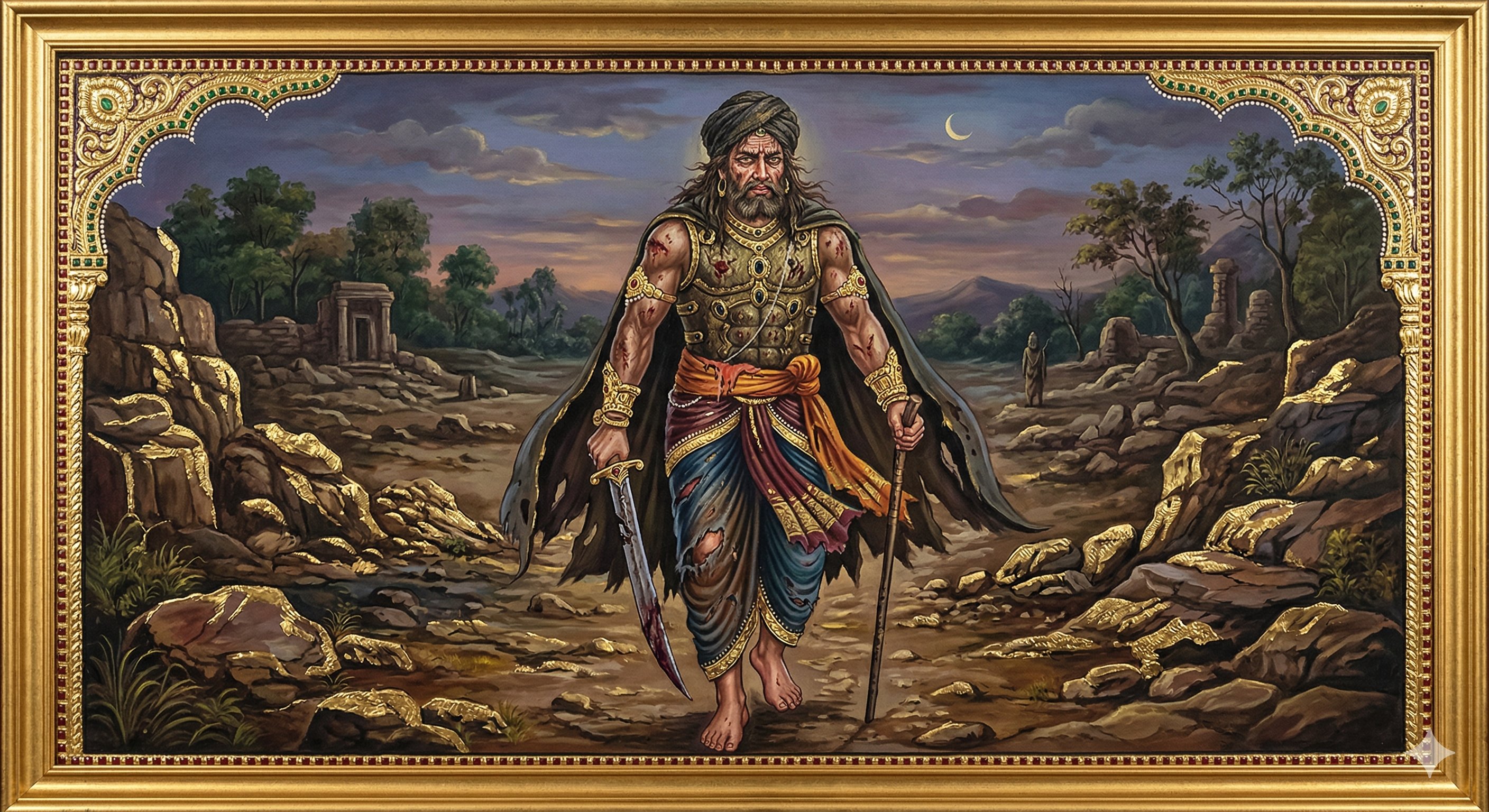
There is a man who has been alive for over 5,000 years. He wanders forests, plains, and mountains with an open wound on his forehead that never heals and never kills him. He cannot die. He cannot be relieved. He is cursed to carry the memory of what he did until the end of time itself.
His name is Ashwatthama, and according to the Mahabharata, he is still out there.
This isn't a minor footnote in the epic. Ashwatthama's story is one of the most psychologically complex and morally devastating narratives in all of ancient literature. He is simultaneously a victim and a monster, a warrior of extraordinary ability and a man who committed one of the most unforgivable acts in the history of warfare. And his punishment eternal life without peace raises a question that the Mahabharata never fully answers: is immortality a gift, or the worst curse imaginable?
Who Was Ashwatthama?
Ashwatthama was the son of Dronacharya, the supreme commander of the Kaurava army and the guru who trained both the Pandavas and Kauravas in warfare. His mother was Kripi, the sister of Kripacharya. By birth, he was a Brahmin-Kshatriya descended from sages but trained for war.
He wasn't just any warrior. The Mahabharata describes him as a Maharathi a warrior capable of fighting 720,000 soldiers simultaneously. He possessed the Narayanastra (a weapon of Vishnu), the Brahmastra (the weapon of ultimate destruction), and skill in combat that rivaled the greatest fighters of his era.
But Ashwatthama's defining characteristic was not his power. It was his relationship with his father.
The Gem on His Forehead
Ashwatthama was born with a divine gem (mani) embedded in his forehead. This gem granted him several abilities:
| Power | Description |
|---|---|
| Protection from lower beings | No weapon wielded by demons, animals, or lesser beings could harm him |
| Freedom from hunger and fatigue | He could fight indefinitely without exhaustion |
| Immunity to disease | No illness or poison could affect him |
| Spiritual radiance | The gem marked him as a being of elevated cosmic stature |
The gem was not merely decorative. It was part of his identity a sign of his divine heritage and his father's spiritual merit. Remember this gem. It becomes central to his punishment.
What Ashwatthama Did - The Night Massacre
The Kurukshetra War lasted 18 days. On Day 15, Ashwatthama's father Drona was killed through a deception orchestrated by the Pandavas. Yudhishthira the most honest man alive shouted that "Ashwatthama is dead," referring to an elephant named Ashwatthama, but deliberately allowing Drona to believe his son had been killed. Hearing this, Drona laid down his weapons in grief, and Dhrishtadyumna beheaded him.
Ashwatthama watched his father die because of a lie.
By Day 18, the Kauravas had lost. Duryodhana lay dying. Only three warriors remained on the Kaurava side: Ashwatthama, Kripacharya, and Kritavarma. In the chaos of the final day, something broke inside Ashwatthama.
The Sauptika Parva "The Book of the Sleeping"
What happened next is recorded in the Sauptika Parva (Book 10 of the Mahabharata), and it is one of the darkest chapters in any epic ever written.
In the dead of night, consumed by grief and rage, Ashwatthama observed an owl attacking sleeping crows in a tree. Inspired by this, he made a decision that would define him for eternity: he would attack the Pandava camp while they slept.
He entered the camp at night. The warriors were sleeping, unarmed, defenseless, in what should have been the safety of a war's aftermath the battlefield equivalent of a hospital or a ceasefire zone. What Ashwatthama did next violated every code of dharmic warfare:
- He killed Dhrishtadyumna The man who beheaded his father by stomping him to death. Dhrishtadyumna begged for a warrior's death by the sword. Ashwatthama refused.
- He killed Shikhandi The warrior who had neutralized Bhishma.
- He killed the Upapandavas The five sons of Draupadi, sleeping in their beds. He mistook them for the five Pandavas, but even after realizing his error, he did not stop.
- He slaughtered every remaining warrior in the camp Thousands of soldiers, killed in their sleep.
- He set fire to the camp exits so those who awoke could not escape.
By dawn, the Pandava camp was a graveyard. Every son of Draupadi was dead. The five Pandavas survived only because they had slept elsewhere that night, on Krishna's counsel.
The Brahmastra - The Final Act
When confronted by the Pandavas the next morning, Ashwatthama did not surrender. He did not repent. He launched the Brahmastra, the nuclear weapon of Vedic warfare aimed at the Pandavas.
Arjuna countered with his own Brahmastra. Two world-ending weapons racing toward each other.
The sages Vyasa and Narada intervened, ordering both warriors to withdraw their weapons. Arjuna, having been taught the full mantra, recalled his Brahmastra. Ashwatthama could not. His father had taught him how to launch it but not how to call it back.
Unable to withdraw it, Ashwatthama redirected the Brahmastra toward Uttara's womb specifically targeting the unborn child of Abhimanyu and Uttara, the last surviving heir of the Pandava bloodline.
This was the act that sealed his fate. He tried to end not just his enemies, but their entire future.
The Curse of Krishna
Krishna saved the unborn child (who would be born as Parikshit, the future emperor). Then he turned to Ashwatthama and delivered one of the most devastating punishments in all of literature.
Mahabharata, Sauptika Parva, Chapter 16:
Krishna's curse had multiple layers:
| Element of the Curse | Description |
|---|---|
| The gem was ripped from his forehead | Leaving a wound that would never heal, bleed forever, and cause unending pain |
| Immortality | Not as a gift as a prison. He cannot die, no matter how much he suffers |
| Eternal wandering | He must roam the Earth alone, with no companionship, no shelter, no rest |
| Disease and decay | His body would be afflicted with sores, wounds, and illness none of which would kill him |
| Banishment from human contact | No one would give him food, shelter, or conversation. He would exist among people but be entirely alone |
| Duration | Until the end of the current Kali Yuga approximately 432,000 years. Some texts say until the end of the current kalpa |
The gem that once made him invincible was made the instrument of his suffering. The forehead that once radiated power now bleeds without end. The body that could not be defeated by any weapon is now devastated by suffering that cannot defeat it.
The Chiranjeevis - The Seven Immortals
Ashwatthama is not the only immortal in Hindu tradition. He is one of the Chiranjeevis, seven (or sometimes eight) beings believed to be alive from ancient times until the end of the current age.
| Chiranjeevi | Who They Are | Why They Are Immortal | Nature of Immortality |
|---|---|---|---|
| Ashwatthama | Son of Drona, Mahabharata warrior | Cursed by Krishna for the night massacre and Brahmastra attack | Punishment suffering, wandering, isolation |
| Bali (Mahabali) | Generous demon king | Blessed by Vishnu (as Vamana) for his extraordinary devotion despite defeat | Blessing - rules Patala, returns annually (Onam) |
| Vyasa | Author of the Mahabharata | Lives to preserve and transmit the Vedas across ages | Duty - guardian of knowledge |
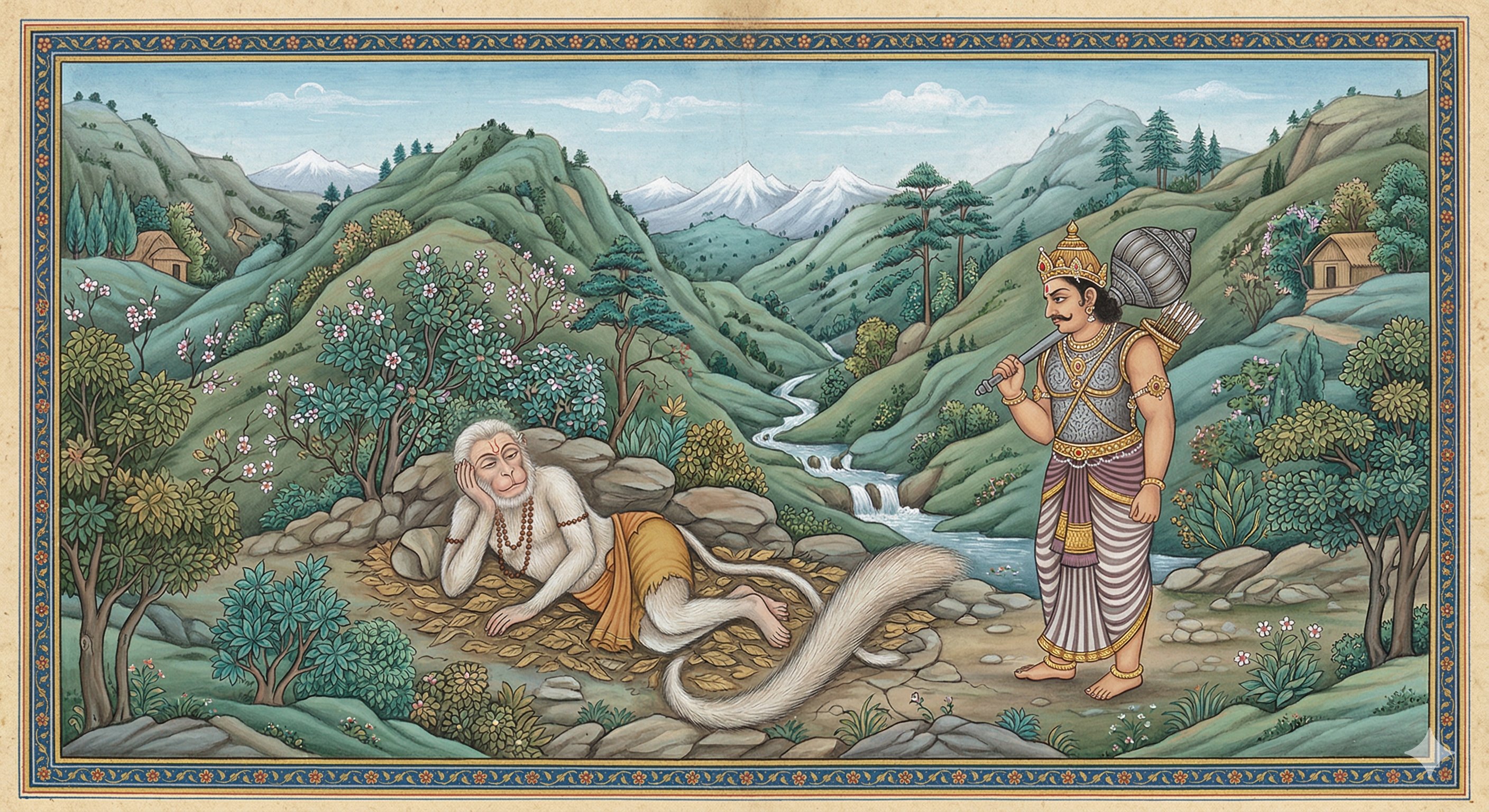
| Hanuman | Devotee of Rama, son of Vayu | Blessed by Rama, Sita, and multiple gods for his selfless service | Blessing - chooses to remain to hear Rama's name |
| Vibhishana | Brother of Ravana, allied with Rama | Blessed by Rama to rule Lanka and maintain dharma | Duty - guardian of Lanka and righteousness |
| Kripacharya | Guru and Kaurava warrior | Blessed for his adherence to dharma regardless of allegiance | Blessing - teacher across ages |
| Parashurama | Sixth avatar of Vishnu | Eternal warrior-sage, awaits the next avatar | Duty - will train Kalki's army |
Notice the pattern: six of the seven Chiranjeevis are immortal as a blessing or duty. Only Ashwatthama is immortal as a punishment. He is the anti-Hanuman, condemned to the same endless existence but stripped of everything that makes existence bearable: purpose, love, community, and peace.
The Alleged Sightings - Legend Meets Folklore
Across India, there are persistent folk traditions claiming that Ashwatthama has been seen or encountered as recently as the modern era.
The Forested Temple Stories
Multiple temple priests in Madhya Pradesh, Rajasthan, and Gujarat have reported a recurring folk tradition: a tall, disheveled figure with a bleeding forehead approaches remote temples at night, asking for turmeric paste and oil. He applies it to his wound, which provides no lasting relief. By morning, he is gone. These stories are unverifiable but remarkably consistent across regions that have no obvious connection.
The Asirgarh Fort Legend
Asirgarh Fort in Burhanpur, Madhya Pradesh, is one of the most commonly cited locations associated with Ashwatthama. Local tradition holds that he visits a Shiva temple within the fort every morning. According to a widely repeated (though unverified) legend, a British military doctor stationed at the fort in the colonial era documented treating a man with an inexplicable, non-healing wound on his forehead. The man disappeared overnight.
The Narmada River Tradition
Along the Narmada River in central India one of the most ancient pilgrimage routes local communities maintain that Ashwatthama wanders the forested banks. The Narmada valley is one of the most sparsely populated and densely forested corridors in India, and oral traditions here predate written records. Whether these are genuine encounters, inherited folklore, or both, is impossible to determine.
The Railway Station Account
One of the most modern accounts, circulated widely on Indian internet forums, describes a railway doctor in a small town who treated a patient with a wound on his forehead that would not stop bleeding. The patient refused to give his name, disappeared from the clinic overnight, and was never seen again. This story is anecdotal but has become part of the contemporary Ashwatthama folk narrative.
A necessary note: None of these sightings are empirically verifiable. They exist in the same territory as legends about holy grails, lake monsters, and wandering saints, somewhere between faith, folklore, and the human need for mystery. The Mahabharata itself does not describe any post-curse sightings.
The Philosophy Behind the Punishment
Ashwatthama's curse is not arbitrary cruelty. When examined through the Mahabharata's moral framework, every element of the punishment corresponds to a specific transgression.
The Moral Mathematics
| Ashwatthama's Crime | Corresponding Punishment |
|---|---|
| Killed sleeping warriors (denied them dignity) | Denied the dignity of death forced to live in agony |
| Attacked in darkness, in secret | His wound is visible and permanent, his shame is always exposed |
| Destroyed the Pandavas' children | His own future is destroyed no descendants, no legacy, no continuation |
| Misused the Brahmastra (a sacred weapon of creation used for destruction) | His own divine gift (the gem) becomes the source of his suffering |
| Acted alone, rejecting dharmic counsel | Condemned to eternal solitude, alone among billions |
| Tried to end the Pandava lineage permanently | His punishment is also permanent, a mirror of his intention |
The Mahabharata is making a philosophical point about the nature of karma that goes beyond simple "punishment fits the crime" logic. The consequence doesn't just match the action it reveals the action's deepest nature. Ashwatthama wanted to create permanent, inescapable suffering for his enemies. He received exactly that directed at himself.
Immortality as Hell
This is perhaps the Mahabharata's most subversive contribution to world literature: immortality, stripped of meaning, is the worst possible fate.
Every other mythological tradition treats eternal life as the ultimate prize. Gilgamesh crosses the world to find it. The Greek gods hoard it. Alchemists spend lifetimes pursuing it. The Mahabharata asks: what if you got your wish, and it destroyed you?
Ashwatthama has everything people claim to want, infinite time, a body that cannot be defeated and none of what makes time worth having. No relationships. No purpose. No rest. No ending. He is the Mahabharata's proof that context determines whether any gift is a blessing or a curse.
Ashwatthama in the Kali Yuga
According to some Puranic traditions, Ashwatthama's story doesn't end with wandering. He has a role yet to play.
The Kalki Purana references Ashwatthama as one of the figures who will appear at the end of the Kali Yuga (the current age of conflict and moral decline). In some versions, he will encounter Kalki, the prophesied final avatar of Vishnu and either serve as a warrior in the final battle or finally receive release from his curse through Kalki's grace.
This adds another layer to the narrative: Ashwatthama's punishment may have a purpose beyond retribution. His survival may serve as a living witness proof, walking the Earth, that actions have consequences beyond a single lifetime. In an age (Kali Yuga) defined by the abandonment of dharma, Ashwatthama is a warning that refuses to die.
Why Ashwatthama's Story Still Resonates
The Mahabharata was composed thousands of years ago, but Ashwatthama's narrative maps onto concerns that feel urgently modern:
War crimes and accountability. Ashwatthama's night massacre is a war crime by any standard ancient or modern. The Geneva Conventions prohibit attacking those who are hors de combat (out of the fight). The Mahabharata established this principle millennia earlier and showed the consequences of violating it.
Grief as a weapon. Ashwatthama's atrocity was driven by grief over his father's death. The Mahabharata doesn't dismiss his grief it acknowledges it as legitimate. But it draws an absolute line: pain does not justify inflicting pain on the innocent. The sleeping children of Draupadi had nothing to do with Drona's death. Ashwatthama knew this and acted anyway.
The cycle of revenge. Ashwatthama's logic was: they killed my father through deception, so I will kill their children through ambush. If the Pandavas had retaliated in kind, the cycle would continue forever. Krishna's curse breaks the cycle, not through forgiveness, but through a punishment so total that it removes Ashwatthama from the equation entirely.
For those who want to read the Sauptika Parva in full, the original Sanskrit alongside word-by-word translations Vedapath includes the complete Mahabharata text with Scholar Mode breakdowns and an AI-powered Q&A feature that lets you ask specific questions about Ashwatthama's narrative across all 18 Parvas.
Frequently Asked Questions
Is Ashwatthama still alive?
According to Hindu tradition, yes. As one of the seven Chiranjeevis (immortals), Ashwatthama is believed to be alive and wandering the Earth until the end of the Kali Yuga. This is a matter of religious belief, not empirical fact. The Mahabharata text states that Krishna's curse condemned him to roam for 3,000+ years (interpretations vary, some say until the end of the current kalpa). Folk traditions across central India include alleged sightings.
Why was Ashwatthama cursed?
Ashwatthama was cursed by Krishna for three specific acts: (1) massacring the sleeping Pandava camp at night, including the five sons of Draupadi, violating all rules of dharmic warfare; (2) launching the Brahmastra, a weapon of mass destruction at the unborn child in Uttara's womb, attempting to end the Pandava lineage permanently; and (3) being unable to recall the Brahmastra, demonstrating reckless misuse of sacred weapons.
What is the gem on Ashwatthama's forehead?
Ashwatthama was born with a divine gem (mani) embedded in his forehead. This gem granted him protection from disease, hunger, fatigue, and attack by lower beings. As part of his punishment, Krishna demanded the gem be extracted, leaving a permanent, non-healing wound. The gem was given to Draupadi as partial atonement for the murder of her sons. In some traditions, the gem had been part of Ashwatthama since birth, making its removal an act of stripping away his very identity.
Who are the Chiranjeevis?
The Chiranjeevis are seven (sometimes eight) beings in Hindu tradition who are believed to be immortal, alive from ancient times until the end of the current age. They are: Ashwatthama, Bali (Mahabali), Vyasa, Hanuman, Vibhishana, Kripacharya, and Parashurama. A traditional verse identifies them: Ashwatthama Balirvyaso Hanumanshcha Vibhishanah / Kripah Parashuramascha Saptaite Chiranjivinah. Ashwatthama is the only chiranjeevi whose immortality is a curse rather than a blessing.
Did Ashwatthama really kill Draupadi's sons?
Yes, according to the Mahabharata (Sauptika Parva). Ashwatthama entered the Pandava camp at night and killed the five Upapandavas Prativindhya (son of Yudhishthira), Sutasoma (son of Bhima), Shrutakarma (son of Arjuna), Satanika (son of Nakula), and Shrutasena (son of Sahadeva). He initially believed he was killing the Pandavas themselves, but the act was deliberate regardless. He also killed Dhrishtadyumna, Shikhandi, and thousands of sleeping soldiers.
Will Ashwatthama ever be freed from the curse?
Some Puranic texts, particularly the Kalki Purana, suggest that Ashwatthama may be freed at the end of the Kali Yuga when the final avatar Kalki appears. In one version, Ashwatthama will serve Kalki in the final battle against adharma, and his service will earn him release. In another tradition, his curse naturally expires at the end of the current age. The Mahabharata itself does not specify an endpoint, Krishna's words imply a punishment of extraordinary duration without clearly defining when or if it ends.
Key Takeaways
- Ashwatthama, son of Dronacharya, is one of the seven Chiranjeevis (immortals) and the only one cursed with eternal life as punishment, not blessing
- His crime: massacring the sleeping Pandava camp at night and launching the Brahmastra at an unborn child, violating every code of dharmic warfare
- Krishna's curse stripped his divine gem, leaving an eternally bleeding wound, and condemned him to wander the Earth alone, diseased, and unable to die
- The Mahabharata uses Ashwatthama to argue that immortality without purpose, peace, or connection is the worst possible fate not a gift, but a prison
- Folk traditions across India include alleged sightings of Ashwatthama, and some Puranic texts suggest he will appear again at the end of the Kali Yuga alongside the avatar Kalki
Comments
Sign in to join the discussion