
Bhagavad Gita — Moksha Sannyasa Yoga, Shloka 48
Moksha Sannyasa Yoga
सहजं कर्म कौन्तेय सदोषमपि न त्यजेत् । सर्वारम्भा हि दोषेण धूमेनाग्निरिवावृताः ॥ १८.४८ ॥
sahajaṁ karma kaunteya sadoṣam api na tyajet | sarvārambhā hi doṣeṇa dhūmenāgnir ivāvṛtāḥ || 18.48 ||

হে কৌন্তেয়! স্বভাৱজাত কৰ্ম দোষযুক্ত হলেও ত্যাগ নকৰিবা; কিয়নো সকলো উদ্যোগ ধোঁৱাই আগুন ঢাকি থকাৰ দৰে কোনো-না-কোনো দোষে আৱৃত থাকে।
हे कुन्तीपुत्र! अपने स्वभाव से प्राप्त कर्म को दोषयुक्त होने पर भी नहीं छोड़ना चाहिए; क्योंकि समस्त उद्योग धुएँ से अग्नि की भाँति किसी-न-किसी दोष से आवृत रहते हैं।
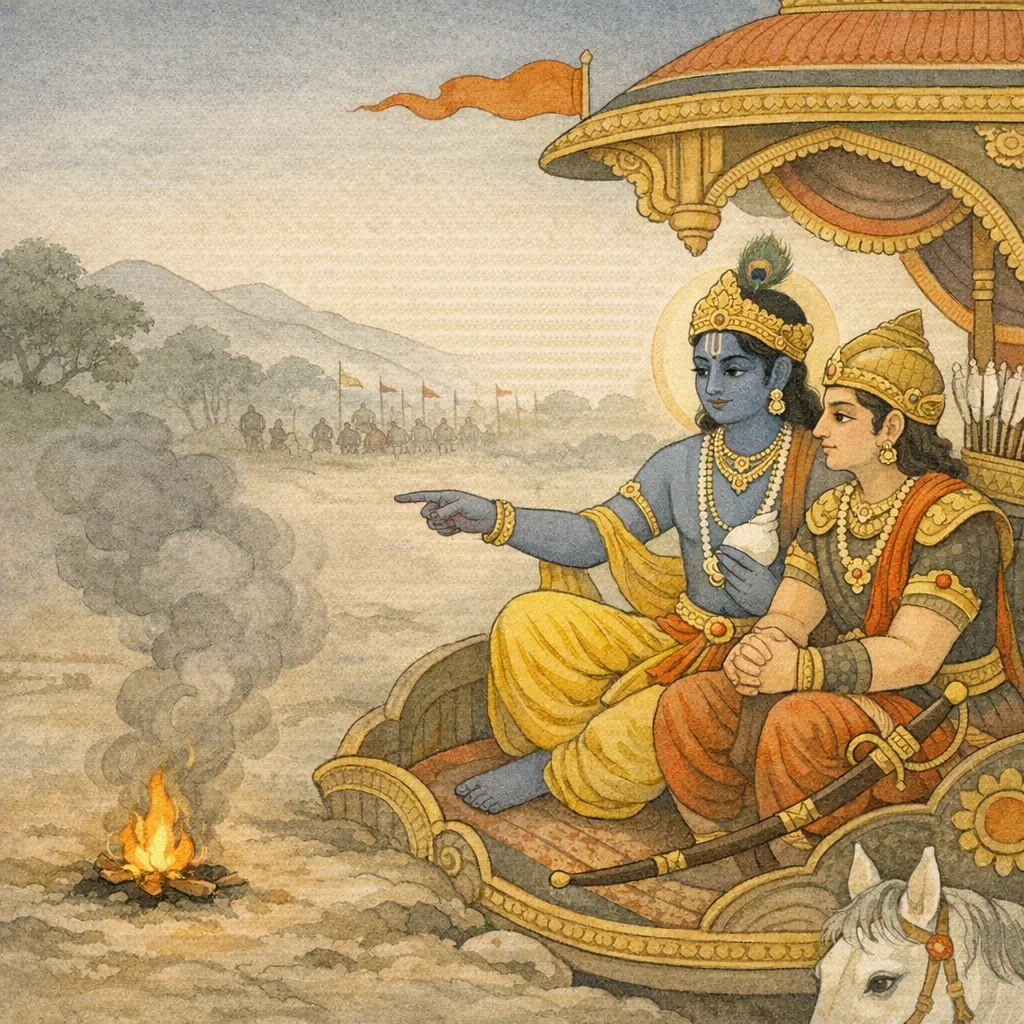
O son of Kuntī, one should not abandon the action that is innate (to one’s station and disposition), even if it has defects; for every undertaking is enveloped by some defect, as fire is by smoke.
Most recensions read the same sense: ‘sahaja’ as ‘born-with/innate’ (often interpreted as svadharma). Traditional commentators tend to connect ‘innate action’ with varṇa-āśrama duty, while academic readings may broaden it to psychologically and socially conditioned vocation. The simile (fire/smoke) supports a pragmatic ethic: imperfection does not negate duty.
FAQs
The verse counsels against perfectionism and avoidance: all real-world projects include friction, error, and mixed motives. A stable mind learns to act responsibly without demanding flawless conditions.
In the Gītā’s framework, embodied action is shaped by guṇas and thus cannot be absolutely defect-free. The aim is not metaphysical ‘spotlessness’ of action but right orientation—performing one’s role with discipline and reduced attachment.
In Chapter 18, Kṛṣṇa clarifies renunciation: rather than abandoning prescribed responsibilities, one should relinquish attachment to results and egoistic ownership while continuing appropriate action.
In work and family life, choose responsible commitments aligned with your capacities and social obligations, and improve them gradually instead of quitting solely because conditions are imperfect.
Ask anything about this verse
Curious about the meaning, context, or a word? Ask, and continue the conversation in the Vedapath app.
A free Google sign-in keeps your chat saved across web and the app.
Read Bhagavad Gita in the Vedapath app
Scan the QR code to open this directly in the app, with audio, word-by-word meanings, and more.