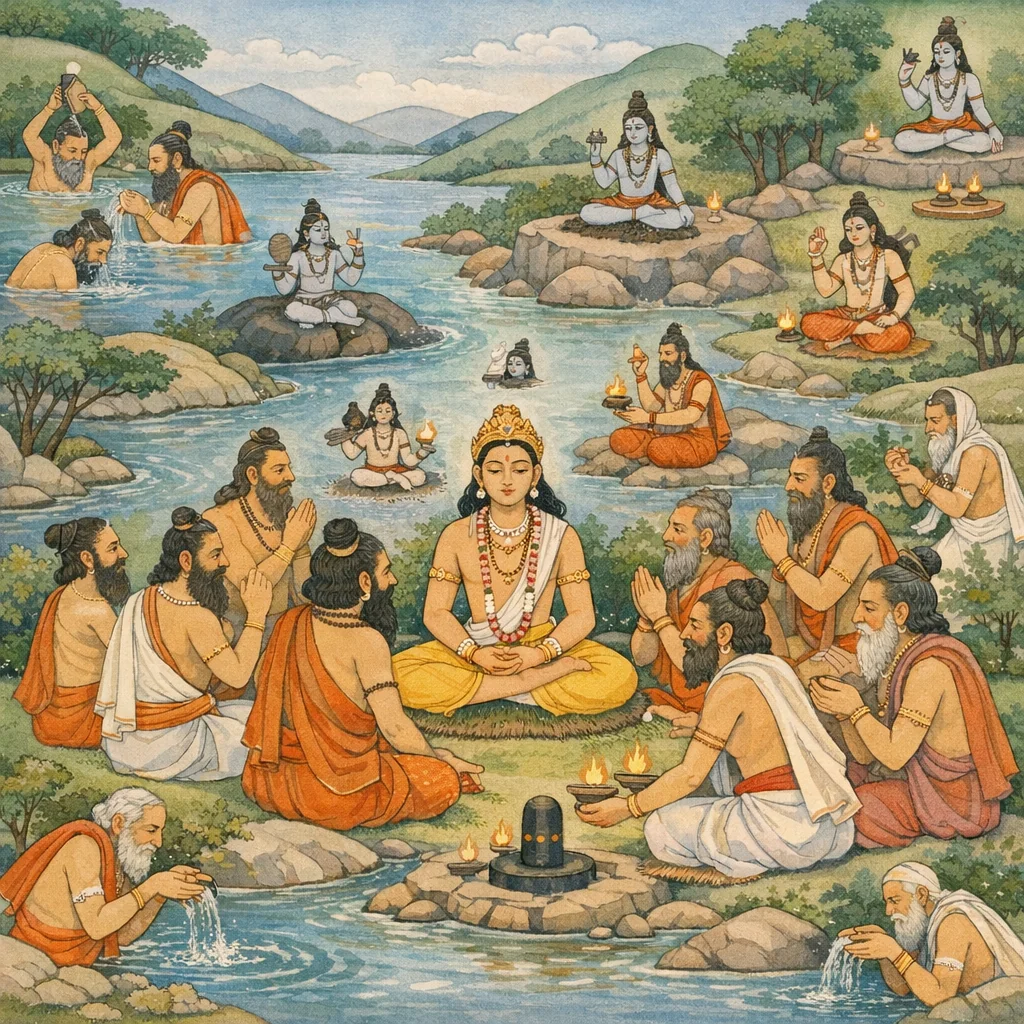
Adhyaya 57: Prahlada’s Pilgrimage Circuit: Tirtha-Mahatmya from Naimisha to Rudrakoti and Shalagrama
प्रह्लादतीर्थानुगतिः (Prahlāda-Tīrthānugatiḥ)
Naimisha to Shalagrama
Within the Pulastya–Nārada dialogic frame, this Adhyāya presents a sustained itinerary of Prahlāda’s tirtha-yātrā, functioning as a topographical sanctification of pan-Indic sacred space. The narrative foregrounds asura-dharma expressed through vrata (fasting), dāna, and meticulous pūjā, while repeatedly pairing Vaiṣṇava and Śaiva iconographic descriptions—Vāsudeva, Ajita, Varāha, and Hayagrīva are worshipped alongside Śaṅkara as Mahākāla, Ardhanārīśvara, Paśupati, Nīlakaṇṭha, and Rudrakoṭi. The chapter’s syncretic theology is enacted ritually: Prahlāda bathes at named rivers and tīrthas, offers piṇḍa and tarpaṇa to pitṛs, and circumambulates shrines, implying a shared salvific economy across sectarian forms. A climactic Kurukṣetra–Sarasvatī emphasis appears in the Rudrakoṭi episode, where Śiva multiplies into ‘a crore of forms’ to receive competing sages, thereby mythologizing the site’s ritual capacity. The closing verses explicitly frame this pilgrimage as universally purificatory through kīrtana, śravaṇa, and sparśa.
Divine Beings
Sacred Geography
Mortal & Asura Figures
Key Content Points
- Prahlāda’s sequential tirtha-circuit is narrated as a ritual manual: repeated snāna, arcana, pradakṣiṇā, upavāsa, and pitṛ-kriyā (piṇḍa/tarpaṇa) across multiple regions.
- Sectarian synthesis is performed through paired worship: Vaiṣṇava forms (Ajita/Puruṣottama, Vāsudeva, Varāha, Hayagrīva, Śrīnivāsa) are honored alongside Śaiva forms (Mahākāla, Ardhanārīśvara, Paśupati, Nīlakaṇṭha), presenting a shared tīrtha-based soteriology.
- Rudrakoṭi at Sarasvatī/Koṭitīrtha is etiologized: innumerable sages arrive for Śiva-darśana; Śiva becomes Koṭimūrti to accommodate them, establishing the tīrtha-name and its merit; the chapter concludes by praising Prahlāda’s route as sarva-pāpa-pramocana.
Shlokas in Adhyaya 57
Verse 4
देवदेवं तथेशानं संपूज्य विधिना ततः गयायां गोपतिं द्रष्टुं जगाम स महासुरः
Narrator describing the pilgrim’s prescribed actions at Gayā
Verse 6
उदपाने तथा स्नात्वा तत्राभ्यर्च्य पितॄन् वशी गदापाणिं समभ्यर्च्य गोपतिं चापि शङ्करम्
Likewise, having bathed at the well (udāpāna) and having worshipped the Pitṛs there, the self-controlled one duly worshipped Gadāpāṇi, and also Gopati, and Śaṅkara.
Verse 8
तस्यां स्नात्वा समभ्यर्च्य गोप्रतारे कुशेशयम् उपोष्य रजनीमेकां विरजां नगरीं ययौ
Having bathed in that (river Sarayū) and duly worshipped Kuśeśaya at Gopratāra, and having fasted for one night, he went to the city of Virajā.
Verse 9
स्नात्वा विरजसे तीर्थे दत्त्वा पिण्डं पितॄंस् तथा दर्शनार्थ ययौ श्रीमान् अजितं पुरुषोत्तमम्
Having bathed at the Viraja-tīrtha and having offered piṇḍa-oblations to the Pitṛs, the illustrious one went for the sake of darśana to Ajita, the Supreme Person (Puruṣottama).
Verse 10
तं दृष्ट्वा पुण्डरीकाक्षमक्षरं परमं शुचिः षड्रात्रमुष्य तत्रैव महेन्द्रं दक्षिणं ययौ
Having beheld that lotus‑eyed Lord—imperishable, supreme, and pure—he stayed there for six nights; then he proceeded to the southern Mahendra (tīrtha/region).
Verse 11
तत्र देववरं शंभुमर्द्धनारीश्वरं हरम् दृष्ट्वार्च्य संपूज्य पितॄन् महेन्द्रं चोत्तरं गतः
There, having seen Śambhu—best of the gods—Hara as Ardhanārīśvara, he worshipped and duly honored him; and having performed rites for the Pitṛs, he went on to the northern Mahendra.
Verse 12
तत्र देववरं शंभुं गोपालं सोमपायिनम्. दृष्ट्वा स्नात्वा सोमतीर्थे सह्याचलमुपागतः
VamP 57.13
Verse 13
तत्र स्नात्वा महोदक्यां वैकुण्ठं चार्च्यं भक्तितः सुरान् पितृन् समभ्यर्च्य पारियात्रं गिरिं गतः
Having bathed there in the Mahodakyā (tīrtha), and having worshipped Vaikuṇṭha (Viṣṇu) with devotion, and having duly offered worship to the gods and to the Pitṛs (ancestral spirits), he then proceeded to Mount Pāriyātra.
Verse Adhyāya 54 (Nakṣatra-yoga-pūjā and dāna prescriptions)
तत्र स्नात्वा लाह्गलिन्यां पूजयित्वापराजितम् कशेरुदेशं चाभयेत्य विश्वरूपं ददर्श सः
বুদ্ধিমান ব্যক্তিয়ে ব্ৰাহ্মণক নিবেদন কৰিব লাগে—ছত্�Vamana Purana,57,15,VamP 57.15,yatra devavaraḥ śaṃbhurgaṇānāṃ tu supūjitam viśvarūpamathātmānaṃ darśayāmāsa yogavit,यत्र देववरः शंभुर्गणानां तु सुपूजितम् विश्वरूपमथात्मानं दर्शयामास योगवित्,Saromahatmya (Tirtha-Mahatmya Cycle),Stuti / Theophany (Divine Self-revelation),Adhyaya 57 (Śaṃbhu’s Viśvarūpa revelation at a sacred locus),57.15,yatra devavaraḥ śaṃbhurgaṇānāṃ tu supūjitam viśvarūpamathātmānaṃ darśayāmāsa yogavit,yatra devavaraḥ śaṃbhur gaṇānāṃ tu supūjitam viśvarūpam athātmānaṃ darśayāmāsa yogavit,There
Verse yadakṣaraṃ brahma vadanti sarvagaṃ niśamya yaṃ mṛtyumukhāt pramucyate tamīśvaraṃ tṛptamanuttamairguṇaiḥ parāyaṇaṃ viṣṇumupaimi sāśvatam
यत्र देववरः शंभुर्गणानां तु सुपूजितम् विश्वरूपमथात्मानं दर्शयामास योगवित्
Maṅkuṇikā (tīrtha/waters); Malayācala / Malaya mountain (southern sacred mountain range)
Verse 16
तत्र मङ्कुणिकातोये स्नात्वाभ्यर्य्य महेश्वरम् जगामाद्रिं स सौगन्धि प्रह्लादो मलायाचलम्
There, having bathed in the waters of Maṅkuṇikā and having worshipped Maheśvara, that fragrant (i.e., perfumed/garlandeVamana Purana,54,30,VamP 54.30,nakṣatrapuruṣākhyaṃ hi vratānāmuttamaṃ vratam pūrvaṃ kṛtaṃ hi bhṛguṇā sarvapātakanāśanam,नक्षत्रपुरुषाख्यं हि व्रतानामुत्तमं व्रतम् पूर्वं कृतं हि भृगुणा सर्वपातकनाशनम्,Saromahatmiya,Dharma Teaching (Vrata Mahatmya),Adhyaya 54 (Vrata-prashamsa / Nakshatra-Purusha Vrata),30,nakṣatrapuruṣākhyaṃ hi vratānāmuttamaṃ vratam |
Verse 21
तत्रस्थेन सुरेशेन श्वेतकिर्नाम भूपतिः रक्षितस्त्वन्तकं दग्ध्वा सर्वबूतापहारिणम्
There, by the Lord of the gods who was present (in that place), the king named Śvetakir was protected—after (the deity) burned Antaka, the abductor/destroyer of all beings.
Verse 22
तत्रातिहृष्टो वसति नित्यं शर्वः सहोमया वृतः प्रमथकोटीभिर्बहुभिस्त्रिदशार्चितः
ഭക്തിയോടെ ഞാൻ ആ ഭഗവാന്റെ ശരണം പ്രാപിക്കുന്നു—ഗുണാധ്യക്ഷൻ, അക്ഷയൻ, പദ്മനേത്രൻ; ശരണാഗതരുടെ യഥാർത്ഥ ആശ്രയം, ഭക്തവത്സലൻ।
Verse 26
अश्वतीर्थे ततः स्नात्वा दृष्ट्वा च तुरगाननम् श्रीधरं चैव संपूज्य पञ्चालविषयं ययौ
Then, having bathed at Aśvatīrtha and having seen Turagānana, and having also duly worshipped Śrīdhara, he went to the region of Pañcāla.
Verse Implicit Vaishnava frame via Prahlāda (iconic Vishnu-bhakta) and the Nakṣatra-Puruṣa observance; no explicit Vāmana/Trivikrama mention in this verse
स्नात्वा सन्निहिते तीर्थे यामुने लोकविश्रुते दृष्ट्वा वटेश्वरं रुद्रं माधवं योगशायिनम्
Saromahatmya (Tirtha-Mahatmya Cycle)
Verse 30
ततो ऽस्यां वरणायं च तीर्थेषु च पृथक् पृथक् सर्वपापहराद्येषु स्नात्वार्ऽच्य पितृदेवताः
Then, in this (city/region), and at the Varāṇā (river) as well, and at the various tīrthas one by one—beginning with those that remove all sins—having bathed, he worshipped the Pitṛs and the deities.
Verse 31
प्रदक्षिमीकृत्य पुरीं पूज्याविमुक्तकेशवौ लोलं दिवाकरं दृष्ट्वा ततो मधुवनं ययौ
Having circumambulated the city, and having paid reverence to Avimukta and Keśava—both worthy of worship—he then, seeing the sun (Divākara) moving unsteadily (across the sky), proceeded from there to Madhuvana.
Verse 32
तत्र स्वयंभुवं देवं ददर्शासुरसत्तमः तमभ्यर्च्य महातेजाः पुष्करारण्यमागमत्
There the foremost of the Asuras beheld the self-born god. Having worshipped him, the radiant one then came to the forest of Puṣkara.
Verse 33
तेषु त्रिष्वपि तीर्थेषु स्नात्वार्ऽच्य पितृदेवताः पुष्कराक्षमयोगन्धि ब्रह्माणं चाप्यपूजयत्
Having bathed in all three of those tīrthas, and having worshipped the deities of the ancestors (Pitṛs), he also worshipped Brahmā—(Brahmā) whose eyes are like lotuses (puṣkara) and whose fragrance is of a divine, subtle kind.
Verse 35
नैमिषेया द्विजवरा मागधेयाः ससैन्धवाः धर्मारण्याः पौष्करेया दण्डकारण्यकास्तथा
Excellent brāhmaṇas came—those of Naimiṣa, those of Māgadha along with those of Sindhu; those of Dharmāraṇya, those of Puṣkara, and likewise those of the Daṇḍaka forest.
Verse 36
चाम्पेया भारुकच्छेया देविकातीरगाश्च ये ते तत्र शङ्करं द्रष्टुं समायाता द्विजातयः
Those from Cāmpā, those from Bhārukaccha, and those who dwell along the banks of the Devikā river—all those twice-born came there in order to behold Śaṅkara.
Verse 37
कोटिसंख्यास्तपः सिद्धा हरदर्शलालसाः अहं पूर्वमहं पूर्वमित्येवं वादिनो मुन्
O sage, ascetics perfected through austerities—numbering in crores—longing for the sight of Hara, kept disputing among themselves, each declaring, “I first! I first!”
Verse 38
तान् संक्षुब्धान् हरो दृष्ट्वा महर्षीन् दग्धकिल्बिषान् तेषामेवानुकम्पार्थं कोटिमूर्त्तिरभूद् भवः
Seeing those great seers agitated—and their faults (impurities) burned away—Hara, out of compassion for them alone, became Bhava of a crore forms.
Verse 39
ततस्ते मुनयः प्रीताः सर्व एव महेश्वरम् संपूजयन्तस्तस्थुर्वै तीर्थं कृत्वा पृथक् पृथक् इत्येवं रुद्रकोटीति नाम्ना शंभुरजायत
Then all those sages, delighted, stood worshipping Maheśvara; and each, separately, established a sacred ford (tīrtha). Thus Śambhu came to be known by the name ‘Rudrakoṭi’.
Verse 40
तं ददर्श महातेजाः प्रह्लादो भक्तिमान् वशी कोटितीर्थे ततः स्नात्वा तर्पयित्वा वसुन् पितॄन् रुद्रकोटिं समभ्यर्च्य जगाम कुरुजाङ्गलम्
Tirtha Mahima / Darśana of Deity
Verse 42
सारस्वते ऽम्भसि स्नात्वा स्थाणुं संपूज्य भक्तितः स्नात्वा दसाश्वमेधे च संपूज्य च सुरान् पितृन्
Having bathed in the waters of the Sarasvatī and having devoutly worshipped Sthāṇu, and then bathing also at Daśāśvamedha, he worshipped the gods and the ancestors as well.
Verse 43
सहस्रलिङ्गं संपूज्य स्नात्वा कन्याह्रदे शुचिः अभिवाद्य गुरुं शुक्रं सोमतीर्थं जगाम ह
Having duly worshipped Sahasraliṅga, and having bathed—purified—in the Kanyā-hrada, he paid reverence to his guru Śukra and then proceeded to Soma-tīrtha.
Verse 44
तत्र स्नात्वार्ऽच्य च पितृन् सोमं संपूज्य भक्तिततः क्षीरिकावासमभ्येत्य स्नानं चक्रे महायशाः
{"primary_rasa": "adbhuta", "secondary_rasa": "bhakti", "intensity": 8, "emotional_arc": "Astonishment (vismaya) blossoms into praise as witnesses internalize the miracle as divine revelation.", "mood_keywords": ["astonished eyes", "marvel", "choral praise", "revelation", "uplift", "devotional wonder"]}
Verse 45
प्रदक्षिणीकृत्य तरुं वरुणं चार्च्य बुद्धिमान् भूयः कुरुध्वजं दृष्ट्वा पद्माख्यां नगरी गतः
The wise one, having circumambulated the sacred tree and having worshipped Varuṇa, then again, upon seeing Kurudhvaja, went to the city called Padmākhyā.
Verse 46
तत्रार्च्य मित्रावरुणौ भास्करौ लोकपूजितौ कुमारधारामभ्येत्य ददर्श स्वामिनं वशी
There, having worshipped Mitra and Varuṇa, and the two Bhāskaras (Sun-deities) revered by the world, the self-controlled one approached the Kumāra-stream and beheld his Lord.
Verse 47
स्नात्वा कपिलधारायां संतर्प्यार्च्य पितृन् सुरान् दृष्ट्वा स्कन्दं समभ्यर्च्य नर्मदायां जगाम ह
Having bathed in Kapiladhārā, and having satisfied and worshipped the Pitṛs and the gods, and having seen Skanda and duly worshipped him, he then went to the Narmadā.
Verse 48
तस्यां स्नात्वा समभ्यर्च्य वासुदेवं श्रियः पतिम् जगाम भूधरं द्रष्टुं वाराहं चक्रधारिणम्
Having bathed there (in the Narmadā) and duly worshipped Vāsudeva, the Lord of Śrī (Lakṣmī), he went to the mountain to behold Varāha, the discus-bearing one.
Verse 49
स्नात्वा कोकामुके तीर्थे संपूज्य धरणीधरम् त्रिसौवर्णं महादेवमर्बुदेशं जगाम ह
Having bathed at the Kokāmukha sacred ford, and having duly worshipped Dharaṇīdhara—Mahādeva known as Trisauvarṇa—he then went to the Arbuda region.
Verse 50
तत्र नारीह्रदे स्नात्वा पूजयित्वा च शङ्करम् कालिञ्जरं समभ्येत्य नीलकण्ठं ददर्श सः
There, having bathed in the lake called Nārīhrada and having worshipped Śaṅkara, he approached Kāliñjara and beheld Nīlakaṇṭha.
Verse nimnagā (a river; unnamed in this verse)
नीलतीर्थजले स्नात्वा पूजयित्वा ततः शिवम् जगाम सागरानूपे प्रभासे द्रष्टुमीश्वरम्
{"bhagavata_parallel": null, "vishnu_purana_parallel": null, "ramayana_connection": null, "mahabharata_echo": "Kurukṣetra–Sarasvatī tīrtha networks are central in Mahābhārata Vana-parvan tīrtha-yātrā; confluence bathing is repeatedly praised.", "other_puranas": ["Skanda Purāṇa (Sarasvatī/Prabhāsa tīrtha cycles)", "Śiva Purāṇa (Someśvara/Somanātha-related epithets and kṣetra praise)"], "vedic_reference": "Nadīstuti (Ṛgveda 10.75) as a general river-sacrality resonance; Sarasvatī praised across Vedic corpus (e.g., RV 6.61), though not explicitly cited here."}
Verse 53
यो दक्षशापनिर्दग्धः क्षयी ताराधिपः शशी आप्यायितः शङ्करेण विष्णुना सकपर्दिना
That Moon—lord of the stars—who, wasting away, had been scorched by Dakṣa’s curse, was restored to fullness by Śaṅkara—by Viṣṇu himself, the Kapardin.
Verse 54
तावर्च्य देवप्रवरौ प्रजगाम महालयम् तत्र रुद्रं समभ्यर्च्य प्रजगामोत्तरान् कुरून्
Having worshipped those two foremost gods, he went to Mahālaya; and there, having duly worshipped Rudra, he proceeded to the northern Kurus (Uttara-Kuru).
Verse 55
पद्मनाभं स तत्रर्च्य सप्तगोदावरं ययौ तत्र स्नात्वार्ऽच्य विश्वेशं भीमं त्रैलोक्यवन्दितम्
Having worshipped Padmanābha there, he went on to Saptagodāvara. There, after bathing, he worshipped Viśveśa (the Lord of all), the Bhīma (form of Śiva) who is revered by the three worlds.
Verse 57
प्लक्षावतरणं गत्वा श्रीनिवासमपूजयत् ततश्च कुण्डिनं गत्वा संपूज्य प्रामतृप्तिदम्
Going to Plakṣāvataraṇa, he worshipped Śrīnivāsa. Then, having gone to Kuṇḍina, he worshipped (the deity there), the giver of complete satisfaction to living beings.
Verse taritas-taṭa: a riverbank is mentioned, but the river is not named in the provided text
शूर्पारके चतुर्बाहुं पूजयित्वा विधानतः मागधारण्यमासाद्य ददर्श वसुधाधिपम्
tamarcayitvā viśveśaṃ sa jagāma prajāmukham mahātīrthe tataḥ snātvā vāsudevaṃ praṇamya ca
Verse ["Bhṛgutuṅga", "Himavat-pāda", "dāna dvija", "vidhivat pūjā", "tīrtha itinerary", "Bhṛgu peak"]
तमर्चयित्वा विश्वेशं स जगाम प्रजामुखम् महातीर्थे ततः स्नात्वा वासुदेवं प्रणम्य च
["Vishnu", "Shiva"]
Verse 62
तत्र देवं महेशानं जटाधरमिति श्रुतम् तं दृष्ट्वार्ऽच्य हरिं चासौ तीर्थं कनखलं ययौ
There (in that region) he beheld the god Maheśāna, famed as ‘the matted-haired one’ (Jaṭādhara). Having seen him and performed worship—and also having worshipped Hari—he then went to the tīrtha called Kanakhala.
Verse bhūtas
तत्रार्च्य भद्रकालीशं वीरभद्रं च दानवः धनाधिपं च मेघङ्कं ययावथ गिरिव्रजम्
tatra: there (at that sacred spot); deva: the deity; paśupati: ‘Lord of beings/creatures’, epithet of Śiva; lokanātha: ‘Lord/Protector of the worlds’; maheśvara: ‘Great Lord’, Śiva; saṃpūjayitvā: having worshipped fully/properly; kāmarūpa: ‘one who assumes forms at will’ (also a toponym in other contexts, but here used as an epithet/ability); jagāma: went; pidhivat: ‘as if covered/veiled/concealed’ (comparative manner).
Verse 65
शशिप्रभं देववरं त्रिनेत्रं संपूजयित्वा सह वै मृडान्या जगाम तीर्थप्रवरं महाख्यं तस्मिन् महादेवमपूजयत्
Having worshipped the excellent god, three-eyed, radiant like the moon—together with Mṛḍānī—he went to the foremost tīrtha called Mahākhya; there he worshipped Mahādeva.
Verse 66
ततस्त्रिकूटं गिरिमत्रिपुत्रं जगाम द्रष्टुं स हि चक्रपाणिनम् तमीड्य भक्त्या तु गजेन्द्रसोक्षणं जजाप जप्यं परमं पवित्रम्
Then he went to the mountain Trikūṭa, (said to be) the son of Atri, in order to behold the wielder of the discus. Having praised him with devotion—the remover of Gajendra’s distress—he recited a supremely pure mantra worthy of recitation.
Verse 67
तत्रोष्य दैत्येश्वरसूनुरादरान्मासत्रयं मूलफलाम्बुभक्षी निवेद्य विप्रप्रवरेषु काञ्चनं जगाम घोरं स हि दण्डकं वनम्
bearing the form of a forest-tree—(yet) lotus-eyed
Verse 69
तस्याधस्थात् त्रिरात्रं स महाभागवतो ऽसुरः स्थितः स्थिण्डिलशायी तु पठन् सारस्वतं स्तवम्
Beneath it, that Asura—yet a great devotee—remained for three nights, lying upon bare ground, reciting the Sārasvata hymn of praise.
Verse 70
तस्मात् तीर्थवरं विद्वान् सर्वपापप्रमोचनम् जगाम दानवो द्रष्टुं सर्वपापहरं हरिम्
Therefore the Daitya, being wise, went to that excellent sacred ford (tīrtha)—the remover of all sins—in order to behold Hari, the one who takes away all sins.
Verse 71
तस्याग्रतो जजापासौ स्तवौ पापप्रणाशनौ यौ पुरा भगवान् प्राह क्रोडरूपी जनार्दनः
Before him, he recited those two hymns that destroy sin—hymns which, in former times, the Blessed Lord Janārdana, in the form of the Boar, had spoken.
Verse 73
तस्मादथागाद् दैत्येन्द्रः शालग्रामं महाफलम् यत्र संनिहितो विष्णुश्चरेषु स्थावरेषु च / 57.72 तत्र सर्वगतं विष्णुं मत्वा चक्रे रतिं बली पूजयन् भगवत्पादौ महाभागवतो मुने
Then the lord of the Daityas went to Śālagrāma, the giver of great fruit, where Viṣṇu is present among moving beings and unmoving beings as well. There, understanding Viṣṇu to be all-pervading, Bali developed loving devotion, worshipping the feet of the Blessed Lord—O sage—being a great devotee.
Verse ["Kavaca/pañjara as ritual protection", "Transition from hymn to action", "Bali’s aggression within the Vāmana-Bali cycle"]
इयं तवोक्ता मुनिसंघजुष्टा प्रह्लादतीर्थानुगतिः सुपुण्या यत्कीर्त्तनाच्छ्रवणात् स्पर्शनाच्च विमुक्तपापा मनुजा भवन्ति
“Thus has been described to you this supremely meritorious course (of pilgrimage/observance) connected with Prahlāda’s tīrtha, frequented by hosts of sages. By its very glorification (kīrtana), by hearing of it, and by touching (its waters/soil), human beings become freed from sins.”
Frequently Asked Questions
It does so through ritual equivalence and sequential darśana: Prahlāda repeatedly performs the same purificatory acts (snāna, arcana, upavāsa, pitṛ-tarpaṇa) before both Vaiṣṇava forms (Ajita/Puruṣottama, Vāsudeva, Varāha, Hayagrīva, Śrīnivāsa) and Śaiva forms (Mahākāla, Ardhanārīśvara, Paśupati, Nīlakaṇṭha, Rudrakoṭi). The chapter’s syncretic theology is thus enacted as shared tīrtha-based merit rather than argued abstractly.
The Rudrakoṭi/Koṭitīrtha episode functions as a tīrtha-etymology and capacity myth: countless sages converge to see Śaṅkara at Koṭitīrtha on the Sarasvatī; to resolve their rivalry, Śiva manifests as Koṭimūrti (a ‘crore-formed’ presence), enabling simultaneous worship and establishing the site’s fame. This explicitly sacralizes the Sarasvatī corridor as a high-density pilgrimage zone with exceptional pāpa-haraṇa potency.
Rather than advancing the Vāmana–Bali conflict directly, the chapter develops asura-dharma through Prahlāda’s exemplary conduct: disciplined vows (multi-night fasts), generosity (dāna to eminent brāhmaṇas), and devotion to Hari and Hara across India’s tīrthas. The mention of Bali at Śālagrāma underscores Vaiṣṇava presence in the landscape and frames devotion as a trans-sectarian path to purification.