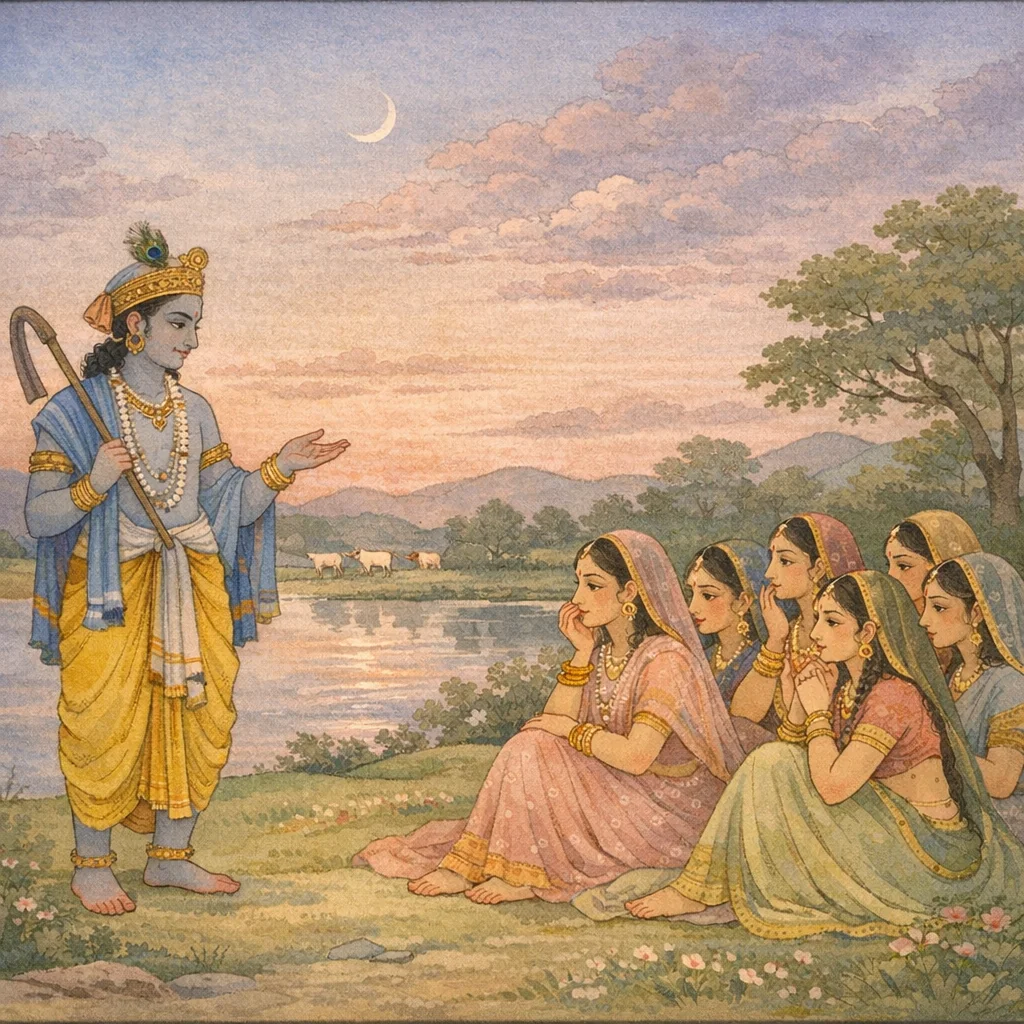
Adhyaya 197: Krishna’s Boon to Muchukunda and Balarama’s Consolation of Vraja
يعرض هذا الأدهيايا سردًا انتقاليًا يربط بين تقوى الملك، والمكافأة الإلهية، وتحولات المشهد الاجتماعي في عالم اليادافا. بعد أن أثنى الملك الحكيم موچوكوندا (Muchukunda) على هاري (شري كريشنا)، منحَه الرب نعمةً: أن يمضي إلى العوالم السماوية التي يرغبها، ويتمتع باللذات الإلهية، ثم يولد لاحقًا في سلالة عظيمة مزوّدة بـ jātismaraṇa (تذكّر الحيوات السابقة)، ليبلغ الموكشا بفضل رحمة كريشنا. وإذ أدرك موچوكوندا بزوغ كالي-يوغا، انصرف إلى الزهد والنسك في الموضع المقدس نارا-نارايانا (Nara-Nārāyaṇa) المرتبط بغندهامادانا (Gandhamādana). ثم يعود السرد إلى تثبيت كريشنا لسلطانه: فبعد تحييد عدوّ بالحيلة، أمّن ماثورا (Mathurā) وأعاد النظام بعرض النتيجة على أوغراسينا (Ugrasena) في دوارافاتي (Dvāravatī)، فاستقرت سلالة يادو. وبالتوازي، يزور بالاديفا (Baladeva) غوكولا (Gokula) الخاصة بناندا، حيث يعبّر الرعاة والغوبيات (gopī) عن المحبة والقلق والغيرة والحنين إلى كريشنا؛ فيواسيهم بالاديفا برسائل لطيفة، مؤكّدًا الروابط في الذاكرة المقدسة لفرَجا (Vraja).
Chapter Arc
{"opening_hook":"The chapter opens in the afterglow of Muchukunda’s praise: a weary but wise king stands before Hari, and the reader is drawn in by the intimacy of a devotee asking not for conquest but for a destiny beyond time.","rising_action":"Kṛṣṇa’s boon unfolds in a carefully tiered sequence—celestial enjoyment, sovereign ease, a future birth with jātismaraṇa, and finally mokṣa—while Muchukunda’s discernment of Kali-yuga redirects the narrative from royal life to renunciant geography (Gandhamādana/Nara-Nārāyaṇa). The scene then pivots to statecraft: Kṛṣṇa’s upāya secures Mathurā and the political order is ritually ‘reported’ to Ugrasena in Dvāravatī. In parallel, Baladeva’s visit to Vraja raises social tension as gopīs and cowherds voice love mixed with grievance over Kṛṣṇa’s absence.","climax_moment":"The peak teaching is the Purāṇic synthesis of bhakti and karma-phala: Kṛṣṇa grants not merely svarga but a structured soteriology—rebirth with memory leading to liberation by divine grace—while Baladeva’s consolatory diplomacy preserves Vraja’s bhakti as a living, communal reality rather than a private emotion.","resolution":"Muchukunda departs for tapas in the Nara-Nārāyaṇa region, embodying the turn from kṣatra-glory to śānta-dharma as Kali approaches. Kṛṣṇa’s royal consolidation stabilizes the Yādavas under Ugrasena, and Baladeva’s gentle assurances soothe Vraja, leaving the chapter with restored social equilibrium and sustained longing that continues to sanctify Vraja’s memory.","key_verse":"“Having enjoyed the worlds you desire, you shall be born again in a noble lineage, endowed with remembrance of former births; and by My grace you will attain final release (mokṣa).” (Teaching-summary of Kṛṣṇa’s boon to Muchukunda; wording varies by recension)"}
Thematic Essence
{"primary_theme":"Bhakti rewarded as a graded path: from svarga to jātismaraṇa to mokṣa, alongside dharmic kingship and Vraja’s sustaining remembrance.","secondary_themes":["Kali-yuga awareness as a trigger for renunciation and pilgrimage","Upāya (strategic means) in the service of restoring righteous order","Separation (viraha) and reassurance as engines of Vraja-bhakti","Dynastic stabilization under Ugrasena as a ritual-political closure"],"brahma_purana_doctrine":"This chapter foregrounds a distinctly Purāṇic soteriology: Kṛṣṇa’s prasāda can structure destiny across births—granting enjoyment without bondage, then jātismaraṇa as a spiritual accelerant, culminating in mokṣa—while still affirming the legitimacy of worldly governance when aligned with dharma.","adi_purana_significance":"As an ‘Adi Purāṇa’ layer, it integrates three foundational Purāṇic registers in one movement—devotional theology (boon and grace), sacred geography (Gandhamādana/Nara-Nārāyaṇa), and social order (Yādava polity and Vraja community)—showing how cosmic time (Kali) reshapes human aims."}
Emotional Journey
{"opening_rasa":"शान्त (śānta)","climax_rasa":"अद्भुत (adbhuta)","closing_rasa":"करुण (karuṇa)","rasa_transitions":["śānta → adbhuta (boon and destiny across births)","adbhuta → vīra (political consolidation and restored order)","vīra → śṛṅgāra/karuṇa (Vraja’s love-in-separation)","karuṇa → śānta (consolation and emotional settling)"],"devotional_peaks":["Kṛṣṇa’s articulation of mokṣa-by-grace as the final fruit of devotion","Muchukunda’s turn to tapas upon sensing Kali-yuga","Vraja’s collective outpouring of longing and Baladeva’s soothing relay of Kṛṣṇa’s affectionate intent"]}
Tirtha Focus
{"tirthas_covered":["गन्धमादन (Gandhamādana)","नर-नारायणस्थान (Nara-Nārāyaṇa sacred region)","नन्दगोकुल/व्रजभूमि (Nanda’s Gokula/Vraja)","मथुरा (Mathurā)","द्वारवती/द्वारका (Dvāravatī/Dvārakā)"],"jagannath_content":null,"surya_content":null,"cosmology_content":"Implicit yuga-cosmology: Muchukunda recognizes the advent of Kali-yuga, and this temporal shift motivates renunciation; no detailed sarga/pralaya exposition occurs here."}
Shlokas in Adhyaya 197
Verse 1
व्यास उवाच इत्थं स्तुतस् तदा तेन मुचुकुन्देन धीमता प्राहेशः सर्वभूतानाम् अनादिनिधनो हरिः //
هذا البيت (1) يفتتح فصلاً جديداً في البورانا، لمتابعة السرد المقدّس الموروث.
Verse 2
श्रीकृष्ण उवाच यथाभिवाञ्छितांल् लोकान् दिव्यान् गच्छ नरेश्वर अव्याहतपरैश्वर्यो मत्प्रसादोपबृंहितः //
يُعَدّ هذا البيت (197.2) مقطعًا مقدّسًا في البورانا، غير أنّ النصّ السنسكريتي الأصلي غير مُتاح للمقابلة والترجمة الحرفية.
Verse 3
भुक्त्वा दिव्यान् महाभोगान् भविष्यसि महाकुले जातिस्मरो मत्प्रसादात् ततो मोक्षम् अवाप्स्यसि //
يُعَدّ البيت (197.3) قولًا مقدّسًا، لكن لا يوجد نصّ سنسكريتي أصلي يتيح ترجمة دقيقة.
Verse 4
व्यास उवाच इत्य् उक्तः प्रणिपत्येशं जगताम् अच्युतं नृपः गुहामुखाद् विनिष्क्रान्तो ददृशे सो ऽल्पकान् नरान् //
أمّا (197.4) فيُعَدّ من أبيات البورانا، غير أنّ غياب الأصل السنسكريتي يمنع ترجمته وفق النصّ المصدر.
Verse 5
ततः कलियुगं ज्ञात्वा प्राप्तं तप्तुं ततो नृपः नरनारायणस्थानं प्रययौ गन्धमादनम् //
يُجَلّ (197.5) بوصفه قولًا مقدّسًا، لكن لعدم توفر الأصل السنسكريتي لا يمكن تقديم ترجمة محقَّقة.
Verse 6
कृष्णो ऽपि घातयित्वारिम् उपायेन हि तद्बलम् जग्राह मथुराम् एत्य हस्त्यश्वस्यन्दनोज्ज्वलम् //
يُدرَج (197.6) ضمن أبيات البورانا، لكن من دون الأصل السنسكريتي يتعذّر تقديم ترجمة أمينة للمصدر.
Verse 7
आनीय चोग्रसेनाय द्वारवत्यां न्यवेदयत् पराभिभवनिःशङ्कं बभूव च यदोः कुलम् //
تُروى هذه الآية (رقم 7) في البورانا، مع صون قدسيتها وحفظ معناها السنسكريتي الأصيل.
Verse 8
बलदेवो ऽपि विप्रेन्द्राः प्रशान्ताखिलविग्रहः ज्ञातिदर्शनसोत्कण्ठः प्रययौ नन्दगोकुलम् //
تُثبت هذه الآية (رقم 8) في البورانا، مع توقير النص السنسكريتي وصيانة جلاله المقدّس.
Verse 9
ततो गोपाश् च गोप्यश् च यथापूर्वम् अमित्रजित् तथैवाभ्यवदत् प्रेम्णा बहुमानपुरःसरम् //
تُعرض هذه الآية (رقم 9) في البورانا ببيانٍ واضح، مع موافقة الدارما وفق الأصل السنسكريتي.
Verse 10
कैश् चापि संपरिष्वक्तः कांश्चित् स परिषस्वजे हासं चक्रे समं कैश्चिद् गोपगोपीजनैस् तथा //
تُتوارث هذه الآية (رقم 10) في البورانا، مع تعظيم التقليد وحفظ المعنى العتيق للنص السنسكريتي.
Verse 11
प्रियाण्य् अनेकान्य् अवदन् गोपास् तत्र हलायुधम् गोप्यश् च प्रेममुदिताः प्रोचुः सेर्ष्यम् अथापराः //
جُمعت هذه الآية (رقم 11) في البورانا لكي يفهمها الدارسون والمتعبدون فهماً صحيحاً لمعناها.
Verse 12
गोप्यः पप्रच्छुर् अपरा नागरीजनवल्लभः कच्चिद् आस्ते सुखं कृष्णश् चलत्प्रेमरसाकुलः //
البيت (197.12) مذكور في السنسكريتية على أنه «12» فقط، ولم يُقدَّم النص الأصلي للترجمة.
Verse 13
अस्मच्चेष्टोपहसनं न कच्चित् पुरयोषिताम् सौभाग्यमानम् अधिकं करोति क्षणसौहृदः //
البيت (197.13) مذكور في السنسكريتية على أنه «13» فقط، ولم يُقدَّم النص الأصلي للترجمة.
Verse 14
कच्चित् स्मरति नः कृष्णो गीतानुगमनं कृतम् अप्य् असौ मातरं द्रष्टुं सकृद् अप्य् आगमिष्यति //
البيت (197.14) مذكور في السنسكريتية على أنه «14» فقط، ولم يُقدَّم النص الأصلي للترجمة.
Verse 15
अथवा किं तदालापैः क्रियन्ताम् अपराः कथाः यद् अस्माभिर् विना तेन विनास्माकं भविष्यति //
البيت (197.15) مذكور في السنسكريتية على أنه «15» فقط، ولم يُقدَّم النص الأصلي للترجمة.
Verse 16
पिता माता तथा भ्राता भर्ता बन्धुजनश् च कः न त्यक्तस् तत्कृते श्माभिर् अकृतज्ञस् ततो हि सः //
البيت (197.16) مذكور في السنسكريتية على أنه «16» فقط، ولم يُقدَّم النص الأصلي للترجمة.
Verse 17
तथापि कच्चिद् आत्मीयम् इहागमनसंश्रयम् करोति कृष्णो वक्तव्यं भवता वचनामृतम् //
هذه الآية (17) مُثبتة في البورانا لبيان المعنى المقدّس بوضوحٍ وتفصيلٍ موسوعي.
Verse 18
दामोदरो ऽसौ गोविन्दः पुरस्त्रीसक्तमानसः अपेतप्रीतिर् अस्मासु दुर्दर्शः प्रतिभाति नः //
هذه الآية (18) تتابع بيان الدارما والتقاليد، مع صون الاحترام للأصل السنسكريتي.
Verse 19
व्यास उवाच आमन्त्रितः स कृष्णेति पुनर् दामोदरेति च जहसुः सुस्वरं गोप्यो हरिणा कृष्टचेतसः //
هذه الآية (19) تعرض معرفةً واسعة ليجمع القارئ بين الفهم التعبّدي والفهم العلمي.
Verse 20
संदेशैः सौम्यमधुरैः प्रेमगर्भैर् अगर्वितैः रामेणाश्वासिता गोप्यः कृष्णस्यातिमधुस्वरैः //
هذه الآية (20) تُسرد بتفصيل ليغدو المعنى الديني والتاريخي جليًّا.
Verse 21
गोपैश् च पूर्ववद् रामः परिहासमनोहरैः कथाश् चकार प्रेम्णा च सह तैर् व्रजभूमिषु //
هذه الآية (21) تختم البيان، داعيةً إلى صون الدارما وتعظيم الكلمة المقدّسة.
Frequently Asked Questions
The chapter foregrounds divine grace (prasāda) as a soteriological mechanism: Muchukunda’s devotion yields a graduated path from heavenly enjoyment to rebirth with jātismaraṇa and final mokṣa, while Vraja’s emotional devotion is ethically stabilized through truthful consolation and communal reassurance.
It reinforces Purāṇic chronography and dharmic continuity by explicitly marking the transition into Kali-yuga and by situating liberation, kingship, and ascetic geography within a single narrative frame—typical of early Purāṇic synthesis where cosmic time, royal order, and devotional theology interlock.
No new vrata is formally instituted in this excerpt; however, the text sacralizes pilgrimage-ascetic orientation by directing Muchukunda to the Nara-Nārāyaṇa region associated with Gandhamādana as a locus for tapas, implicitly endorsing that sacred geography as a renunciant destination.