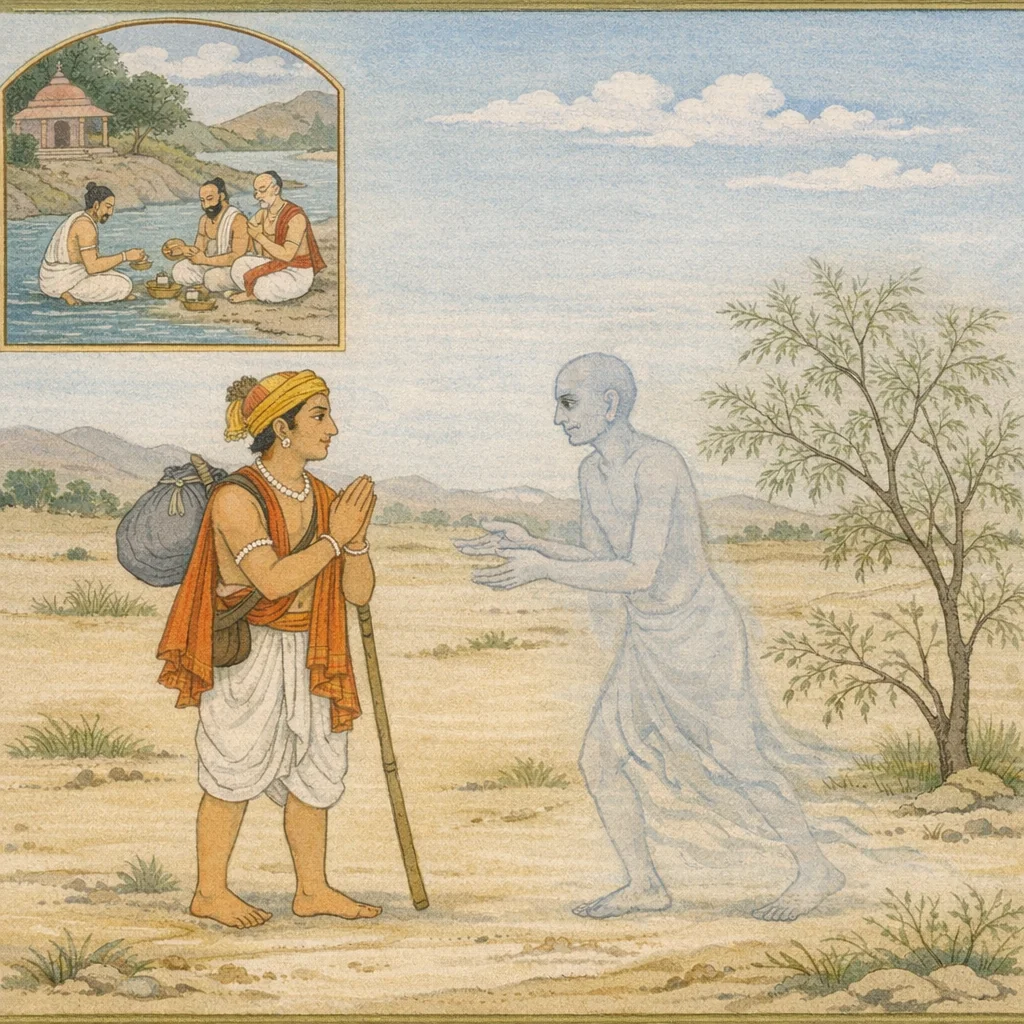
Adhyaya 52: The Merit of Śravaṇa-Dvādaśī and the Liberation of a Preta through Gayā Piṇḍa-Rites
श्रवणद्वादशी-माहात्म्य एवं प्रेतमोचन-कथा (Śravaṇa-dvādaśī-māhātmya evaṃ preta-mocana-kathā)
Liberation of a Preta
Within the Pulastya–Nārada dialogue-frame, this adhyāya first presents a pilgrimage itinerary marked by ritual bathing, fasting, and paired worship of Hari and Hara—Trivikrama, Īśāna, Hṛṣīkeśa, Nārāyaṇa, and Śiva—thereby foregrounding the Vāmana Purāṇa’s syncretic theology and its practical tirtha-guidance. The narrative then shifts to Madradeśa (Śākala), where a merchant’s son, robbed in a desert, encounters a preta-leader beneath a śamī tree. Through an etiological account, the preta (formerly a miserly brāhmaṇa) explains how a single act of dāna on the auspicious Śravaṇa-Dvādaśī—water in a new vessel, sweet dadhyodana, and gifts such as umbrella and footwear—continues to manifest as daily sustenance in the preta-state. The preta prescribes Gayā piṇḍa-nirvapaṇa as the decisive rite for release from pretabhāva, illustrating Purāṇic asura-dharma’s moral inverse (misery from miserliness) and the salvific economy of śrāddha. The chapter culminates in the preta’s liberation and a didactic affirmation of vrata, dāna, and tirtha as instruments of purification and social-ritual order.
Divine Beings
Sacred Geography
Mortal & Asura Figures
Key Content Points
- Pulastya narrates a tirtha-sequence featuring repeated snāna, upavāsa, and integrated worship of Viṣṇu (Trivikrama, Hṛṣīkeśa, Nārāyaṇa, Garuḍāsana) and Śiva (Īśāna, Jayeśa/Śaśiśekhara), exemplifying syncretic theology.
- A merchant’s son from Śākala is robbed in a desert and meets a preta-chief under a śamī tree; miraculous food and water appear due to prior merit, prompting an etiological explanation of dāna-phala.
- The preta (Somaśarman) teaches the specific salvific protocol: Śravaṇa-Dvādaśī vrata and Gayā piṇḍa-nirvapaṇa (with naming/saṅkalpa) as the ritual mechanism for release from pretabhāva and ascent to higher lokas.
Shlokas in Adhyaya 52
Verse 1
इति श्रीवामनपुराणे एकपञ्चाशो ऽध्यायः नारद उवाच कानि तीर्थानि विप्रेन्द्र प्रह्लादो ऽनुजगाम ह प्रह्लादतीर्थयात्रां मे सम्यगाख्यातुमर्हसि
(Thus ends the fifty-first chapter in the Śrī Vāmana Purāṇa.) Nārada said: O best of Brahmins, which sacred fords did Prahlāda visit? You should relate to me properly the pilgrimage of Prahlāda.
Verse 2
पुलस्त्य उवाच शृणुष्व कथयिष्यामि पापपङ्कप्रणाशिनीम् प्रह्लादतीर्थयात्रां ते शुद्धपुण्यप्रदायिनीम्
Pulastya said: Listen; I shall recount to you Prahlāda’s pilgrimage to the sacred fords—one that destroys the mire of sin and bestows pure merit.
Verse 4
संत्यज्य मेरुं कनकाचलेन्द्रं तीर्थं जगामामरसंघजुष्टम् ख्यातं पृतिव्यां शुभदं हि मानसं यत्र स्थितो मत्स्यवपुः सुरेशः // वम्प्_52.3 तस्मिंस्तीर्थवरे स्नात्वा संतर्प्य पितृदेवताः संपूज्य च जगन्नाथमच्युतं श्रुतिभिर्युतम्
Leaving Meru, the lord of golden mountains, he went to a sacred ford frequented by hosts of immortals—famed upon the earth as the auspicious Mānasatīrtha—where the Lord of the gods, bearing the form of a Fish, abides. Having bathed at that excellent tīrtha, he satisfied the Pitṛs and the deities with offerings, and duly worshipped Jagannātha Acyuta, accompanied by Vedic recitations.
Verse 6
तस्यां स्नात्वा महानद्यां संपूज्य च जगत्पतिम् समुपोष्य शुचिर्भूत्वा दत्वा विप्रेषु दक्षिणाम्
Having bathed in that great river, and having worshipped the Lord of the world, he observed a fast; becoming purified, he then gave dakṣiṇā (honoraria/gifts) to the brāhmaṇas.
Verse 7
नमस्कृत्य जगन्नाथमथो कूर्मवपुर्धरम् ततो जगाम कृष्णाख्यं द्रष्टुं वाजिमुखं प्रभुम् तत्र देवह्रदे स्नात्वा तर्पयित्वा पितॄन् सुरान्
Having bowed to Jagannātha, the Lord who bears the form of the Tortoise (Kūrma), he then went to the place called Kṛṣṇa to behold the Horse-faced Lord. There, having bathed in Deva-hrada, he offered libations (tarpana) to the Pitṛs and to the gods.
Verse 8
संपूज्य हयशीर्षं च जगाम गजसाह्वयम् तत्र देवं जगन्नाथं गोविन्दं चक्रपाणिनम्
Having duly worshiped Hayśīrṣa (Hayagrīva), he went to the place called Gaja. There (he beheld/worshiped) the god Jagannātha—Govinda, the bearer of the discus (cakra).
Verse 9
स्नात्वा संपूज्य विधिवत् जगाम यमुनां नीम् तस्यां स्नातः शुचिर्भूत्वा संतर्प्यार्षिसुरान् पितॄन् ददर्श देवदेवेशं लोकनाथं त्रिविक्रमम्
Having bathed and worshiped according to rule, he went to the Yamunā. Having bathed in her and become purified, and having offered libations to sages, gods, and ancestors, he beheld Trivikrama—the Lord of lords, the Lord of the world.
Verse 10
नारद उवाच साम्प्रतं भगवान् विष्णुस्त्रैलोक्याक्रमणं वपुः करिष्यति जगत्स्वामी बलेर्बन्धनमीश्वरः
Nārada said: “Now the Blessed Lord Viṣṇu—the Lord of the universe—will assume the form that strides across the three worlds; that sovereign Lord will bind Bali.”
Verse 12
पुलस्त्य उवाच श्रूयतां कथियिष्यामि यो ऽयं प्रोक्तस्त्रिविक्रमः यस्मिन् काले संबभूव यं च वञ्चितवानसौ
Pulastya said: “Listen; I shall relate (the account of) this Trivikrama who has been mentioned—when he came to be (manifest) and whom he deceived.”
Verse 13
आसीद् धुन्धुरिति ख्यातः कश्यपस्यौरसः सुतः दनुगर्भसमुद्भूतो माबलपराक्रमः
There was (an Asura) known as Dhundhu, the legitimate son of Kaśyapa, born from the womb of Danu, whose might and valor were immeasurable.
Verse 14
स समाराद्य वरदं ब्रह्माणं तपसासुरः अवध्यत्वं सुरैः सेन्द्रैः प्रार्थयत् स तु नारद
That Asura, having propitiated Brahmā—the granter of boons—by austerities, requested invulnerability from the gods, together with Indra; and so (it was), O Nārada.
Verse 15
तद् वरं तस्य च प्रादात् तपसा पङ्कजोद्भवः परितुष्टः स च बली निर्जगाम त्रिविष्टपम्
Pleased by his austerities, the Lotus-born (Brahmā) granted him that boon; and he, empowered and confident, then set forth toward Triviṣṭapa (the heavenly realm).
Verse ["Vishnu"]
चतुर्थस्य कलेरादौ जित्वा देवान् सवासवान् धुन्धुः शक्रत्वमकरोद्धिरण्यकशिपौ सति
At the beginning of the fourth age, Kali, Dhundhu—having conquered the gods together with Indra—conferred the sovereignty of Indra (the office of Śakra) upon Hiraṇyakaśipu, while he yet lived.
Verse 20
ते धुन्धुवाक्यं तु निशम्य दैत्याः प्रोचुर्न नो विद्यति लोकपाल गतिर्यया याम पितामहाजिरं सुदुर्गमो ऽयं परतो हि मार्गः
Hearing Dhundhu’s words, the Daityas replied: “There is no known course, O protector of the world, by which we might go to the courtyard of the Grandfather (Brahmā). The path beyond is indeed very difficult to traverse.”
Verse 21
इतः सहस्रैर्बहुयोजनाख्यैर्लोको महर्नाम महर्षिजुष्टः येषां हि दृष्ट्यार्ऽपणचोदितेन दह्यन्ति दैत्याः सहसेक्षितेन
From here, at a distance of many thousands of yojanas, lies the world called Maharloka, frequented by great sages. For, when their gaze is directed (toward an object), the Daityas are burned up by that sudden look.
Verse 22
ततो ऽपरो योजनकोटिना वै लोको जनो नाम वस्न्ति यत्र गोमातरो ऽस्मासु विनाशकारि यासां रजो ऽपीह महासुरेन्द्र
Beyond that, at a distance of one koṭi of yojanas, lies the world called Jana-loka, where the ‘cow-mothers’ dwell. O great lord of the Asuras, even the dust (raised) by them here is destructive to us.
Verse 23
ततो ऽपरो योजनकोटिभिस्तु षड्भिस्तपो नाम तपस्विजुष्टः तिष्ठन्ति यत्रासुर साध्यवर्या येषां हि नश्वासमरुत् त्वसह्यः
Beyond that, at a distance of six koṭis of yojanas, is the realm called Tapo-loka, frequented by ascetics. O Asura, the foremost Sādhyas abide there, whose very breath-wind is unbearable.
Verse 24
ततो ऽपरो योजनकोटिभिस्तु त्रिंशद्भिरादित्यसहस्रदीप्तिः सत्याभिधानो भगवन्निवासो वरप्रदो ऽभुद् भवतो हि यो ऽसौ
Beyond that, at a distance of thirty koṭis of yojanas, is the abode called Satya, radiant like a thousand suns—an abode of the Blessed Lord. That very one became the giver of boons to you.
Verse 25
यस्य वेदध्वनिं श्रुत्वा विकसन्ति सु रादयः संकोचमसुरा यान्ति ये च तेषां सधर्मिणः
Hearing the resonance of whose Vedic sound, the virtuous ones blossom forth; but the Asuras—and those who share their disposition—shrink back and fall into contraction.
Verse 26
तस्मान्मा त्वं महाबाहो मतिमेतां समादधः वैराजभुवनं धुन्धो दुरारोहं सदा नृभिः
Therefore, O mighty-armed one, do not adopt this intention. O Dhundhu, the Vairāja realm is ever difficult for mortals to ascend.
Verse He was being honored by the gods
तेषां वचनमाकर्ण्य धुन्धुः प्रोवाच दानवान् गन्तुकामः स सदनं ब्रह्मणो जेतुमीश्वरान्
Having heard their words, Dhundhu spoke to the Dānavas. Desiring to depart, he sought to conquer the abode of Brahmā and the divine lords.
Verse 28
कथं तु कर्मणा केन गम्यते दानवर्षभाः कथं तत्र सहस्राक्षः संप्राप्तः सह दैवतैः
“But by what act, and by what kind of rite, is that (state/goal) attained, O bulls among the Dānavas? And how did Sahasrākṣa (Indra) arrive there together with the gods?”
Verse 29
ते धुन्धुना दानवेन्द्राः पृष्टाः प्रोचुर्वचो ऽधिपम् कर्म तन्न वयं विद्मः शुक्रस्तद् वेत्त्यसंशयम्
“Questioned by Dhundhu, those lordly Dānavas replied to their ruler: ‘That act (karma) we do not know; Śukra knows it without doubt.’”
Verse 30
दैत्यानां वचनं श्रुत्वा धुनधुर्दैत्यपुरोहितम् पप्रच्छ शुक्रं किं कर्म कृत्वा ब्रह्मसदोगतिः
“Hearing the Daityas’ words, Dhundhu asked Śukra, the Daitya priest: ‘Having performed what act does one attain the state of reaching Brahmā’s assembly (Brahma-sadana)?’”
Verse 31
ततो ऽस्मै कथयामास दैत्यचार्यः कलिप्रिय शक्रस्य चरितं श्रीमान् पुरा वृत्ररिपोः किल
Then the preceptor of the Daityas—fond of contention—recounted to him the illustrious deeds of Śakra (Indra), the ancient enemy of Vṛtra.
Verse 32
शक्रः शतं तु पुण्यानां क्रोतूनामजयत् पुरा दैत्येन्द्र वाजिमेधानां तेन ब्रह्मसदो गतः
O lord of the Daityas, Śakra formerly surpassed (others) by means of a hundred meritorious sacrifices—Aśvamedhas; by that he attained the assembly/seat of Brahmā (i.e., the highest divine eminence).
Verse 33
तद्वाक्यं दानवपतिः श्रुत्वा शुक्रस्य वीर्यवान् यष्टुं तुरगमेधानां चकार मतिमुत्तमाम् अथामन्त्र्यासुरगुरुं दानवांश्चाप्यनुत्तमान्
Hearing those words of Śukra, the valiant lord of the Dānavas formed an excellent resolve—to perform horse-sacrifices. Then he summoned the Asura preceptor and also the foremost Dānavas.
Verse 34
प्रोवाच यक्ष्ये ऽहं यज्ञैरश्वमेधैः सदक्षिमैः तदागच्छध्वमवनीं गच्छामो वसुधाधिपान्
He said: “I shall perform sacrifices—Aśvamedha rites—together with competent officiants. Therefore, come to the earth; let us go to the lords of the land (the kings).”
Verse 35
विजित्य हयमेधान् वै यथाकामगुणन्विनतान् आहूयन्तां च निधयस्त्वाज्ञाप्यनातां च गुह्यकाः
“Having won (secured) the horse-sacrifices—endowed with whatever qualities are desired—let the treasures be summoned, and let the Guhyakas also be commanded.”
Verse 36
आमन्त्र्यन्तां च ऋषयः प्रयामो देविकाटतम् सा हि पुण्या सरिच्छ्रेष्ठ सर्वसिद्धिकरी शुभा स्थानं प्राचीनमासाद्य वाजिसेधान् यजामहे
“Let the sages also be invited. Let us set out for the bank of the Devikā. For she is holy—the best of rivers—auspicious, bestowing every attainment. Having reached the eastern sacred site, we shall perform the horse-sacrifices.”
Verse 37
इत्थं सुरारेर्वचनं निशम्यासुरयाजकः बाढमित्यब्रवीद् हृष्टो निधयः संदिदेश सः
Having thus heard the words of the enemy of the gods (i.e., the Daitya king), the priest of the Asuras replied joyfully, “So be it,” and he then directed that the treasures (and requisites) be brought forth/arranged.
Verse 38
ततो धुन्धुर्देविकायाः प्राचीने पापनाशने भार्गवेन्द्रेण शुक्रेण वाजिमेधाय दीक्षितः
Then Dhundhu was consecrated for the Aśvamedha (horse-sacrifice) by Śukra—the foremost of the Bhārgavas—at the eastern, sin-destroying (tīrtha) of the Devikā (river).
Verse 39
सदस्या ऋत्विजश्चापि तत्रासन् भार्गवा द्विजाः शुक्रस्यानुमते ब्रह्मन् शुक्रशिष्याश्च पण्यिताः
There, the members of the sacrificial assembly (sadasyas) and the officiating priests (ṛtviks) were Bhārgava Brahmins; and, O Brahmin, with Śukra’s approval, learned disciples of Śukra were also present.
Verse 47
ऋते पिनाकिनो देवात् त्रात्ऽस्मान् न यतो हरे अतो विवृद्धिमगमद् यथा व्याधिरुपेक्षितः
“O Hari, since there is no one to protect us except the Pināka-bearing God, therefore (the Asura’s power) increased—just as a disease grows when it is neglected.”
Verse 49
शतं क्रतूनामिष्ट्वासौ ब्रह्मलोकं महासुरः अरोढुमिच्छति वशी विजेतुं त्रिदशानपि
“Having performed a hundred sacrifices, that great Asura—self-controlled and powerful—desires to ascend to Brahmaloka and to conquer even the Thirty (gods).”
Verse 53
देहं त्यक्त्वा निरालम्बं काष्टवद् देविकाजले क्षणान्मज्जंस्तथोन्मज्जन्मुक्तकेशो यदृच्छया
Casting off bodily control and becoming unsupported, like a piece of wood in the waters of Devikā, he would for a moment sink and then rise again, his hair loosened, drifting as chance carried him.
Verse 58
ब्राह्मणो गुणवानासीत् प्रभास इति विश्रुतः सर्वसास्त्रार्थवित् प्राज्ञो गोत्रतश् चापि वारुणः
There was a virtuous brāhmaṇa, renowned by the name Prabhāsa—wise, knowing the meanings of all the śāstras, and by lineage belonging to the Vāruṇa gotra.
Verse 59
तस्य पुत्रद्वयं जातं मन्दप्रज्ञं सुदुःखितम् तत्र ज्येष्ठो मम भ्राता कनीयानपरस्त्वहम्
From him two sons were born—of dull understanding and greatly afflicted. Of those two, the elder was my brother; the younger, on the other hand, was I.
Verse 60
नेत्रभास इति ख्यातो ज्येष्ठो भ्राता ममासुर मम नाम पिता चक्रे गतिभासेति कौतुकात्
My elder brother, the Asura, was renowned by the name Netrabhāsa. My father, out of playful fancy, gave me the name Gatibhāsa.
Verse 63
ततो मयोक्तः स भ्राता विभजाम गृहं वयम् तेनोक्तो नैव भवतो विद्यते भागा इत्यहम्
Then I said to that brother, ‘Let us divide the household/property.’ He replied, ‘Indeed, you have no share.’ Thus (he spoke) to me.
Verse tell (me) how Purūravā worshipped the God
कुब्जवामनखञ्जानां क्लीबानां श्वित्रिणामपि उन्मत्तानां तथान्धानां धनभागो न विद्यते
For the hunchbacked, the dwarf, the lame, the impotent, and even those afflicted with leucoderma; likewise for the mad and the blind—no share in property is recognized.
Verse 65
शय्यासनस्थानमात्रं स्वेच्छयान्नभुजक्रिया एतावद् दीयते तेभ्यो नार्थभागहरा हि ते
“Only a bed, a seat, and a place to stay, and—according to one’s own choice—the act of eating food: only this much is to be given to them; for they are not, indeed, takers of a share in one’s property.”
Verse 66
एवमुक्ते मया सोक्तः किमर्थं पैतृकाद् गृहात् धनार्थभागमर्हामि नाहं न्यायेन केन वै
“When I had spoken thus, he said: ‘For what reason do I deserve a share of wealth/property from the ancestral house? By what principle of justice, indeed, do I (deserve it)?’”
Verse bearing conch
इत्युक्तावति वाक्ये ऽसौ भ्राता मे कोपसंयुतः समुत्क्षिप्याक्षिपन्नद्यामस्यां मामिति कारणात्
“When these words had been spoken, that brother of mine—filled with anger—lifted me up and threw me into this river, for that reason (i.e., on account of this matter).”
Verse 75
इति द्विजानां वचनं श्रुत्वा दैत्यपतिर्वचः प्राह द्विजेन्द्र ते दद्मि यावदिच्छसि वै धनम्
“Having heard these words of the Brahmins, the lord of the Daityas spoke: ‘O best of Brahmins, I give you as much wealth as you indeed desire.’”
Verse 76
दास्ते गृहं हिरण्यं च वाजिनः स्यन्दनान् गजान् प्रयच्छाम्यद्य भवतो व्रियतामीप्सितं विभो
“I shall give you today a house and gold, horses, chariots, and elephants. Let what is desired be chosen for you, O venerable one.”
Verse 78
सोदरेणापि हि भ्रात्रा ह्रियन्ते यस्य संपदः तस्याक्षमस्य यद्दत्तं किमन्यो न हरिष्यति
Even by a brother born of the same womb, the wealth of one who is incapable (of protecting it) is carried off. If what is given belongs to such a powerless person, what other (person) will not take it away?
Verse 79
दासीदासांश्च भृत्यांश्च गृहं रत्नं परिच्छदम् समर्थेषु द्विजेन्द्रेषु प्रयच्छस्व महाभुज
Give away—(even) female and male servants, attendants, the house, jewels, and household furnishings—to capable, foremost Brahmins, O mighty-armed one.
Verse 80
मम प्रमाणमालोक्य मामकं च पदत्रयम् संप्रयच्छस्व दैत्येन्द्र नाधिकं रक्षितुं क्षमः
“Considering my measure (my small stature), grant me only three steps of land that are mine (i.e., suited to me), O lord of the Daityas; you are not capable of protecting (i.e., maintaining your pledge) if you give more than that.”
Verse 81
इत्येवमुक्ते वचने महात्मना विहस्य दैत्याधिपतिः सऋत्विजः प्रादाद् द्विजेन्द्राय पदत्रयं तदा यदा स नान्यं प्रगृहाण किञ्चित्
When these words were spoken by the great-souled one, the lord of the Daityas—together with his officiating priests—smiled and then granted the three steps to the foremost of Brahmins, at that very time, for he (Vāmana) accepted nothing else whatsoever.
Verse 82
क्रमत्रयं तावदवेक्ष्य दत्तं महासुरेन्द्रेण विभुर्यशस्वी चक्रे ततो लङ्घयितुं त्रिविक्रमं रूपमनन्तशक्तिः
Having observed that the three strides had indeed been granted by the great lord of the Asuras, the glorious, all-pervading Lord—of infinite power—then assumed the form of Trivikrama in order to overstep (measure) them.
Verse 86
पतता वासुदेवेन दानवोपरि नारद त्रिंशद्योजनसाहस्री भूमेर्गर्ता दृढीकृता
O Nārada, as Vāsudeva descended upon the Dānava, a firm pit in the earth—measuring thirty thousand yojanas—was formed.
Verse 87
ततो दैत्यं समुत्पाट्य तस्यां प्रक्षिप्य वेगतः अवर्षत् सिकतावृष्ट्या तां गर्तामपूरयत
Then, uprooting the Daitya, he hurled him swiftly into that pit; and by a rain of sand he filled up that chasm.
Verse 88
ततः स्वर्गं सहस्राक्षो वासुदेवप्रसादतः सुराश्च सर्वे त्रैलोक्यमवापुर्निरुपद्रवाः
Thereupon, by the grace of Vāsudeva, Sahasrākṣa (Indra) regained heaven, and all the gods attained the three worlds free from affliction.
Verse guruḥ: teacher/spiritual preceptor; pūjyaḥ: worthy of worship/veneration; tava: your; pitā: father; tasya api: even of him; aham: I; mama api: even for me/for my part; bhagavān: the Blessed Lord (possessing divine excellences); loka-guruḥ: teacher of the world; hariḥ: Hari (Vishnu)
भगवानपि दैत्येन्द्रं प3क्षिप्य सिकतार्णवे कालिन्द्य रूपमाधाय तत्रैवान्तरधीयत
The Blessed Lord, having cast the lord of the Daityas into the sandy ocean, assumed the form of Kāлиндī (the Yamunā) and disappeared there itself.
Frequently Asked Questions
Pulastya’s narration repeatedly pairs iconographic and ritual acts—snāna, upavāsa, and arcana—directed to Trivikrama/Hṛṣīkeśa/Nārāyaṇa alongside Īśāna/Śaśiśekhara/Parameśvara, presenting a functional Harihara-synthesis where pilgrimage practice validates both traditions without doctrinal conflict.
The chapter maps a north-Indian tirtha-corridor through Kālindī (Yamunā), Kedāra, Badarikāśrama, Sarasvatī waters (Varāha-tīrtha), and riverine sites on Vipāśā and Irāvatī, culminating in Gayā/Gayāśīrṣa as the definitive śrāddha-field for piṇḍa offerings—an explicit topographical sanctification tied to specific rites (snāna, arcana, upavāsa, piṇḍa-nirvapaṇa).
A single, properly timed act of dāna on Śravaṇa-Dvādaśī (water-vessel, dadhyodana, and ancillary gifts) generates enduring post-mortem benefit, yet full release from pretabhāva requires the prescribed Gayā piṇḍa-nirvapaṇa with correct saṅkalpa (naming the deceased), demonstrating the Purāṇic linkage between charity, vrata-observance, and ancestral rites.