Adhyaya 27: Shiva’s Wedding Procession to Kailasa and the Marriage of Girija (Kali)
शिवविवाह-प्रकरणम् (Śiva-Vivāha-Prakaraṇam)
Marriage of Girija Continued
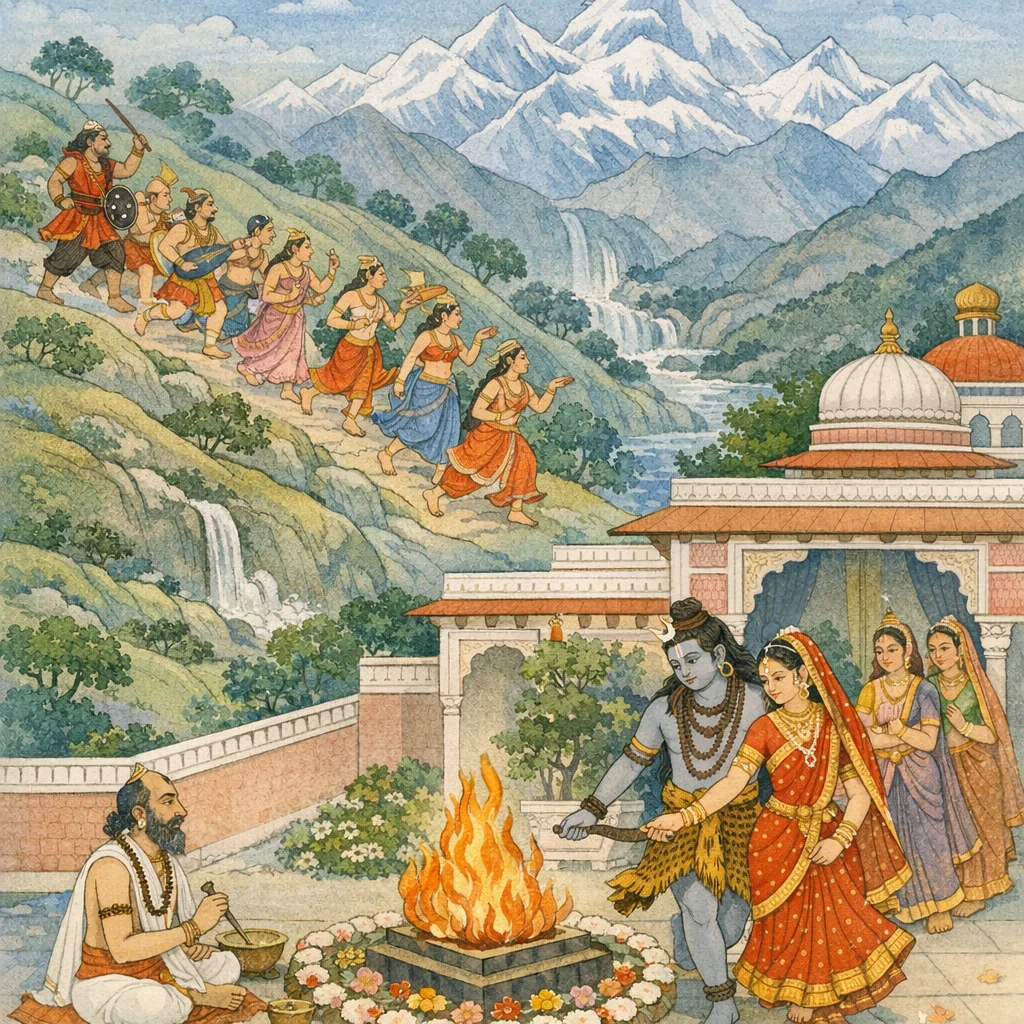
Within the Pulastya–Nārada narrative frame, this adhyāya presents a richly ceremonial account of Śiva’s movement toward the Himalayan abode for the vaivāhika-vidhi (marriage rite) with Girijā (also styled Kālī). The text foregrounds syncretic theology by staging Viṣṇu (Janārdana) and Lakṣmī as honored participants in a Śaiva rite, while Brahmā officiates and Indra, rivers (Yamunā, Sarasvatī), seasons, gandharvas, apsarases, and vast gaṇa-hosts accompany the procession. Iconographic descriptions of Hara—bone-crest, serpent-ornaments, ash-smeared body, vṛṣabha-mount—are integrated with courtly spectacle and the social gaze of the city women. The ritual sequence includes madhuparka reception, agni-pradakṣiṇā, lāja-homa, and auspicious benedictions, culminating in the establishment of the Vālakhilya sages. The chapter thus sacralizes Himalayan topography (Kailāsa/Himavān) while modeling Hari–Hara concord through shared participation and mutual honor.
Divine Beings
Sacred Geography
Mortal & Asura Figures
Key Content Points
- Śiva (Vṛṣaketu/Vṛṣadhvaja) is welcomed by the assembled devas; Viṣṇu, Brahmā, Indra, gaṇas, siddhas, yakṣas, gandharvas, apsarases, rivers, and seasons join the grand wedding procession toward Kailāsa.
- Detailed iconography and pageantry: Śiva’s ash-and-serpent adornment, gaṇa retinues led by Vīrabhadra, and the public excitement of the city women as the divine party enters the mountain-king’s palace.
- Marriage rites and outcomes: madhuparka, agni-pradakṣiṇā, lāja offerings, blessings to Mālinī, the arising/recognition of the Vālakhilya sages, and Śiva’s departure to Mandara after honoring the gods.
Shlokas in Adhyaya 27
Verse 1
इति श्रीवामनपुराणे षड्विंशो ऽध्यायः पुलस्त्य उवाच समागतान् सुरान् दृष्ट्वा नन्दिराख्यातवान् विभोः अथोत्थाय हरिं भक्त्या परिष्वज्य न्यपीडयत्
"Thus ends the twenty-sixth chapter in the Śrī Vāmana Purāṇa." Pulastya said: Seeing the assembled gods, Nandin informed the Lord. Then, rising up, he embraced Hari with devotion and pressed (him close).
Verse 2
ब्रह्मणां शिरसा नत्वा समाभाष्य शतक्रतुम् आलोक्यान्यान् सुरगणान् संभावयत् स शङ्करः
Having bowed his head to the Brahmins, and having spoken with Śatakratu (Indra), Śaṅkara looked upon the other groups of gods and honored (greeted) them.
Verse 3
गणाश्च जय देवेति वीरभद्रपुरोगमाः शैवाः पाशुपताद्याश्च विविशुर्मन्दरालम्
And the gaṇas—led in front by Vīrabhadra—crying ‘Victory to the Lord!’, the Śaivas and those beginning with the Pāśupatas, entered Mandara’s abode/realm.
Verse 4
ततस्तस्मान्महाशैलं कैलासं सह दैवतैः जगाम भगवान् शर्वः कर्तुं वैवाहिकं विधिम्
Then from there, the Blessed Śarva (Śiva), together with the gods, went to the great mountain Kailāsa in order to perform the wedding rite.
Verse 5
ततस्तस्मिन् महाशैले देवमातादितिः शुभा सुरभिः सुरसा चान्याश्चक्रर्मण्डनमाकुलाः
Then, on that great mountain, the auspicious mother of the gods, Aditi, along with Surabhī, Surasā, and other (divine) ladies, were present—crowding around the discus-circle (cakra-maṇḍana) in a bustling assembly.
Verse 6
महास्थिशेखरी चारुरोचनालिकलो हरः सिंहाजिनी चालिनीलभुजङ्गकृतकुण्डलः
Hara (Śiva) appeared—(with a retinue including) Mahāsthiśekharī and Cārurocanā; he wore a lion-skin, and he had earrings fashioned from dark-blue serpents.
Verse 13
ऋतवः षट् समादाय कुसुमं गन्धसंयुतम् पञ्चवर्णं महेशानं जग्मुस्ते कामचारिणः
The six seasons, taking fragrant flowers of five colors, went to Maheśāna; they moved as they wished (freely).
Verse 15
गन्धर्वास्तुम्बरुमुखा गायन्तो मधुरस्वरम् अनुजग्मुर्महादेवं वादयन्तश् च किन्नराः
The Gandharvas—led by Tumburu—sang in sweet tones, and the Kinnaras followed Mahādeva while playing instruments.
Verse 16
नृत्यन्त्यो ऽप्सरश्चैव स्तुवन्तो मुनयश्च तम् गन्धर्वा यान्ति देवेशं त्रिनेत्रं शूलपाणिनम्
Apsarases danced, and sages praised him; the Gandharvas proceed to the Lord of the gods—the three-eyed one, bearing the trident in his hand.
Verse 20
ततः क्षणेन देवेशः क्ष्माधराधिपतेस्तलम् संप्राप्तास्त्वागमन् शैलाः कुञ्जरस्थाः समन्ततः
Then, in an instant, the Lord of the gods reached the domain of the king of mountains. From all directions the mountains arrived, stationed upon elephants.
Verse 21
ततो ननाम भगवांस्त्रिनेत्रः स्थावराधिपम् शैलाः प्रणेमुरीशानं ततो ऽसौ मुदितो ऽभवत्
Then the Blessed Three-eyed Lord bowed to the lord of immovables (the mountain-king). The mountains bowed to Īśāna, and then he (the lord) became pleased.
Verse 24
माल्यार्द्धमन्या चादाय करेणैकेन भामिनी केशपाशं द्वितीयेन शङ्कराभिमुखी गता
Another passionate woman, taking (only) half of a garland in one hand and (holding) her braid of hair with the other, went facing toward Śaṅkara.
Verse 25
अन्यालक्तकरागाढ्यं पादं कृत्वाकुलेक्षणा अनलक्तकमेकं हि हरं द्रष्टुमुपागता
Another woman, her eyes restless with excitement, having colored one foot richly with lac-dye, came to see Hara—leaving the other foot indeed uncolored.
Verse 26
एकेनाक्ष्णाञ्जितेनैव श्रुत्वा भीममुपागतम् साञ्जनां च प्रगृह्यान्या शलाकां सुष्ठु धावति
With only one eye already anointed (with collyrium), on hearing that the fearsome one had arrived, another woman, seizing her collyrium and the applicator-stick, runs swiftly.
Verse 28
अन्यातिक्रान्तमीशानं श्रुत्वा स्तनभरालसा अनिन्दत रुषा बाला यौवनं स्वं कृशोदरी
Another girl—slender-waisted yet languid from the weight of her breasts—on hearing that Īśāna (Śiva) had passed by, angrily blamed her own youth.
Verse 29
इत्थं स नगरस्त्रीणां क्षोभं संजनयन् हरः जगाम वृषभारूढो दिव्यं श्वशुरमन्दिरम्
Thus Hara (Śiva), stirring excitement and agitation among the women of the city, departed—mounted upon the bull—and went to the divine mansion of his father-in-law.
Verse 30
ततः प्रविष्टं प्रसमीक्ष्य शंभुं शैलेन्द्रवेश्मन्यबला ब्रुवन्ति स्थाने तपो दुश्चरमम्बिकायाश्चीर्णं महानेष सुरस्तु शंभुः
Then, seeing Śambhu enter, the women in the dwelling of the Lord of Mountains said: ‘Indeed, Ambikā has performed severe and difficult austerity in the proper manner; this great god is none other than Śambhu.’
Verse 31
स एष येनाङ्गमानङ्गतां कृतं कन्दर्पनाम्नः कुसुमायुधस्य क्रतोः क्षयी दक्षविनाशकर्ता भगाक्षिहा शूलधरः पिनाकी
He is the very one by whom Kāma—called Kandarpa, whose weapon is flowers—was made bodiless; the destroyer of the sacrifice, the agent of Dakṣa’s ruin, the one who struck out Bhaga’s eyes; the bearer of the trident, the wielder of the Pināka bow.
Verse 32
नमो नमः शङ्कर शूलपाणे मृगारिचर्माम्बर कालशत्रो महाहिहाराङ्कितकुण्डलाय नमो नमः पार्वतिवल्लभाय
Homage, homage to Śaṅkara, the wielder of the trident; to Him whose garment is the hide of the foe of beasts (the tiger), the enemy of Death; to Him whose earrings are marked/adorned with the great serpent as an ornament—homage, homage to the beloved of Pārvatī.
Verse 33
इत्थं संस्तूयमानः सुरापतिविधृतेनातपत्रेण शंभुः सिद्धैर्वन्द्यः सयक्षैरहिकृतवलयी चारुभस्मोपलिफ्तः अग्रस्थेनाग्रजेन प्रमुदितमनसा विष्णुना चानुगेन वैवाहीं मङ्गलाढ्यां हुतवहमुदितामारुरोहाथ वेदीम्
Thus being praised, Śaṃbhu—honoured by the Siddhas, accompanied by the Yakṣas, wearing bracelets fashioned of serpents, and beautifully smeared with sacred ash—while Indra held the royal parasol over him, and while Viṣṇu, the delighted elder brother, attended him as an escort, then ascended the wedding-altar (vedī), rich in auspicious rites, where the Fire-god rejoiced.
Verse 38
एवं क्रीडां हरः कृत्वा समं च गिरिकन्यया आगच्छद् दक्षिणां वेदिमृषिभिः सेवितां दृढाम्
Thus, having sported (enjoyed divine play), Hara, together with the Daughter of the Mountain, came to the southern altar-platform (vedī), firm and well-established, which was attended by sages.
Verse 39
अथाजगाम हिमवान् शुक्ललाम्बरधरः शुचिः पवित्रपाणिरादाय मधुपर्कमथोज्ज्वलम्
Then Himavān came—pure, wearing white garments—his hands sanctified (holding purificatory grass), bringing the bright madhuparka (the ceremonial offering of hospitality).
Verse 40
उपविष्टस्त्रिनेत्रस्तु शाक्रीं दिशमपश्यत सप्तर्षिकांश्च शैलन्द्रः सूपविष्टो ऽवलोकयन्
Seated, the Three-eyed one looked toward the direction of Śakra (Indra). And the lord of mountains (Himavān), well seated, observed the Seven Sages as well.
Verse 41
सुखासीनास्य शर्वस्य कृताञ्ज0लिपुटो गिरिः प्रोवाच वचनं श्रीमान् धर्मसाधनमात्मनः
While Śarva (Śiva) sat at ease, the mountain (Himavat), with hands folded in reverence, the illustrious one, spoke words intended to accomplish his purpose in accordance with dharma.
Verse 42
हिमवानुवाच मत्पुत्रीं भगवन् कालीं पौत्रीं च पुलहाग्रजे पितॄणामपि दौहित्रीं प्रतीच्छेमां मयोद्यताम्
Himavat said: “O Blessed Lord, accept this Kāli—my daughter—who is also (said to be) the granddaughter of Pulaha’s elder brother, and indeed the granddaughter (daughter’s daughter) of the Pitṛs. Accept her, whom I have presented (to you).”
Verse 43
पुलस्त्य उवाच इत्येवमुक्त्वा शैलेन्द्रो हस्तं हस्तेन योजयन् प्रादात् प्रतीच्छ भगवन् इदमुच्चैरुदीरयन्
Pulastya said: Having spoken thus, the lord of mountains (Himavat), joining hand with hand, gave (her) and, loudly uttering these words, said: “O Lord, accept (this).”
Verse 53
अथोवाच महादेवो दत्तं मालिनि मुञ्च माम् सौभाग्यं निजगोत्रीयं यो ऽस्यास्तं शृणु वच्मि ते
Then Mahādeva spoke: “Mālinī, release me—(for) the gift has been given. The auspicious one who belongs to your own gotra—hear who he is; I shall tell you.”
Verse 58
ततो ऽब्रवीद्वरो ब्रह्मन् न द्विजान् हन्तुमर्हसि अमी महर्षयो धन्या वालखिल्याः पितामह
Then the excellent one said: ‘O Brahman, you should not kill the twice-born. These are blessed great sages—the Vālakhilyas, O Grandfather.’
Verse the sports were wondrous: trees laden with blossoms were sprinkled by falling drops of water; the ground was lavishly strewn with fragrant powders
ततो विवाहे निर्वृत्ते प्रविष्टः कौतुकं हरः रेमे सहोमया रात्रिं प्रभाते पुनरुत्थितः
Then, when the wedding had been completed, Hara entered into festive rejoicing; together with Umā he delighted through the night, and at dawn he rose again.
Verse 62
ततः सुरान् ब्रह्महरीन्द्रमुख्यान् प्रणम्य संपूज्य यथाविभागम् विसर्ज्य भूतैः सहितो महीध्रमध्यावसन्मन्दरमष्टमूर्तिः
Then, having bowed to the gods—chiefly Brahmā, Hari (Viṣṇu), and Indra—and having duly honored each according to his proper share, he dismissed them. Accompanied by the Bhūtas, the Eight-Formed One (Śiva) took up residence on the mountain Mandara.
Frequently Asked Questions
The chapter enacts syncretic theology through ritual participation: Viṣṇu (Janārdana), accompanied by Lakṣmī, is portrayed as an honored attendee within a Śaiva marriage rite officiated by Brahmā and supported by Indra and the devas. Śiva’s blessings explicitly reference Viṣṇu (e.g., the ‘saubhāgya’ linked to the pītāmbara-dhara Madhusūdana), presenting devotional harmony rather than sectarian rivalry.
Topographical sanctification centers on the Himalayan sacred zone: Kailāsa and the domain of Himavān (Śailarāja) function as the ritual landscape for divine marriage, while Mandara becomes Śiva’s subsequent abode. Although not a Kurukṣetra-focused tīrtha-catalogue passage, the chapter sacralizes these mountain locales by embedding them in formal vaivāhika rites and divine assemblies.
This adhyāya does not advance the Bali–Vāmana cycle. Its narrative function is ceremonial and theological: it models Hari–Hara concord and establishes ancillary mythic outcomes (notably the Vālakhilya sages) within the Pulastya–Nārada purāṇic frame.