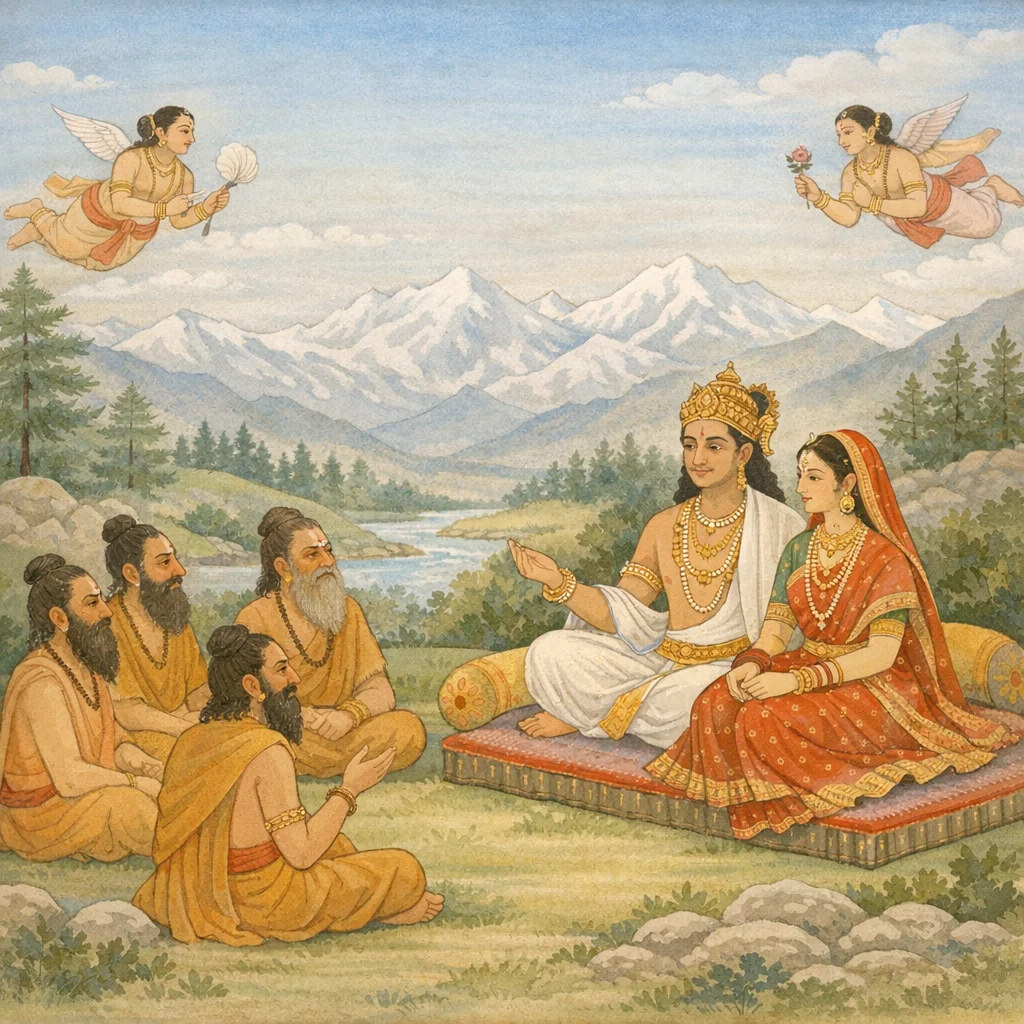
Adhyaya 25: The Saptarishis Seek Uma for Shiva: Himavan Grants the Marriage
उमा-विवाहार्थ-याचनम् (Umā-vivāhārtha-yācanam)
Himavan Grants the Marriage
Within the Pulastya–Nārada narrative frame, this adhyāya foregrounds syncretic theology by presenting Rudra (Śaṅkara/Hara/Tripurāntaka) as a deity who is ritually honored by sages and whose marital union sustains cosmic order. At Mandara mountain, Śiva recalls the Saptarṣis and commissions them to approach Himavān for Umā, identified as Satī reborn after Dakṣa’s offense and her yogic self-release. The sages, accompanied by Arundhatī, travel to Himālaya, where the mountain-king’s court—populated by personified mountains and celestial beings—becomes a sacralized topographical assembly. Himavān’s humility and purification-by-contact motifs (pāda-paṅkaja sanctification) mirror tīrtha-logic, while Menā’s counsel frames the marriage as teleological: the future son will destroy demonic threats (Tāraka, Mahīṣa). The chapter culminates in consent, auspicious calendrics (Uttarāphālgunī, Maitra muhūrta), and the sages’ return to report success to Mahādeva, reinforcing dharma through ritual propriety and inter-sectarian reverence.
Divine Beings
Sacred Geography
Mortal & Asura Figures
Key Content Points
- Pulastya narrates how Śiva, pleased at Mandara, summons the Saptarṣis and commissions them to request Umā (Satī reborn) from Himavān, establishing a Shaiva-centered yet broadly dharmic mandate within the Purāṇic frame.
- A courtly-tīrtha motif unfolds in Himālaya: Himavān receives the sages with arghya and declares his body and realm purified by their presence, echoing pilgrimage sanctification logic applied to sacred geography.
- Himavān consults the assembled mountains and Menā; consensus grants Umā to Śiva, with prophetic asura-dharma consequences (the future son’s slaying of Tāraka and Mahīṣa) and precise auspicious timing (Uttarāphālgunī yoga; Maitra muhūrta).
Shlokas in Adhyaya 25
Verse 1
इति श्रीवामनपुराणे चतुर्विंशो ऽध्यायः पुलस्त्य उवाच मेनायाः कन्यकास्तिस्रो जाता रूपगुणान्विताः सुनाभ इति च ख्यातश्चतुर्थस्तनयो ऽभवत्
Thus (ends) the twenty-fourth chapter of the Śrī Vāmana Purāṇa. Pulastya said: To Menā were born three daughters endowed with beauty and virtues; and a fourth (child), a son, was born who became known as Sunābha.
Verse 2
रक्ताङ्गी रक्तनेत्रा च रक्ताम्बरविभूषिता रागिणि नाम संजाता ज्येष्ठा मेनासुता मुने
She was red-limbed, red-eyed, and adorned with red garments. She was born with the name Rāgiṇī—the eldest daughter of Menā, O sage.
Verse 3
शुभाङ्गी पद्मपत्राक्षी नीलकुञ्चितमूर्धजा श्वेतमाल्याम्बरधरा कुटिला नाम चापरा
Another was beautiful-limbed, lotus-petal-eyed, with dark, curly hair; wearing white garlands and garments. She was named Kuṭilā.
Verse 4
नीलाञ्चनचयप्रख्या नीलेन्दीवरलोचना रूपेणानुपमा काली जघन्या मेनकासुता
The youngest daughter of Menakā, Kālī, was dark like a mass of blue collyrium; her eyes were like blue lotuses; and in beauty she was incomparable.
Verse 5
जातास्ताः कन्यकास्तिस्रः षडब्दात् परतो मुने कर्तुं तपः प्रयातास्ता देवास्ता ददृशुः शुभाः
O sage, after six years those three maidens, having been born, set out to perform austerities; the gods then beheld those auspicious ones.
Verse 6
ततो दिवाकरैः सर्वैर्वसुभिश्च तपस्विनी कुटिला ब3ह्मलोकं तु नीता शशिकरप्रभा
Then the ascetic Kuṭilā—radiant like the rays of the moon—was carried to Brahmaloka by all the Divākaras and by the Vasus.
Verse 7
अथोचुर्देवताः सर्वाः किं त्वियं जनयिष्यति पुत्रं महिषहन्तारं ब्रह्मन् व्याख्यातुमर्हसि
Then all the gods said: “What son will this woman give birth to—the slayer of the buffalo (demon)? O Brahman, you ought to explain (this) to us.”
Verse 8
ततो ऽब्रवीत् सुरपतिर्नेयं शक्ता तपस्विनी शार्वं धारयितुं तेजो वराकी मुच्यातां त्वियम्
Then the lord of the gods said: “This female ascetic is not able to bear the Śārva (Śiva’s) fiery energy. The poor woman—let her be released from this (burden).”
Verse 9
ततस्तु कुटुला ऋद्धा ब्रह्माणं प्राह नारद तथा यतिष्ये भगवन् यता शार्वं सुदुर्द्धरम्
Then Kuṭulā, endowed with prosperity, spoke to Brahmā—O Nārada: “O Lord, I will strive in such a way that (I may bear) the very difficult-to-bear Śārva (Śiva’s) energy.”
Verse 10
धारयिष्याम्यहं तेजस्तथैव श्रुणु सत्तम तपसाहं सुतप्तेन समाराध्य जनार्दनम्
“I shall sustain (this) spiritual power/energy; likewise, listen, O best (of beings). Having performed well-heated austerity, I will propitiate Janārdana (Viṣṇu).”
Verse 11
यथा हरस्य मूर्धानं नमयिथ्ये पितामह तथा देव करिष्यामि सत्यं सत्यं मयोदितम्
“Just as I shall make Hara’s head bow, O Grandfather (Pitāmaha), so, O god, I will do (it). What I have spoken is truth—truth indeed.”
Verse 12
पुलस्त्य उवाच ततः पितामहः क्रुद्धः कुटिलां प्राह दारुणाम् भगवानादिकृद् ब्रह्मा सर्वेशो ऽपि महामुन्
Pulastya said: “Then the Grandfather (Brahmā), enraged, spoke harsh (words) to Kuṭilā. That blessed Brahmā—creator from the beginning—even though lord of all, O great sage…”
Verse 13
ब्रह्मोवाच यस्मान्मद्वचनं पापे न क्षान्तं कुटिले त्वया तस्मान्मच्छापनिर्दग्धा सर्वा आपो भविष्यसि
Brahmā said: “Because, O sinful and crooked one, you did not accept (i.e., did not patiently submit to) my word, therefore, burned by my curse, you shall become entirely ‘the Waters’ (Āpaḥ).”
Verse 14
इत्येवं ब्रह्मणा शप्ता हिमवद् दुहिता मुने आपोमयी ब्रह्मलोकं प्लावयामास वेगिनी
Thus, O sage, cursed by Brahmā, the daughter of Himavat—having become made of water—swiftly flooded Brahmaloka.
Verse 15
तामुद्वृत्तजलां दृष्ट्वा प्रबबन्ध पितामहः ऋक्सामाथर्वयजुभिर्वाङ्मयैर्बन्धनैर्दृढम्
Seeing her as waters risen in tumult, Pitāmaha (Brahmā) firmly bound her with bindings made of speech—(the mantras) of the Ṛg, Sāma, Atharva, and Yajus (Vedas).
Verse 16
सा बद्धा सिस्थिता ब्रह्मन् तत्रैव गिरिकन्यका आपोमयी प्लावयन्ती ब्रह्मणो विमला जटाः
O brāhmaṇa, that mountain-maiden was bound and made to remain right there; being of the nature of water, she flooded (soaked) the pure matted locks of Brahmā.
Verse 17
सापि क्रुद्धाब्रवीन्नूनं तथा तप्स्ये महत्तपः यथा मन्नामसंयुक्तो महिषघ्नो भविष्यति
She too, being angry, said: ‘Indeed, I shall perform great austerity in such a way that a slayer of the buffalo (Mahiṣaghna) will come to be, associated with my name.’
Verse 18
तामप्यथाशपद् ब्रह्म सन्ध्या पापे भविष्यसि या मद्वाक्यमलङ्घ्यं वै सुरैर्लङ्घयसे बलात्
Then Brahmā also cursed her: “O Sandhyā, you shall become sinful, since you forcibly transgress the command that is not to be violated—(a command) even by the gods.”
Verse 19
तामप्यथाशपद् ब्रह्म सन्ध्या पापे भविष्यसि या मद्वाक्यमलङ्घ्यं वै सुरैर्लङ्घयसे बलात्
Then Brahmā also cursed her: “O Sandhyā, you shall become sinful, since you forcibly transgress the inviolable command—(a command) even for the gods.”
Verse 20
सापि जाता मुनिश्रेष्ठ सन्ध्या रागवती ततः प्रतीच्छत् कृत्तिकायोगं शैलेया विग्रहं दृढम्
Then she too, O best of sages, became Sandhyā possessed of passion; thereafter she accepted the Kṛttikā-yoga and (took on) a firm bodily form, mountain-born (stone-like).
Verse 21
ततो गते कन्यके द्वे ज्ञात्वा मेना तपस्विनी तपसो वारयमास उमेत्येवाब्रवीच्च सा
When the two maidens had departed, Menā—herself devoted to austerity—understood (their intent) and tried to restrain (her daughter) from performing tapas; and she said, “Uma!”
Verse 22
तदेव माता नामास्याश्चक्रे पितृसुता शुभा उमेत्येव हि कन्यायाः सा जगाम तपोवनम्
Thus the auspicious daughter of the Mountain-father had that very name given by her mother—indeed, ‘Umā’; and that maiden went to the grove/forest of austerities.
Verse 23
ततः सा मनसा देवं शूलपाणिं वृषध्वजम् रुद्रं चेतसि संधाय तपस्तेपे सुदुष्करम्
Then she, with her mind, fixed Rudra in her heart—Śūlapāṇi (the trident-bearer), Vṛṣadhvaja (he whose banner is the bull)—and performed extremely difficult austerity.
Verse 24
ततो ब्रह्माब्रवीद् देवान् गच्छध्वं हिमवत्सुताम् इहानयध्वं तां कालीं तपस्यन्तीं हिमालये
Then Brahmā said to the gods: “Go to the daughter of Himavat. Bring here that Kālī who is performing austerities in the Himālaya.”
Verse 25
ततो देवाः समाजग्मुर्ददृशुपः शैलनन्दिनीम् तेजसा विजितास्तस्या न शेकुरुपसर्पितुम्
Then the gods came together and beheld Śailanandinī (the mountain’s daughter). Conquered by her radiance, they were not able to approach her.
Verse 26
इन्द्रो ऽमरगणैः सार्द्धं निर्द्धूतस्तेजसा तया ब्रह्मणो ऽधिकतेजो ऽस्या विनिवेद्य प्रतिष्ठितः
Indra, together with the hosts of immortals, being repelled by her radiance, reported to Brahmā that her splendor was greater (even) than Brahmā’s, and then remained (there/returned and stood).
Verse 27
ततो ब्रह्माब्रवीत् सा दि ध्रवं शङ्करवल्लभा यूयं यत्तेजसा नूनं विक्षिप्तास्तु हतप्रभाः
Then Brahmā spoke (to them): “O beloved of Śaṅkara, indeed you have been scattered by his very radiance, your splendor struck down.”
Verse 28
तस्माद् भजध्वं स्व स्वं हि स्थानं भो विगतज्वराः सतारकं हि महिषं विदध्वं निहतं रणे
“Therefore, return each to your own proper station, O you whose fever (agitation) has passed. Know that the buffalo-demon, along with Tāraka, has been slain in battle.”
Verse 29
इत्येवमुक्ता देवेन ब्रह्मणा सेन्द्रकाः सुराः जग्मुः स्वान्येव धिष्ण्यानि सद्यो वै विगतज्वराः
Thus addressed by the god Brahmā, the gods together with Indra went at once to their own abodes, their agitation immediately gone.
Verse 30
उमामपि तपस्यन्तीं हिमवान् पर्वतेश्वरः निवर्त्य तपसस्तस्मात् सदारो ह्यनयद्गृहान्
Himavān, lord of mountains, even when Umā was practicing austerities, turned her back from that penance and, together with his wife, led her home.
Verse 31
देवो ऽप्याश्रित्य तद्रौद्रं व्रतं नाम्ना निराश्रयम् विचचार महाशैलान् सेरुप्राग्र्यान् महामतिः
That god too, adopting that fierce observance called ‘Nirāśraya’ (“without refuge/support”), the great-minded one wandered among the great mountains and foremost peaks.
Verse 32
स कदाचिन्महाशैलं हिमवन्तं समागतः तेनार्चितः श्रद्धयासौ तां रात्रिमवसद्धरः
Once, he came to the great mountain Himavān. Worshipped by him with faith, that bearer (of the world) stayed there for that night.
Verse 33
द्वितीये ऽह्नि गिरीशेन महादेवो नमन्त्रितः इहैव तिष्ठस्व विभो तपःसाधनाकारणात्
On the second day, Mahādeva was addressed by Girīśa: “Stay here itself, O Lord, for the sake of accomplishing austerities.”
Verse 34
इत्येवमुक्तो गिरिणा हरश्चक्रे मतिं च ताम् तस्थावाश्रममाश्रित्य त्यक्त्वा वासं निराश्रयम्
Thus addressed by the mountain(-lord), Hara adopted that very resolve; taking refuge in an āśrama, he remained there, having abandoned a dwelling that was without shelter/support.
Verse 35
वसतो ऽप्याश्रमे तस्य देवदेवस्य शूलिनः तं देशमगमत् काली गिरिराजसुता शुभा
While that Devadeva, the trident-bearing one, was residing in the āśrama, Kāli—the auspicious daughter of the king of mountains—came to that place.
Verse 36
तामागतां हरो दृष्ट्वा भूयो जातां प्रियां सतीम् स्वागतेनाभिसंपूज्य तस्थौ योगरतो हरः
Seeing Sati, his beloved, returned again, Hara welcomed her with due honors; then Hara remained absorbed in yoga.
Verse 37
सा चाभ्येत्य वरारोहा कृताञ्जपरिग्रहा ववन्दे चरणौ शौवौ सखीभिः सह भामिनी
And she—the fair-hipped lady—approached with hands joined in reverence, and with her companions the graceful woman bowed to Shiva’s feet.
Verse 38
ततस्तु सुचिराच्छर्वः समीक्ष्य गिरिकन्यकाम् न युक्तं चैवमुक्त्वाथ सगणो ऽन्तर्दधे ततः
Then, after a long time, Śarva looked at the mountain-born maiden; saying, ‘This is not proper,’ he thereupon disappeared, along with his attendants.
Verse 39
सापि शर्ववचो रौद्रं श्रुत्वा ज्ञानसमन्विता अन्तर्दुःखेन दह्यन्ती पितरं प्राह पार्वती
She too—endowed with understanding—having heard the fierce words of Śarva, and burning inwardly with sorrow, Pārvatī spoke to her father.
Verse 40
तात यास्ये महारण्ये तप्तुं घोरं महत्तपः आराधनाय देवस्य शङ्करस्य पिनाकिनः
‘Father, I shall go to the great forest to perform a dreadful, great austerity, for the worship of the god Śaṅkara, the bearer of the Pināka bow.’
Verse 41
तथेत्युक्तं वचः पित्रा पादे तस्यैव विस्तृते ललिताख्या तपस्तेपे हराराधनाकाम्यया
When her father had said, ‘So be it,’ and his feet were extended (for her reverence), she performed an austerity called ‘Lalitā,’ desiring to worship (and win the favor of) Hara.
Verse 42
तस्याः सख्यस्तदा देव्याः परिचर्या तु कुर्वते समित्कुशफलं चापि मूलाहरणमादितः
Then the Goddess’s female companions performed attendance (service) for her—bringing fuel-sticks, kuśa grass, fruits, and also gathering roots and other items.
Verse 43
विनोदनार्थं पार्वत्या मृन्मयः शूलधृग् हरः कृतस्तु तेजसा युक्तो भद्रमस्त्विति साब्रवीत्
For the sake of amusement (or diversion), Pārvatī made a clay figure of Hara, the trident-bearer; it became endowed with radiance, and she said, “Let it be auspicious.”
Verse 44
पूजां करोति तस्यैव तं पश्यति मुहुर्मुहुः ततो ऽस्यास्तुष्टिमगमच्छ्रद्धया त्रिपुरान्तकृत्
She performed worship of him alone and looked upon him again and again; then, through her faith, the destroyer of Tripura became pleased with her.
Verse 45
बटुरूपं समाधाय आषाढी मुञ्जमेखली यज्ञोपवीती छत्री च मृगाजिनधरस्तथा
Assuming the form of a young brahmacārin, wearing (the garb appropriate to) Āṣāḍha, girded with a muñja-grass belt, bearing the sacred thread, carrying a parasol, and clad in a deer-skin as well.
Verse 46
कमण्डलुव्यग्रकरो भस्मारुणितविग्रहः प्रत्याश्रमं पर्यटन् स तं काल्याश्रममागतः
With his hand intent on (holding) the water-pot, his body reddened/covered with ash, wandering from one hermitage to another, he came to that hermitage of Kālī.
Verse 47
तमुत्थाय तदा काली सखीभिः सह नारद पूजयित्वा यथान्यायं पर्यपृच्छदिदं ततः
Then Kālī, rising up together with her companions—O Nārada—having duly honored him according to propriety, thereafter asked him this.
Verse 48
उमोवाच कस्मादागम्यते भिक्षो कुत्र स्थाने तवाश्रमः क्व च त्वं प्रतिगन्तासि मम शीघ्रं निवेदय
Umā said: “From where have you come, O mendicant? In what place is your hermitage? And where are you going? Tell me quickly.”
Verse 49
भिक्षुरुवाच/ ममाश्रमपदं बाले वाराणस्यां शुचिव्रते अथातस्तीर्थयात्रायां गमिष्यामि पृथूदकम्
The mendicant said: “My hermitage-abode, O girl of pure vows, is in Vārāṇasī. Now, therefore, on a pilgrimage to sacred places, I shall go to Pṛthūdaka.”
Verse 50
देव्युवाच किं पुण्यं तत्र विप्रेन्द्र लब्धासि त्वं पृथूदके पथि स्नानेन च फलं केषु किं लब्दवानसि
The Goddess said: “What merit is obtained there, O best of Brahmins, at Pṛthūdaka? And what is the fruit of bathing on the way? In which respects, and what, have you obtained?”
Verse 51
भिक्षुरुवाच मया स्नानं प्रयागे तु कृतं प्रथममेव हि ततो ऽथ तीर्थे कुब्जाम्रे जयन्ते चण्डिकेश्वरे
The mendicant said: “I first performed the sacred bath at Prayāga. Then I bathed at the tīrtha of Kubjāmra, at Jayanta, and at Caṇḍikeśvara.”
Verse 52
बन्धुवृन्दे च कर्कन्धे तीर्थे कनखले तथा सरस्वत्यामग्निकुण्डे भद्रायां तु त्रिविष्टपे
“(I bathed) at Bandhuvṛnda, at Karkandha, at the tīrtha of Kanakhala as well; at the Agnikuṇḍa on the Sarasvatī; and at Bhadrā in Triviṣṭapa (the divine realm).”
Verse 53
कोनटे कोटितीर्थे च कुब्जके च कृसोदरि निथ्कामेन कृतं स्नानं ततो ऽभ्यागां तवाश्रमम्
“At Konaṭa, at Koṭitīrtha, and at Kubjaka too, O slender-waisted one, I performed the baths without desire; then I came to your hermitage.”
Verse 54
इहस्थां त्वां समाभाष्य गमिष्यामि पृथूदकम् पृच्छामि यदहं त्वां वै तत्र न क्रोद्धुमर्हसि
Having spoken with you here, I shall go to Pṛthūdaka. I will ask you something there; you ought not to become angry at me because of that.
Verse 55
अहं यत्तपसात्मानं शोषयामि कृशोदरि बाल्ये ऽपि संयततनुस्तत्तु श्लाघ्यं द्विजन्मनाम्
O slender-waisted one, in that I dry up (mortify) my body through austerity—though still in childhood—such bodily restraint is indeed praiseworthy among the twice-born.
Verse 56
किमर्थं भवती रौद्रं प्रथमे वयसि स्थिता तपः समाश्रिता भीरु संशयः प्रतिभाति मे
For what reason, O timid one, have you—being in the first stage of youth—taken refuge in fierce austerity? A doubt arises in my mind.
Verse 57
प्रथमे वयसि स्त्रीणां सह भर्त्रा विलासिनि सुभोगा भोगिताः काले व्रजन्ति स्थिरयौवने
“O playful lady, in the first stage of women’s life, pleasures are enjoyed together with one’s husband; in due time those well-enjoyed pleasures pass on, and one comes to steady youth.”
Verse 58
तपसा वाञ्छयन्तीह गिरिजे सचराचराः रूपाभिजनमैश्वर्यं तच्च ते विद्यते बहु
“O Girijā, here (in the world) all beings—moving and unmoving—seek through austerity beauty, noble birth, and lordship; and you already possess these in abundance.”
Verse 59
तत् किमर्थमपास्यैतानलङ्काराञ् जटा धृताः चीनांशुकं परित्यज्य किं त्वं वल्कलधारिणी
“Then for what reason, having cast aside these ornaments, have you worn matted locks? Why, abandoning fine garments, have you become a wearer of bark-cloth?”
Verse 60
पुलस्त्य उवाच ततस्तु तपसा वृद्धा देव्याः सोमप्रभा सखी भिक्षवे कथयामास यथावत् सा हि नारद
Pulastya said: Then Somaprabhā, the goddess’s companion, matured through austerity, narrated everything properly to the mendicant; she indeed (spoke thus), O Nārada.
Verse 61
सोमप्रभोवाच तपश्चर्या द्विजश्रेष्ठ पार्वत्या येन हेतुना तं शृणुष्व त्वियं काली हरं भर्तारमिच्छति
Somaprabhā said: O best of twice-born, listen to the reason for Pārvatī’s practice of austerity: this Kāli desires Hara as her husband.
Verse 62
पुलस्त्य उवाच सोमप्रभाया वचनं श्रुत्वा संकम्प्य वै शिरः विहस्य च महाहासं भिक्षुराह वचस्त्विदम्
Pulastya said: Having heard Somaprabhā’s words, the mendicant shook his head, and laughing with a great laugh, spoke these words.
Verse ["Shiva", "Parvati"]
भिक्षुरुवाच/ वदामि ते पार्वति वाक्�Vamana Purana
Shaiva doctrine; reverence for Shiva beyond external marks (bhasma, serpents, skins)
Verse 69
भूत्वोवाच प्रिये गच्छ स्वमेव भवनं पितुः तवार्थाय प्रहेष्यामि महर्षिन् हिमवद्गृहे
“Having (thus) become (manifest), he said: ‘Beloved, go to your father’s own house. For your sake I shall dispatch a great sage to the house of Himavat.’”
Verse 72
इत्येवमुक्ता देवेन गिरिराजसुता मुने जगामाम्बरमाविश्य स्वमेव भवनं पितुः
“Thus addressed by the Deva, O sage, the daughter of the king of mountains entered the sky and went to her own father’s abode.”
Verse 73
शङ्करो ऽपि महातेजा विसृज्य किरिकन्यकाम् पृथूदकं जगामाथ स्नानं चक्रे विधानतः
Even Śaṅkara, the greatly resplendent one, having dismissed (left behind) Kirikanyakā, then went to Pṛthūdaka and performed the bath according to proper rite.
Verse 74
ततस्तु देवप्रवरो महेश्वरः पृथूदके स्नानमपास्तकल्मषः कृत्वा सनन्दिः सगणः सवाहनो महागिरिं मन्दरमाजगाम
Then Maheśvara, the foremost among the gods, having bathed at Pṛthūdaka so that impurities were removed, set out with Nandin, with his gaṇas, and with his vehicle, and came to the great mountain Mandara.
Verse 75
आयाति त्रिपुरान्तके सह गणैर्ब्रह्मर्षिभिः सप्तभिरारोहत्पुलको बभौ गिरिवरः संहृष्टतित्तः क्षणात् चक्रे दिव्यफलैर्जलेन शुचिना मूलैश्च कन्दादिभिः पूजां सर्वगणेश्वरैः सह विभोरद्रिस्त्रिनेत्रस्य तु
When Tripurāntaka arrived together with his gaṇas and the seven brahmarṣis, the excellent mountain at once appeared thrilled with rapture, its mind delighted. Then the mountain performed worship of that mighty three-eyed Lord, together with all the gaṇeśvaras, offering divine fruits, pure water, and roots and tubers and the like.
Frequently Asked Questions
Although the episode is Shaiva in plot (Śiva seeking Umā), the chapter embeds a syncretic Purāṇic court: Brahmā and Viṣṇu appear among the devas who come to see Hara, and the sages’ ritual protocols (arghya, vinaya, mantra) present Śiva as universally venerable rather than sect-exclusive. The Pulastya narration frames this as dharma-maintenance, aligning Śaiva devotion with broader Purāṇic cosmology.
The chapter sacralizes landscape through personified mountains and purification-by-contact motifs: Mandara becomes the ritual stage where Śiva receives sages, and Himālaya is depicted as a sanctified royal space where Himavān declares himself ‘dhūtapāpa’ (sins washed away) by the sages’ foot-contact and presence—an explicit tīrtha logic applied to terrain. The extensive roll-call of mountains (Meru, Kailāsa, Vindhya, Malaya, Pāriyātra, etc.) functions as a geographic catalogue that maps a pan-Indic sacred topography.
The Saptarṣis formally request Umā (identified as Satī reborn) for Śiva; Himavān, advised by the mountain-assembly and Menā, grants the marriage. The chapter also fixes auspicious timing (Uttarāphālgunī yoga and Maitra muhūrta) and introduces the teleological promise that the union will produce a son who destroys major asuric threats (notably Tāraka and Mahīṣa).