Adhyaya 5: Rudra’s Wrath at Daksha’s Sacrifice and the Iconography of Kālarūpa through the Zodiac
दक्षयज्ञविध्वंसः कालरूपवर्णनं च (Dakṣa-Yajña-Vidhvaṃsaḥ Kālarūpa-Varṇanaṃ ca)
Iconography of Kalarupa through the Zodiac
Within the Pulastya–Nārada dialogue-frame, this Adhyāya narrates the catastrophic disruption of Dakṣa’s sacrificial arena as Śaṅkara (Tripuraghna, Vṛṣadhvaja) manifests uncompromising Rudra-tejas. Hari (Vişṇu) withdraws and becomes hidden, while the devas and attendant gaṇas scatter; the episode functions as a theological critique of ritualism severed from reverence, and as a Shaiva assertion that yajña requires the consent of the cosmic Lord. The text then pivots from narrative to iconographic-cosmological exposition: Pulastya explains Śiva’s Kālarūpa as a sky-pervading form mapped onto rāśis and nakṣatra-portions, assigning bodily loci (head, face, arms, heart, navel, thighs, knees, legs, feet) to zodiacal sectors. This syncretic theology integrates sacrificial myth with astral symbolism, presenting time (kāla) as Śiva’s embodied order, while retaining Purāṇic didacticism through precise, enumerative description.
Divine Beings
Sacred Geography
Mortal & Asura Figures
Key Content Points
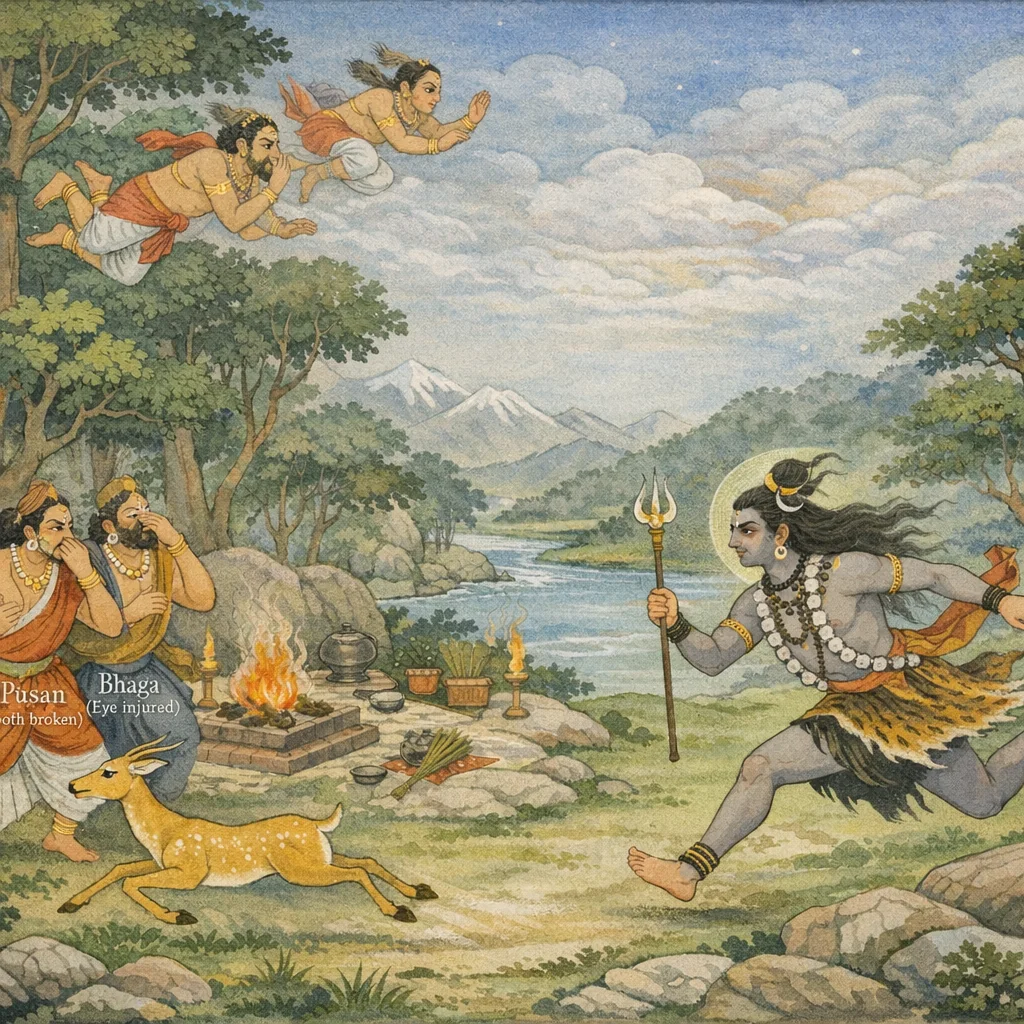
- Dakṣa-yajña disruption: Śaṅkara’s wrath routs devas; Pūṣan’s teeth are broken and Bhaga’s eyes are struck, dramatizing the collapse of sacrificial authority without proper devotion.
- Yajña’s flight and pursuit: the sacrifice personified becomes a divine mṛga (deer) and is pursued by Mahādeva wielding the Pāśupata missile—an emblem of Rudra’s supremacy over ritual forms.
- Kālarūpa and astral iconography: Pulastya details Śiva’s cosmic body as correlated with the twelve rāśis and nakṣatra-quarters, followed by concise lakṣaṇa and ‘habitat’ descriptions for each zodiac sign.
Shlokas in Adhyaya 5
Verse 1
इति श्रीवामनपुराणे चतुर्थो ऽध्यायः पुलस्त्य उवाच जटाधरं हरिर्द्दष्ट्वा क्रोधादारक्तलोचनम् तस्मात् स्थानादपाक्रम्य कुब्जाम्रे ऽन्तर्हितः स्थितः
Pulastya said: Having seen the matted-haired (Śiva), Hari, whose eyes were reddened with anger, withdrew from that place and remained hidden in the (place called) Kubjāmra.
Verse 2
वसवो ऽष्टौ हरं दृष्ट्वा सुस्रुवुर्वेगतो मुने सा तु जाता सरिच्छ्रेष्ठा सीता नाम सरस्वती
O sage, having seen Hara, the eight Vasus flowed forth swiftly; and she was born as the best of rivers—Sarasvatī, by name Sītā.
Verse 3
एकादश तथा रुद्रास्त्रिनेत्रा वृषकेतनाः कान्दिशीका लयं जग्मुः समभ्येत्यैव शङ्करम्
Likewise the eleven Rudras—three-eyed, bearing the bull as their emblem—hastened (in agitation) and, having approached Śaṅkara, entered into dissolution/mergence (in him).
Verse 4
विश्वे ऽश्विनौ चच साध्याश्च मरुतो ऽनलभास्कराः समासाद्य पुरोडाशं भक्ष्याश्च महामुने
O great sage, the Viśvedevas, the Aśvins, the Sādhyas, the Maruts, Agni, and the Sun—having assembled—partook of the sacrificial rice-cake (puroḍāśa) and other foods.
Verse 5
चन्द्रः सममृक्षगणैर्निशां समुपदर्शयन् उत्पत्यरुह्य गगनं स्वमधिष्ठानमास्थितः
The Moon, together with the host of stars (nakṣatras), revealed the night; rising up and ascending the sky, he took his own station.
Verse 6
कश्यपाद्याश्च ऋषयो जपन्तः शतरुद्रियम् पुष्पाञ्जलिपुटा भूत्वा प्रणताः संस्थिता मुने
O sage, Kaśyapa and the other seers, chanting the Śatarudrīya, stood with hands cupped in offerings of flowers, bowed in reverence.
Verse 7
असकृद् दक्षदयिता दृष्ट्वा रुद्रं बलाधिकम् शक्रादीनां सुरेशानां कृपणं विललाप ह
Again and again Dakṣa’s beloved (Satī), seeing Rudra as superior in strength, lamented piteously over the wretched state of the lordly gods beginning with Śakra (Indra).
Verse 8
ततः क्रोधाभिभूतेन शङ्करेण महात्मना तलप्रहारैरमरा बहवो विनिपातिताः
Then, overcome by anger, the great-souled Śaṅkara struck with blows of his palm, and many of the immortals (gods) were felled.
Verse 9
पादप्रहारैरमरा त्रिशुलेनापरे मुने दृष्ट्यग्निना तथैवान्ये देवाद्याः प्रलयीकृताः
By blows of his feet some gods were struck down; others, O sage, by the trident; and still others—gods and the like—were likewise reduced to dissolution by the fire of his glance.
Verse 10
ततः पूषा हरं वीक्ष्य विनिघ्नन्तं सुरासुरान् क्रोधाद् बाहू प्रसार्यथ प्रदुद्राव महेश्वरम्
Then Pūṣan, seeing Hara striking down both gods and demons, in anger stretched out his arms and rushed at Maheśvara.
Verse 11
तमापतन्तं भगवान् संनिरीक्ष्य त्रिलोचनः बाहुभ्यां प्रतिजग्राह करेणैकेन शङ्करः
Seeing him rushing in, the blessed Three-eyed Lord seized him with both arms; Śaṅkara held him fast with a single hand.
Verse 12
कराभ्यां प्रगृहीतस्य शंभुनांशुमतो ऽपि हि कराङ्गुलिभ्यो निश्चेरुरसृग्धाराः समन्ततः
Though he was radiant, when he was firmly seized by Śambhu with both hands, streams of blood issued forth on all sides from his fingers.
Verse 13
ततो वेगेन महता अंशुमन्तं दिवाकरम् भ्रामयामास सततं सिंहो मृगशिशुं यथा
Then, with great force, he kept whirling Aṃśumān, the Sun, just as a lion whirls a young deer.
Verse 14
भ्रामितस्यातिवेगेन नारदांशुमतो ऽपि हि भुजौ हस्वत्वमापन्नौ त्रुटितस्नायुबन्धनौ
O Nārada, when he was whirled with excessive speed, even Aṃśumān’s arms became shortened, with the bindings of the sinews torn.
Verse 15
रुधिराप्लुतसर्वाङ्गमंशुमन्तं महेश्वरः संनिरीभ्योत्ससर्जैनमन्यतो/भिजगाम ह
Mahēśvara, seeing Aṃśumān with all his limbs drenched in blood, released him from that condition and then approached from another direction.
Verse 16
ततस्तु पूषा विहसन् दशनानि विदर्शयन् प्रोवाचैह्येहि कापालिन् पुनः पुनरथेश्वरम्
Then Pūṣan, laughing and showing his teeth, spoke: “Come, come, O skull-bearing ascetic (Kāpālin)!”—repeatedly addressing the Lord of the chariot (Ratheśvara).
Verse 17
ततः क्रोधाभिभूतेन पूष्णे वेगेन शंभुना मुष्टिनाहत्य दशनाः पातिता धरणीतले
Then, as Pūṣan was overcome (by Śiva’s wrathful onrush), Śambhu struck with his fist; Pūṣan’s teeth were knocked down upon the surface of the earth.
Verse 18
भग्नदन्तस्तथा पूषा शोणिताभिप्लुताननः पपात भुवि निःसंज्ञो वज्राहत इवाचलः
Thus Pūṣan, his teeth broken and his face drenched in blood, fell upon the ground unconscious—like a mountain struck by a thunderbolt.
Verse 19
भगो/भिवीभ्य पूषाणं पतितं रुधिरोक्षितम् नेत्राभ्यां घोररूपाभ्यां वृषध्वजमवैक्षत
Bhaga, terrified, looked at Pūṣan lying fallen and drenched in blood, and then, with dreadful-looking eyes, fixed his gaze upon Vṛṣadhvaja (Śiva).
Verse 20
त्रिपुरघ्नस्ततः क्रुद्धस्तलेनाहत्य चक्षुषी निपातयामास भुवि क्षोभयन्सर्वदेवताः
Then Tripuraghna (Śiva), enraged, struck (them) with his palm upon their eyes and caused (them) to fall to the ground, shaking all the deities.
Verse 22
ततो दिवाकराः सर्वे पुरस्कृत्य शतक्रतुम् मरुद्भिश्च हुताशैश्च भयाज्जग्मुर्दिशो दश / 5.21 प्रतियातेषु देवेषु प्रह्लादाद्या दितीस्वराः नमस्कृत्य ततः सर्वे तस्थुः प्राञ्जलयो मुने
Then all the solar deities, placing Śatakratu (Indra) at their head, together with the Maruts and Agni, fled in fear to the ten directions. When the gods had thus withdrawn, Prahlāda and the other lords born of Diti, having bowed, all stood there with joined palms, O sage.
Verse 23
ततस्तं यज्ञवाटं तु शङ्करो घोरचक्षुषा ददर्श दग्धुं कोपेन सर्वांश्चैव सुरामुरान्
Then Śaṅkara, with terrible eyes, looked upon that sacrificial enclosure, intending in anger to burn it—and all the Devas and Asuras as well.
Verse 24
ततो निलिल्यिरे वीराः प्रणेमुर्दुद्रुस्तथा भयादन्ये हरं दृष्ट्वा गता वैवस्वतक्षयम्
Then the warriors hid themselves; some bowed down, and others fled in fear. Seeing Hara, some went to the abode of Vaivasvata (Yama)—that is, they met death.
Verse 25
त्रयो ऽग्नयस्त्रिभिर्नेर्दुःसहं समवैक्षत दृष्टमात्रास्त्रिनेत्रेण भस्मीभूताभवन् क्षणात्
Three fires, unbearable, were directed (by him) through the three (eyes). Merely upon being seen by the three-eyed one, they became ash in an instant.
Verse 26
अग्नौ प्रणष्टे यज्ञो ऽपि भूत्वा दिव्यवपुर्मृगः दुद्राव विक्लवगतिर्दक्षिणासहितो ऽम्बरे
When the sacrificial fire was destroyed, the Yajña (the sacrifice) itself, taking the form of a deer with a divine body, fled in panic through the sky, accompanied by the sacrificial fees (dakṣiṇā).
Verse 27
तमेवानुससारेशश्चापमानम्य वेगवान् शरं पाशुपतं कृत्वा कालरूपी महेश्वरः
The Lord (Īśa), swift in speed, pursued him alone; bending his bow, Maheśvara—assuming the form of Time (Kāla)—made (readied) a Pāśupata arrow.
Verse 28
अर्द्धेन यज्ञवाटान्ते जटाधर इति श्रुतः अर्द्धेन गगने शर्वः कालरूपी च कथ्यते
With one half (of his presence) at the edge of the sacrificial enclosure, he was known as ‘Jaṭādhara’ (the matted-haired one); with the other half in the sky, Śarva is spoken of as being in the form of Time (Kālarūpa).
Verse 29
नारद उवाच कालरूपी त्वयाख्यातः शंभुर्गगनगोचरः लक्षणं च स्वरूपं च सर्वं व्याख्यातुमर्हसि
Nārada said: You have described Śambhu as having the form of Time and as moving in the sky. You should explain completely both his characteristics and his essential form.
Verse 30
पुलस्त्य उवाच स्वरूपं त्रिपुरघ्नस्य वदिष्ये कालपूपिणः येनाम्बरं मुनिश्रेष्ठ व्याप्तं लोकहितेप्सुना
Pulastya said: I shall tell (you) the essential form of Tripuraghna, the one embodied as Time—by whom, O best of sages, the firmament is pervaded, as he seeks the welfare of the worlds.
Verse 31
यत्राश्विनी च भरणी कुत्तिकायास्तथांशकः मेषो राशिः कुजक्षेत्रं तच्छिरः कालरूपिणः
Where (are situated) Aśvinī and Bharaṇī, and likewise a portion of Kṛttikā—(that region is) the sign Meṣa (Aries), the domain of Kuja (Mars); that is the head of the Time-formed (deity).
Verse 32
आग्नेयाशास्त्रयो ब्रह्मन् प्राजापत्यं कवेर्गृहम् सौम्यार्द्ध वृषनामेदं वदनं परिकीर्तितम्
O Brāhmaṇa, the (nakṣatras) Aśvinī and Bharaṇī are said to be the house of Agni; Kṛttikā is the house of Prajāpati; and the first half of Vṛṣabha (Taurus) is proclaimed to be the face (of Śiva).
Verse 33
मृगार्द्धमार्द्रादित्यांशास्त्रयः सौम्यगृहं त्विदम् मिथुनं भुजयोस्तदस्य गगनस्थस्य शूलिनः
The latter half of Mṛgaśīrṣa, Ārdrā, and the three Āditya-portions (i.e., the three nakṣatras of the Āditya group) constitute this lunar (Saumya) house. Mithuna (Gemini) is (assigned) to the arms of that trident-bearing Lord who abides in the sky.
Verse 35
आदित्यांशश्च पुष्यं च आश्लेषा शशिनो गृहम् राशिः कर्कटको नाम पार्श्वे मखविनाशिनः/थ 5.34 पित्र्यर्क्षं भगदैवत्यमुत्तरांश् च केसरी सूर्यक्षेत्रं विभोर्ब्रह्मन् हृदयं परिगीयते
The Āditya portion, Puṣya, and Āśleṣā are the house of the Moon. The zodiac sign named Karkaṭaka (Cancer) is on the side of the destroyer of (Dakṣa’s) sacrifice. The Pitṛ-nakṣatra, whose deity is Bhaga, and the Uttarā (nakṣatra group) are (also assigned); O brāhmaṇa, the Sun’s region is sung as the heart of that Lord.
Verse 36
उत्तरांशास्त्रयः पाणिश्चित्रार्धं कन्यका त्वियम् सोमपुत्रस्य सद्मैतद् द्वितीयं जठरं विभोः
The three northern portions are the Hand; and half of Citrā is this Virgo. This is the abode of Soma’s son (Budha/Mercury); it is also said to be the second belly (region) of the Cosmic Lord.
Verse 37
चित्रांशद्वितयं स्वातिर्विशाखायांशकत्रयम् द्वितीयं सुक्रसदनं तुला नाभिरुदाहृता
Two portions of Citrā, (then) Svātī, and three portions of Viśākhā—this constitutes Tulā (Libra). It is (also) declared the second abode of Śukra (Venus), and Tulā is said to correspond to the navel.
Verse 38
विशाखांशमनूराधा ज्येष्ठा भौमगृहं त्विदम् द्वितीयं वृश्चिको राशिर्मेढ्रं कालसवरूपिणः
(With) a portion of Viśākhā, (then) Anurādhā and Jyeṣṭhā—this is the house of Bhauma (Maṅgala/Mars). Scorpio (Vṛścika) is the second (such division) among the rāśis, and it is said to correspond to the generative organ of the Lord whose form is Time.
Verse 39
मूलं पूर्वोत्तरांशश्च देवाचजार्यगृहं धनुः ऊरुयुगलमीशस्य अमरर्षे प्रगीयते
O divine sage, Mūla, the preceding and following portions, Devācajārya’s abode, and Dhanuḥ (Sagittarius) are proclaimed as the pair of thighs of the Lord.
Verse 40
उत्तरांशास्त्रयो ऋक्षं श्रवणं मकरो मुने धनिष्ठार्धं शतभिषा जानुनी परमेष्ठिनः
O sage, the three northern portions—(together with) Śravaṇa and Makara (Capricorn)—and the latter half of Dhaniṣṭhā along with Śatabhiṣā are the two knees of the Supreme Lord.
Verse 41
धनिष्ठार्धं शतभिषा प्रौष्ठपद्यांशकत्रयम् सौरेः सद्मापरमिदं कुम्भो जङ्घे च विश्रते
The latter half of Dhaniṣṭhā, Śatabhiṣā, and the three portions of Prauṣṭhapadā (Bhādrapadā) are this further abode of Saura; and Kumbha (Aquarius) is established as the two shanks (lower legs).
Verse 42
प्रोष्ठपद्यांशमेकं तु उत्तरा रेवती तथा द्वितीयं जीवसदनं मीनस्तु चरणावुभौ
One portion (pāda) belongs to Proṣṭhapadā; likewise (one) to Uttarā and to Revatī. The second (division) is the abode of Jupiter; and Mīna (Pisces) consists of both the pādas.
Verse 43
एवं कृत्वा कालरूपं त्रिनेत्रो यज्ञं क्रोधान्मार्गराजघान विद्धश्चासौ वेदनाबुद्धिमुक्तः खे संतस्थौ तारकाभिश्चिताङ्गः
Having thus assumed a form of Time (kālarūpa), the three-eyed one, in anger, struck down Yajña—(he who is) the slayer of Mārgarāja. Pierced, and freed from pain and ordinary awareness, he remained stationed in the sky, his body marked/arrayed with stars.
Verse 44
नारद उवाच राशयो गदिता ब्रह्मंस्त्वया द्वादश वै मम तेषां विशेषतो ब्रूहि लक्षणानि स्वरूपतः
Nārada said: ‘O Brahman (revered one), you have told me of the twelve rāśis. Now explain to me, in particular, their defining characteristics, according to their true forms.’
Verse 45
पुलस्त्य उवाच स्वरूपं तव वक्ष्यामि राशीनां शृणु नारद यादृशा यत्र संचारा यस्मिन् स्थाने वसन्ति च
Pulastya said: “I shall tell you the nature of the zodiacal signs; listen, Nārada—what they are like, where their movements occur, and in what places they reside.”
Verse 46
मेषः समानमूर्तिश्च अजाविकधनादिषु संचारस्थानमेवास्य धान्यरत्नाकरादिषु
“Meṣa (Aries) has a form akin to (a ram), and is connected with goats, sheep, wealth and the like. Its sphere of movement is indeed among grains, jewels, mines/treasuries and the like.”
Verse 47
नवशादूलसंछन्नवसुधायां च सर्वशः नित्यं चरति फुल्लेषु सरसां पुलिनेषु च
“On earth covered everywhere with fresh shoots/young grass, it moves constantly—among blooming (places/flowers) and upon the sandbanks/shores of lakes.”
Verse 48
वृषः सदृशरूपो हि चरते गोकुलादिषु तस्याधिवासभूमित्तु कुषीवलधराश्रयः
‘Vṛṣa (the Bull)’ indeed moves about in places such as cowherd-settlements (gokulas), having a form similar to a bull. The ground that is his dwelling is said to be the refuge/support of the ploughman (the cultivator).
Verse 49
स्त्रीपुंसयोः समं रूपं शय्यासनपरिग्रहः वीणावाद्यधृङ् मिथुनं गीतनर्तकशिल्पिषु
In Mithuna (the Twins), the form of woman and man is equal; (they are) possessors of bed and seat (domestic furnishings). Mithuna is depicted as bearing the vīṇā and other instruments, among singers, dancers, and artisans.
Verse 50
स्थितः क्रीडारतिर्नित्यं विहारावनिरस्य तु मिथुनं नाम विख्यातं राशिर्द्वेधात्मकः स्थितः
He/it remains ever devoted to play and delight, inclined to recreation and enjoyment. The sign renowned as ‘Mithuna’ is established as a rāśi of twofold nature (dual in essence).
Verse 51
कर्किः कुलीरेण समः सलिलस्थः प्रकीर्तितः केदारवापीपुलिने विविक्तावनिरेव च
The karki is described as being like a crab, living in the water; and it is also (found) on the bank of the Kedāra-pond, in a solitary tract of land as well.
Verse 52
सिहस्तु पर्वतारण्यदुर्गकन्दरभूमिषु वसते व्याधपल्लीषु गह्वरेषु गुहासु च
But the lion dwells in mountain-forests, in difficult strongholds and ravines; it lives in hunters’ hamlets, in deep hollows and in caves as well.
Verse 53
व्रीहिप्रदीपिककरा मनावारूढा च कन्यका चरते स्त्रीरतिस्थाने वसते नड्वलेषु च
A maiden—holding a rice-lamp in her hand and mounted upon (something called) manā—moves about; she dwells in places of women’s erotic sport, and also in reed-beds.
Verse 54
तुलापाणिश्च पुरुषो वीथ्यापणविचारकः नगराध्वानशालासु वसते तत्र नारद
A man becomes one who carries a weighing-scale in his hand—an inspector/handler of the street and market. He dwells in towns, on highways, and in roadside lodging-houses; thus it is, O Nārada.
Verse 55
श्वभ्रवल्मीकसंचारी वृश्चिको वृश्चिकाकृतिः विषगोमयकीटादिपाषाणादिषु संस्थितः
He becomes a scorpion, scorpion-shaped, moving about in pits and anthills, and settled among poison, dung, insects and the like, and among stones and such places.
Verse 56
धनुस्तु रङ्गजघनो दीप्यमानो धनुर्धरः वाजिशूरास्त्रविद्वीरः स्थायी गजरथादिषु
He becomes an archer, blazing in appearance, bearing a bow—heroic, skilled in weapons, a brave fighter on steeds—stationed among elephants, chariots, and the like (i.e., in the martial ranks).
Verse 57
मृगास्यो मकरो ब्रह्मन् वृषस्कन्धेक्षणाङ्गजः मकरो ऽसौ नदीचारी वसते च महोदधौ
O Brāhmaṇa, the makara has the face of a deer and is born with the shoulders and eyes of a bull. That makara moves in rivers, and it also dwells in the great ocean.
Verse 58
रिक्तमुम्भश्च पुरुषः स्कन्धधारी जलाप्लुतः द्यूतशालाचरः कुम्भः स्थायी शौण्डिकसद्मसु
A man with an empty water-pot, carrying it on his shoulder and drenched with water—this ‘kumbha’ frequents gambling-halls and stays in the houses of liquor-sellers/drunkards.
Verse 59
मीनद्वयमथासक्तं मीनस्तीर्थाब्धिसंचरः वसते पुण्यदेशेषु देवब्राह्नणसद्मसु
Then the pair of fishes, attached together—the fish that moves through tīrthas and the ocean—dwells in holy regions, in the homes of gods and Brāhmaṇas.
Verse 60
लक्षणा गदितास्तुभ्यं मेषादीनां महामुने न कस्यचित् त्वयाख्येयं गुह्यमेतत्पुरातनम्
O great sage, the characteristics of Aries and the other (signs) have been told to you. This ancient secret should not be disclosed by you to just anyone.
Verse 61
एतन् मया ते कथितं सुरर्षे यथा त्रिनेत्रः प्रमाथ यज्ञम् पुण्यं पुराणं परमं पवित्रमाख्यातवान्पापहरं शिवं च
O best of sages among the gods, I have told you this—how the three-eyed one (Śiva) disrupted the sacrifice, and how he also proclaimed the meritorious Purāṇa, supremely purifying and sin-destroying.
Frequently Asked Questions
The narrative preserves a syncretic theology by allowing Hari (Viṣṇu) to withdraw rather than rival Śiva’s Rudra-tejas, while presenting Śiva as the regulator of yajña and kāla (time). The chapter thus frames cosmic order as requiring both devotional legitimacy (Śiva’s consent) and divine governance, avoiding a sectarian contest and instead emphasizing complementary divine functions within the Purāṇic cosmos.
A key topographical marker is the naming of the Sarasvatī as “Sītā,” arising in connection with the devas’ movement and fear during the upheaval. While the chapter is not a full tīrtha-māhātmya catalogue, it sacralizes the Sarasvatī basin by embedding the river’s mythic emergence within a major theogonic event, and it also references the yajñavāṭa as a sanctified (and contested) ritual landscape.
This Adhyāya does not advance the Bali–Vāmana cycle directly. Instead, it develops a parallel Purāṇic theme—ritual authority, asura-dharma, and cosmic sovereignty—through the Dakṣa-yajña episode and the astral mapping of Śiva’s Kālarūpa, which later supports broader Purāṇic discussions of divine order and dharma.