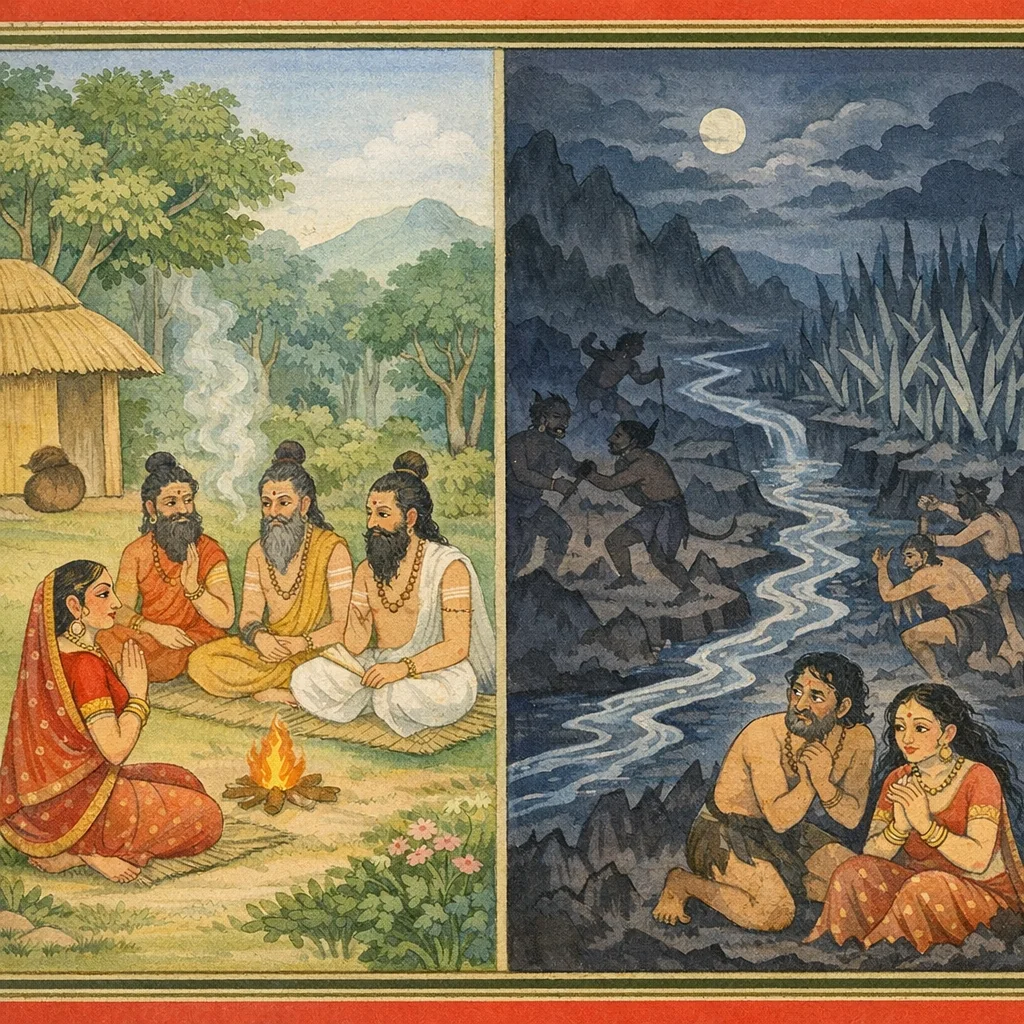
Adhyaya 12: Karmic Causes of Narakas and the Irremediability of Ingratitude (Kṛtaghna-doṣa)
नरक-प्रकरणम् (Naraka-prakaraṇam) / कृतघ्न-दोष-निरूपणम् (Kṛtaghna-doṣa-nirūpaṇam)
Ingratitude and Irremediable Sin
Within the overarching Pulastya–Nārada narrative frame that structures the Vāmana Purāṇa’s didactic sections, this adhyāya presents a catalogic exposition of karmic causality (karma-phala) through the mapping of specific transgressions to specific narakas (hell-realms) and punishments administered by Yama’s attendants. The discourse begins as Sukeśi inquires how beings reach these infernal states, and the ṛṣis respond with a graded taxonomy of sins: blasphemy of Veda and dvijas, disruption of social and ritual order (śrāddha, atithi-dharma), betrayal of trust (nyāsa-apahāra), sexual and familial violations, and sacrilege toward cows, fire, and sacred institutions. The chapter culminates in a syncretic theological register typical of the Vāmana Purāṇa: a litany of ‘pravaras’ (excellences) across cosmic categories, followed by a sharp ethical thesis—while expiations may exist for even grave sins (e.g., brahmahatyā), there is no true niṣkṛti for the kṛtaghna (ingrate) who destroys a benefactor’s good. The result is a moral-ritual geography of afterlife that reinforces dharma through vivid iconographic punishments rather than pilgrimage topography.
Divine Beings
Sacred Geography
Mortal & Asura Figures
Key Content Points
- A dialogic prompt (Sukeśi → ṛṣis) frames a karma-based explanation of how beings ‘go to’ particular narakas, emphasizing deterministic moral causality (svakarma-phala-bhoga).
- A detailed sin-to-punishment catalogue: ritual violations (śrāddha/daiva meals), disrespect to parents/teachers, slander of sādhus and Veda, theft of deposits (nyāsa), sacrilege toward cow/fire/sun-moon, and social betrayal (creating divisions among kin and ritual relations).
- Doctrinal climax: a comparative ‘pravarā’ hymn-like sequence leading to the assertion that expiation is unavailable for kṛtaghna-doṣa (ingratitude), marking an ethical absolute within the purāṇic jurisprudence of sin.
Shlokas in Adhyaya 12
Verse 1
इति श्रीवामनपुराणे एकादशो ऽध्यायः सुकेशिरुवाच कर्मणा नरकानेतान् केन गच्छन्ति वै कथम् एतद् वदन्तु विप्रेन्द्राः परं कौतूहलं मम
“Thus (ends) the eleventh chapter in the Śrī Vāmana Purāṇa. Sukeśī said: ‘By what action do people go to these hells, and how? Tell me this, O best of Brahmins; great indeed is my curiosity.’”
Verse 2
ऋषय ऊचुः कर्मणा येन येनेह यान्ति शालकटङ्कट स्वकर्मफलभोगार्थं नरकान् मे शृणुष्व तान्
“The sages said: ‘By whatever actions (people) go here (to those states), O Śālakaṭaṅkaṭa, listen from me about those hells—(entered) for the sake of experiencing the fruits of one’s own deeds.’”
Verse 3
वेदवेवद्विजातीनां यैर्निन्दा सततं कृता ये पुराणेतिहासार्थान् नाभिनन्दन्ति पापिनः
Sinful people who constantly indulge in censure of the Veda and of the twice-born (dvijas), and who do not approve of (or take delight in) the teachings/meaning of the Purāṇas and Itihāsas (epics), incur demerit.
Verse 5
कुरुनिन्दाकरा ये च सखविघ्नकराश्च ये दातुर्निवारकाये च तेषु ते निपतन्ति हि / 12.4 सुहृद्दम्पतिसोदर्यस्वामिभृत्यपितासुतान् याज्योपाध्याययोर्यैश्च कृतो भेदो ऽधमैर्मिथः
Those who engage in reviling the Kurus, those who create obstacles among friends, and those who prevent a donor from giving—upon them (the consequences/punishments) surely fall. Likewise, base people who foment mutual division between well-wishers, husband and wife, siblings, master and servant, father and son, and between the sacrificer (patron) and the officiating priest/teacher—upon them too the consequences surely descend.
Verse 6
कन्यामेकस्य दत्त्वा च ददत्यन्यस्य ये ऽधमाः करपत्रेण पाट्यन्ते ते द्विधा यमकिङ्करैः
Those base persons who, having given a maiden to one man, then give her to another—are torn in two with a hand-knife (or blade) by Yama’s attendants.
Verse 7
परोपतापजनकाश्चन्दनोशीरहारिणः बालव्यजनहर्त्तारः करम्भसिकताश्रिताः
They become agents that cause affliction to others—(like) those who steal sandalwood and uśīra (fragrant roots), those who take away children’s fans, and those who resort to (mixing) sand into karambha (a food preparation).
Verse 8
निमन्त्रितो ऽन्यतो भुङ्क्ते श्राद्धे दैवे सपैतृके स द्विधा कृष्यते मूढस्तीक्ष्णतुण्डैः खगोत्तमैः
If, having been invited, a person eats elsewhere during a śrāddha—whether in a rite for the gods (daiva) or together with the ancestors (sa-paitṛka)—that deluded man is dragged in two directions by excellent birds with sharp beaks.
Verse 9
मर्माणि यस्तु साधूनां तुदन् वाग्भिर्निकृन्तति तस्योपरि तुदन्तस्तु तुण्डैस्तिष्ठन्ति पत्त्रिणः
Whoever pierces the vital points of the virtuous with words—cutting them down by speech—upon him birds stand above and peck (at him) with their beaks.
Verse 10
यः करोति च पैशुन्यं साधूनामन्यथामतिः वज्रतुण्डनखा जिह्वामाकर्षन्ते ऽस्य वायसाः
Whoever commits slander against the virtuous, harboring a perverse (misguided) attitude toward them—crows with thunderbolt-like beaks and claws tear and drag out his tongue.
Verse 11
मातापितृगुरूणां च ये ऽवज्ञां चक्रुरुद्धताः मज्जन्ते पूयविम्मूत्रे त्प्रतिष्ठे ह्यधोसुखाः
Those arrogant ones who show contempt toward mother, father, and teacher sink in pus and excrement, in (a hell called) Tpratiṣṭha, experiencing only base/low pleasures.
Verse 12
देवतातिथिभूतेषु भृत्येष्वभ्यागतेषु च अभुक्तवत्सु ये ऽश्नन्ति बालपित्रग्निमातृषु
Those who eat while the deities, guests, beings (creatures), servants, and arrivals have not been fed—(and likewise) when children, father, sacred fire, and mother remain unfed—(commit a grave fault).
Verse 13
दुष्टचासृक्पूयनिर्यासं भुञ्जते त्वधमा इमे सूचीमुखाश्च जायन्ते क्षुधार्त्ता गिरिविग्रहाः
These vile ones eat foul mixtures of blood, pus, and oozing discharge. They are born with needle-like mouths, tormented by hunger, having bodies like mountains.
Verse 14
एकपङ्क्त्युपविष्टानां विषमं भोजयन्ति ये विड्भोजनं राक्षसेन्द्र नरकं ते व्रजन्ति च
O lord of the Rākṣasas, those who, when people are seated in a single line, feed them unequally—those persons go to the hell called Viḍbhojana as well.
Verse 15
एकसार्थप्रयातं ये पश्यन्तश्चार्थिनं नराः असंविभज्य भुञ्जन्ति ते यान्ति श्लेष्मभोजनम्
Those men who, while traveling in the same caravan, see a needy person and yet eat without sharing—those go to the (hell) called Śleṣmabhojana (mucus-eating).
Verse 16
गोब्राह्णणाग्नयः स्पृष्टा यैरुच्छिष्टैः क्षपाचर क्षिप्यन्ते हि करास्तेषां तप्तसुम्भे सुदारुणे
O night-roamer (kṣapācara), those by whose leftover-impurity (ucchiṣṭa) cows, brahmins, or the sacred fire are touched—indeed the hands of such people are cast into a very dreadful heated cauldron.
Verse 17
सूर्येन्दुतारका दृष्टा यैरुच्छिष्टैश्च कामतः तेषां नेत्रगतो वह्निर्धम्यते यमकिङ्करैः
Those who, while in a state of leftover-impurity (ucchiṣṭa), deliberately (out of desire) gaze at the sun, moon, and stars—into their eyes fire enters, and it is blown (fanned) by Yama’s attendants.
Verse 18
मित्रजायाथ जननी ज्येष्ठो भ्राता पिता स्वसा जामयो गुरवो वृद्धा यैः संस्पृष्टाः पदा नृभिः
Those men by whose feet (padā) are touched (i.e., stepped on/pressed against) a friend’s wife, one’s mother, an elder brother, father, sister, sisters-in-law, teachers, and the aged—(are implicated in a grave impropriety).
Verse 19
बद्धाङ्घ्रयस्ते विगडैर्लोहैर्वाह्निप्रतापितैः क्षिप्यन्ते रौरवे घोरे ह्याजानुपरिदाहिनः
Their feet are bound with iron fetters heated in fire; they are hurled into the dreadful Raurava (hell), where they are scorched all around up to the knees.
Verse 20
पायसं कृशरं मांसं वृथा भुक्तानि यैर्नरैः तेषामयोगुडास्तप्ताः क्षिप्यन्ते वदने ऽद्भुताः
Those men by whom rice-pudding, kṛśara (a mixed dish), and meat were eaten in vain (wastefully/without proper purpose), for them—wondrously—heated balls of iron are hurled into the mouth.
Verse 21
गुरुदेवद्विजातीनां वेदानां च नराधमैः निन्दा निशामिता यैस्तु पापानामिति कुर्वताम्
But those vile men who engage in the reviling of gurus, deities, the twice-born, and the Vedas—who listen to (and participate in) such slander as though it were the affair of sinners—(are thereby implicated).
Verse 22
तेषां लोहमयाः कीला वह्निवर्णाः पुनः पुनः श्रवणेषु निखन्यन्ते धर्मराजस्य किङ्करैः
For them, iron spikes, the color of fire, are again and again driven into their ears by the servants of Dharmarāja (Yama).
Verse 23
प्रपादेवकुलालामान् विप्रवेश्मसभामठान् कूपवापीतडागांश्च भङ्क्त्वा विध्वंसयन्ति ये
Those who, having broken, destroy drinking-water rest-houses, temples, charitable almshouses, Brahmins’ dwellings, assembly-halls and monasteries, and also wells, step-wells/ponds, and tanks—(such people incur the punishments described).
Verse 24
तेषां विलपतां चर्म देहतः क्रियते पृथक् कर्त्तिकाभिः सुतीक्ष्णीभिः सुरौद्रैर्यमकिङ्करैः
While they wail, their skin is separated from the body, made distinct (flayed), by Yama’s attendants—terribly fierce—using very sharp knives.
Verse 25
गोब्राह्मणार्कमग्निं च ये वै मेहन्ति मानवाः तेषां गुदेव चान्त्राणि विनिःकृन्तन्ति वायसाः
Those humans who urinate upon cows, Brahmins, the sun, and fire—crows tear out their anus and intestines (as punishment).
Verse 26
स्वपोषणपरो यस्तु परित्यजति मानवः पुत्रभृत्यकलत्रादिबन्धुवर्गमकिञ्चनम् दुर्भिक्षे संभ्रमे चापि स श्वभोज्ये निपात्यते
A person who, intent only on his own maintenance, abandons his impoverished circle of dependents—sons, servants, wife, and other relatives—especially in times of famine and panic, is cast down into (a hell/state called) ‘dog’s food’ (i.e., fit to be eaten by dogs / reduced to canine fare).
Verse 27
शरणागतं ये त्यजन्ति ये च बन्धनपालकाः पतन्ति यन्त्रपीडे ते ताड्य मानास्तु किङ्करैः
Those who abandon a person who has sought refuge, and those who act as custodians of confinement (i.e., jailers/keepers) in a cruel manner—fall into torment by instruments (mechanical tortures), being beaten by attendants.
Verse 28
क्लेशयन्ति हि विप्रादीन् ये ह्यकर्मसु पापिनः ते पिष्यन्ते शिलापेषे शोष्यनते ऽपि च शोषकैः
Indeed, those sinners who afflict Brahmins and others, and who engage in wrongful/forbidden conduct, are ground in a stone-press; they are also dried up by “dryers” (tormentors).
Verse 29
न्यासापहारिणः पापा बध्यन्ते निगडैरपि श्रुत्क्षामाः शुष्कताल्वोष्ठाः पात्यन्ते वृश्चिकाशने
Sinful people who steal (or misappropriate) entrusted deposits are bound even with fetters; wasted by hunger, with parched palates and lips, they are thrown into the ‘scorpion-eating’ (torment) [hell].
Verse 30
पर्वमैथुनिनः पापाः परदाररताश्च ये ते वह्नितप्तां कूटाग्रामालिङ्गन्ते च शाल्मलीम्
Sinful people who engage in intercourse on prohibited festival/sacred days (parva), and those who delight in another’s wife, embrace the Śālmalī tree whose thorns/spikes are heated by fire.
Verse 31
उपाध्यायमधःकृत्य यैरधीतं द्विजाधमैः तेषामध्यापको यश्च स शिलां शिरसा वहेत्
Those lowest of the twice-born who study (the Veda/śāstra) after humiliating their teacher— and the instructor who teaches them—he must bear a stone upon his head.
Verse 32
मूत्रश्लेष्मपुरीषाणि यैरुत्सृष्टानि वारिणि ते पात्यन्ते च विण्मूत्रे दुर्गन्धे पूयपूरिते
Those by whom urine, phlegm, and feces are discharged into water— they are made to fall into excrement and urine, foul-smelling and filled with pus.
Verse 33
श्राद्धातिथेयमन्योन्यं यैर्भुक्तं भुवि मानवैः परस्परं भक्षयन्ते मांसानि स्वानि बालिशाः
Those foolish people on earth who consume one another’s śrāddha-offerings and guest-offerings— they eat each other’s flesh in return.
Verse 34
वेदवह्निगुरुत्यागी भार्यापित्रोस्तथैव च/ गिरिशृड्गादधःपातं पात्यन्ते यमकिङ्करैः
One who abandons the Veda, the sacred fire, and the guru—and likewise (one who abandons) wife and parents—is made to fall down from a mountain peak, cast downward by Yama’s attendants.
Verse 35
पुनर्भूपतयो ये च कन्याविध्वंसकाश्च ये तद्गर्भश्राद्धभुग् यश्च कृमीन्भक्षेत्पिपीलिकाः
Those who take a woman again (as ‘punarbhū’), those who violate maidens, and one who consumes the śrāddha (offering/meal) connected with her pregnancy—(such a person) becomes one who eats worms and ants.
Verse 36
चाण्डालादन्त्यजाद्वापि प्रतिगृह्णाति दक्षिणाम् याजको यजमानश्च सो ऽस्मान्तः स्थूलकीटकः
If a priest accepts a dakṣiṇā from a Cāṇḍāla or another outcaste, then both—the officiating priest and the sacrificer—become, after death, large worms/insects.
Verse 37
पृष्ठमांसाशिनो मूढास्तथैवोत्कोचजीविनः क्षिप्यन्ते वृकभक्षे ते नरके रजनीचर
O night-ranger, the deluded who eat the flesh of the back, and likewise those who live by bribes, are cast into the hell called Vṛkabhakṣa.
Verse 38
स्वर्णस्तेयी च ब्रह्मघ्नः सुरापो गुरुलल्पगः तथा गोभूमिहर्त्तरो गोस्त्रीबालहनाश्च ये
The stealer of gold, the slayer of a brāhmaṇa, the drinker of liquor, the violator of the guru’s bed, likewise those who steal cows or land, and those who kill cows, women, or children—(all such sinners are condemned to hells, as the context continues).
Verse 39
एत नरा द्विजा ये च गोषु विक्रयिणस्तथा सोमविक्रयिणो ये च वेदविक्रयिणस्तथा
And those men—brāhmaṇas as well—who sell cows; those who sell Soma; and those who sell the Veda likewise (are condemned, as the context continues).
Verse 40
कूटसभ्यास्त्वशौचाश्च नित्यनैमित्तनाशकाः कूटसाक्ष्यप्रदा ये च ते महारौरवे स्थिताः
Those who are members of a corrupt assembly, who are impure, who destroy (or obstruct) daily and occasional rites, and those who give false testimony—such people dwell in the great hell called Mahāraurava.
Verse 41
दशवर्ष सहस्राणि तावत् तामिस्रके स्थिताः तावच्चैवान्धतामिस्रे असिपत्रवने ततः
For ten thousand years they remain in Tāmisra; for the same duration in Andhatāmisra; and thereafter (they go) to the forest of sword-leaves, Asipatravana.
Verse 42
तावच्चैव घटीयन्त्रे तप्तकुम्भे ततः परम् प्रपातो भवते तेषां यैरिदं दुष्कृतं कृतम्
For the same duration (they suffer) in the Ghaṭī-yantra and in the heated cauldron (Tapta-kumbha). After that, a downfall/precipice (prapāta) befalls those by whom this evil deed has been done.
Verse 43
ये त्वेते नरका रौद्रा रौरवाद्यास्तवोदिताः ते सर्वे क्रमशः प्रोक्ताः कृतघ्ने लोकनिन्दिते
“Those dreadful hells—Raudra, Raurava, and the others—spoken by you: all of them have been declared in due order for the ungrateful person and for one condemned by the world (for blameworthy conduct).”
Verse 44
यथा सुराणां प्रवरो जनार्दनो यथा गिरीणामपि शैशिराद्रिः यथायुधानां प्रवरं सुदर्शनं यथा खगानां विनतातनूजः महोरगाणां प्रवरो ऽप्यनन्तो यथा च भूतेषु मही प्रधाना
“Just as among the gods Janārdana is the foremost; just as among mountains the Śaiśira mountain is foremost; just as among weapons the Sudarśana (discus) is foremost; just as among birds the son of Vinatā (Garuḍa) is foremost; just as among great serpents Ananta is foremost; and just as among beings the Earth is principal—(so is the praised object understood as supreme in its class).”
Verse 46
नदीषु गङ्गा जलजेषु पद्मं सुरारिमुख्येषु हराङ्घ्रिभक्तः क्षेत्रेषु यद्वत्कुरुजङ्गलं वरं तीर्थेषु यद्वत् प्रवरं पृथूदकम् // वम्प्_12.45 सरस्सु चैवोत्तरमानसं यथा वनेषु पुण्येषु हि नन्दनं यथा लोकेषु यद्वत्सदनं विरिञ्चेः सत्यं यथा धर्मविधिक्रियासु
“As the Gaṅgā is foremost among rivers; the lotus among water-born things; the devotee of Hara’s feet among the foremost (leaders) of the enemies of the gods; as Kurujāṅgala is excellent among sacred regions; as Pṛthūdaka is foremost among tīrthas; as Uttaramānasa is foremost among lakes; as Nandana is foremost among holy forests; as the abode of Viriñci (Brahmā) is foremost among worlds; and as Truth is foremost in rites performed according to dharma—(so is the praised object understood as preeminent).”
Verse 47
यथाश्वमेधः प्रवरः क्रतूनां पुत्रो यथा स्पर्शवतां वरिष्ठः तपोधनानामपि सुम्भयोनिः श्रुतिर्वरा यद्वदिहागमेषु
Just as the Aśvamedha is the foremost among sacrifices, and a son is the best among those who are ‘tangible’ (objects of touch); just as (a great sage) born in the Sumbha-line is pre-eminent even among the wealthy in austerity—so too, among the Āgamas, Śruti is the most excellent.
Verse 48
मुख्यः पुराणेषु यथैव मात्स्यः स्वायंभुवोक्तिस्त्वपि संहितासु मनुः स्मृतीनां प्रवरो यथैव तिथीषु दर्शा विषुवेषु दानम्
Just as the Mātsya (Purāṇa) is chief among the Purāṇas, and the teaching spoken by Svāyambhuva (Brahmā) is foremost among the Saṃhitās; just as Manu is the best among the Smṛtis—so too, among lunar days the Darśā (new-moon day) is foremost, and among the equinox/solstice points (viṣuvas) giving (dāna) is pre-eminent.
Verse 49
तेजस्विनां यद्वदिहार्क उक्तो ऋक्षेषु चन्द्रो जलधिर्ह्वदेषु भवान् यथा राक्षससत्तमेषु पाशेषु नागस्तिमितेषु बन्धः
Just as among the radiant ones the Sun is declared supreme here; among the constellations the Moon; among lakes the ocean; just as you are (supreme) among the best of Rākṣasas; among snares the Nāga (serpent) (is foremost), and among the motionless/immobile (things) bondage (is predominant).
Verse 50
धान्येषु शलिर्द्विपदेषु विप्रः चतुष्पदे गौः श्वपदां मृगेन्द्रः पुष्पेषु जाती नगरेषु काञ्ची नारीषु रम्भा श्रमीणां गृहस्थः
Among grains, rice is best; among two-footed beings, the brāhmaṇa; among four-footed animals, the cow; among wild beasts, the lion. Among flowers, jasmine; among cities, Kāñcī; among women, Rambhā; and among the āśramas (stages of life), the householder is foremost.
Verse 51
कुशस्थली श्रेष्ठतमा पुरेषु देशेषु सर्वेषु च मध्यदेशः फलेषु चूतो मुकुलेष्वशोकः सर्वौषधीनां प्रवरा च पथ्या
Kuśasthalī is the best among cities; among all regions, the Madhyadeśa is best. Among fruits, the mango is best; among buds, the aśoka is best; and among all medicines, pathyā (harītakī) is foremost.
Verse 52
मूलेषु कन्दः प्रवरो यथोक्तो व्याधिष्वजीर्णं क्षणदाचरेन्द्र श्वेतेषु दुग्धं प्रवरं यथैव कार्पासिकं प्रावरणेषु यद्वत्
Among roots, the kanda (tuber) is said to be best. Among ailments, indigestion is foremost (i.e., the chief/root trouble). O lord of the night-wanderers (rākṣasas), among white things milk is best; and among coverings/garments, cotton cloth is best.
Verse 53
कलासु मुख्या गणितज्ञता च विज्ञानमुख्येषु यथेन्द्रजालम् शाकेषु मुख्या त्वपि काकमाची रसेषु मुख्यं लवणं यथैव
“Among the arts, skill in mathematics is foremost; among the foremost branches of knowledge, (there is) indrajāla (the science of marvels/illusion). Among vegetables, kākamācī is foremost; and among tastes, salt is foremost.”
Verse 54
तुङ्ड्गेषु तालो नलिनीषु पम्पा वनौकसेष्वेव च ऋक्षराजः महीरुहेष्वेव यथा वटश्च यथा हरो ज्ञानवतां वरिष्ठः
“Among the tuṅḍga-trees, the tāla (palm) is foremost; among lotus-lakes, Pampā is foremost; among forest-dwellers, the king of bears (lion) is foremost; among trees, the banyan is foremost—so too Hara (Śiva) is the श्रेष्ठ (best) among the wise.”
Verse 55
यथा सतीनां हिमवत्सुता हि यथार्जुनीनां कपिला वरिष्ठा यथा वृषाणामपि नीलवर्णो यथैव सर्वेष्वपि दुःसहेषु दुर्गेषु रौद्रेषु निशाचरेश नृपातनं वैतरणी प्रधाना
“As Himavat’s daughter (Pārvatī) is foremost among virtuous women; as Kapilā is foremost among Arjunī (a class/breed, likely of mares/cows); as the blue-colored one is foremost among bulls—so, among all dreadful, hard-to-endure, fierce and perilous crossings, O lord of night-rangers, the Vaitaraṇī is preeminent as the ‘king-toppling’ (most formidable) [river/passage].”
Verse 56
पापीयसां तद्वदिह कृघ्नाः सर्वेषु पापेषु वनशाचरेन्द्र ब्रह्मघ्नगोघ्नादिषु निष्कृतिर्हि विद्येतत नैवास्य तु दुष्टचारिणः न निष्कृतिश्चास्ति कृतघ्नवृत्तेः सुहृत्कृतं नाशयतो ऽब्दकोटिभिः
“Likewise, O lord of the forest-dwellers, the ungrateful are the worst among all sinners. For sins such as brahma-slaughter or cow-slaughter, an expiation is indeed taught; but for that wicked-doer who lives by ingratitude—who destroys the good done by a benefactor—no expiation exists, even in tens of millions of years.”
Frequently Asked Questions
Although primarily a dharma-judicial naraka catalogue, the chapter closes with a ‘pravarā’ (excellence) litany that places Janārdana (Vishnu) and Hara (Shiva) within a single comparative hierarchy of cosmic superlatives. This rhetorical strategy reflects the Vāmana Purāṇa’s syncretic theology: sectarian identities are not opposed but coordinated, with divine functions distributed across a shared sacred order.
This adhyāya is not a Kurukṣetra/Sarasvatī-basin tīrtha-māhātmya unit; its ‘geography’ is infernal and moral rather than terrestrial. The named loci—Tāmisra, Andhatāmisra, Asipatravana, Raurava, Mahāraurava, and the Vaitaraṇī ordeal—function as topographical sanctions that encode ethical and ritual violations into a structured afterlife map.
The concluding doctrine asserts a hierarchy of culpability: even for major sins (e.g., brahmahatyā, gohatyā) expiatory mechanisms (niṣkṛti/prāyaścitta) may be conceived, but for the kṛtaghna—one who destroys a benefactor’s good—no true niṣkṛti exists. The chapter thus elevates gratitude and loyalty to benefaction as an ethical absolute within purāṇic dharma.