Adhyaya 15: Dietary Rules, Purification (Śauca), and the Duties of the Householder and Forest-Dweller
भोज्याभोज्य-शौचविधि तथा गृहस्थ-वानप्रस्थधर्म (Bhojyābhojya-Śaucavidhi tathā Gṛhastha-Vānaprastha-dharma)
Duties of the Ashrama System
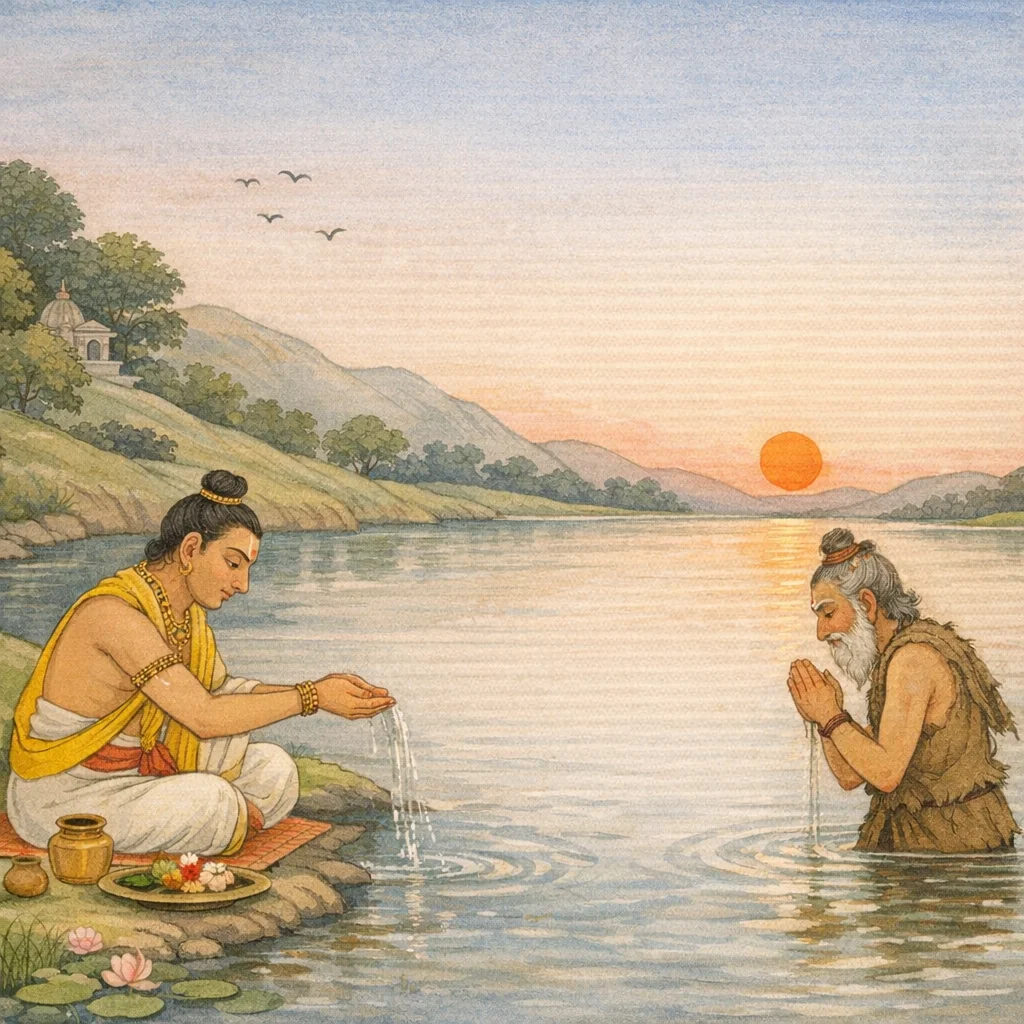
Within the Purāṇic narrative frame (Pulastya as the authoritative transmitter), this Adhyāya functions as a dharma-śāstric digest on purity, food-ethics, and āśrama discipline. The ṛṣis enumerate bhojya/abhojya categories, rules for cleansing substances (cloth, vessels, metals), and graded expiations for contact with impurity—mapping śauca as a practical technology of ritual order. Social-ethical typologies are expressed through animal metaphors (e.g., “śvāna,” “kukkuta”), defining deviant conduct that renders food blameworthy. The chapter then turns to life-cycle impurity (birth/death), śrāddha procedure (ekoddiṣṭa, sapiṇḍīkaraṇa), and the transition from gṛhastha to vānaprastha, emphasizing restraint, homa, triṣavaṇa snāna, and minimalism. Although not a tīrtha catalogue, the text preserves the Vāmana Purāṇa’s syncretic theology by grounding varṇāśrama-dharma in cosmic governance (Bhāskara as moral regulator), aligning social order with sacral cosmology rather than sectarian polemic.
Divine Beings
Sacred Geography
Mortal & Asura Figures
Key Content Points
- Bhojya/abhojya taxonomy: permissible foods and prohibited sources; Manu is cited on edible animals and grains, and on blameworthy food linked to impure persons.
- Śauca protocols: purification of textiles, vessels, metals, earth/house-sites; methods include water, heat, ash, alkaline agents, scraping, and wind-drying.
- Moral-social diagnostics via metaphors: definitions of “ṣaṇḍha,” “mārjāra,” “ākhu,” “śvāna,” “kukkuta,” “patita,” “apaviddha,” “nagna,” “cāṇḍāla,” and corresponding impurity of their food.
- Aśauca and expiation: bathing rules after contact with specific persons/objects; fasting (trirātra) and other prāyaścittas for eating defiled food.
- Antyeṣṭi and śrāddha sequence: water-offering to the preta, bone-collection timing, ekoddiṣṭa and sapiṇḍīkaraṇa within the annual cycle, and ongoing pitṛ-prīṇana through darśa-pūrṇamāsa rites and dāna.
- Āśrama-dharma transition: gṛhastha summarized as optimal; vānaprastha discipline detailed (forest subsistence, brahmacarya, homa, triṣavaṇa snāna, jaṭā/valkala, non-attachment, and ātma-jñāna orientation).
Shlokas in Adhyaya 15
Verse 1
इति श्रीवामनपुराणे चतुर्दशो ऽध्यायः ऋषय ऊचुः यच्च जर्ज्यं महाबाहो सदाधर्मस्थितैर्नरैः यद्भोज्यं च समुद्दिष्टं कथयिष्यामहे वयम्
Thus ends the fourteenth chapter in the Śrī Vāmana Purāṇa. The sages said: ‘O mighty-armed one, we shall explain what is to be avoided by men who are ever established in dharma, and also what is declared fit to be eaten.’
Verse 2
भोज्यमन्नं पर्युषितं स्नेहाक्तां चिरसंभृतम् अस्नेहा व्रीहयः श्लक्ष्णा विकाराः पयसस्तथा
Food that has become stale, and (food) smeared with fat and kept for a long time; rice grains that are without oil (i.e., plain/unsmeared) and fine; and likewise preparations made from milk—(these are) stated in the context of what is fit to be eaten.
Verse 3
शशकः शल्यको गोधा श्वाविधो मत्स्यकच्छपौ तद्वद् द्विदलकादीनि भोज्यानि मनुरब्रवीत्
Hare, porcupine, iguana, hedgehog, fish and tortoise—likewise pulses and the like—Manu declared these to be edible (fit for consumption).
Verse 4
मणिरत्नप्रवालानां तद्वन्मुक्ताफलस्य च शैलदारुमयानां च तृणमूलौषधान्यपि
Of gems, jewels, and corals—and likewise of pearls; and of things made of stone and wood; also of grass, roots, and medicinal herbs (these are included in the discussion).
Verse 5
शूर्पधान्याजिनानां च संहतानां च वाससाम् वल्कलानामशेषाणामम्बुना शुद्धिरिष्यते
For winnowing-baskets, grains, animal hides, and for woven/stitched garments, and for all garments made of bark—purification by water is prescribed.
Verse 6
सस्नेहानामथोष्णेन तिलकल्केन वारिणा कार्पासिकानां वस्त्राणां सुद्धिः स्यात्सह भस्मना
For (cloth) that is stained with oil/grease, purification is effected with warm water mixed with a paste of sesame; for cotton garments, cleansing is accomplished along with (the use of) ash.
Verse 7
नागदन्तास्थिशृङ्गाणां तक्षणाच्छुद्धिरिष्यते पुनः पाकेन भाण्डानां मृन्मयानां च मेध्यता
For ivory, bone, and horn, purification is accepted as arising from scraping/paring. And for earthen vessels, fitness (for use) is restored again by re-firing (heating/baking).
Verse 8
शुचि भैक्षं कारुहस्तः पण्यं योषिन्मुखं तथा रथ्यागतमविज्ञातं दासवर्गेण यत्कृतम्
Alms-food is (to be regarded as) pure; merchandise (handled) by an artisan’s hand (is to be treated with caution regarding purity); likewise (contact with) a woman’s mouth; an unknown item obtained from the street; and that which is made by the class of servants—(these are categories discussed in judging purity/acceptability).
Verse 9
वाक्प्रशस्तं चिरातीतमनेकान्तरितं लघु चेष्टितं बालवृद्धानां बालस्य च मुखं शुचि
Commendable speech is that which is not long-winded, does not dwell on the distant past, is not circuitous (not full of digressions), and is light (concise). The natural actions of children and the aged are (treated as) pure; and the mouth of a child is pure.
Verse 10
कर्मान्ताङ्गारशालासु स्तनन्धयसुताः स्त्रियः वाग्विप्रुषो द्विजेन्द्राणां संतप्ताश्चाम्बुबिन्दवः
In work-areas and in charcoal/fire-rooms (kitchens or furnace-places), women with nursing children (are regarded as pure/acceptable). The droplets of speech (spittle) of eminent Brāhmaṇas, and water-drops that have been heated, (are also treated as pure/cleansing in context).
Verse 11
भूमिर्विशुध्यते खातदाहमार्जनगोक्रमैः लेपादुल्लेखनात् सेकाद् वेश्म संमार्जनार्जनात्
Earth becomes purified by digging, by burning, by wiping/cleaning, and by the passing of cows (treading). A dwelling is purified by plastering (smearing), by scraping, by sprinkling (with water), and by sweeping and cleaning.
Verse 12
केशकीटावपन्ने ऽन्ने गोघ्राते मक्षिकान्विते मृदम्बुभस्मक्षाराणि प्रक्षेप्तव्यानि शुद्धये
When food has been contaminated by hair or insects, has been smelt by a cow, or is infested with flies, earth (clay), water, ash, and alkali should be added/mixed in for purification.
Verse 13
औदुम्बराणां चाम्लेन क्षारेण त्रपुसीसयोः भस्माम्बिभिश्च कांस्यानां शुद्धिः प्लावोद्रवस्य च
Udumbara-wood items are purified with a sour agent; tin and lead are purified with alkali; bronze vessels are purified with ash and water; and likewise (purification is prescribed) for what is washed/soaked and for what has flowed out/spilled.
Verse 14
अमेध्याक्तस्य मृत्तोयैर्गन्धापहरणेन च अन्येषामपि द्रव्याणां शुद्धिर्गन्धापहारतः
For something smeared with impure matter, purification is (done) by earth and water and by removing the odor; and for other substances too, purification is achieved through the removal of bad smell.
Verse 15
मातुः प्रस्रवणे वत्सः शकुनिः फलपातने गर्दभो भारवाहित्वे श्वा मृगग्रहणे शुचिः
A calf is pure with respect to its mother’s milk-flow; a bird is pure in causing fruits to fall; a donkey is pure in bearing burdens; and a dog is pure in catching game.
Verse 16
रथ्याकर्दमतोयानि नावः पथि तृणानि च मारुतेनैव सुद्ध्यन्ति पक्वेष्टकचितानि च
Street-mud and puddle-water, boats, and grasses on a path are purified merely by the wind; and so too are structures built of baked bricks.
Verse 17
शृतं द्रोणाढकस्यान्नममेध्याभिप्लुतं भवेत् अग्रमुद्धृत्य संत्याज्यं शेषस्य प्रोक्षणं स्मृतम्
If cooked food (even in the quantity of a droṇa or an āḍhaka) becomes defiled by contact with an impure substance, the upper portion should be lifted out and discarded; sprinkling (with water) is prescribed for the remainder.
Verse 18
उपवासं त्रिरात्रं वा दूषितान्नस्य भोजने अज्ञाते ज्ञातपूर्वे च नैव शुद्धिर्विधीयते
If one has eaten defiled food, one should fast for three nights. But if (the defilement) was unknown (at the time), even if it becomes known later, no purification rite is prescribed.
Verse 19
उदक्याश्वाननग्नांश्च सूतिकान्त्यावसायिनः स्पृष्ट्वा स्नायीत शौचार्थं तथैव मृतहारिणः
Having touched a menstruating woman, a horse, a dog, a naked person, a woman in childbirth, or an outcaste (low occupational group), one should bathe for the sake of purity; likewise (one should bathe) after touching one who carries the dead.
Verse 20
सस्नेहमस्थि संस्पृस्य सवासाः स्नानमाचरेत् आचम्यैव तु निःस्नेहं गामालभ्यार्कमीक्ष्य च
Having touched a bone that is greasy (with flesh/fat), one should bathe while wearing clothes. Then, after sipping water (ācāmana), when free from greasiness, one should touch a cow and look at the sun.
Verse 21
न लङ्घयेत्पुरीषासृक्ष्ठीवनोद्वर्त्तनानि च गृहादुच्छिष्टविण्मूत्रे पादाम्भांसि क्षिपेद् बहिः
One should not step over feces, blood, spittle, or the (powder/unguent) used for rubbing the body. From the house, one should throw outside (any) leftovers, feces and urine, and the water used for washing the feet.
Verse 22
पञ्चपिण्डाननुद्धत्य न स्नायात् परवारिणि स्नायीत देवखातेषु सरोहदसरित्सु च
Without first removing the five lumps (of impurity), one should not bathe in another’s water. One should bathe in tanks (ponds) dug for the gods, and in lakes and rivers.
Verse 23
नोद्यानादौ विकालेषु प्राज्ञस्तिष्ठेत् कदाचन नालपेद् जनविद्विष्टं वीरहीनां तथा स्त्रियम्
A wise person should never remain in gardens and such places at improper times. Nor should one converse with a person hated by the people, nor with a woman who is without a protector (lit. without a man/guardian).
Verse 24
देवतापितृसच्छास्त्रयज्ञवेदादिनिन्दकैः कृत्वा तु स्पर्शमालापं शुद्ध्यतेर्ऽकावलोकनात्
If one has made bodily contact or conversation with those who revile the gods, the ancestors, the true śāstras, sacrifices, the Vedas and the like, one becomes purified by looking upon the Sun.
Verse 25
अभोज्याः सूतिकाषण्ढमार्जाराखुश्वकुक्कुटाः पतितापविद्धनग्नाश्चाण्डालाद्यधमाश्च ये
Those are unfit to be eaten from (i.e., one should not accept food from them): a woman in the post-partum period, a eunuch/impotent person, (and also) cat, rat, dog, and cock; likewise, the fallen, the outcaste/defiled, the naked (ascetic or shameless), and those base persons beginning with the caṇḍāla.
Verse 26
सुकेशिरुवाच भवद्भिः कीर्तिताभोज्या य एते सूतिकादयः अमीषां श्रोतुमिच्छामि तत्त्वतो लक्षणानि हि
Sukeśin said: ‘Those who are “abhojya” have been mentioned by you—such as the sūtikā and others. I wish to hear, in truth, their defining characteristics.’
Verse 27
ऋषय ऊचुः ब्राह्मणी ब्राह्मणस्यैव यावरोधत्वमागता तावुभौ सूतिकेत्युक्तौ तयोरन्नं विगर्हितम्
The sages said: A Brāhmaṇa woman, having entered the state of confinement/impurity (associated with childbirth) with a Brāhmaṇa, those two are both called ‘sūtikā’ (in the puerperal/impure state); and the food belonging to them is censured (to be avoided).
Verse 28
न जुहोत्युचिते काले न स्नाति न ददाति च पितृदेवार्चनाद्धीनः स षण्ढः परिगीयते
He does not offer oblations at the proper time; he does not bathe; he does not give (in charity). Devoid of worship of the ancestors and the gods, he is spoken of as a ‘ṣaṇḍha’ (a contemptuous designation for one unfit/ineffective in dharma).
Verse 29
दम्भार्थं जपते यश्च तप्यते यजते तथा न परत्रार्थमुद्यक्तो स मार्जारः प्रकीर्तितिः
One who recites (mantras), practices austerity, and performs sacrifices only for the sake of display, and is not intent on the true aim of the hereafter, is declared to be a ‘mārjāra’ (a ‘cat’—a metaphor for stealthy hypocrisy).
Verse 30
विभवे सति नैवात्ति न ददाति जुहोति च तमाहुराखुं तस्यान्नं भुक्त्वा कृच्छ्रेण सुद्ध्यति
Even though he has the means, he neither eats (rightly), nor gives (in charity), nor offers (oblations) in sacrifice. The sages call such a person a “rat”; by eating his food one is purified only with difficulty (i.e., after arduous expiation).
Verse 31
यः परेषां हि मर्माणि निकृन्तन्निव भाषते नित्यं परगुणद्वेषी स श्वान इति कथ्यते
He who speaks as though cutting into the vital spots (sensitive points) of others, and who is always hostile to others’ good qualities—such a person is called a “dog.”
Verse 32
सभागतानां यः सभ्यः पक्षपातं समाश्रयेत् तमाहुः कुक्कुटं देवास्तस्याप्यन्नं विगर्हितम्
A member of an assembly who, among those gathered, resorts to partisanship is called a “cock,” say the gods; even his food is censured (deemed blameworthy).
Verse 33
स्वघर्मं यः सुत्सृज्य परधर्मं समाश्रयेत् अनापदि स विद्वद्भिः पतितः परिकीर्त्यते
He who abandons his own duty (svadharma) and takes refuge in another’s duty (paradharma), when there is no emergency, is declared by the learned to be ‘fallen’ (patita).
Verse 34
देवत्यागी पितृत्यागी गुरुभक्त्यरतस्तथा गोब्राह्मणस्त्रीवधकृदपविद्धः स कीर्त्यते
One who abandons the gods, abandons the ancestors, and likewise one who is devoted to (improper) ‘guru-bhakti’ (i.e., misdirected allegiance), as well as one who kills a cow, a brāhmaṇa, or a woman—such a person is spoken of as outcast/rejected (apaviddha).
Verse 35
येषां कुले न वेदो ऽस्ति न सास्त्रं नैव च व्रतम् ते नग्नाः कीर्तिताः सद्भिस् तेषामन्नं विगर्हितम्
Those in whose lineage there is no Veda, no śāstra, and no observance of vows—such people are called ‘nagna’ (bare/uncultured) by the virtuous; their food is censured (not to be accepted).
Verse 36
आशार्तानामदाता च दातुश्च प्रतिषेधकः शरणागतं यस्त्यजति स चाण्डालो ऽधमो नरः
One who does not give to those afflicted by need, and one who prevents another from giving—(and) he who abandons a person who has sought refuge—such a man is a caṇḍāla, the lowest of men.
Verse 37
यो बान्धवैः परित्यक्तः साधुभिर्ब्राह्मणैरपि कुण्डाशी यश्च तस्यान्नं भुक्त्वा चान्द्रायणं चरेत्
One who has been abandoned by his kinsmen, and even by sādhus and brāhmaṇas—(and) the ‘kuṇḍāśī’; having eaten that person’s food, one should perform the Cāndrāyaṇa (expiatory observance).
Verse 38
यो नित्यकर्मणो हानिं कुर्यान्नैमित्तिकस्य च भुक्त्वान्नं तस्य शुद्ध्येत त्रिरात्रोपोषितो नरः
If someone causes the omission of daily rites and also of occasional rites, then having eaten that person’s food, a man becomes purified by fasting for three nights.
Verse 39
गणकस्य निषादस्य गणिकाभिषजोस्तथा कदर्यस्यापि शुद्ध्येत त्रिरात्रोपोषितो नरः
A man becomes purified (fit again for purity-based rites) by fasting for three nights—even if he is a gambler, a Niṣāda, a courtesan, a physician, or even a miser.
Verse 40
नित्यस्य कर्मणो हानिः केवलं मृतजन्मसु न तु नैमित्तिकोच्छेदः कर्त्तव्यो हि कथञ्चन
Only the daily obligatory rites (nitya-karman) are suspended in cases of death or birth impurity; but the occasional/conditional rites (naimittika) should not be discontinued in any way.
Verse 41
जाते पुत्रे पितुः स्नानं सचैलस्य विधीयते मृते च सर्वबन्धूनामित्याह भगवान् भृगुः
When a son is born, a bath is prescribed for the father, with garments on (sacaila-snāna); and when there is a death, (a bath is prescribed) for all relatives—so said the revered Bhṛgu.
Verse 42
प्रेताय सलिलं देयं बहिर्दग्ध्वा तु गोत्रजैः प्रमे ऽह्नि चतुर्थे वा सप्तमे वास्थिसंचयम्
Water should be offered for the departed (preta). After cremating outside (the settlement), the kinsmen of the same lineage (gotra) should collect the bones either on the next day, or on the fourth day, or on the seventh day.
Verse 43
ऊर्द्ध्वं संचयनात्तेषामङ्गस्पर्शो विधीयते सोदकैस्तु क्रिया कार्या संशुद्धैस्तु सपिण्डजैः
After the bone-collection, bodily contact with them (the participants) is permitted. However, the rites should be performed along with water (purificatory water), and by sapinda-relatives who are purified.
Verse 44
विषोद्बन्धनशस्त्राम्बुवह्निपातमृतेषु च बाले प्रव्राजि संन्यासे देशान्तरमृते तथा
And (special rules apply) in cases of those who die by poison, hanging/strangulation, weapons, water (drowning), fire, or a fall; likewise in the case of a child, a renunciant (pravrājaka/saṃnyāsin), and one who dies in a foreign place.
Verse 45
सद्यः शौचं भवेद्वीर तच्चाप्युक्तं चतुर्विधम् गर्भस्रावे तदेवोक्तं पूर्णकालेन चेतरे
O hero, immediate purification (sadyaḥ-śauca) is prescribed; and that has been described as fourfold. In the case of a miscarriage (garbha-srāva) that same rule is stated; in other cases, purification is according to the full (prescribed) period.
Verse 46
ब्रह्मणानामहोरात्रं क्षत्रियाणां दिनत्रयम षड्रात्रं चैव वैश्यानां शूद्राणां द्वादशाह्निकम्
For Brāhmaṇas (the period is) one day and night; for Kṣatriyas, three days; for Vaiśyas, six nights; and for Śūdras, a period of twelve days.
Verse 47
दशद्वादशमासार्द्धमाससंख्यैर्दिंश्च तैः स्वाः स्वाः कर्मक्रियाः कुर्युः सर्वे वर्णा यथाक्रामम्
By those counts—ten and twelve months, half-months, and days—each (group) should perform its respective ritual acts; all the varṇas should do so in due order.
Verse 48
प्रेतमुद्दिस्य कर्त्तव्यमेकोद्दिष्टं विधानतः सपिण्डीकरणं कार्यं प्रेते आवत्सरान्नरैः
With the departed (as a preta) in view, the ekoddiṣṭa śrāddha should be performed according to rule. And the sapiṇḍīkaraṇa rite should be carried out for the preta by men, up to (the completion of) a year.
Verse 49
ततः पितृत्वमापन्ने दर्शपूर्णादिभिः सुभैः प्रीणनं तस्य कर्त्तव्यं यथा श्रुतिनिदर्शनात्
Then, when he has attained the status of a pitṛ, he should be satisfied/propitiated by auspicious observances such as the new-moon and full-moon rites, in accordance with what is indicated by the Veda (śruti).
Verse 50
पितुरर्थं समुद्दिश्य भूमिदानादिकं स्वयम् कुर्याद्येनास्य सुप्रीताः पितरो यान्ति राक्षस
Dedicating it for the sake of one’s father, one should personally perform gifts such as the donation of land and the like—by which his ancestors become well-pleased, O Rākṣasa.
Verse 51
यद् यदिष्टतमं किञ्चिद् यच्चास्य दयितं गृहे तत्तद् गुणवते देयं तदेवाक्षयमिच्छता
Whatever is most desired by a person, and whatever is dear to him in his household—one who seeks imperishable merit should give precisely that, and give it to a worthy person.
Verse 52
अध्येतव्या त्रयी नित्यं भाव्यं च विदुषा सदा धर्मतो धनमाहार्यं यष्टव्यं चापि शक्तितः
The three Vedas should be studied daily, and a learned person should always cultivate reflection. Wealth should be acquired through dharma, and sacrifice (yajña) should be performed according to one’s capacity.
Verse 53
यच्चापि कुर्वतो नात्मा जुगुप्सामेति राक्षस तत् कर्त्तव्यमशङ्केन यन्न गोप्यं महाजने
O Rākṣasa, whatever, when one does it, does not cause one’s own self to feel disgust (or self-reproach)—that should be done without hesitation: that which need not be concealed from the public.
Verse 54
एवमाचरतो लोके पुरुषस्य गृहे सतः धर्मार्थकामसंप्राप्तिः परत्रेह च शोभनम्
For a man who lives in his home and conducts himself in this manner in the world, there is attainment of dharma, artha, and kāma; and there is well-being and honor both here and hereafter.
Verse 55
एष दूद्देशतः प्रोक्तो गृस्थाश्रम उत्तमः वानप्रस्थाश्रमं धर्मं प्रवक्ष्यामो ऽवधार्यताम्
Thus, in brief, the excellent discipline of the householder stage has been explained. Now we shall teach the dharma of the vānaprastha stage—let it be carefully heeded.
Verse 56
अपत्यसंततिं दृष्ट्वा प्राज्ञो देहस्य चानतिम् वानप्रस्थाश्रमं धर्मं प्रवक्ष्यामो ऽवधार्यताम्
Having seen the continuity of offspring, and also the decline of the body, the wise (person turns toward the next stage). We shall explain the dharma of the vānaprastha āśrama—let it be carefully heeded.
Verse 57
तत्रारण्योपभोगैश्च तपोभिश्चात्मकर्षणम् भूमौ शय्या ब्रह्मचर्यं पितृदेवातिथिक्रिया
There (in the forest), by subsisting on forest enjoyments/produce and by austerities, one should practice self-discipline. One should sleep on the ground, maintain celibacy, and perform the proper rites toward ancestors, gods, and guests.
Verse 58
होमस्त्रिषवणं स्नानं जटावल्कलधारणम् वन्यस्नेहनिषेवित्वं वानप्रस्थविधिस्त्वयम्
Offering oblations (homa), bathing at the three daily junctions, wearing matted hair and bark-garments, and using only forest-derived fats (as food/for cooking) — this is the prescribed rule of the vānaprastha.
Verse 59
सर्वसङ्गपरित्यागो ब्रह्मचर्यममानिता जितेन्द्रियत्वमावासे नैकस्मिन् वसतिश्चिरम्
Abandoning all attachments, celibacy, humility (freedom from craving honor), and conquest of the senses; and in regard to dwelling, not staying long in a single place — these are (the marks of the forest-dweller’s discipline).
Verse 60
अननारम्भस्तथाहारो भैक्षान्नं नातिकोपिता आत्मज्ञानावबोधेच्छा तथा चात्मावबोधनम्
Non-initiation of new undertakings; simple sustenance, with food obtained by alms; not given to excessive anger; the desire to awaken to self-knowledge, and the realization of the Self—these are (the marks/duties spoken of here).
Verse 61
चतुर्थे त्वाश्रमे धर्मा अस्माभिस्ते प्रकीर्तिताः वर्णधर्माणि चान्यानि निशामय निशाचर
Thus, the duties of the fourth āśrama have been proclaimed to you by us. Now listen, O night-roamer, to the other duties pertaining to the social orders (varṇas).
Verse 62
गार्हस्थ्यं ब्रह्मचर्यं च वानप्रस्थं त्रयाश्रमाः क्षत्रियस्यापि कथिता ये चाचारा द्विजस्य हि
Householder life, student life (brahmacarya), and forest-dwelling (vānaprastha)—these three āśramas are also prescribed for the kṣatriya; and (these are) the proper observances indeed of a twice-born (dvija).
Verse 63
वैखानसत्वं गार्हस्थ्यमाश्रमद्वितयं विशः गार्हस्थ्ययमुत्तमं त्वेकं शूद्रस्य क्षणदाचर
For the vaiśya, there are two āśramas—(the life of) a vaikhānasa and the householder’s state. But for the śūdra there is only one, the excellent householder’s state, O Kṣaṇadācara.
Verse 64
स्वानि वर्णाश्रमोक्तानि धर्माणीह न हापयेत् यो हापयति तस्यासौ परिकुप्यति भास्करः
Here one should not abandon the duties prescribed for one’s own varṇa and āśrama. He who abandons them—against him the Sun (Bhāskara) becomes exceedingly angry.
Verse 65
कुपितः कुलनाशाय ईश्वरो रोगवृद्धये भानुर्वै यतते तस्य नरस्य क्षणदाचर
When angered, the lordly Sun strives for the destruction of that man’s lineage and for the increase of his diseases, O Kṣaṇadācara.
Verse 66
तस्मात् स्वरधर्मं न हि संत्यजेत न हापयेच्चापि हि नात्मवंशम् यः संत्यजेच्चापि निजं हि धर्मं तस्मै प्रकुप्येत दिवाकरस्तु
Therefore one should not abandon one’s own duty (svadharma), nor should one cause the ruin of one’s own lineage. Whoever gives up his rightful duty—against him the Sun (Divākara) becomes wrathful.
Verse 67
पुलस्त्य उवाच इत्येवमुक्तो मुनिभिः सुकेशी प्रणम्य तान् ब्रह्मनिधीन् महर्षीन् जगाम चोत्पत्य पुरं स्वकीयं मुहुर्मुहुर्धर्ममवेक्षमाणः
Pulastya said: Thus instructed by the sages, Sukeśī bowed to those great seers—treasuries of sacred knowledge—and then departed, rising up and going to his own city, again and again reflecting upon dharma.
Frequently Asked Questions
It anchors varṇāśrama-dharma and ritual purity in cosmic governance (Bhāskara/Divākara as a regulator of order and consequence), presenting dharma as a universal sacral law that can be shared across devotional communities—an implicit mode of Purāṇic syncretism even without explicit Harihara iconography in this passage.
The chapter gives practice-oriented bathing guidance by privileging “devakhāta” (sacred reservoirs) and natural waters such as lakes (saras/hrada) and rivers (sarit) for snāna, while warning against improper bathing conditions. This is a procedural, not topographical, tīrtha layer—no named Kurukṣetra/Sarasvatī sites are specified here.
It does not advance the Bali–Vāmana episode. The Adhyāya is primarily normative: food ethics, purification technologies, social-ritual impurity, śrāddha sequencing, and āśrama duties (gṛhastha and vānaprastha), framed within the broader Purāṇic transmission attributed to Pulastya.