Sarga 98
महोदरवधः (The Slaying of Mahodara)
युद्धकाण्ड
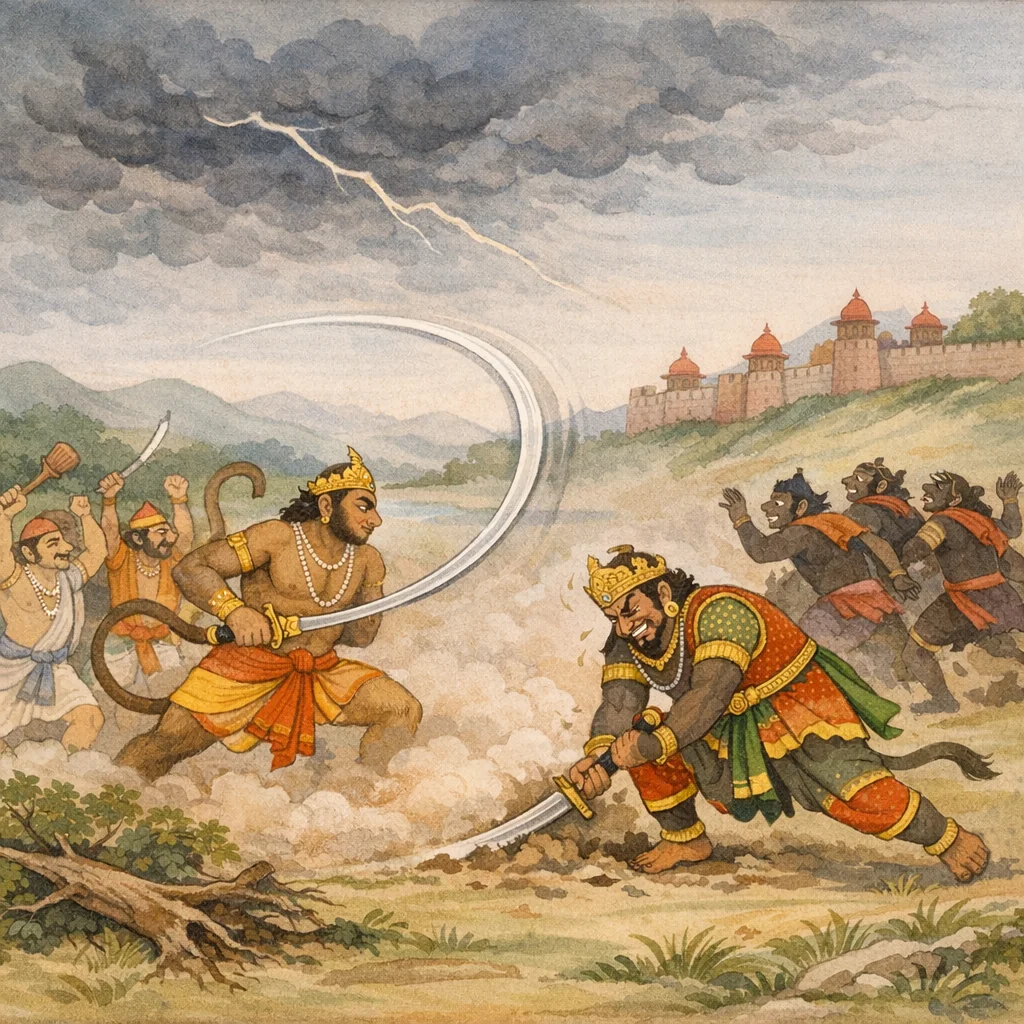
Sarga 98 depicts a decisive single-combat episode embedded within the larger attritional battle. Ravana, enraged by the collapse of his forces and the fall of Virupaksha, identifies Mahodara as the present locus of his “hope of victory” and commands him to repay royal patronage through exemplary valor. Mahodara enters the Vanara ranks like a moth into fire, inflicting severe casualties and scattering troops. Sugriva responds to the routed Vanaras, initiating a duel characterized by escalating weapon exchanges: rocks, a sala tree used as a bludgeon, an iron bar (parigha), maces, and finally sword-and-shield combat. The narrative uses battlefield similes (armies like dried lakes in midsummer; combatants like thunderclouds with lightning) to mark the exhaustion of forces and the intensification of personal contest. The climax arrives when Sugriva severs Mahodara’s head while the latter is engaged in extracting a lodged sword, triggering Rakshasa panic and flight, while Vanaras exult and Ravana’s fury deepens—an episode that functions as both tactical turning point and moral demonstration of leadership under crisis.
Shlokas
Verse 1
हन्यमानेबलेतूर्णमन्योन्यंतेमहामृथे ।सरसीवमहाघर्मेसोपक्षीणेबभूवतुः ।।6.98.1।।
In that great battle, as the armies swiftly destroyed one another, they appeared like lakes in the height of summer, their waters utterly diminished.
Verse 2
स्वबलस्यविघातेनविरूपाक्ष्वधेन च ।बभूवद्विगुणंक्रुद्धोरावणोराक्षसाधिपः ।।6.98.2।।
Rāvaṇa, lord of the Rākṣasas, became doubly enraged—both at the devastation of his forces and at the slaying of Virūpākṣa.
Verse 3
प्रक्षीणंतुबलंदृष्टवावध्यमानंवलीमुखैः ।बभूवास्यव्यथायुद्धेप्रेक्ष्यदैवविपर्ययम् ।।6.98.3।।
Seeing his forces greatly diminished and being slain by the monkey-warriors, he was afflicted with anguish in the midst of battle, beholding a reversal of fate.
Verse 4
उवाच च समीपस्थंमहोदरमरिन्दमम् ।अस्मिन्कालेमहाबाहोजयाशात्वयिमेस्थिता ।।6.98.4।।
Rāvaṇa spoke to Mahodara, who stood nearby and was hard for enemies to withstand: “At this moment, O mighty-armed one, my hope of victory rests upon you.”
Verse 5
जहिशत्रुचमूंवीरदर्शयाद्यपराक्रमम् ।भर्तृपिण्डस्यकालोऽऽयंनिर्देष्टुंसाधुयुध्यताम् ।।6.98.5।।
“Destroy the enemy host, O hero, and show your prowess today. This is the time to repay the sustenance received from your lord—therefore, fight well!”
Verse 6
एवमुक्तस्तथेत्युक्त्वाराक्षसेन्द्रोमहोदरः ।प्रविवेशारिसेनांतांपतङ्गइवपावकम् ।।6.98.6।।
Thus addressed, Mahodara, lord among the Rākṣasas, replied “So be it,” and plunged into that enemy army like a moth into a flame.
Verse 7
ततस्सकदनंचक्रेवानराणांमहाबलः ।भर्तृवाक्येनतेजस्वीस्वेनवीर्येणचोदितः ।।6.98.7।।
Then the mighty one wrought havoc among the Vānaras—brilliant, urged on by his lord’s command and by his own martial strength.
Verse 8
वानराश्चमहासत्त्वाःप्रगृह्वःविपुलाशशिलाः ।प्रविश्यारिबलंभीमंजघ्नुस्तेरजनीचरान् ।।6.98.8।।
The great-souled Vānaras too, seizing massive rocks, charged into the dreadful enemy host and struck down the night-ranging Rākṣasas.
Verse 9
महोदरस्तुसङ्कृद्धश्शरैःकाञ्चनभूषणैः ।चिच्छेदपाणिपादोरुन्वानराणांमहाहवे ।।6.98.9।।
But Mahodara, enraged, in that great battle severed the Vānaras’ hands, feet, and thighs with arrows adorned in gold.
Verse 10
ततस्तेवानरास्सर्वेराक्षसैरर्दिताभृशम् ।दिशोदशद्रुताःकेचित्केचित्सुग्रीवमाश्रिताः ।।6.98.10।।
Then, those vānaras—sorely harassed by the rākṣasas—scattered in all ten directions; some, however, sought refuge with Sugrīva.
Verse 11
प्रभग्नांसमरेदृष्टवावानराणांमहाचमूम् ।अभिदुद्रावसुग्रीवोमहोदरमनन्तरम् ।।6.98.11।।
Seeing the great vānara host broken in the fight, Sugrīva immediately rushed toward Mahodara.
Verse 12
प्रगृह्यविपुलांघोरांमहीधरसमांशिलाम् ।चिक्षेप स महातेजास्तद्वधायहरीश्वरः ।।6.98.12।।
That mighty, radiant lord of the vānaras seized a huge, dreadful rock like a mountain and hurled it, intent on slaying him.
Verse 13
तामापततनींसहसाशिलांदृष्टवामहोदरः ।असम्भ्रान्तस्ततोबाणैर्निर्बिभेददुरासदाम् ।।6.98.13।।
Seeing that formidable rock rushing toward him, Mahodara did not lose his composure; at once he pierced and shattered it with arrows.
Verse 14
रक्षसातेनबाणौघैर्निकृत्तासासहस्रधा ।निपपातशिलाभूमौगृध्रचक्रमिवाकुलम् ।।6.98.14।।
Severed into a thousand fragments by that rākṣasa’s torrent of arrows, the rock fell to the ground, scattered like a swirling circle of vultures.
Verse 15
तांतुभिन्नांशिलांदृष्टवासुग्रीवःक्रोधमूर्छितः ।सालमुत्पाट्यचिक्षेपराक्षसेरणमूर्थनि ।।6.98.15।।
But when Sugrīva saw the rock shattered, he was overcome by anger; tearing up a sāla tree, he hurled it at the rākṣasa in the thick of battle.
Verse 16
शरैश्चविददारैनंशूरःपरपुरञ्जयः ।स ददर्शततःक्रुद्धःपरिघंपतितंभुवि ।।6.98.16।।
That hero, the vanquisher of enemy strongholds, tore into him with arrows; then, enraged, he saw the club-like weapon fallen upon the ground.
Verse 17
आविध्यतु स तंदीप्तंपरिघंतस्यदर्शयन् ।परिघाग्रेणवेगेनजघानास्यहयोत्तमान् ।6.98.17।।
Whirling that blazing iron bar and displaying it to him, he struck, with the bar’s tip and tremendous force, Mahodara’s finest horses.
Verse 18
तस्माद्धतहयावदीरःसोऽऽवप्लुत्यमहारथात् ।गदांजग्राहसंक्रुद्धोराक्षसोऽऽथमहोदरः ।।6.98.18।।
Then Mahodara—the rākṣasa hero, his horses slain—leapt down from the great chariot and, enraged, seized a mace.
Verse 19
गदापरिघहस्तौतौयुधिवीरौसमीयतुः ।नर्दन्तौगोवृषप्रख्यौघनाविवसविद्युतौ ।।6.98.19।।
On the battlefield the two heroes advanced toward each other—mace and iron bar in hand—roaring like mighty bulls, like storm-clouds flashing with lightning.
Verse 20
ततःक्रुद्धोगदांतस्यैचिक्षेपरजनीचरः ।ज्वलतनींभास्कराभासांसुग्रीवायमहोदरः ।।6.98.20।।
Then Mahodara, the night-ranging Rākṣasa, enraged, hurled a blazing mace—sun-bright—toward Sugrīva.
Verse 21
गदांतांसुमहाघोरामापततनींमहाबलः ।सुग्रीवोरोषताम्राक्षस्समुद्यम्यमहाहवे ।।6.98.21।।आजघानगदांतस्यपरिघेणहरीश्वर ।पपात स गदोद्भिन्नःपरिघस्तस्यभूतले ।।6.98.22।।
In that dreadful clash, mighty Sugrīva—his eyes reddened with anger—raised his iron bar and struck Mahodara’s onrushing mace. Shattered by the blow, the mace fell to the ground.
Verse 22
गदांतांसुमहाघोरामापततनींमहाबलः ।सुग्रीवोरोषताम्राक्षस्समुद्यम्यमहाहवे ।।6.98.21।।आजघानगदांतस्यपरिघेणहरीश्वर ।पपात स गदोद्भिन्नःपरिघस्तस्यभूतले ।।6.98.22।।
In that dreadful clash, mighty Sugrīva—his eyes reddened with anger—raised his iron bar and struck Mahodara’s onrushing mace. Shattered by the blow, the mace fell to the ground.
Verse 23
ततोजग्राहतेजस्वीसुग्रीवोवसुधातलात् ।आयसंमुसलंघोरंसर्वतोहेमभूषितम् ।।6.98.23।।
Then the radiant Sugrīva picked up from the earth a fearsome iron club, adorned with gold on every side.
Verse 24
स तमुद्यम्यचिक्षेपसोऽऽप्यन्यांव्याक्षिपद्गदाम् ।भिन्नावन्योन्यमासाद्यपेततुद्दरणीतले ।।6.98.24।।
Sugrīva lifted and hurled that club; Mahodara too flung another mace in return. Meeting each other mid-course, both weapons shattered and fell upon the earth.
Verse 25
ततोग्नप्रहरणौमुष्टिभ्यांतौसमीयतुः ।तेजोबलसमाविष्टौदीप्ताविवहुताशनौ ।।6.98.25।।
Thereafter, their weapons broken, the two closed in with their fists—filled with might and fiery energy, like two blazing fires.
Verse 26
जघ्नतुस्तौतदान्योन्यंवेदतुश्चपुनःपुनः ।तलैश्चान्योन्यमहत्यपेततुश्चमहीतले ।।6.98.26।।
Then the two struck each other again and again, roaring; and slapping one another with their palms, they fell and tumbled upon the ground.
Verse 27
उत्पेततुस्ततस्तूर्णंजघ्नतुश्चपरस्परम् ।भुजैश्चिक्षिपतुर्वीरावन्योन्यमपराजितौ ।।6.98.27।।
Then they sprang up swiftly and struck each other; those two undefeated heroes shoved one another with their arms.
Verse 28
जग्मतुस्तौश्रमंवीरौबाहुयुधेपरंतपौ ।अजहारतदाखडगमदूरपरिवर्तिनम् ।।6.98.28।।राक्षसश्चर्मणासार्धंमहावेगोमहोदरः ।
The two heroes—scourges of their foes—grew weary in their wrestling combat. Then Mahodara, the Rākṣasa, swift in movement, seized a sword lying nearby, along with a shield.
Verse 29
थैव च महाखडगंचर्मणापतितंसह ।।6.98.29।।जग्राहवानरश्रेष्ठस्सुग्रीवोवेगवत्तरः।।
In the same way, Sugrīva—the foremost of the Vānaras, swifter still—took up a mighty sword that had fallen there, together with a shield.
Verse 30
तौतुरोषपरीताङ्गौनर्दन्तावभ्यधावताम् ।।6.98.30।।उद्यतासीरणेहृष्टावुभौशस्त्रविशारदौ ।
Then, their limbs overtaken by anger, roaring aloud, the two charged at each other. In the press of battle they advanced with swords raised—both exultant, both skilled in weapons.
Verse 31
दक्षिणंमण्डलंचोभौसुतूर्णंसम्परीयतुः ।।6.98.31।।अन्योन्यमभिसङ्कृद्धौ जये प्रणिहितावुभौ ।
Both of them wheeled swiftly in rightward circles, each enraged at the other; and both, fixed upon victory, closed in again.
Verse 32
तुशूरोमहावेगोवीर्यश्लाघीमहोदरः ।।6.98.32।।महाचर्मणितंखडगंपातयामासदुर्मतिः ।
But Mahodara—valiant, swift, and boastful of his prowess—evil in counsel, brought down his sword upon Sugrīva’s great shield.
Verse 33
लग्नमुत्कर्षतःखडगंखडगेनकपिकुञ्जरः ।।6.98.33।।जहारसशिरस्त्राणंकुण्डलोपहितंशिरः ।
As Mahodara tugged to pull free the sword that had stuck fast, Sugrīva—the elephant among monkeys—struck with his own blade and severed Mahodara’s head, adorned with earrings and protected by a helmet.
Verse 34
निकृत्तशिरसस्तस्यपतितस्यमहीतले ।।6.98.34।।तद्बलंराक्षसेन्द्रस्यदृष्टवातत्र न तिष्टते ।
With his head cut off and fallen upon the earth, the host of the Rākṣasa king, seeing it, did not stand its ground there.
Verse 35
हत्वांतंवानरैस्सार्धंननादमुदितोहरिः ।।6.98.35।।चुक्रोध च दशग्रीवोबभौहृष्टश्चराघवः ।
After slaying him, Sugrīva, rejoicing together with the Vānaras, roared aloud. Daśagrīva grew wrathful, while Rāghava appeared glad.
Verse 36
विषण्णवदनास्सर्वेराक्षसादीनचेतसः ।।6.98.36।।विद्रवन्तिततस्सर्वेभयवित्रस्तचेतसः ।
All the Rākṣasas, their faces cast down and their spirits broken, fled from that place—every one of them shaken in mind by fear.
Verse 37
महोदरंतंन्वििपात्यभूमौमहागिरेःकीर्णमिवैकदेशम् ।सूर्यात्मजस्तत्ररराजलक्ष्म्यसूर्यस्स्वतेजोभिरिवाप्रधृष्यः ।।6.98.37।।
Having felled Mahodara to the ground—like a fragment of a great mountain cast down—the son of the Sun shone there in splendor, unassailable, like the Sun blazing by its own radiance.
Verse 38
Then the lord of the Vānaras attained victory at the very front of battle; and hosts of Suras, Siddhas, and Yakṣas—together with multitudes of beings on earth—were stirred with joy as they watched.
Frequently Asked Questions
The pivotal action is Ravana’s framing of Mahodara’s duty as repayment for royal sustenance—an articulation of warrior obligation—countered by Sugriva’s leadership response to a collapsing line, where restoring morale becomes an ethical act of kingship in war.
The chapter contrasts compelled loyalty to an unjust ruler with principled leadership in crisis: Ravana’s hope is outsourced to force, while Sugriva embodies responsibility toward his troops, showing that victory in the epic is tied to disciplined agency, not merely ferocity.
No named city-gates or landmarks are foregrounded; instead, the “battlefield of Lanka” is mapped through culturally salient martial objects—parigha, gada, sword-and-shield, gold-adorned arrows—and through stock similes (midsummer lakes drying) that function as poetic landmarks.