Sarga 92
युद्धकाण्डे द्विनवतितमः सर्गः — Indrajit’s Fall, Rama’s Embrace, and Sushena’s Battlefield Healing
युद्धकाण्ड
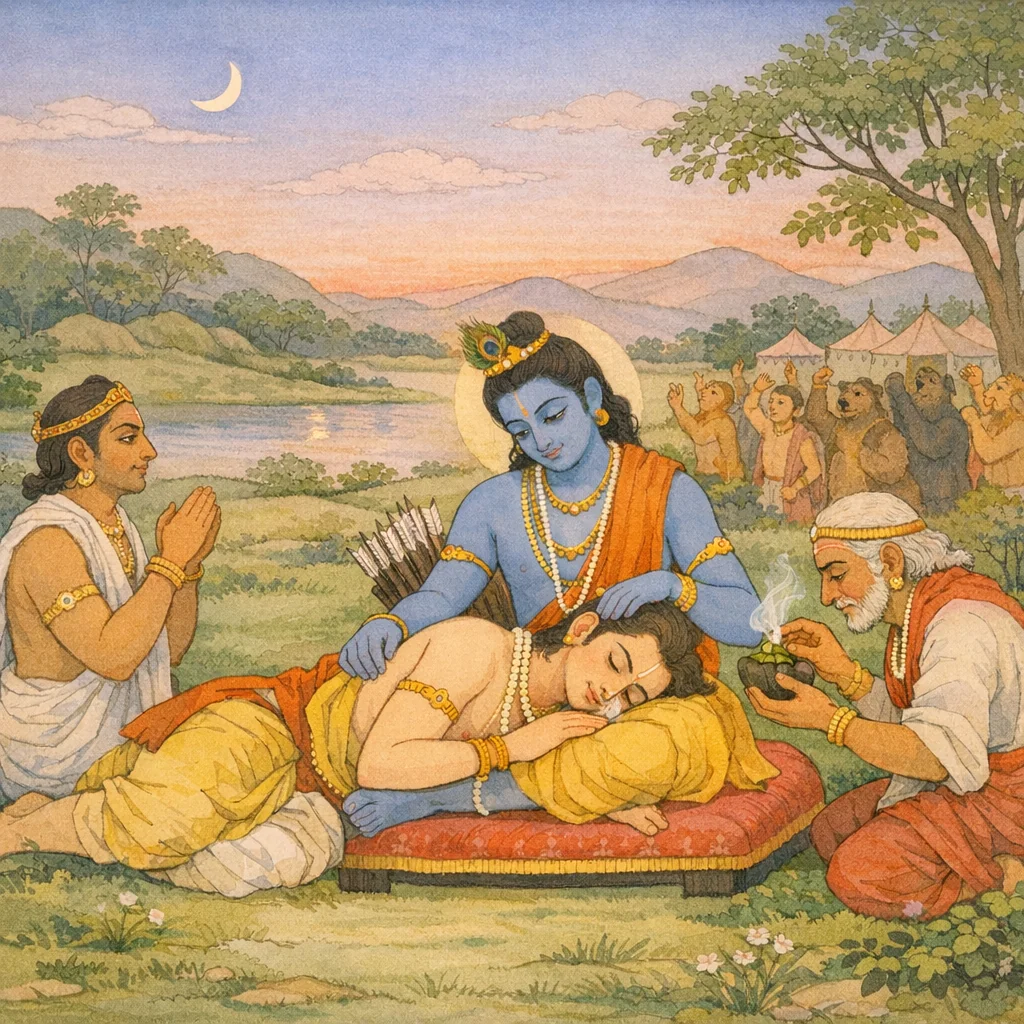
Sarga 92 records the immediate aftermath of Indrajit’s death and frames it as both a strategic turning point and a moral-ritual validation of Lakṣmaṇa’s service. Blood-smeared and wounded, Lakṣmaṇa reports the terrible slaying of Indrajit; Vibhīṣaṇa corroborates the severing of the rākṣasa prince’s head. Rāma’s response is twofold: public praise (kīrti-vardhana) and intimate fraternal care—drawing Lakṣmaṇa onto his lap, repeatedly examining his arrow-tormented body, and consoling him. Rāma interprets the event as a decisive weakening of Rāvaṇa’s war-capacity, anticipating that the grieving rākṣasa-king will emerge with a large host and declaring readiness to finish him. The chapter then shifts to battlefield medicine and coalition welfare: Rāma summons Suṣeṇa, instructing him to remove arrows and treat not only Lakṣmaṇa and Vibhīṣaṇa but also wounded bear and vānar fighters. Suṣeṇa administers a supreme medicine by nasal inhalation; Lakṣmaṇa immediately becomes viśalya (free of arrows), painless, and restored. The allied leaders rejoice, and the sarga closes by praising the near-impossible deed and its morale effect on the army.
Shlokas
Verse 1
रुधिरक्लिन्नगात्रस्तुलक्ष्मणःशुभलक्षणः ।बभूवहृष्टस्तंहत्वाशक्रजेतारमाहवे ।।।।
Lakṣmaṇa—marked with auspicious signs, though his body was soaked with blood—felt joy after slaying in battle the conqueror of Indra (Indrajit).
Verse 2
ततःसजाम्बवन्तंचहनूमन्तंचवीर्यवान् ।संनिपत्यमहातेजास्तांश्चसर्वान्वनौकसः ।।।।आजगामततःशीघ्रंयत्रसुग्रीवराघवौ ।विभीषणमवष्टभ्यहनूमन्तंचलक्ष्मणः ।।।।
Then the valiant, mighty Lakṣmaṇa summoned Jāmbavān and Hanumān, along with all the vānaras. Quickly he went to where Sugrīva and Rāghava were, supported by Vibhīṣaṇa and Hanumān.
Verse 3
ततःसजाम्बवन्तंचहनूमन्तंचवीर्यवान् ।संनिपत्यमहातेजास्तांश्चसर्वान्वनौकसः ।।6.92.2।।आजगामततःशीघ्रंयत्रसुग्रीवराघवौ ।विभीषणमवष्टभ्यहनूमन्तंचलक्ष्मणः ।।6.92.3।।
Then the valiant, mighty Lakṣmaṇa summoned Jāmbavān, Hanūmān, and the other Vānara leaders; and, supported by Vibhīṣaṇa and accompanied by Hanūmān, he quickly went to the place where Sugrīva and Rāghava (Rāma) were.
Verse 4
ततोराममभिक्रम्यसौमित्रिरभिवाद्य च ।तस्थौभ्रातृसमीपस्थःशक्रस्येन्द्रानुजोयथा ।।।।
Then Saumitri (Lakṣmaṇa) approached Rāma, paid his respects, and stood close by his brother—like Upendra standing near Śakra (Indra).
Verse 5
निष्टनन्निवचागत्यराघवायमहात्मने ।आचचक्षेतदावीरोघोरमिन्द्रजितोवधम् ।।।।
Then the heroic Lakṣmaṇa, coming to the great-souled Rāghava, reported—his voice as though strained with exhaustion—the dreadful slaying of Indrajit.
Verse 6
रावणेस्तुशिरश्छिन्नंलक्ष्मणेनमहात्मना ।न्यवेदयतरामायतदाहृष्टोविभीषणः ।।।।
Then the delighted Vibhīṣaṇa informed Rāma that the head of Rāvaṇa’s son had been severed by the great-souled Lakṣmaṇa.
Verse 7
श्रुत्वैवतुमहावीर्योलक्षणनेन्द्रजिद्वधम् ।प्रहर्षमतुलंलेभेवाक्यंचेदमुवाच ह ।।।।
Hearing at once from Lakṣmaṇa of Indrajit’s death, the great hero (Rāma) was filled with incomparable joy and spoke these words.
Verse 8
साधुलक्ष्मणतुष्टोऽस्मिकर्मचासुकरंकृतम् ।रावणेर्हिविनाशेनजितमुत्यपधारय ।।।।
Well done, Lakṣmaṇa! I am pleased. A difficult deed has been accomplished; know this for certain—by the destruction of Rāvaṇa’s son (Indrajit), victory is effectively secured.
Verse 9
स तंशिरस्युपाघ्रायलक्ष्मणंकीर्तिवर्धनम् ।लज्जमानंबलात्स्नेहादङ्गमारोप्यवीर्यवान् ।।।।उपवेश्यतमुत्सङ्गेपरिष्वज्यावपीडितम् ।भ्रातरंलक्ष्मणंस्निग्धंपुनःपुनरुदैक्षत ।।।।
Then the valiant Rāma bent down and kissed Lakṣmaṇa on the head—Lakṣmaṇa, enhancer of glory. Though Lakṣmaṇa felt shy, Rāma, out of affection, drew him onto his lap, seated him there, embraced his wounded brother, and looked at him again and again with tender concern.
Verse 10
स तंशिरस्युपाघ्रायलक्ष्मणंकीर्तिवर्धनम् ।लज्जमानंबलात्स्नेहादङ्गमारोप्यवीर्यवान् ।।6.92.9।।उपवेश्यतमुत्सङ्गेपरिष्वज्यावपीडितम् ।भ्रातरंलक्ष्मणंस्निग्धंपुनःपुनरुदैक्षत ।।6.92.10।।
Then the valiant Rāma bent down and kissed Lakṣmaṇa on the head—Lakṣmaṇa, enhancer of glory. Though Lakṣmaṇa felt shy, Rāma, out of affection, drew him onto his lap, seated him there, embraced his wounded brother, and looked at him again and again with tender concern.
Verse 11
शल्यसंपीडितंशस्तंनिःश्वसन्तंतुंलक्ष्मणम् ।रामस्तुदुःखसन्तप्तंतंतुनिःश्वासपीडितम् ।।।।मूर्ध्निचैनमुपाघ्रायभूयःसंस्पृश्य च त्वरन् ।उवाचलक्ष्मणंवाक्यमाश्वास्यपुरुषर्षभः ।।।।
Lakṣmaṇa, pierced and tormented by weapons, was breathing hard. Rāma, distressed with grief at his condition, again kissed him on the head and touched him quickly; then that bull among men reassured Lakṣmaṇa and spoke to him.
Verse 12
शल्यसंपीडितंशस्तंनिःश्वसन्तंतुंलक्ष्मणम् ।रामस्तुदुःखसन्तप्तंतंतुनिःश्वासपीडितम् ।।6.92.11।।मूर्ध्निचैनमुपाघ्रायभूयःसंस्पृश्य च त्वरन् ।उवाचलक्ष्मणंवाक्यमाश्वास्यपुरुषर्षभः ।।6.92.12।।
“You—doer of deeds difficult for others—have accomplished a supremely auspicious act. Today I deem that with his son slain, Rāvaṇa too is as good as killed in battle.”
Verse 13
कृतंपरमकळ्याणंकर्मदुष्करकर्मणा ।अद्यमन्येहतेपुत्रेरावणंनिहतंयुधि ।।।।
“You—doer of deeds difficult for others—have accomplished a supremely auspicious act. Today I deem that with his son slain, Rāvaṇa too is as good as killed in battle.”
Verse 14
अद्याहंविजयीशत्रौहतेतस्मिन् दुरात्मनि ।रावणस्यनृशंसस्यदिष्ट्यावीरत्वयारणे ।।।।छिन्नोहिदक्षिणोबाहुः स हितस्यव्यपाश्रयः ।विभीषणहनूमद्भ्यांकृतंकर्ममहद्रणे ।।।।
“Today I am victorious, O hero, since that evil one—the cruel Rāvaṇa’s (son)—has been slain by you in battle. Indeed, his right arm, the very support of his power, has been cut off; and in this war a great deed has been accomplished by Vibhīṣaṇa and Hanūmān as well.”
Verse 15
अद्याहंविजयीशत्रौहतेतस्मिन् दुरात्मनि ।रावणस्यनृशंसस्यदिष्ट्यावीरत्वयारणे ।।6.92.14।।छिन्नोहिदक्षिणोबाहुः स हितस्यव्यपाश्रयः ।विभीषणहनूमद्भ्यांकृतंकर्ममहद्रणे ।।6.92.15।।
His right arm—on which his welfare depended—has indeed been cut off. In battle, a great deed has been accomplished by Vibhīṣaṇa and Hanumān.
Verse 16
अहोरात्रैस्त्रिभिर्वीरःकथञ्चितवन्दिपातितः ।विरमित्रःकृतोऽस्म्यद्यनिर्यास्यतिहिरावणः ।।।।बलव्यूहेनमहताश्रुत्वापुत्त्रंनिपातितम् ।
In three days and nights, that hero has somehow been brought down. Today I stand free of that foe; for Rāvaṇa—hearing that his son has been slain—will surely come forth with a great battle-array.
Verse 17
तंपुत्रवधसन्तप्तंनिर्यान्तंराक्षसाधिपम् ।।।।बलेनावृत्यमहतानिहनिष्यामिदुर्जयम् ।
That lord of rākṣasas, burning with grief for his son’s death and coming forth, I shall surround with a great force and slay—though he is hard to overcome.
Verse 18
त्वयालक्ष्मणनाथेनसीता च पृथिवी च मे ।।।।न दुष्प्रापाहतेतस्मिन् शक्रजेतरिचाहवे ।
With you, Lakṣmaṇa, as my protector—and with that conqueror of Indra slain in battle—neither Sītā nor my kingdom (the earth) will be hard for me to regain.
Verse 19
सतंभ्रातरमाश्वास्यपरिष्वज्य च राघवः ।।।।रामःसुषेणंमुदितस्समाभाष्येदमब्रवीत् ।
Thus Rāma, the Rāghava, heartened his brother and embraced him. Then, pleased, he addressed Suṣeṇa and spoke these words.
Verse 20
सशल्योऽयंमहाप्राज्ञस्सौमित्रिर्मित्रवत्सलः ।।।।यथाभवतिसुस्वस्थस्तथात्वंसमुपाचर ।
This Saumitri—wise and dear to his friends—still bears the embedded shafts. Treat him in such a way that he becomes fully well.
Verse 21
विशल्यःक्रियतांक्षिप्रंसौमित्रिस्सविभीषणः ।।।।ऋक्ष्वानरसैन्यानांशूराणांद्रुमयोधिनाम् ।येचाप्यन्येऽत्रयुध्यन्तिसशल्याव्रणिनस्तथा ।।।।तेऽपिसर्वेप्रयत्नेनक्रियन्तांसुखिनस्तथा ।
Let Saumitri, along with Vibhīṣaṇa, be quickly freed of the embedded shafts. And among the armies of bears and vānaras—those heroic fighters who battle with trees—and any others here who are wounded and pierced with shafts: let them all, with effort, be treated and made well.
Verse 22
विशल्यःक्रियतांक्षिप्रंसौमित्रिस्सविभीषणः ।।6.92.21।।ऋक्ष्वानरसैन्यानांशूराणांद्रुमयोधिनाम् ।येचाप्यन्येऽत्रयुध्यन्तिसशल्याव्रणिनस्तथा ।।6.92.22।।तेऽपिसर्वेप्रयत्नेनक्रियन्तांसुखिनस्तथा ।
Let Saumitri, with Vibhīṣaṇa, be quickly relieved of the embedded shafts. And all the heroic bear and vānar troops—tree-fighters—and any others here who are wounded and pierced: let them all be treated with effort and restored to well-being.
Verse 23
एवमुक्तस्तुरामेणमहात्माहरियूथपः ।।।।लक्ष्मणायदरौनस्तस्सुषेणःपरमौषधम् ।
Thus instructed by Rāma, the noble leader of the vānaras, Suṣeṇa, administered to Lakṣmaṇa a supreme medicine through the nostrils.
Verse 24
स तस्यगन्धमाघ्रायविशल्यस्समपद्यत ।।।।तदानिर्वेदनश्चैवसंरूढव्रणएव च ।
He inhaled that fragrance, and at once became free of the embedded shafts; then he was also released from pain, and his wounds closed up, returning to a normal state.
Verse 25
विभीषणमुखानां च सुहृदांराघवाज्नाया ।।।।सर्ववानरमुख्यानांचिकित्सामकरोत्तदा ।
Then, by Rāghava’s command, treatment was given to Vibhīṣaṇa and the other friends, and to all the foremost among the Vānaras.
Verse 26
ततःप्रकृतिमापन्नोहृतशल्योगतव्यथ: ।।।।सौमित्रिर्मुदितस्तत्र क्षणेन विगतज्वरः ।
Then Saumitri (Lakṣmaṇa), with the shafts removed and pain gone, returned to his natural condition; in a moment his feverish anguish vanished, and he rejoiced there.
Verse 27
तदैवरामःप्लवगाधिपस्तथाविभीषणश्चर्क्षपतिश्चजाम्बवान् ।आवेक्ष्यसौमित्रिमरोगमुथतितंमुदाससैन्यास्सुचिरंजहर्षिरे ।।।।
Just then Rāma, the lord of the Vānaras, Vibhīṣaṇa, and Jāmbavān—together with their forces—seeing Saumitri rise up free of illness and wounds, rejoiced for a long while.
Verse 28
अपूजयत्कर्म स लक्ष्मणस्यसुदुष्करंदाशरथिर्महात्मा ।बभूवहृष्टोवानरेन्द्रोनिशम्यतंशक्रजितंनिपातितम् ।।।।
The great-souled son of Daśaratha (Rāma) praised Lakṣmaṇa’s deed—so difficult to accomplish. And the lord of the Vānaras (Sugrīva), hearing that Śakrajit (Indrajit) had been struck down, was filled with delight.
Frequently Asked Questions
The pivotal action is the transition from lethal duty to compassionate responsibility: after Indrajit’s fall, Rāma immediately prioritizes the care of the wounded (Lakṣmaṇa, Vibhīṣaṇa, and the wider allied host), modeling that righteous warfare includes restoration and protection of dependents.
Victory is framed as dharmic only when joined to restraint, gratitude, and care: Rāma praises Lakṣmaṇa without ego-inflation, interprets strategic consequences soberly, and insists on healing the community of fighters—suggesting that leadership is measured by protection, not merely conquest.
Rather than a new location, the sarga highlights battlefield culture: coalition coordination among vānaras and allies, the medical practice of removing śalya (arrows) and administering an inhaled remedy (paramauṣadha) as an emergency therapeutic protocol within the Lanka war theatre.