Sarga 6
रावणस्य मन्त्रविचारः — Ravana’s Council on Strategy
युद्धकाण्ड
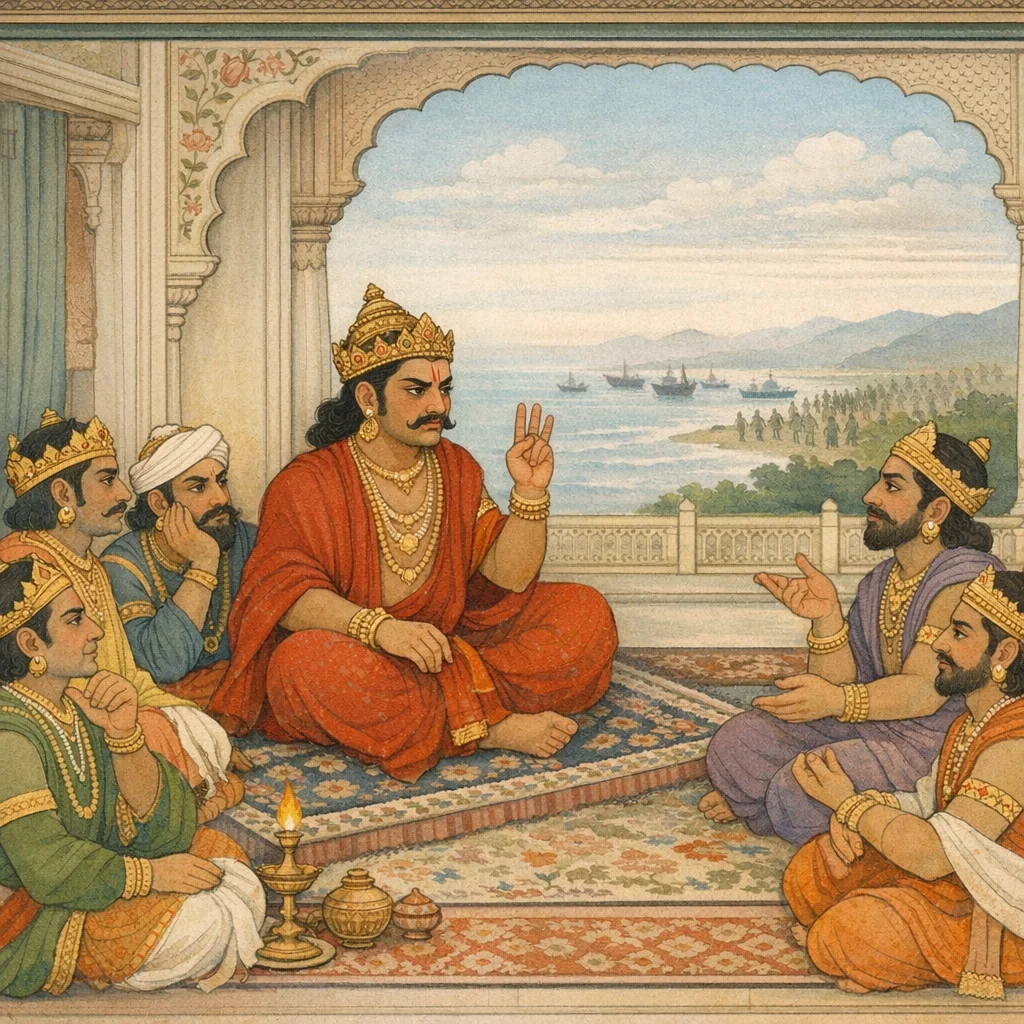
This sarga opens with Rāvaṇa assessing the भयावह (terrifying) consequences of Hanumān’s actions in Laṅkā—an intrusion that included destruction, the killing of leading rākṣasas, and the successful sighting of Sītā. Marked by a rare note of शर्म/ह्री (shame) and a lowered head, the rākṣasa king turns to collective deliberation, explicitly treating victory as मन्त्र-मूल (rooted in counsel). He then classifies human agency and advisory quality into a threefold typology—uttama, madhyama, adhama—linking competence to the discipline of consultation and to reliance on daiva (trust in a higher moral order). The “best” actor deliberates with capable ministers and allies and proceeds with faith; the “mediocre” acts alone; the “lowly” ignores merit and demerit and asserts egoic independence (“I will do it”) without daiva. Extending this into political theory, he ranks counsel itself: unanimous, śāstra-informed agreement is optimal; consensus reached after divergent views is middling; stubborn factional speech without unity is condemned. The chapter concludes with an immediate strategic urgency: Rāma, surrounded by thousands of valorous Vānaras, is approaching to besiege Laṅkā, and Rāvaṇa requests a plan benefiting both city and army.
Shlokas
Verse 1
लङ्कायांतुकृतंकर्मघोरंदृष्टवाभयावहम् ।राक्षसेन्द्रोहनुमताशक्रेणेवमहात्मना ।।6.6.1।।अब्रवीद्राक्षसान् सर्वान्ह्रियाकिञ्चिदवाङ्मुखः ।
Seeing the dreadful, fearsome deed done in Laṅkā by Hanumān—the great-souled one, like Indra in might—the lord of rākṣasas, somewhat ashamed and with head bowed, addressed all the rākṣasas.
Verse 2
धर्षिताचप्रविष्टाचलङ्कादुष्प्रसहापुरी ।।6.6.2।।तेनवानरमात्रेणदृष्टासीताचजानकी ।
That hard-to-enter city of Laṅkā was violated and entered by him—by one who was, after all, only a single Vānara; and Janaka’s daughter Sītā was seen.
Verse 3
प्रासादोधर्षितश्चैत्यःप्रवराराक्षसाहताः ।।6.6.3।।आविलाचपुरीलङ्कासर्वाहनुमताकृता ।
Mansions and shrines were ravaged, foremost Rākṣasas were slain, and the entire city of Laṅkā was thrown into turmoil—all by Hanumān.
Verse 4
किंकरिष्यामिभद्रंवोकिंवायुक्तमनन्तरम् ।।6.6.4।।उच्यतांनस्समर्थंयत्कृतंचसुकृतंभवेत् ।
What should I do? What, in truth, is the proper course now? Tell us what is truly effective—what action would be well-done and beneficial.
Verse 5
मन्त्रमूलंचविजयंप्रवदन्तिमनस्विनः ।।6.6.5।।तस्मद्वैरोचयेमन्त्रंरामंप्रतिमहाबलाः ।
The wise declare that victory is rooted in counsel; therefore, O mighty ones, I seek deliberation and advice in facing Rāma.
Verse 6
त्रिविधाःपुरुषालोकेउत्तमाधममध्यमाः ।।6.6.6।।तेषांतुसमवेतानांगुणदोषौवदाम्यहम् ।
In this world, people are of three kinds—excellent, middling, and base. Of these, as they appear in an assembly, I will speak of their strengths and faults.
Verse 7
मन्त्रिभिर्हितसंयुक्तैस्समर्थैर्मन्त्रनिर्णये ।।6.6.7।।मित्रैर्वापिसमानार्थैर्बान्धवैरपिवाधिकैः ।सहितोमन्त्रियित्वायःकर्मारम्भान्प्रवर्तयेत् ।।6.6.8।।दैवेचकुरुतेयत्नंतमाहुःपुरुषोत्तमम् ।
He is called the best of men who, supported by well-wishing ministers capable of sound counsel—along with friends and kinsmen sharing the same aims—deliberates before beginning undertakings, and then strives with due regard for the divine.
Verse 8
मन्त्रिभिर्हितसंयुक्तैस्समर्थैर्मन्त्रनिर्णये ।।6.6.7।।मित्रैर्वापिसमानार्थैर्बान्धवैरपिवाधिकैः ।सहितोमन्त्रियित्वायःकर्मारम्भान्प्रवर्तयेत् ।।6.6.8।।दैवेचकुरुतेयत्नंतमाहुःपुरुषोत्तमम् ।
He is called the best of men who, supported by well-wishing ministers capable of sound counsel—along with friends and kinsmen sharing the same aims—deliberates before beginning undertakings, and then strives with due regard for the divine.
Verse 9
कोऽर्थंविमृशेदेकोधर्मेप्रकुरुतेमनः ।।6.6.9।।कःकार्याणिकुरुतेतमाहुर्मध्यमंनरम् ।
One who reflects on aims alone, deliberates on duty only within his own mind, and carries out tasks by himself—such a person is said to be a ‘middling’ man (of merely average counsel and capacity).
Verse 10
गुणदोषौवनिशिचत्य त्यक्त्यादैवव्यपाश्रयम् ।।6.6.10।।करिष्यामीतियःकार्यमुपेक्षेत्सनराधमः ।
He who, without weighing merit and fault, and having abandoned reliance on providence, undertakes a task thinking, “I alone will do it,”—that man is the lowest of men.
Verse 11
यथेमेपुरुषानित्यमुत्तमाधममध्यमाः ।।6.6.11।।वंमन्त्राऽहिविज्ञेयाउत्तमाधममध्यमः ।
Just as men are invariably of three kinds—excellent, middling, and base—so too should counsel be understood as threefold: excellent, middling, and base.
Verse 12
ऐकमत्यमुपागम्यशास्त्रदृष्टेनचक्षुषा ।।6.6.12।।मन्त्रिणोयत्रनिरतास्तमाहुर्मन्त्रमुत्तमम् ।
That counsel is called the best in which ministers, looking with the eye of śāstra, come together in unanimity and remain firmly committed to it.
Verse 13
बह्व्योऽपिमतीर्गत्वामन्त्रिणामर्थनिर्णये ।।6.6.13।।पुनर्यत्रैकतांप्राप्तस्समन्त्रोमध्यमस्स्मृतः ।
When, in deciding a matter, ministers arrive at many differing views but later attain unity, that counsel is remembered as middling.
Verse 14
अन्योन्यमतिमास्थाययत्रसम्प्रतिभाष्यते ।।6.6.14।।नचैकमत्येश्रेयोऽस्तिमन्त्रस्सोऽधमउच्यत ।
Where each clings to his own opinion and speaks only in self-pleasing rebuttal, and no good arises through unanimity—such counsel is called base.
Verse 15
तस्मात्सुमन्त्रितंसाधुभवन्तोमतिसत्तमा: ।।6.6.15।।कार्यंसम्प्रतिपद्यन्तामेतत्कृत्यंमतंमम ।
Therefore, O best of the wise, deliberate well and rightly, and settle upon the course of action—this is my considered requirement.
Verse 16
वानराणांहिधीराणांसहस्रैःपरिवारितः ।।6.6.16।।रामोऽभ्येतिपुरीलङ्कामस्माकमुपरोधकः ।
For Rāma, surrounded by thousands of steadfast Vānaras, is advancing toward the city of Laṅkā to lay siege against us.
Verse 18
समुद्रमुच्छोषयतिवीर्येणान्यत्करोतिवा ।।6.6.18।।अस्मिन्नेवंगतेकार्येविरुद्धेवानरैस्सह ।हितंपुरेचसैन्येचसर्वसम्मन्त्रयतांमम ।।6.6.19।।
He may, by his prowess, dry up the ocean—or accomplish some other extraordinary deed. Since matters have come to this, with the Vānaras as our adversaries, advise me fully on what will be beneficial both for the city and for the army.
Frequently Asked Questions
Rāvaṇa confronts a leadership crisis after Hanumān’s successful incursion and must choose between impulsive reaction and disciplined consultation; the sarga frames ethical action as evaluating guṇa-doṣa (merits and faults) and avoiding ego-driven decisions made without daiva-oriented restraint.
The chapter teaches that effective power is inseparable from wise counsel: unanimity grounded in śāstra yields the best outcomes, while factional stubbornness degrades decision-making; additionally, action undertaken with consultation and daiva-vyapāśraya is ranked superior to solitary or self-willed conduct.
Laṅkā (as a fortified capital and civic space) is central, and the समुद्र (ocean) is invoked as a strategic boundary that Rāma may overcome by extraordinary means, underscoring the siege geography and the cultural imagination of superhuman war-capability.