Sarga 59
युद्धकाण्डे एकोनषष्टितमः सर्गः — Rāvaṇa’s Assault on Nīla and Lakṣmaṇa; Hanumān Bears Rāma
युद्धकाण्ड
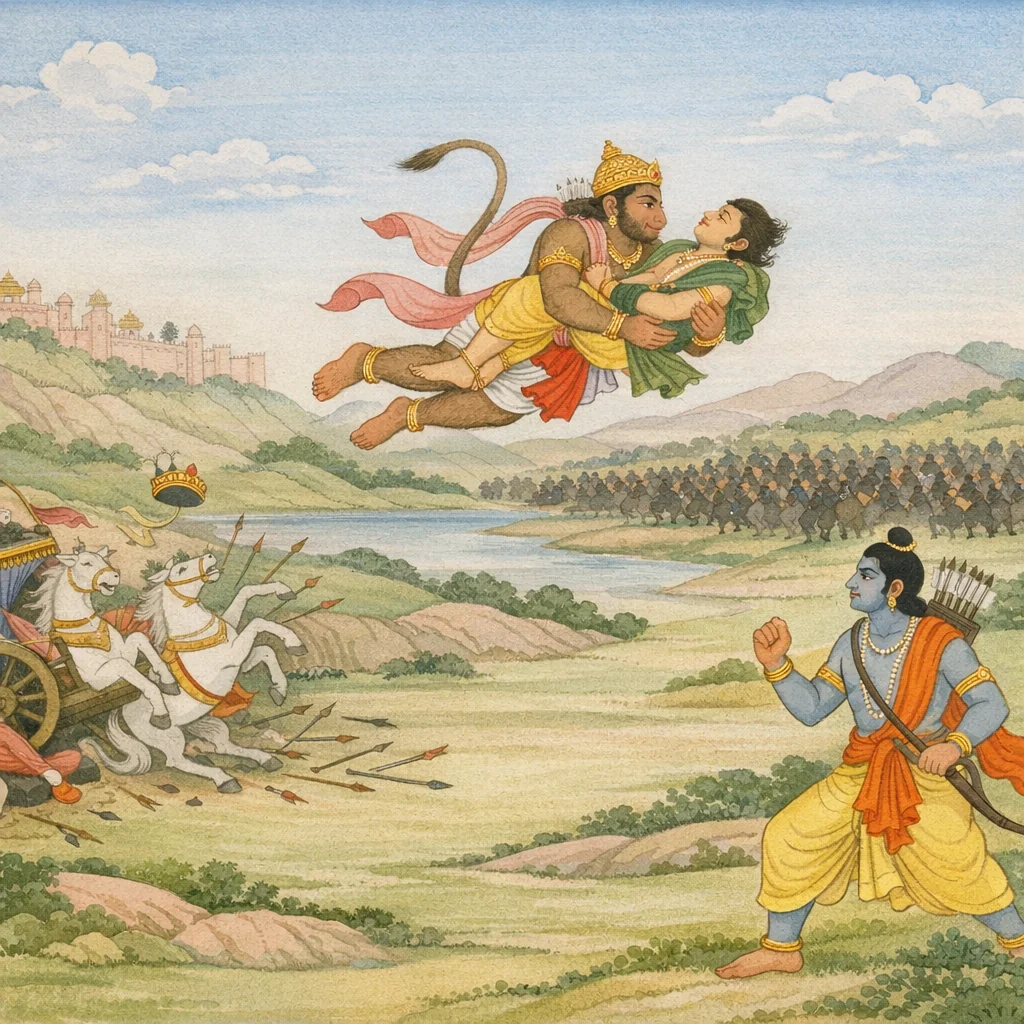
Sarga 59 escalates the war’s center of gravity from general engagement to direct royal confrontation. After the fall of the Rakṣasa commander-in-chief (reported as slain by Nīla), Rāvaṇa emerges from Laṅkā and surveys the Vānara host massed like an ocean of clouds wielding trees and rocks. Tactical exchanges unfold: Sugrīva’s mountain-peak assault is neutralized, and several Vānara leaders are driven to seek refuge with Rāma. Rāvaṇa then concentrates on Nīla, whose agility atop the enemy’s bow momentarily destabilizes the king’s response, prompting Rāvaṇa to employ a fire-charged missile that strikes Nīla down without ending his life. The narrative pivots to a high-stakes duel between Rāvaṇa and Lakṣmaṇa: volleys of arrows are cut down, Rāvaṇa uses a Brahmā-gifted arrow to wound Lakṣmaṇa, and finally hurls a formidable śakti (javelin) that pierces Lakṣmaṇa’s chest. As Lakṣmaṇa falters, Rāvaṇa attempts to seize him, but cannot lift him; Hanumān intervenes with a thunderbolt-like fist, rescues Lakṣmaṇa to Rāma, and offers his back as a mount. Rāma accepts, advances on Hanumān, shatters Rāvaṇa’s chariot and crown, yet—declaring Rāvaṇa exhausted—refrains from killing him, directing him to return rested for a renewed encounter. The sarga thus juxtaposes ferocity with restraint, highlighting war-ethics, ally-protection, and the controlled deployment of power.
Shlokas
Verse 1
तस्मिन्हतेराक्षससैन्यपालेप्लवङ्गमानामृषभेणयुद्धे ।भीमयुधंसागरतुल्यवेगंविदुद्रुवेराक्षसराजसैन्यम् ।।6.59.1।।
When the commander of the Rakshasa army was slain in battle by the bull among the Vanaras, the Rakshasa king’s forces—armed with dreadful weapons and rushing like the ocean’s surge—broke and fled.
Verse 2
गत्वाऽथरक्षोधिपतेश्शशंसुस्सेनापतिंपावकसूनुशस्तम् ।तच्छापितेषांवचनंनिशम्यरक्षोधिपःक्रोधवशंजगाम ।।6.59.2।।
Then, having gone to the lord of the rākṣasas, the survivors reported that the commander-in-chief had been slain by the son of the Fire-god. Hearing their report, the lord of the rākṣasas fell under the sway of anger.
Verse 3
सङ् ख्येप्रहस्तंनिहतंनिशम्यशोकार्दितःक्रोधपरीतचेताः ।उवाचतान्राक्षसयूथमुख्यानिन्द्रोयथानिर्जरयोथमुख्यान् ।।6.59.3।।
Hearing that Prahasta had been slain in battle, he—struck by grief and overwhelmed by anger—addressed the foremost leaders of the rākṣasa hosts, as Indra addresses the chiefs of the immortal troops.
Verse 4
नावज्ञारिपवेकार्यायैरिन्द्रबलसूदनः ।सूदितस्सैन्यपालोमेसानुयात्रस्सकुञ्जरः ।।6.59.4।।
“Do not hold the enemy in contempt—he is the one by whom my commander of the army was slain, a warrior capable of crushing even Indra’s host, along with his followers and elephants.”
Verse 5
सोऽहंरिपुविनाशायविजयायाविचारयन् ।स्वयमेवगमिष्यामिरणशीर्षंतदद्भुतम् ।।6.59.5।।
“So I myself, intent on the enemy’s destruction and on victory, shall go—without hesitation—to that wondrous forefront of the battle.”
Verse 6
अद्यतद्वानरानीकंरामंचसहलक्ष्मणम् ।निर्दहिष्यामिबाणौघैर्वनंदीप्स्सैरिवानगिभिः ।।6.59.6।।
“Today I shall burn up that Vānara host—Rāma as well, together with Lakṣmaṇa—by torrents of arrows, as though a forest were set ablaze by flames that need no fire-brand.”
Verse 7
सएवमुक्त्वाज्वलनप्रकाशंरथंतुरङ्गोत्तमराजयुक्तम् ।प्रकाशमानंवपुषाज्वलन्तंसमारुरोहामरराजशत्रुः ।।6.59.7।।
Having spoken thus, Rāvaṇa—the foe of Indra—mounted a chariot radiant like fire, yoked to the finest royal steeds, blazing with a golden sheen.
Verse 8
सशङ्खभेरीपणवप्रणादैरास्फोटितक्षेळ्वितसिंहनादैः ।पुण्यैस्स्तवैश्चाप्यभिपूज्यमानस्तदाययौराक्षसराजमुख्य:।। 6.59.8।।
Then the foremost king of the Rākṣasas went forth, accompanied by the blare of conches, the booming of drums, the clapping and shouts, and lion-like roars—while he was praised and highly honored with auspicious hymns.
Verse 9
सशैलजीमून्तिकाशरूपैर्मांसादनैःपावकदीप्तनेत्रैः ।बभौवृतोराक्षसराजमुख्योभूतैर्वृतोरुद्रइवासुरेशः ।।6.59.9।।
Surrounded by flesh-eating beings with eyes blazing like fire, whose forms resembled mountains and storm-clouds, the foremost king of the Rākṣasas shone forth—like Rudra encircled by bhūtas among the asuras.
Verse 10
ततोनगर्यास्सहसामहौजानिष्क्रम्यतद्वानरसैन्यमुग्रम् ।महार्णवाभ्रस्तनितंददर्शसमुद्यतंपादपशैलहस्तम् ।।6.59.10।।
Then the mighty one suddenly came out from the city and saw that fierce Vanara host, gathered and uplifted—like the roar of ocean and thunderclouds—bearing trees and rocks in their hands.
Verse 11
तद्राक्षसानीकमतिप्रचण्डमालोक्यरामोभुजगेन्द्रबाहुः ।विभीषणंशस्त्रभृतांवरिष्ठमुवाचसेवानुगतःपृथुश्रीः ।।6.59.11।।
Seeing that exceedingly fierce host of Rākṣasas, Rama—whose arms were like the serpent-king’s, radiant with broad splendour, and attended by his forces—addressed Vibhīṣaṇa, foremost among weapon-bearers.
Verse 12
नानापताकध्वजशस्त्रजुष्टंप्रासासिशूलायुथवज्रजुष्टम् ।कस्येदमक्षोभ्यमभीरुजुष्टंमहेन्द्रोपमनागजुष्टम् ।।6.59.12।।
“Whose is this unshakable army—adorned with many kinds of banners and standards, bristling with weapons such as spears, swords, tridents, clubs and thunderbolt-like arms, fearless, and supported by elephants as vast as Mount Mahendra?”
Verse 13
ततस्तुरामस्यनिशम्यवाक्यंविभीषणंश्शक्रसमानवीर्यः ।शशंसरामस्यबलप्रवेगंमहात्मनांराक्षसपुङ्गवानाम् ।।6.59.13।।
Then Vibhīṣaṇa—heroic as Indra—having heard Rāma’s words, reported to Rāma the might and onrush of the great-souled leaders of the Rākṣasas.
Verse 14
योऽसौगजस्कन्धगतोमहात्मानवोदितार्कोपमताम्रवक्त्रः ।प्रकम्पयन्नागशिरोऽभ्युपैतिह्यकम्पनंत्वेनमवेहिराजन् ।।6.59.14।।
O King, know him to be Akampana—this great warrior who sits upon the elephant’s shoulder, whose coppery face is like the newly risen sun, and who approaches, making the elephant’s head tremble.
Verse 15
योऽसौरथस्थोमृगराजकेतुर्दून्वस्थिन्दनुश्शक्रधनुःप्रकाशम् ।करीवभात्युग्रविवृत्तदंष्ट्रस्सइन्द्रजिन्नामवरप्रधानः ।।6.59.15।।
He there, standing on his chariot and marked with the emblem of a lion, brandishes a bow shining like Indra’s. With fearsome tusks thrust forward, he appears like an elephant—this is Indrajit, eminent through the boons he has obtained.
Verse 16
यश्चैषव्निध्यास्तमहेन्द्रकल्पोधन्वीरथस्थोऽतिरथोतिवीरः ।विष्पारयन् चापमतुल्यमानंनाम्नातिकायोऽतिविवृद्धकायः ।।6.59.16।।
And this one—like the Vindhya and Mahendra mountains—an archer on his chariot, a great chariot-warrior and mighty hero, stretching a bow of unmatched size: he is named Atikāya, huge-bodied and immensely grown.
Verse 17
योऽसौनवार्कोदितताम्रचक्षुरारुह्यघण्टानिनदप्रणादम् ।गजंखरंगर्जतिवैमहात्मामहोदरोनामसएषःवीरः ।।6.59.17।।
He there, with copper-red eyes as though the new sun had risen, mounting an elephant whose trumpeting resounds like bells, roars harshly—this great warrior is named Mahodara.
Verse 18
योऽसौहयंकाञ्चनचित्रभाण्डमारुह्यसन्ध्याभ्रगिरिप्रकाशम् ।प्रासंसमुद्यम्यमरीचिनद्धंपिशाचएषोऽशनितुल्यवेगः ।।6.59.18।।
He there, mounted on a horse adorned with golden ornaments and shining like a mountain wreathed in twilight clouds, raises a spear that gleams with rays; this is Piśāca, swift as a thunderbolt.
Verse 19
यश्चैषशूलंनिशितंप्रगृह्यविद्युत्प्रभंकिङ्करवज्रवेगम् ।वृषेन्द्रमास्थायगिरिप्रकाशमायातियोऽसौत्रिशिरायशस्वी ।।6.59.19।।
And this one, grasping a sharpened trident that flashes like lightning and moves with the speed of a thunderbolt, comes riding a lordly bull shining like a mountain—he is the famed Triśirā.
Verse 20
असौचजीमूतनिकाशरूपःकुम्भःपृथुव्यूढसुजातवक्षाः ।समाहितःपन्नगराजकेतुर्विष्पारयन्यातिधनुर्विधून्वन् ।।6.59.20।।
And there comes Kumbha, cloud-like in form, with a broad, well-built chest—fully prepared, bearing the emblem of the king of serpents, drawing and brandishing his bow as he advances.
Verse 21
यश्चैषजाम्बूनदवज्रजुष्टंदीप्तंसधूमंपरिघंप्रगृह्य ।आयातिरक्षोबलकेतुभूतःसोऽसौनिकुम्भोऽद्भुतघोरकर्मा ।।6.59.21।।
And this one, seizing a blazing iron club studded with gold and diamonds, smoky as it shines, advances as the very standard-bearer of the rākṣasa host—this is Nikumbha, performer of wondrous and dreadful deeds.
Verse 22
यश्चैषचापासिशरौघजुष्टंपताकिनंपावकदीप्तरूपम् ।रथंसमास्थायविभात्युदग्रोनरान्तकोऽसौनगशृङ्गयोधी ।।6.59.22।।
And this one, mounted on a chariot crowded with bows, swords, and flights of arrows—flagged and blazing like fire—shines forth aloft: he is Narāntaka, the fighter who battles with mountain-peaks.
Verse 23
यश्चैषनानाविधघोररूपैर्व्याघ्रोष्ट्रनागेन्द्रमृगाश्ववक्त्रै: ।भूतैर्वृतोभातिविवृत्तनेत्स्रैसोऽसौसुराणामपिदर्पहन्ता ।।6.59.23।।त्रैतदिन्दुप्रतिमंविभातिछत्रंसितंसूक्ष्मशलाकमग्य्रम् ।अत्रैषरक्षोधिपतिर्महात्माभूतैर्वृतोरुद्रइवावभाति ।।6.59.24।।
He who shines there, encircled by spirits of many terrifying forms—faces like tiger, camel, lordly elephant, deer, and horse—eyes rolling wildly: that is the very one who crushes the pride even of the gods.
Verse 24
यश्चैषनानाविधघोररूपैर्व्याघ्रोष्ट्रनागेन्द्रमृगाश्ववक्त्रै: ।भूतैर्वृतोभातिविवृत्तनेत्स्रैसोऽसौसुराणामपिदर्पहन्ता ।।6.59.23।।त्रैतदिन्दुप्रतिमंविभातिछत्रंसितंसूक्ष्मशलाकमग्य्रम् ।अत्रैषरक्षोधिपतिर्महात्माभूतैर्वृतोरुद्रइवावभाति ।।6.59.24।।
There shines above him a supreme white royal canopy, moon-like, with delicate ribs. Here stands that great lord of the rākṣasas, surrounded by spirits, blazing like Rudra amid his attendants.
Verse 25
असौकिरीटीचलकुण्डलास्योनगेन्द्रविन्ध्योपमभीमकायः ।महेन्द्रवैवस्वतदर्पहन्तारक्षोधिपस्सूर्यइवावभाति ।।6.59.25।।
There stands the rākṣasa-lord, crowned, his face adorned with swinging earrings—his dreadful body like the king of mountains and the Vindhya—one who has humbled even Indra and Yama; he blazes like the sun.
Verse 26
प्रत्युवाचततोरामोविभीषणमरिन्दम् ।अहोदीप्तमहातेजारावणोराक्षसेश्वरः ।।6.59.26।।
Then Rāma, the subduer of foes, replied to Vibhīṣaṇa: “Ah—Rāvaṇa, lord of rākṣasas, is indeed blazing with tremendous splendor.”
Verse 27
आदित्यइवदुष्प्रेक्ष्योरश्मिभिर्भातिरावणः ।सुव्यक्तंलक्ष्यतेह्यस्यरूपंतेजःसमावृतम् ।।6.59.27।।
Rāvaṇa shines with rays like the sun, hard to look upon; for his form is veiled all around by radiance and cannot be clearly made out.
Verse 28
देवदानववीराणांवपुर्नैवंविधंभवेत् ।यादृशंराक्षसेन्द्रस्यवपुरेतत्प्रकाशते ।।6.59.28।।
Among heroes of the gods and dānavas, such a form would not be found; such is the blazing stature that shines forth in this lord of rākṣasas.
Verse 29
सर्वेपर्वतसङ्काशास्सर्वेपर्वतयोधिनः ।सर्वेदीप्तायुधधरायोधाश्चास्यमहोजस:।। 6.59.29।।
All his warriors are mountain-like; all are fighters who hurl mountains; all bear blazing weapons—these combatants of his are of immense strength.
Verse 30
भातिरक्षोराजोऽसौप्रदीप्त्तैर्भीमविक्रमैः ।भूतैःपरिवृतस्तीक्ष्णैर्देहवद्भिरिवान्तकः ।।6.59.30।।
That king of rākṣasas shines, surrounded by fierce, sharp, embodied beings of dreadful valor—like Antaka (Death) amid his own forms.
Verse 31
दिष्ट्याऽयमद्यपापात्माममदृष्टिपथंगतः ।अद्यक्रोधंविमोक्ष्यामिसीताहरणसम्भवम् ।।6.59.31।।
By good fortune, this sinful one has today come within my sight. Today I will unleash the wrath that was born from Sītā’s abduction.
Verse 32
एवमुक्त्वाततोरामोधनुरादायवीर्यवान् ।लक्ष्मणानुचरस्तस्थौसमुद्धृत्यशरोत्तमम् ।।6.59.32।।
Having spoken thus, the mighty Rāma took up his bow; with Lakṣmaṇa following close, he stood ready, raising an excellent arrow.
Verse 33
ततःसरक्षोधिपतिर्महात्मारक्षांसितान्याहमहाबलानि ।द्वारेषुचर्यागृहगोपुरेषुसुनिर्वृतास्तिष्ठतनिर्विशङ्काः ।।6.59.33।।
Then the great-souled lord of the Rākṣasas addressed those powerful Rākṣasas: “Stand stationed—confident and without fear—at the gates and at the watch-houses and city-towers along the main thoroughfares.”
Verse 34
हाऽगतंमांसहितंभवद्भिर्वनौकसश्छिद्रमिदंविदित्वा ।शून्यापुरींदुष्प्रसहांप्रमथ्यप्रधर्षयेयुस्सहसासमेताः ।।6.59.34।।
“If the forest-dwellers learn that I have come out here along with you, they may take this as a vulnerable opening; gathering swiftly, they could break into the (momentarily) unguarded city and ravage it.”
Verse 35
विसर्जयित्वासचिवांस्ततस्तान्गतेषुरक्षस्सुयथानियोगम् ।व्यचारयद्वानरसागरौघंमहाझषःपूर्णमिवार्णवौघम् ।।6.59.35।।
After dismissing those counsellors, and once the Rākṣasas had gone to their posts as instructed, Rāvaṇa moved through the vast ‘ocean’ of Vānaras—like a great fish cleaving the swelling sea.
Verse 36
तमापतन्तंसहसासमीक्ष्यदीप्तेषुचापंयुधिराक्षसेन्द्रम् ।महत्समुत्पाट्यमहीधराग्रंदुद्रावरक्षोधिपतिंहरीशः ।।6.59.36।।
Seeing the Rākṣasa king rushing forward in battle with his blazing bow, the lord of the Vānaras tore up a massive mountain-peak and charged toward the lord of the Rākṣasas.
Verse 37
तच्छैलशृङ्गंबहुवृक्षसानुंप्रगृह्यचिक्षेपनिशाचराय ।तमापतन्तंसहसासमीक्ष्यचिच्छेदबाणैस्तपनीयपुङ्खैः ।।6.59.37।।
Grasping that mountain-peak, its slopes thick with trees, Sugrīva hurled it at the night-roamer; seeing it rush in, Rāvaṇa swiftly shattered it with arrows whose shafts were of gold.
Verse 38
तस्मिन् प्रवृद्धोत्तमसानुवृक्षेशृङ्गेविकीर्णेपतितेपृथिव्याम् ।महाहिकल्पंशरमन्तकाभंसमादधेराक्षसलोकनाथः ।।6.59.38।।
When that towering, tree-clad peak lay shattered and strewn upon the ground, the lord of the Rākṣasa realm fitted an arrow—serpent-like and deathly in its appearance—as though to bring annihilation.
Verse 39
सतंगृहीत्वाऽनिलतुल्यवेगंसविस्फुलिङ्गज्वलनप्रकाशम् ।बाणंमहेन्द्राशनितुल्यवेगंचिक्षेपसुग्रीववधायरुष्टः ।।6.59.39।।
Enraged, he seized that arrow—swift as the wind, gleaming like a flame scattering sparks, and fast as Indra’s thunderbolt—and hurled it for Sugrīva’s death.
Verse 40
ससायकोरावणबाहुमुक्तःशक्राशनिप्रख्यवपुश्शिताग्रः ।सुग्रीवमासाद्यबिभेदवेगाद्गुहेरिताक्रौञ्चमिवोग्रशक्तिः ।।6.59.40।।
That missile, released from Rāvaṇa’s arm—keen-pointed and formidable like Indra’s thunderbolt—reached Sugrīva and pierced him with force, like the fierce spear once hurled by Guha that split Mount Krauñca.
Verse 41
ससायकार्तोविपरीतचेताःकूजन्पृथिव्यांनिपपातवीरः ।तंप्रेक्ष्यभूमौपतितंविसंज्ञंनेदुःप्रहृष्टायुधियातुधानाः ।।6.59.41।।
That hero, wounded by an arrow and bereft of clear awareness, fell to the earth, groaning. Seeing him lying senseless on the ground, the yātudhānas (rākṣasas) cried out in the battle, exulting.
Verse 42
ततोगवाक्षोगवयस्सुदंष्ट्रस्त्वथर्षभोज्योतिमुखोनलश्च ।शैलान् समुत्पाट्यविवृद्धकायाःप्रदुद्रुवुस्तंप्रतिराक्षसेन्द्रम् ।।6.59.42।।
Then Gavākṣa, Gavaya, Sudaṃṣṭra, and also Ṛṣabha, Jyotimukha, and Nala—swelling their bodies in might—tore up rocks and rushed against that lord of the rākṣasas.
Verse 43
तेषांप्रहारान् सचकारमोघान् रक्षोधिपोबाणशतैःशिताग्रैः ।तान्वानरेन्द्रानपिबाणजालैर्बिभेदजाम्बूनदचित्रपुङ्खैः ।।6.59.43।।
The lord of the rākṣasas rendered their blows futile with hundreds of sharp-pointed arrows; and with volleys of arrows—golden, with variegated fletching—he pierced even those vānaras who were leaders.
Verse 44
तेवानरेन्द्रास्त्रिदशारिबाणैर्भिन्नानिपेतुर्भुविभीमकायाः ।ततस्तुतद्वानरसैन्यमुग्रंप्रच्छादयामाससबाणजालैः ।।6.59.44।।
Those fearsome-bodied leaders of the vānaras, torn by the arrows of the foe of the gods, fell upon the ground. Then he covered that formidable vānara army with torrents of arrows.
Verse 45
तेवध्यमानाःपतिताःप्रवीरानानद्यमानाभयशल्यविद्धाः ।शाखामृगारावणसायकार्ताजग्मुश्शरण्यंशरणंस्मरामम् ।।6.59.45।।
Struck down and fallen—those foremost heroes, crying out and pierced by the dart of fear—those monkeys, afflicted by Rāvaṇa’s arrows, went to Rāma as their refuge, the one worthy to grant protection.
Verse 46
ततोमहात्मासधनुर्धनुष्मानादायरामस्सहसाजगाम ।तंलक्ष्मणःप्राञ्जलिरभ्युपेत्यउवाचवाक्यंपरमार्थयुक्तम् ।।6.59.46।।
Then the great-souled Rāma, the mighty bowman, took up his bow and moved forth at once. Approaching him with folded hands, Lakṣmaṇa spoke words grounded in the highest purpose and truth.
Verse 47
काममार्यस्सुपर्याप्तोवधायास्यदुरात्मनः ।विधमिष्याम्यहंचैतमनुजानीहिमांविभो ।।6.59.47।।
“O noble one, I am fully able to bring about the death of this evil-minded foe. I shall destroy him—grant me leave, O mighty lord.”
Verse 48
तमब्रवीन्महातेजारामस्सत्यपराक्रमः ।गच्छयत्नपरश्चापिभवलक्ष्मण संयुगे ।।6.59.48।।
To him Rāma—radiant in power and steadfast in true valor—said: “Go, Lakṣmaṇa; and in the battle be vigilant and careful.”
Verse 49
रावणोहिमहावीर्योरणेऽद्भुतपराक्रमः ।त्रैलोक्येनापिसङ्क्रुद्धोदुष्प्रसह्योनसंशयः ।।6.59.49।।
“For Rāvaṇa is a mighty hero, of wondrous prowess in battle. When enraged, he is hard to withstand even for the three worlds—of this there is no doubt.”
Verse 50
तस्यच्छिद्राणिमार्गस्वस्वच्छिद्राणिचलक्ष्य ।चक्षुषाधनुषायत्ना प्रक्षात्मानंसमाहितः ।।6.59.50।।
Stay vigilant: track the course of his missiles, aim your own shafts accordingly, and with steady eyes, bow in hand, strive to guard yourself with full composure.
Verse 51
राघवस्यवचश्श्रुत्वासपरिष्वज्याभिपूज्यच ।अभिवाद्यतत् रामंययौसौमित्रिराहवम् ।।6.59.51।।
Hearing Rāghava’s words, Saumitri embraced him, honored him with reverence, saluted Rama, and then went forth to the battle.
Verse 52
सरावणंवारणहस्तबाहुंददर्शभीमोद्यतदीप्तचापम् ।प्रच्छादयन्तंशरवृष्टिजालैस्तान्वानराभनिन्नविकीर्णदेहान् ।।6.59.52।।
He beheld Rāvaṇa—mighty-armed like an elephant’s trunk—his blazing bow raised in terror, as he covered the field with nets of arrow-showers, while the vānaras lay shattered and strewn about.
Verse 53
तमालोक्यमहातेजाहनूमान्मारुतात्मजः ।निवार्यशरजालानिप्रदुद्रावसरावणम् ।।6.59.53।।
Seeing him, the radiant Hanumān, son of the Wind, checked the onrushing nets of arrows and charged straight toward Rāvaṇa.
Verse 54
रथंतस्यसमासाद्यबाहुमुद्यम्यदक्षिणम् ।त्रासयन्रावणंधीमान्हनूमान्वाक्यमब्रवीत् ।।6.59.54।।
Closing in on his chariot, the wise Hanumān lifted his right arm in menace toward Rāvaṇa and spoke these words.
Verse 55
देवदानवगन्धर्वायक्षाश्चसहराक्षैसैः ।अवश्यंतुत्वयाभग्नावानरेभ्यस्तुतेभयम् ।।6.59.55।।
“Surely you have broken gods, demons, Gandharvas, and Yakṣas—along with the Rākṣasas at your side; yet it is from the vānaras that you now feel fear.”
Verse 56
एषमेदक्षिणोबाहुःपञ्चशाखःसमुद्यतः ।विधमिष्यतितेदेहाद्भूतात्मानंचिरोषितम् ।।6.59.56।।
“This is my right arm, raised high—five-branched with its fingers; it will drive your long-indwelling spirit from your body.”
Verse 57
श्रुत्वाहनुमतोवाक्यंरावणोभीमविक्रमः ।संरक्तनयनःक्रोधादिदंवचनमब्रवीत् ।।6.59.57।।
Hearing Hanumān’s words, Rāvaṇa—terrible in prowess—his eyes reddened with wrath, replied with these words.
Verse 58
क्षिप्रंप्रहरनिःशङ्कंस्थिरांकीर्तिमवाप्नुहि ।ततस्त्वांज्ञातविक्रान्तंनाशयिष्यामिवानर ।।6.59.58।।
“Strike quickly, without hesitation, and win lasting fame; then, once I have measured your prowess, I shall destroy you, O vānara.”
Verse 59
रावणस्यवचश्श्रुत्वावायुसूनुर्वचोऽब्रवीत् ।प्रहृतंहिमयापूर्वमक्षंतवसुतंतव ।।6.59.59।।
Hearing Rāvaṇa’s words, the Wind’s son replied: “Indeed, I struck down earlier your son Akṣa.”
Verse 60
एवमुक्तोमहातेजारावणोराक्षसेश्वरः ।आजघानानिलसुतंतलेनोरसिवीर्यवान् ।।6.59.60।।
Thus addressed, the mighty and radiant lord of the Rākṣasas—valiant Rāvaṇa—struck Anila’s son (Hanumān) with his palm upon the chest.
Verse 61
सतलाभिहतस्तेनचचालचमुहुर्मुहुः ।स्थित्वामुहूर्तंतेजस्वीस्थैर्यंकृत्वामहामतिः ।।6.59.61।।आजघानाभिसङ्कृद्धस्तलेनैवामरद्विषम् ।
Struck by him with the palm, Hanumān reeled again and again. Then the brilliant, great-minded one stood firm for a moment; regaining steadiness, and inflamed with anger, he struck the foe of the gods (Rāvaṇa) with his own palm.
Verse 62
ततस्ततेनाभिहतोवानरेणमहात्मना ।।6.59.62।।दशग्रीवःसमाधूतोयथाभूमिचलेऽचलः ।
Then, struck by that great-souled Vānara, Daśagrīva was shaken—like a mountain trembling when the earth itself quakes.
Verse 63
सङ्ग्रामेतंतथादृष्टवारावणंतलताडितम् ।।6.59.63।।ऋषयोवानराःसिद्धानेदुर्देवास्सहासुरैः ।
Seeing Rāvaṇa struck by a palm in that manner on the battlefield, sages, Vānaras, and Siddhas cried out—and even the gods, together with the Asuras, raised their voices.
Verse 64
अथाऽश्वास्यमहातेजारावणोवाक्यमब्रवीत् ।।6.59.64।।साधुवानर वीर्येणश्लाघनीयोऽसिमेरिपुः ।
Then the mighty Rāvaṇa, recovering his breath, spoke: “Well done, Vānara! By your valor you are worthy of praise—though you are my enemy.”
Verse 65
रावणेनैवमुक्तस्तुमारुतिर्वाक्यमब्रवीत् ।।6.59.65।।धिगस्तुममवीर्येणयस्त्वंजीवसिरावण ।
Thus addressed by Rāvaṇa, Māruti replied: “Shame on my valor—if you, Rāvaṇa, still live!”
Verse 66
सकृत्तुप्रहरेदानींदुर्भुद्धे किंविकत्थसे ।।6.59.66।।ततस्त्वांमामिकामुष्टिर्नयिष्यतियमक्षयम् ।
“Strike just once more now, evil-minded one—why do you boast? Then this fist of mine will send you to Yama’s abode.”
Verse 67
तोमारतिवाक्येनकोधस्तस्यतदाऽज्वलत् ।।6.59.67।।संरक्तनयनोयत्नान्मुष्टिमुद्यम्यदक्षिणम् ।पातयामासवेगेनवानरोरसिवीर्यवान् ।।6.59.68।।
Stung by Māruti’s words, his anger then flared up. With eyes reddened, the valiant one raised his right fist with effort and, with speed, brought it down upon the Vānara’s chest.
Verse 68
तोमारतिवाक्येनकोधस्तस्यतदाऽज्वलत् ।।6.59.67।।संरक्तनयनोयत्नान्मुष्टिमुद्यम्यदक्षिणम् ।पातयामासवेगेनवानरोरसिवीर्यवान् ।।6.59.68।।
Stung by Māruti’s words, his anger then flared up. With eyes reddened, the valiant one raised his right fist with effort and, with speed, brought it down upon the Vānara’s chest.
Verse 69
हनूमान् वक्षसिव्यूढेसञ्चचालहतःपुनः ।विह्वलंतुतदादृष्टवाहनूमन्तंमहाबलम् ।।6.59.69।।रथेनातिरथशशीघ्रंनीलंप्रतिसमभ्यगात् ।
Struck hard upon the chest, Hanumān was hurt again and reeled. Seeing the mighty Hanumān and growing unnerved, the great charioteer (Rāvaṇa) swiftly drove his chariot toward Nīla.
Verse 70
राक्षसानामधिपतिर्धशग्रीवःप्रतापवान् ।।6.59.70।।पन्नगप्रतिमैर्भीमैःपरमर्माभिभेदिभिः ।शरैरादीपयामासनीलंहरिचमूपतिम् ।।6.59.71।।
Daśagrīva, the formidable lord of the Rākṣasas, assailed Nīla—the commander of the monkey host—with dreadful arrows like serpents, piercing deep into vital points.
Verse 71
राक्षसानामधिपतिर्धशग्रीवःप्रतापवान् ।।6.59.70।।पन्नगप्रतिमैर्भीमैःपरमर्माभिभेदिभिः ।शरैरादीपयामासनीलंहरिचमूपतिम् ।।6.59.71।।
Pressed by torrents of arrows, Nīla, commander of the monkey forces, tore up a mountain-peak with one hand and hurled it at the lord of the Rākṣasas.
Verse 72
सशरौघसमायस्तोनीलःकपिचमूपतिः ।करेणेकैनेशैलाग्रंरक्षोधिपतयेऽसृजत् ।।6.59.72।।
Pressed by torrents of arrows, Nīla, commander of the monkey forces, tore up a mountain-peak with one hand and hurled it at the lord of the Rākṣasas.
Verse 73
हनूमानपितेजस्वीसमाश्वस्तोमहामनाः ।विप्रेक्षमाणोयुद्धेप्सुस्सरोषमिदमब्रवीत् ।।6.59.73।।नीलेनसहसंयुक्तंरावणंराक्षसेश्वरम् ।अन्येनयुद्यमानस्यनयुक्तमभिधावनम् ।।6.59.74।।
Hanumān too—brilliant and high-souled—regained his composure. Eager for battle and watching closely, he spoke in anger: “Rāvaṇa, lord of the Rākṣasas, is already engaged with Nīla; it is not proper to rush upon one who is fighting another.”
Verse 74
हनूमानपितेजस्वीसमाश्वस्तोमहामनाः ।विप्रेक्षमाणोयुद्धेप्सुस्सरोषमिदमब्रवीत् ।।6.59.73।।नीलेनसहसंयुक्तंरावणंराक्षसेश्वरम् ।अन्येनयुद्यमानस्यनयुक्तमभिधावनम् ।।6.59.74।।
Seeing the mountain-peak shattered, Nīla—the slayer of enemy heroes—blazed with anger like the fire of world-destruction.
Verse 75
रावणोऽपिमहातेजास्तंच्छृङ्गंसप्तभिःशरैः ।आजघानसुतीक्ष्णाग्रैस्तद्विकीर्णंपपातह ।।6.59.75।।
Rāvaṇa, mighty in energy, struck that mountain-peak with seven arrows of razor-sharp points, and it fell shattered into fragments.
Verse 76
तद्विकीर्णंगिरेश्शृङ्गंदृष्टवाहरिचमूपतिः ।कालानगिरिवजज्वालकोपेनपरवीरहा ।।6.59.76।।
Seeing the mountain-peak shattered, Nīla—the slayer of enemy heroes—blazed with anger like the fire of world-destruction.
Verse 77
सोऽश्वकर्णान्धान् शालांश्चूताश्चापिसुपुष्पितान् ।अन्यांश्चविविधान् वृक्षान्नीलश्चिक्षेपसंयुगे ।।6.59.77।।
Then, in the thick of battle, Nīla hurled aśvakarṇa trees, śāla trees, mango trees heavy with blossoms, and many other kinds of trees.
Verse 78
सतान्वृक्षान् समासाद्यप्रतिचिच्छेदरावणः ।अभ्यवर्षत्सुघोरेणशरवर्षेणपावकिम् ।।6.59.78।।
Rāvaṇa, meeting those trees head-on, cut them down in return; and upon Nīla, the son of Fire, he poured a dreadful rain of arrows.
Verse 79
अभिवृष्टश्शरौघेणमेघेनेवमहाबलः ।ह्रस्वंकृत्वाततोरूपंध्वजाग्रेनिपपातह ।।6.59.79।।
Though drenched by that torrent of arrows like a mountain by storm-clouds, the mighty Nīla then made his form small and alighted upon the tip of Rāvaṇa’s bow-standard.
Verse 80
पावकात्मजमालोक्यध्वजाग्रेसमवस्थितम् ।जज्वालरावणःक्रोधात्ततोनीलोननादच ।।6.59.80।।
Seeing Nīla, the son of Fire, standing upon the tip of his standard, Rāvaṇa blazed with anger; and then Nīla roared aloud.
Verse 81
ध्वजाग्रेधनुषश्चाग्रेकिरीटाग्रेचतंहरिम् ।लक्ष्मणोऽथहनूमांश्चदृष्टवारामश्चविस्मिताः ।।6.59.81।।
Seeing that monkey shifting to the tip of the standard, the front of the bow, and even the top of the crown, Lakṣmaṇa and Hanūmān—and Rāma as well—were astonished.
Verse 82
रावणोऽपिमहातेजाःकपिलाघवविस्मितः ।अस्त्रमाहारयामासदीप्तमाग्नेयमद्भुतम् ।।6.59.82।।
Rāvaṇa too, possessed of great splendor, marveled at the monkey’s swiftness; then he brought forth the wondrous, blazing Agneya weapon.
Verse 83
ततस्तेचुक्रुशुर्हृष्टालब्दलक्षाःप्लवङ्गमाः ।नीललाघवसम्भ्रान्तंदृष्टवारावणमाहवे ।।6.59.83।।
Then those vanaras, delighted and feeling their aim fulfilled, cried out in joy—seeing Rāvaṇa in the battle thrown into confusion by Nīla’s swiftness.
Verse 84
वानराणांचनादेवसंरब्दोरावणस्तदा ।सम्भ्रमाविष्टहृदयोनकिञ्चित्प्रत्यपद्यत ।।6.59.84।।
And then, provoked by the vanaras’ uproar, Rāvaṇa—his heart seized by agitation—could not decide on any effective response.
Verse 85
आग्नेयेनाधसंयुक्तंगृहीत्वारावणश्शरम् ।ध्वजशीर्षस्थितंसीलमुदैक्षतनिशाचरः ।।6.59.85।।
Then the night-ranging Rāvaṇa, taking an arrow and fitting it with the Agneya power, fixed his gaze upon Nīla who stood upon the top of the standard.
Verse 86
ततोऽब्रवीन्महातेजारावणोराक्षसेश्वरः ।कपेलाघवयुक्तोऽसिमाययापरयाऽनया ।।6.59.86।।
Then Rāvaṇa, the lord of the rākṣasas, blazing with power, said: “O monkey, you are endowed with swift trickery—by this wrongful, deceptive māyā.”
Verse 87
जीवितंखलुरक्षस्वयदिशक्तोऽपिवानर ।तानितान्यात्मरूपाणिसृजसित्वमनेकशः ।।6.59.87।।
O Vānara, if you truly have the power, then save your life—though you keep assuming many different forms of your own again and again.
Verse 88
तथापित्वांमयामुक्तस्सायोकोऽस्त्रप्रयोजितः ।जीवितंपरिरक्षन्तंजीविताद्भ्रंशयिष्यति ।।6.59.88।।
Even so, the arrow I have released—empowered by a weapon-spell—will tear you away from life, even as you strive to protect it.
Verse 89
एवमुक्त्वामहाबाहूरावणोराक्षसेश्वरः ।सन्धायबाणमस्त्रणचमूपतिमताडयत् ।।6.59.89।।
Having spoken thus, broad-armed Rāvaṇa, lord of the Rākṣasas, fixed an arrow and—invoking the astra—struck the commander of the host.
Verse 90
सोऽस्त्रयुक्तेनबाणेननीलोवक्षसिताडितः ।निर्धह्यमानस्सहसानिपपातमहीतले ।।6.59.90।।
Struck on the chest by an astra-charged arrow, Nīla—burning under its force—suddenly fell upon the earth.
Verse 91
पितृमहात्म्यसंयोगात्मनश्चापितेजसा ।जानुभ्यानुपतद्भूमौनतुप्राणैर्व्ययुज्यत ।।6.59.91।।
Through the power of his father’s greatness and by his own inner energy, he fell to the ground upon his knees—yet he was not separated from life.
Verse 92
विसंज्ञंवानरंदृष्टवादशग्रीवोरणोत्सुकः ।रथेनाम्बुदनादेनसौमित्रिमभिदुद्रुवे ।।6.59.92।।
Seeing the Vānara fallen senseless, Daśagrīva—eager for battle—rushed toward Saumitrī in his chariot, roaring like thunderclouds.
Verse 93
आसाद्यरणमध्येतंवारयित्वास्थितोज्वलन् ।धनुर्विष्फारयामासकम्पयन्निवमेदिनीम् ।।6.59.93।।
Reaching him in the midst of battle and blocking his way, he stood blazing, twanging his bow as though he would shake the very earth.
Verse 94
तमाहसौमित्रिरदीनसत्त्वोविष्फारयन्तंधनुरप्रमेयम् ।अभ्येहिमामद्यनिशाचरेन्द्रनवानरांस्त्वप्रतियोद्धुमर्हः ।।6.59.94।।
Saumitrī, undaunted, said to him as he loudly twanged his immeasurable bow: “Come against me today, O lord of the night-rangers; it is not fitting that you contend against the Vānaras.”
Verse 95
सतस्यवाक्यंप्रतिपूर्णघोषंज्याशब्दमुग्रंचनिशम्यराजा ।आसाद्यसौमित्रिमवस्थितंतंकोपान्वितोवाचमुवाचरक्षः ।।6.59.95।।
Hearing his words—full-throated and challenging—and also the harsh twang of the bowstring, the king among the Rākṣasas approached the steadfast Saumitrī and, filled with rage, spoke.
Verse 96
दिष्ट्यासिमेराघव दृष्टिमार्गंप्राप्तोऽन्तगामीविपरीतबुद्धिः ।अस्मिन् क्षणेयास्यसिमृत्युदेशंसम्पाद्यमानोममबाणजालैः ।।6.59.96।।
“Fortune indeed—you, Rāghava, have come within the range of my gaze. With a mind turned upside down, you are nearing your end; struck by my volleys of arrows, this very moment you will go to the realm of death.”
Verse 97
तमाहसौमित्रिरविस्मयानोगर्जन्तमुद्वृत्तसिताग्रदंष्ट्रम् ।राजन्नगर्जन्तिमहाप्रभावाविकत्थसेपापकृतांवरिष्ठ ।।6.59.97।।
Unshaken, Saumitrī said to him as he roared, baring his upthrust white-tipped fangs: “O king, the truly mighty do not roar like this. You boast—foremost among evildoers.”
Verse 98
जानामिवीर्यंतवराक्षसेन्द्रबलंप्रतापंचपराक्रमंच ।अवस्थितोऽहंशरचापपाणिरागच्छकिंमोघविकत्थनेन ।।6.59.98।।
“I know your valor, O lord of rākṣasas—your strength, your fiery might, and your prowess. I stand ready with bow and arrows in hand; come—what is the use of empty boasting?”
Verse 99
सएवमुक्तःकुपितस्ससर्जरक्षोथिपस्सप्तशरान् सुपुङ्खान् ।तान्लक्ष्मणःकाञ्चनचित्रिपुङ्खैश्चिच्छेदबाणैर्निशिताग्रधारैः ।।6.59.99।।
Stung by these words, the lord of rākṣasas angrily released seven well-feathered arrows; Lakṣmaṇa cut them down with sharp-edged missiles whose shafts were adorned with golden, patterned fletching.
Verse 100
तान् प्रेक्षमाणस्सहसानिकृत्तानिकृत्तभोगानिवपन्नगेन्द्रान् ।लङ्केश्वरःक्रोधवशंजगामससर्जचान्यान्निशितान्पृषत्कान् ।।6.59.100।।
Seeing those arrows shattered with force—like lordly serpents with their coils cut—Rāvaṇa, the lord of Laṅkā, fell under the power of wrath and released other sharp shafts.
Verse 101
सबाणवर्षंतुववर्षतीव्रंरामानुजःकार्मुकसम्प्रयुक्तम् ।क्षुरार्धचन्द्रोत्तमकर्णिभल्लैःशरांश्चचिच्छेदनचुक्षुभेच ।।6.59.101।।
Rāma’s younger brother showered a fierce rain of arrows, bow fully drawn; and with kṣura-, ardhacandra-, uttama-, karṇi-, and bhalla-shafts he cut down the enemy’s arrows, without agitation.
Verse 102
सबाणजालान्यथतानितानिमोघानिपश्यंस्त्रिदशारिराजः ।विसिस्मियेलक्ष्मणलाघवेनपुनश्चबाणान्निशितान्मुमोच ।।6.59.102।।
Seeing each and every stream of his arrows rendered futile, the king who was the enemy of the gods marveled at Lakṣmaṇa’s swiftness—and again released sharp arrows.
Verse 103
सलक्ष्मणश्चापिशरान् शिताग्रान्महेन्द्रतुल्योऽशनितुल्यवेगान् ।सन्धायचापेज्वलनप्रकाशान् ससर्जरक्षोधिपतेर्वधाय ।।6.59.103।।
Then Lakṣmaṇa too—like mighty Indra—set on his bow sharp-pointed arrows, swift as a thunderbolt and radiant like fire, and loosed them for the slaying of the lord of rākṣasas.
Verse 104
सतान् प्रचिच्छेदहिराक्षसेन्द्रःछित्वाचतन्लक्ष्मणमाजघान ।शरेणकालाग्निसमप्रभेणस्वयम्भुदत्तेनललाटदेशे ।।6.59.104।।
But the rākṣasa-king cut those arrows to pieces; and having shattered them, he struck Lakṣmaṇa on the forehead with an arrow granted by the Self-born, blazing like the fire of dissolution.
Verse 105
सलक्ष्मणोरावणसायकार्तश्चचालचापंशिधिलंप्रगृह्य ।पुनश्चसंज्ञांप्रतिलभ्यकृच्छ्राच्चिच्छेदचापंत्रिदशेन्द्रशत्रो ।।6.59.105।।
Lakṣmaṇa, pained by Rāvaṇa’s shaft, reeled as he held his bow slackly; yet regaining consciousness with difficulty, he cut apart the bow of the enemy of Indra.
Verse 106
निकृत्तचापंत्रिभिराजघानबाणैस्तदादाशरथिश्शिताग्रैः ।ससायकार्तोविचचालराजाकृच्छ्राच्छसंज्ञांपुनराससाद ।।6.59.106।।
Then the son of Daśaratha struck the king with three sharp-pointed arrows when his bow was cut; wounded by the shafts, the king reeled, and with difficulty regained consciousness again.
Verse 107
सकृत्तचापःशरताडितश्चमेदार्द्रगात्रोरुधिरावसिक्तः ।जग्राहशक्तिंस्वयमुग्रशक्तिस्स्वयम्भुदत्तांयुधिदेवशत्रुः ।।6.59.107।।
With his bow cut, struck by arrows, his body smeared with fat and drenched in blood, the enemy of the gods—terrible in power—seized in battle a spear (śakti) bestowed by the Self-born.
Verse 108
सतांसधूमानलसन्निकाशांवित्रासनींसंयतिवानराणाम् ।चिक्षेपशक्तिंतरसाज्वलन्तींसौमित्रयेराक्षसराष्ट्रनाथः ।।6.59.108।।
The lord of the rākṣasa realm hurled that blazing spear at Saumitrī with sudden force—like smoky fire—terrifying the vānaras in the thick of battle.
Verse 109
तामापतन्तींभरतानुजोऽस्त्रैर्जघानबाणैश्चहुताग्निकल्पैः ।तथापिसातस्यविवेशशक्तिर्भुजान्तरंदाशरथेर्विशालम् ।।6.59.109।।
As it came rushing toward him, Bharata’s younger brother struck it with weapons and arrows like sacrificial fire; yet even so, that spear entered the broad chest of the son of Daśaratha.
Verse 110
सशक्तिमान् शक्तिसमाहतःसन् प्रजज्वालमुहुःरघुप्रवीरः ।तंविह्वलन्तंसहसाभ्युपेत्यजग्राहराजातरसाभुजाभ्याम् ।।6.59.110।।
Though powerful, the Raghu-hero (Lakṣmaṇa), struck hard by the javelin, flared again and again in burning pain; then the king (Rāvaṇa), rushing in suddenly, seized him swiftly by both arms.
Verse 111
हिमवान् मन्दरोमेरुस्तैलोक्यंवासहामरैः ।शक्यंभुजाभ्यामुद्धर्तुंनसङ् ख्येभरतानुजः ।।6.59.111।।
Himavān, Mandara, Meru—indeed even the three worlds together with the gods—might be lifted by two arms; but in battle, Bharata’s younger brother (Lakṣmaṇa) could not be lifted so.
Verse 112
शक्त्याब्राह्म्याहिसौमित्रिस्ताडितास्तुस्तनान्तरे ।विष्णोरचिन्यन्त्यंस्वंभागमात्मानंप्रत्यनुस्मरत् ।।6.59.112।।
For Saumitri, though struck in the midst of the chest by the Brahmā-empowered javelin, recollected within himself his own share—an inconceivable portion—of Viṣṇu.
Verse 113
ततोदानवदर्पघ्नंसौमित्रिंदेवकण्टकः ।तंपीडयित्वाबाहुभ्यांनप्रभुर्लङ्घनेऽभवत् ।।6.59.113।।
Then the thorn of the gods (Rāvaṇa), though crushing Saumitri with his arms, was not able to lift him—Saumitri, the breaker of the demons’ pride.
Verse 114
अथवायुसुतःक्रुद्धोरावणंसमभिद्रवत् ।आजघानोरसिक्रुद्धोवज्रकल्पेनमुष्टिना ।।6.59.114।।
Then the son of the Wind, enraged, rushed straight at Rāvaṇa and—burning with wrath—struck him on the chest with a fist like a thunderbolt.
Verse 115
तेनमुष्टिप्रहारेणरावणोराक्षसेश्वरः ।जानुभ्यामपतद्भूमौचचालचपपातच ।।6.59.115।।
By that blow of the fist, Rāvaṇa, lord of the Rākṣasas, was shaken; he dropped to the ground upon his knees, staggering and falling.
Verse 116
अस्यैश्चनेत्रैश्श्रवणैःपपातरुधिरंबहु ।विघूर्णमानोनिश्चेष्टोरथोपस्थउपाविशत् ।।6.59.116।।
Much blood poured from his mouth, eyes, and ears; spinning and then becoming motionless, he sank down upon the seat of the chariot.
Verse 117
विसंज्ञोमूर्च्छ्रितश्चासीन्नचस्थानंसमालभत् ।विसंज्ञंरावणंदृष्टवासमरेभीमविक्रमम् ।।6.59.117।।ऋषयोवानराश्चैवनेदुर्देवास्सवासवाः ।
He became senseless and fainted, unable to find his bearings. Seeing Rāvaṇa—of dreadful prowess—senseless in the battle, sages and Vānaras, and the gods with Indra, raised a cry of triumph.
Verse 118
हनूमानपितेजस्वीलक्ष्मणंरावणार्धितम् ।।6.59.118।।आनयद्राघवाभ्याशंबाहुभ्यांपरिगृह्यतम् ।
Hanumān too, radiant with prowess, lifting Lakṣmaṇa—wounded by Rāvaṇa—in his arms, carried him near to Rāghava (Rama).
Verse 119
वायुसूनोःसुहृत्त्वेनभक्त्यापरमयाचसः ।।6.59.119।।शत्रूणामप्रकम्प्योऽपिलघुत्वमगमत्कपेः ।
Though unshakable before enemies, he (Lakṣmaṇa) became gentle and yielding toward the Wind-god’s son, through friendship and the highest devotion.
Verse 120
तंसमुत्सृज्यसाशक्तिःसौमित्रिंयुधिदुर्जयम् ।।6.59.120।।रावणस्यरथेतस्मिन् स्थानंपुनरुपागता ।
That spear-power, leaving Saumitrī—hard to overcome in battle—returned again to its place upon Rāvaṇa’s chariot.
Verse 121
आश्वस्तश्चनिशल्यश्चलक्ष्मणश्शत्रुसूदनः ।।6.59.121।।विष्णोर्भागममीमांस्यमात्मानंप्रत्यनुस्मरन् ।
Lakṣmaṇa, slayer of foes—restored and freed from the embedded shafts—again recalled within himself his immeasurable share of Viṣṇu.
Verse 122
रावणोऽपिमहातेजाःप्राप्यसंज्ञांमहाहवे ।।6.59.122।।आददेनिशितान् बाणान् जग्राहचमहद्धमः ।
Rāvaṇa too, of great fiery energy, regaining consciousness in that mighty battle, took up sharp arrows and seized his great bow.
Verse 123
निपातितमहावीरांद्रवन्तींवानरींचमूम् ।।6.59.123।।राघवस्तुरणेदृष्टवारावणंसमभिद्रवत् ।
Seeing in battle the great heroes fallen and the monkey-host in disarray, Rāghava charged straight at Rāvaṇa.
Verse 124
अथैवमुपसङ्गम्यहनूमान्वाक्यमब्रवीत् ।।6.59.124।।ममपृष्ठंसमारुह्यराक्षसंशास्तुमर्हसि ।विष्णुर्यथागरुत्मन्तंबलवन्तंसमाहितः ।।6.59.125।।
Then Hanumān approached and spoke: “Mount my back and you should chastise that Rākṣasa—just as Viṣṇu, composed and intent, mounts the mighty Garuḍa.”
Verse 125
अथैवमुपसङ्गम्यहनूमान्वाक्यमब्रवीत् ।।6.59.124।।ममपृष्ठंसमारुह्यराक्षसंशास्तुमर्हसि ।विष्णुर्यथागरुत्मन्तंबलवन्तंसमाहितः ।।6.59.125।।
Hearing the words spoken by the Wind-god’s son, Rāghava mounted that great, powerful hero among monkeys; and in the press of war, the lord of men saw Rāvaṇa standing on his chariot.
Verse 126
तच्छ्रुत्वाराघवोवाक्यंवायुपुत्रेणभाषितम् ।आरुरोहमहाशूरंबलवन्तंमहाकपिम् ।।6.59.126।।रथस्थंरावणंसङ् ख्येददर्शमनुजाधिपः ।
Hearing the words spoken by the Wind-god’s son, Rāghava mounted that great, powerful hero among monkeys; and in the press of war, the lord of men saw Rāvaṇa standing on his chariot.
Verse 127
तमालोक्यमहातेजाःप्रदुद्रावसराघवः ।।6.59.127।।वैरोचनिवक्रुद्धोविष्णुरभ्युद्यतायुधः ।
Beholding him, mighty Rāghava surged forward—like furious Viṣṇu, weapons raised, charging against Virocana.
Verse 128
ज्याशब्दमकरोत्तीव्रंवज्रनिष्पेषनिस्वनम् ।।6.59.128।।गिरागम्भीरयारामोराक्षसेन्द्रमुवाचह ।
Rāma made the bowstring resound with an intense crack like thunder, and then, in a deep and majestic voice, addressed the lord of the Rākṣasas.
Verse 129
तिष्ठतिष्ठममत्वंहिकृत्वाविप्रियमीदृशम् ।।6.59.129।।क्वनुराक्षसशार्दूल गतोमोक्षमवाप्स्यसि ।
“Stand—stand your ground! Having done me such a grievous wrong, where will you go, O tiger among Rākṣasas, to find release?”
Verse 130
यदीन्द्रवैवस्वतभास्करान्वास्वयम्भुवैश्वानरशंकरान्वा ।गमिष्यसित्वंदशवादिशोवातथापिमेनाद्यगतोविमोक्ष्यसे ।।6.59.130।।
“Even if you flee to Indra, or Yama, or the Sun; even to Brahmā, or Agni, or Śaṅkara; or even to the ten directions—still, having come before me today, you will not escape.”
Verse 131
यश्चैवशक्त्याभिहतस्त्वयाऽद्यइच्छन्विषादंसहसाभ्युपेत्य ।सएषरक्षोगणराजमृत्युःसपुत्रपौत्रस्यतवाद्ययुद्धे ।।6.59.131।।
“And he whom you struck today with the śakti-weapon—though he sought only to end his grief—has now rushed forward at once: he stands here as death to you, O king of the Rākṣasa hosts, and to your sons and grandsons in this battle.”
Verse 132
एतेनचात्यद्भुतदर्शनानिशरैर्जवस्थानकृतालयानि ।चतुर्धशान्यात्तवरायुधानिरक्षःसहस्राणिनिषूदितानि ।।6.59.132।।
“By this very one, thousands of Rākṣasas—terrible to behold—who had made Janasthāna their dwelling and had taken up formidable weapons, fourteen thousand in number, were slain with arrows.”
Verse 133
राघवस्यवचश्श्रुत्वाराक्षसेन्द्रोमहाबलः ।वायुपुत्रंमहावेगंवहन्तंराघवंरणे ।।6.59.133।।रोषेणमहताविष्टःपूर्ववैरमनुस्मरन् ।आजघानशरैर्दीप्स्सैःकालानलशिखोपमैः ।।6.59.134।।
Hearing Rāghava’s words, the mighty lord of the Rākṣasas—overcome with furious wrath and recalling former enmity—shot blazing arrows like the flames of cosmic dissolution at the swift son of the Wind-god, as he bore Rāghava in battle.
Verse 134
राघवस्यवचश्श्रुत्वाराक्षसेन्द्रोमहाबलः ।वायुपुत्रंमहावेगंवहन्तंराघवंरणे ।।6.59.133।।रोषेणमहताविष्टःपूर्ववैरमनुस्मरन् ।आजघानशरैर्दीप्स्सैःकालानलशिखोपमैः ।।6.59.134।।
Hearing Rāghava’s words, the mighty lord of the Rākṣasas—overcome with furious wrath and recalling former enmity—shot blazing arrows like the flames of cosmic dissolution at the swift son of the Wind-god, as he bore Rāghava in battle.
Verse 135
राक्षसेनाहवेतस्यताडितस्यापिसायकैः ।स्वभावतेजोयुक्तस्यभूयस्तेजोऽभ्यवर्धत ।।6.59.135।।
Though struck in battle by the Rākṣasa’s arrows, his innate radiant power only increased all the more.
Verse 136
ततोरामोमहातेजारावणेनकृतव्रणम् ।दृष्टवाप्लवगशार्दूलंक्रोधस्यवशमेयिवान् ।।6.59.136।।
Then Rāma, radiant with great splendor, seeing the tiger among monkeys wounded by Rāvaṇa, came under the sway of anger.
Verse 137
तस्याभिसङ्क्रम्यरथंसचक्रंसाश्वध्वजच्छत्रमहापताकम् ।ससारथिंसाशनिशूलखडगंरामःप्रचिच्छेदशरैस्सुपुङ्खैः ।।6.59.137।।
Closing in on him, Rāma shattered with well-feathered arrows his chariot with its wheels—along with its horses, banner, canopy, and great standard—together with the charioteer and the thunderbolt-like weapons, tridents, and swords.
Verse 138
अथेन्द्रशत्रुंतरसाजघानबाणेनवज्राशनिसन्निभेन ।भुजान्तरेव्यूढसुजातरूपेवज्रेणमेरुंभगवानिवेन्द्रः ।।6.59.138।।
Then, with great force, he struck Indra’s foe with an arrow like a blazing thunderbolt, driving it into the broad, well-formed chest between the shoulders—just as the divine Indra would smite Mount Meru with his vajra.
Verse 139
योवज्रपातशनिसन्निपातान्नचक्षुभेनापिचचालराजा ।सरामबाणाभिहतोभृशार्तश्चचालचापंचमुमोचवीरः ।।6.59.139।।
That king—who would not so much as flinch even under the crash of thunderbolt and lightning—when struck by Rāma’s arrow, reeled in acute pain; the warrior staggered and let his bow slip from his grasp.
Verse 140
तंविह्वलन्तंप्रसमीक्ष्यरामस्समाददेदीप्तमथार्थचन्द्रम् ।तेनार्कवर्णंसहसाकिरीटंचिच्छेदरक्षोधिपतेर्महात्मा ।।6.59.140।।
Seeing the lord of the rākṣasas reeling, the great-souled Rāma then took up a blazing crescent-shaped arrow; and with it, in an instant, he cut off his crown—sun-red in its radiance.
Verse 141
तंनिर्विषाशीविषसन्निकाशंशान्तार्चिषंसूर्यमिवाप्रकाशम् ।गतश्रियंकृत्तकिरीटकूटमुवाचरामोयुधिराक्षसेन्द्रम् ।।6.59.141।।
Then, in the midst of battle, Rāma addressed that lord of the Rākṣasas—now like a serpent whose poison has been spent, like the sun with its radiance quenched—his splendor gone and the crest of his crown shattered.
Verse 142
कृतंत्वयाकर्ममहत्सुभीमंहतप्रवीरश्चकृतस्त्वयाऽहम् ।तस्मात्परिश्रान्तइतिव्यवस्यन्नत्वांशरैर्मृत्युवशंनयामि ।।6.59.142।।
A great and most dreadful deed has been accomplished by you, and by you I have been made bereft of my foremost heroes. Therefore, judging you to be weary, I resolve that I will not, with my arrows, send you into the power of Death.
Verse 143
गच्छानुजानामिरणार्धितस्त्वंप्रविश्यरात्रिंचरराजलङ्काम् ।आश्वस्यनिर्याहिरथीचधन्वीतदाबलंप्रेक्ष्यसिमेरथस्थः ।।6.59.143।।
Go—I grant you leave. I know you are wearied and pained by battle, O king of the night‑rangers. Re-enter Laṅkā and take rest; then come forth again, mounted on your chariot and bearing your bow—then, from your chariot, you will behold my power.
Verse 144
सएवमुक्तोहतदर्पहर्षोनिकृत्तचापश्चहताश्वसूतः ।शरार्दितःकृत्तमहाकिरीटोविवेशलङ्कांसहसास्मराजा ।।6.59.144।।
Thus addressed, the king—his pride and elation crushed, his bow shattered, his horses and charioteer slain, pierced by arrows, and his great crown broken—entered Laṅkā in haste.
Verse 145
प्रविष्टेरजनीचरेन्द्रेमहाबलेदाववदेवशत्रौ ।हरीन् विशल्यान् सहलक्ष्मणेनचकाररामःपरमाहवाग्रे ।।6.59.145।।
When the mighty lord of the night-rangers—an enemy of Dānavas and Devas—had entered (Laṅkā), Rāma, together with Lakṣmaṇa, in the very forefront of the great battle, made the monkeys free of arrows (by drawing the shafts out).
Verse 146
तस्मिन्प्रभन्नेत्रिदशेन्द्रशतौसुरासुराभूतगणादिशश्च ।ससागरास्सर्षिमहोरगाश्चतथैवभूम्यम्बुचराश्चप्रहृष्टाः ।।6.59.146।।
When the enemy of Indra had been routed, the devas and asuras, the hosts of beings, and even the guardians of the quarters—together with the seas, the sages, and the great serpents—likewise all creatures moving on land and in the waters rejoiced.
Frequently Asked Questions
After disabling Rāvaṇa’s chariot and crown, Rāma chooses not to kill him immediately, explicitly reasoning that the enemy is exhausted; this frames a battlefield application of maryādā—victory must not be pursued through opportunistic killing of a weakened opponent.
Power is validated by restraint: even amid extreme violence, the righteous agent protects allies first (Hanumān’s recovery of Lakṣmaṇa) and governs anger through principled limits (Rāma’s refusal to execute a fatigued foe).
Laṅkā’s city-gate context frames Rāvaṇa’s emergence and command decisions; the battlefield is depicted through culturally familiar similes (ocean-cloud massing, thunderbolt force, serpent-coil imagery) and through iconic weapon-categories (Agneya astra, Brahmā-gifted śakti) that signal ritualized martial culture.