Sarga 51
धूम्राक्षप्रेषणम् (The Dispatch of Dhūmrākṣa)
युद्धकाण्ड
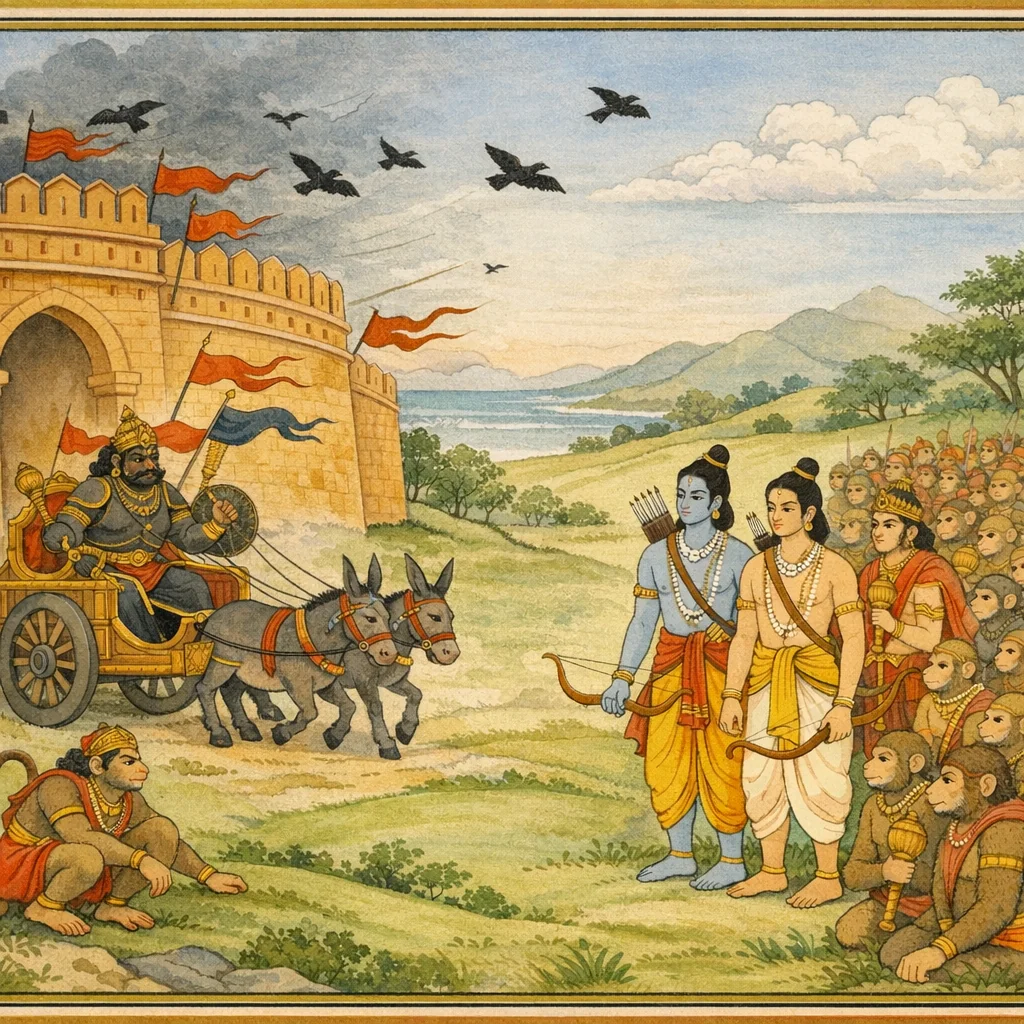
Sarga 51 records a strategic and psychological pivot in Laṅkā’s command. Rāvaṇa hears the tumultuous, celebratory roar of the Vanaras and infers an unexpected reversal. He orders reconnaissance; distressed rākṣasas climb the ramparts, observe Sugrīva’s protected forces, and confirm the critical intelligence: Rāma and Lakṣmaṇa—previously bound by Indrajit’s formidable arrow-bondage—are now visibly freed, likened to elephants snapping ropes. The messengers report in controlled speech despite fear, prompting Rāvaṇa’s anxious anger and doubt about the security of his army and the efficacy of his weapons. He then summons Dhūmrākṣa and commands an immediate sortie to strike Rāma and the Vanaras. Mobilization follows: the army assembles with a catalogue of weapons, chariots, horses, and elephants; Dhūmrākṣa mounts a gold-adorned donkey-yoked chariot and moves toward the western gate where Hanumān stands. En route, ominous portents—vultures, blood imagery, adverse winds, darkness, and earth-tremors—signal impending catastrophe, yet the sortie advances until Dhūmrākṣa beholds the vast Vanara host guarded by Rāghava.
Shlokas
Verse 1
तेषांसुतुमुलंशब्दंवानराणांतरस्विनाम् ।नर्दतांराक्षसैस्सार्धंतदाशुश्रावरावणः ।।6.51.1।।
Then Rāvaṇa, together with his Rākṣasas, heard the ever-rising, highly tumultuous roar of those powerful Vānaras.
Verse 2
स्निग्धगम्भीरनिर्घोषंश्रुत्वासनिनदंभृशम् ।सचिवानांततस्तेषांमध्येवचनमब्रवीत् ।।6.51.2।।
Then, hearing the intense roar—deep and resonant—he spoke words in the midst of his ministers.
Verse 3
यथाऽसौसम्प्रहृष्टानांवानराणांसमुत्थितः ।बहूनांसुमहान्नादोमेघनामिवगर्जिताम् ।।6.51.3।।व्यक्तंसुमहतीप्रीतिरेतेषांनात्रसंशयः ।तथाहिविपुलैर्नादैश्चुक्षुभेवरुणालयः ।।6.51.4।।
Just as that immense roar rose up from the many vānaras who were filled with joy—like the thunder of rumbling clouds—so it was clear, beyond doubt, that their happiness was great; indeed, by those vast shouts even the ocean, Varuṇa’s abode, was stirred.
Verse 4
यथाऽसौसम्प्रहृष्टानांवानराणांसमुत्थितः ।बहूनांसुमहान्नादोमेघनामिवगर्जिताम् ।।6.51.3।।व्यक्तंसुमहतीप्रीतिरेतेषांनात्रसंशयः ।तथाहिविपुलैर्नादैश्चुक्षुभेवरुणालयः ।।6.51.4।।
Just so, from those vānaras who were exceedingly delighted, there arose a very great roar—of many voices—like the thunder of rumbling clouds. Clearly, their joy was immense; of this there is no doubt. Indeed, by those vast clamors even the ocean, Varuṇa’s abode, was stirred and churned.
Verse 5
तौतुबद्धौशरैस्तीक्ष्णैर्भ्रातरौरामलक्ष्मणौ ।अयंचसुमहान्नादशङ्कांजनयतीवमे ।।6.51.5।।
Though the two brothers Rāma and Lakṣmaṇa are bound fast by sharp arrows, this tremendous roar still raises doubt in my mind—what has happened that they rejoice so?
Verse 6
एतत्तुवचनंचोक्त्वामन्त्रिणोराक्षसेश्वरः ।उवाचनैरृतांस्तत्रसमीपपरिवर्तिनः ।।6.51.6।।
After speaking these words to his ministers, the lord of the rākṣasas addressed the rākṣasa warriors who were standing nearby in attendance.
Verse 7
ज्ञायतांतूर्णमेतेषांसर्वेषांचवनचारिणाम् ।शोककालेसमुत्पन्नहर्षकारणमुत्थितम् ।।6.51.7।।
Let it be found out quickly what has arisen as the cause of joy among all these forest-ranging vānaras—joy appearing in a time meant for grief.
Verse 8
तथोक्तास्तेनसम्भ्रान्ताःप्राकारमधिरुह्यच ।ददृशुःपालितांसेनांसुग्रीवेणमहात्मना ।।6.51.8।।तौचमुक्तौसुघोरेणशरबन्धेनराघवौ ।समुत्थितौमहाभागौविषेदुःप्रेक्ष्यराक्षसाः ।।6.51.9।।
Thus addressed by him, the bewildered rākṣasas climbed up onto the ramparts and saw the army—well protected under the great-souled Sugrīva.
Verse 9
तथोक्तास्तेनसम्भ्रान्ताःप्राकारमधिरुह्यच ।ददृशुःपालितांसेनांसुग्रीवेणमहात्मना ।।6.51.8।।तौचमुक्तौसुघोरेणशरबन्धेनराघवौ ।समुत्थितौमहाभागौविषेदुःप्रेक्ष्यराक्षसाः ।।6.51.9।।
And seeing the two Rāghavas freed from that most dreadful net of arrows—standing up again in their full strength—the rākṣasas fell into anxiety.
Verse 10
सन्त्रस्तहृदयाःसर्वेप्राकारात् वरुह्यते ।विषण्णवदनाघोराराक्षसेन्द्रमुपस्थिता ।।6.51.10।।
All those dreadful Rākṣasas, their hearts shaken with fear, climbed down from the ramparts and approached the lord of the Rākṣasas with dejected faces.
Verse 11
तदप्रियंदीनमुखारावणस्यनिशाचराः ।कृत्स्नंनिवेदयामासुर्यथावद्वाक्यकोविदाः ।।6.51.11।।
Those night-ranging Rākṣasas, though downcast, reported the entire unpleasant matter to Rāvaṇa exactly as it was—skilled as they were in delivering their message.
Verse 12
यौताविन्द्रजितायुद्धेभ्रातरौरामलक्ष्मणौ ।निबद्धौशरबन्धेननिष्प्रकम्पभुजौकृतौ ।।6.51.12।।विमुक्तौशरबन्धेनदृश्येतेतौरणाजिरे ।पाशानिवगजौछित्वागजेन्द्रसमविक्रमौ ।।6.51.13।।
“Those two brothers, Rāma and Lakṣmaṇa—whom Indrajit bound in battle with a snare of arrows, rendering their arms immobile—are now seen freed on the battlefield. Like elephants that have snapped their ropes, they stand with the might of lordly elephants.”
Verse 13
यौताविन्द्रजितायुद्धेभ्रातरौरामलक्ष्मणौ ।निबद्धौशरबन्धेननिष्प्रकम्पभुजौकृतौ ।।6.51.12।।विमुक्तौशरबन्धेनदृश्येतेतौरणाजिरे ।पाशानिवगजौछित्वागजेन्द्रसमविक्रमौ ।।6.51.13।।
“Those two brothers, Rāma and Lakṣmaṇa—whom Indrajit bound in battle with a snare of arrows, rendering their arms immobile—are now seen freed on the battlefield. Like elephants that have snapped their ropes, they stand with the might of lordly elephants.”
Verse 14
तच्छ्रुत्वावचनंतेषांराक्षसेन्द्रोमहाबलः ।चिन्तारोषसमाक्रान्तोविषण्णवदनोऽभवत् ।।6.51.14।।
Hearing those words, the mighty lord of the Rākṣasas became overwhelmed by anxious thought and anger, his face falling into dejection.
Verse 15
घोरैर्दत्तवरैर्भद्धौशरैराशीविषोपमैः ।अमोघैस्सूर्यसङ्काशैःप्रमथ्येन्द्रजितायुधि ।।6.51.15।।तदस्त्रबन्धमासाद्ययदिमुक्तौरिपूमम ।संशयस्थमिदंसर्वमनुपश्याम्यहंबलम् ।।6.51.16।।
Bound in battle by Indrajit with dreadful, boon-empowered arrows—like venomous serpents, unfailing and radiant as the sun—(they had been) violently subdued.
Verse 16
घोरैर्दत्तवरैर्भद्धौशरैराशीविषोपमैः ।अमोघैस्सूर्यसङ्काशैःप्रमथ्येन्द्रजितायुधि ।।6.51.15।।तदस्त्रबन्धमासाद्ययदिमुक्तौरिपूमम ।संशयस्थमिदंसर्वमनुपश्याम्यहंबलम् ।।6.51.16।।
If my enemies have been freed even after meeting that weapon-bond, then I see my entire force standing in uncertainty—its fate now doubtful.
Verse 17
निष्फलाःखलुसम्वृत्ताश्शराःवासुकितेजसः ।अदत्तंयैस्तुसङ्ग्रामेरिपूणांजीवितंमम ।।6.51.17।।
Truly, those arrows—brilliant as Vāsuki—have become fruitless, though by them in battle the lives of my enemies should have been taken away.
Verse 18
एवमुक्त्वातुसङ्क्रुद्धोनिश्श्वसन्नुरगोयथा ।अब्रवीद्रक्षसांमध्येधूम्राक्षंनामराक्षसम् ।।6.51.18।।
Having spoken thus, enraged and hissing like a serpent, he addressed in the midst of the rākṣasas a demon named Dhūmrākṣa.
Verse 19
बलेनमहतायुक्तोराक्षसैर्भीमविक्रमः ।त्वंवधायाभिनिर्याहिरामस्यसहवानरैः ।।6.51.19।।
“You of dreadful prowess—go forth, supported by a great force of rākṣasas, to slay Rāma together with his vānaras.”
Verse 20
एवमुक्तस्तुधूम्राक्षोराक्षसेन्द्रेणधीमता ।कृत्वाप्रणामंसम्हृष्टोनिर्जगामनृपालयत् ।।6.51.20।।
Thus addressed by the wise lord of the rākṣasas, Dhūmrākṣa paid homage and, delighted, departed from the royal residence.
Verse 21
अभिनिष्क्रम्यतदद्वारंबलाध्यक्षमुवाचह ।त्वरयस्वबलंतूर्णंकिंचिरेणयुयुत्सतः ।।6.51.21।।
Thus addressed by the wise lord of the rākṣasas, Dhūmrākṣa paid homage and, delighted, departed from the royal residence.
Verse 22
धूम्राक्षवचनंश्रुत्वाबलाध्यक्षोबलानुगः ।बलमुद्योजयामासरावणस्याज्ञयाद्रुतम् ।।6.51.22।।
Hearing Dhumrākṣa’s words, the commander in charge of the large host swiftly readied the army, acting on Rāvaṇa’s command.
Verse 23
तेबद्धघण्टाबलिनोघोररूपानिशाचराः ।विगर्जमानास्सम्हृष्टाधूम्राक्षंपर्यवारयन् ।।6.51.23।।
Those mighty, night-roaming rākṣasas—terrible in form, wearing belts of bells—roared aloud in exhilaration and gathered around Dhumrākṣa.
Verse 24
विविधायुधहस्ताश्चशूलमुद्गरपाणयः ।गदाभिःपट्टसैर्दण्डैरायसैर्मुसलैर्भृशम् ।।6.51.24।।परिघैर्भिण्डिवालैश्चभल्लैप्रासै: परश्वथै: ।निर्ययूराक्षसादिभ्योनर्धन्तोजलदायथा ।।6.51.25।।
Armed with many kinds of weapons—bearing tridents and hammers, maces, swords, staffs, iron clubs, iron bars, stone-hurlers, arrows, spears, and axes—the rākṣasas surged forth, roaring like thunderous rain-clouds.
Verse 25
विविधायुधहस्ताश्चशूलमुद्गरपाणयः ।गदाभिःपट्टसैर्दण्डैरायसैर्मुसलैर्भृशम् ।।6.51.24।।परिघैर्भिण्डिवालैश्चभल्लैप्रासै: परश्वथै: ।निर्ययूराक्षसादिभ्योनर्धन्तोजलदायथा ।।6.51.25।।
Others—armored and bannered—rode out on chariots drawn by donkeys of strange faces and netted with gold; with very swift horses and rut-maddened elephants as well, those ‘tigers among rākṣasas’ advanced, hard to approach like real tigers.
Verse 26
रथैःकवचिनस्त्वन्येध्वजैश्चसमलङ्कृतैः ।सुवर्णजालविहितैःखरैश्चविविधाननैः ।।6.51.26।।हयैःपरमशीघ्रैश्चगजैश्चैवमदोत्कटैः ।निर्ययुर्नैरृतव्याघ्राव्याघ्राइवदुरासदाः ।।6.51.27।।
Others—armored and bannered—rode out on chariots drawn by donkeys of strange faces and netted with gold; with very swift horses and rut-maddened elephants as well, those ‘tigers among rākṣasas’ advanced, hard to approach like real tigers.
Verse 27
रथैःकवचिनस्त्वन्येध्वजैश्चसमलङ्कृतैः ।सुवर्णजालविहितैःखरैश्चविविधाननैः ।।6.51.26।।हयैःपरमशीघ्रैश्चगजैश्चैवमदोत्कटैः ।निर्ययुर्नैरृतव्याघ्राव्याघ्राइवदुरासदाः ।।6.51.27।।
Then the great-warrior Dhumrākṣa set out, surrounded by rākṣasas, laughing as he advanced toward the western gate—where Hanumān, the vānaras’ leader, stood posted.
Verse 28
वृकसिंहमुखैर्युक्तंखरैःकनकभूषणै: ।आरुरोहरथंदिव्यंधूम्राक्षःखरनिस्स्वनः ।।6.51.28।।
Dhumrākṣa, whose voice was harsh as a donkey’s bray, mounted a splendid chariot yoked to donkeys adorned with gold and fashioned with wolf- and lion-like faces.
Verse 29
सनिर्यातोमहावीर्योधूम्राक्षोराक्षसैर्वृतः ।प्रहसन्पश्चिमद्वारंहनुमान्यत्रयूथपः ।।6.51.29।।
Then the great-warrior Dhumrākṣa set out, surrounded by rākṣasas, laughing as he advanced toward the western gate—where Hanumān, the vānaras’ leader, stood posted.
Verse 30
रथप्रवरमास्थायखरयुक्तंखरस्वनम् ।प्रयान्तंतुमहाघोरंराक्षसंभीमदर्शनम् ।।6.51.30।।अन्तरिक्षगताःघोराशकुनाःप्रत्यषेधयन् ।
As that terrible rākṣasa—fearsome to behold—rode forth on his excellent chariot, yoked to donkeys and sounding with their bray, fierce birds in the sky appeared as omens, barring his way.
Verse 31
रथशीर्षेमहान्भीमोगृध्रश्चनिपपातह ।।6.51.31।।ध्वजाग्रेग्रथिताश्चैवनिपेतुःकुणपाशनाः ।
A huge and terrifying vulture swooped down onto the very head of the chariot; and foul carrion-eaters, entangled upon the tip of the banner, fell down—an ominous sign for the rākṣasas.
Verse 32
रुधिरार्द्रोमहान् श्वेतःकबन्धःपतितोभुवि ।।6.51.32।।विस्वरंचोत्सृजन्नादंधूम्राक्षस्यसमीपतः ।ववर्षरुधिरंदेवस्सञ्चचालचमेदिनी ।।6.51.33।।
A great white headless trunk, drenched in blood, fell to the ground near Dhumrākṣa, giving out a harsh and discordant cry—another dreadful portent.
Verse 33
रुधिरार्द्रोमहान् श्वेतःकबन्धःपतितोभुवि ।।6.51.32।।विस्वरंचोत्सृजन्नादंधूम्राक्षस्यसमीपतः ।ववर्षरुधिरंदेवस्सञ्चचालचमेदिनी ।।6.51.33।।
It was as though the very heavens rained blood, and the earth itself trembled—portents declaring the collapse that follows adharma.
Verse 34
प्रतिलोमंवनौवायुर्निर्घातसमनिस्वनः ।तिमिरौघवृतास्तत्रदिशश्चनचकाशिरे ।।6.51.34।।
A wind blew contrary and roared like thunder; masses of darkness covered the quarters, and the directions could no longer be made out.
Verse 35
सतूत्पातांस्तदादृष्टवाराक्षसानांभयावहान् ।प्रादुर्भूतान्सुघोरांश्चधूम्राक्षोव्यथितोऽभवत् ।।6.51.35।।मुमुहूराक्षसाःसर्वेधूम्राक्षस्यपुरस्सराः ।
Seeing those dreadful portents that brought fear upon the rākṣasas, Dhumrākṣa became shaken; and all the rākṣasas marching before him swooned.
Verse 36
ततःसुभीमोबहुभिर्निशाचरैर्वृतोऽभिनिष्क्रम्यरणोत्सुकोबली ।ददर्शतांराघवबाहुपालितांमहौघकल्पांबहुवानरींचमूम् ।।6.51.36।।
Then that mighty and formidable one, surrounded by many night-rangers and eager for battle, advanced and beheld the vast army of many vānaras—guarded by Rāghava’s arms and resembling a great flood at the world’s end.
Frequently Asked Questions
The pivotal action is Rāvaṇa’s decision-making under destabilizing intelligence: upon learning that Indrajit’s seemingly unfailing arrow-bondage has failed, he shifts from uncertainty to punitive escalation by ordering Dhūmrākṣa to launch an immediate attack, illustrating crisis leadership driven by fear and anger.
The chapter emphasizes that apparent invincibility (boon-backed weapons and prior victories) is contingent; overreliance on force without moral steadiness produces strategic anxiety. Conversely, recovery and collective morale (Vanara rejoicing) function as a decisive, non-material battlefield advantage.
Laṅkā’s defensive architecture (the prākāra/ramparts) and the western gate (paścima-dvāra) are central, functioning as surveillance and deployment nodes; the omen-filled sky and trembling earth are framed as culturally legible signals (utpāta) marking a doomed sortie.