Sarga 50
सुपर्णागमनम् (Garuda’s Arrival and the Release from the Serpent-Arrow Bond)
युद्धकाण्ड
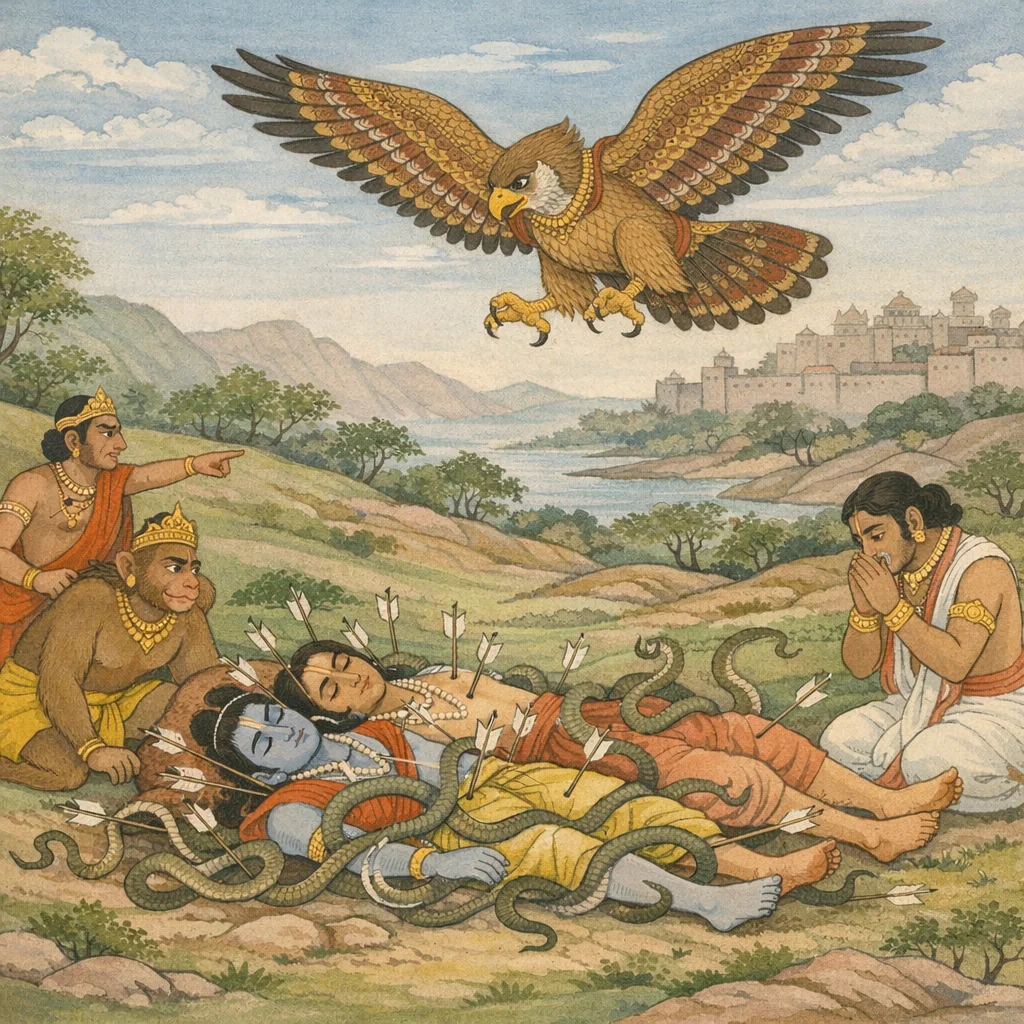
Sarga 50 depicts a battlefield crisis and its resolution through counsel, medicine-lore, and divine intervention. Sugrīva observes the vānaras panicking and questions their fear; Aṅgada identifies the cause—Rāma and Lakṣmaṇa lie on a “bed of arrows,” bound by Indrajit’s māyā that manifests as serpents. Vibhīṣaṇa arrives, is initially suspected, then laments upon seeing the princes wounded, blaming the deceitful stratagem of Rāvaṇa’s side and expressing personal despair. Sugrīva consoles Vibhīṣaṇa, predicts Rāvaṇa’s defeat, and consults Suṣeṇa, who recalls divine-asura war healing and proposes obtaining rare herbs (Sañjīvakaraṇī, Viśalyakaraṇī) from the Kṣīroda ocean region (Chandra and Droṇa mountains), recommending Hanumān. Before this plan unfolds, atmospheric turmoil and island trees falling signal Garuḍa’s approach. The serpents flee; Garuḍa touches and cleanses the princes, instantly healing wounds and restoring their brilliance, strength, memory, and morale. Garuḍa identifies himself as Rāma’s friend, warns against trusting rākṣasas in war, foretells victory and Sītā’s recovery, then departs after circumambulation. The vānar host rejoices with lion-roars, drums, conches, and advances again toward Laṅkā’s gates.
Shlokas
Verse 1
अथोवाचमहातेजाहरिराजोमहाबलः ।किमियंव्यथितासेनामूढवातेवनौर्जले ।।6.50.1।।
Then the mighty and radiant king of the monkeys spoke: “Why is this army distressed—like a boat on the water, tossed about by a bewildering wind?”
Verse 2
सुग्रीवस्यवचश्श्रुत्वावालिपुत्रोऽङ्गदोऽब्रवीत् ।नत्वंपश्यसिरामंचलक्ष्मणंचमहारथम् ।।6.50.2।।शरजालचितौवीरावुभौदशरथात्मजौ ।शरतल्पेमहात्मानौशयानौरुधिरोक्षितौ ।।6.50.3।।
Hearing Sugrīva’s words, Aṅgada—Vāli’s son—replied: “Do you not see Rāma, and Lakṣmaṇa the great chariot-warrior?”
Verse 3
सुग्रीवस्यवचश्श्रुत्वावालिपुत्रोऽङ्गदोऽब्रवीत् ।नत्वंपश्यसिरामंचलक्ष्मणंचमहारथम् ।।6.50.2।।शरजालचितौवीरावुभौदशरथात्मजौ ।शरतल्पेमहात्मानौशयानौरुधिरोक्षितौ ।।6.50.3।।
Both heroic sons of Daśaratha lay there—covered by a net of arrows—those great-souled brothers stretched upon a bed of shafts, drenched in blood.
Verse 4
अथाब्रवीद्वानरेन्द्रस्सुग्रीवःपुत्रमङ्गदम् ।नानिमित्तमिदंमन्येभवितव्यंभयेनतु ।।6.50.4।।
Then Sugrīva, lord of the Vānaras, said to his son Aṅgada: “I do not think this commotion is without cause; surely something to be feared is about to occur.”
Verse 5
विषण्णवदनाह्येतेत्यक्तप्रहरणादिशः ।प्रपलायन्तिहरयस्त्रासादुत्फुल्ललोचनाः ।।6.50.5।।
The Vānara troops—faces fallen in despair, weapons cast away—fled in all directions, their eyes widened in fear.
Verse 6
अन्योन्यस्यनलज्जन्तेनिरीक्षन्तिपृष्ठतः ।विप्रकर्षन्तिचान्योन्यंपतितंलङ्घयन्तिच ।।6.50.6।।
They feel no shame before one another; they keep looking back, pulling away from each other, and even leap past those who have fallen.
Verse 7
एतस्मिन्नन्तरेवीरोगदापाणिर्विभीषणः ।सुग्रीवंवर्धयामासराघवंचनिरैक्षत ।।6.50.7।।
Meanwhile, the heroic Vibhīṣaṇa—mace in hand—encouraged Sugrīva with heartening words and then looked toward Rāghava (Rāma).
Verse 8
विभीषणंचसुग्रीवोदृष्टवावानरभीषणम् ।ऋक्षराजंमहात्मानंसमीपस्थमुवाचह ।।6.50.8।।
Seeing Vibhīṣaṇa—who caused alarm among the Vānaras—Sugrīva spoke to the great-souled king of bears (Jāmbavān), who stood nearby.
Verse 9
विभीषणोऽयंसम्प्राप्तोयंदृष्टवावानरर्षभाः ।विद्रवन्तिपरितत्रसरावणात्मजशङ्कया ।।6.50.9।।
“This is Vibhīṣaṇa, who has arrived. On seeing him, the foremost Vānaras are fleeing in alarm, suspecting him to be Rāvaṇa’s son.”
Verse 10
शीघ्रमेतान् सुसन्त्रस्तान्बहुधाविप्रधावितान् ।पर्यवस्थापयाख्याहिविभीषणमुपस्थितम् ।।6.50.10।।
“Quickly stop these men—terrified and scattering in many directions. Call them back and announce that Vibhīṣaṇa has arrived here.”
Verse 11
सुग्रीवेणैवमुक्तस्तुजाम्बवानृक्षपार्थिवः ।वानरान्सान्त्वयामाससन्निरुध्यप्रधानतः ।।6.50.11।।
Thus addressed by Sugrīva, Jāmbavān—the king of the bears—restrained the Vānaras, and foremost among them, reassured them and restored their confidence.
Verse 12
तेनिवृत्ताःपुनःसर्वेवानरास्त्यक्तसम्भ्रमाः ।ऋक्षराजवचश्श्रुत्वातंचदृष्टवाविभीषणम् ।।6.50.12।।
Hearing the words of the bear-king, all the Vānaras turned back, casting off their panic, and they beheld Vibhīṣaṇa.
Verse 13
विभीषणस्तुरामस्यदृष्टवागात्रंशरैश्चितम् ।लक्ष्मणस्यचधर्मात्माबभूवव्यथितस्तदा ।।6.50.13।।
But Vibhīṣaṇa, righteous at heart, on seeing Rāma’s body and Lakṣmaṇa’s as well—filled with arrows—became anguished then.
Verse 14
जलक्लिन्नेनहस्तेनतयोर्नेत्रेप्रमृज्यच ।शोकसम्पीडितमनारुरोदविललापच ।।6.50.14।।
Wetting his hand with water, he wiped their eyes; his mind crushed by grief, he wept and lamented aloud.
Verse 15
इमौतौसत्त्वसम्पन्नौविक्रान्तौप्रियसम्युगौ ।इमामवस्थांगमितौराक्षसैःकूटयोधिभिः ।।6.50.15।।
“These two—noble in spirit, heroic, and lovers of battle—have been brought to this condition by deceitful, treacherous-fighting Rākṣasas.”
Verse 16
भ्रातुःपुत्रेणमेतेनदुष्पुत्रेणदुरात्मना ।राक्षस्याजिह्मयाबुध्याचालितावृजुविक्रमौ ।।6.50.16।।
“By this son of my brother—wicked-souled and a disgrace as a son—these two, straightforward in their valor, have been deceived through a Rākṣasa’s crooked mind.”
Verse 17
शरैरिमावलंविद्धौरुधिरेणसमुक्षितौ ।वसुधायामिमौसुप्तौदृश्येतेशल्यकाविव ।।6.50.17।।
“Pierced all over by arrows and drenched in blood, the two lie asleep upon the earth, appearing like porcupines.”
Verse 18
ययोर्वीर्यमुपाश्रित्यप्रतिष्ठाकाङ्क्षितामया ।तावुभौदेहनाशायप्रसुप्तौपुरुषर्षभौ ।।6.50.18।।
Relying on whose valor I sought honor and standing—those two bulls among men now lie as if asleep, their bodies brought near to ruin.
Verse 19
जीवन्नद्यविपन्नोऽस्मिनष्टराज्यमनोरथः ।प्राप्तप्रतिज्ञश्चरिपुःसकामोरावणःकृतः ।।6.50.19।।
Today, though still alive, I am undone—my hope of kingship is shattered. My enemy Rāvaṇa has fulfilled his vow and achieved his desire by this.
Verse 20
एवंविलपमानंतंपरिष्वज्यविभीषणम् ।सुग्रीवःसत्त्वसम्पन्नोहरिराजोऽब्रवीदिदम् ।।6.50.20।।
As Vibhīṣaṇa lamented thus, Sugrīva—the monkey-king, rich in courage—embraced him and spoke these words.
Verse 21
राज्यंप्राप्स्यसिधर्मज्ञ लङ्कायांनात्रसंशयः ।रावणस्सहपुत्रेणस्वकामंनेहलप्स्यते ।।6.50.21।।
“O knower of dharma, you will surely obtain the kingship in Laṅkā—there is no doubt of it. Rāvaṇa, together with his sons, will not gain what he seeks here.”
Verse 22
नरुजापीडितावेतावुभौराघवलक्ष्मणौ ।त्यक्त्वामोहंवधिष्येतेसगणंरावणंरणे ।।6.50.22।।
“These two—Rāghava and Lakṣmaṇa—are not truly overcome by pain. Casting off their swoon, they will slay Rāvaṇa together with his forces in battle.”
Verse 23
तमेवंसान्त्वयित्वातुसमाश्वास्यचराक्षसम् ।सुषेणंश्वशुरंपार्श्वेसुग्रीवस्तमुवाचह ।।6.50.23।।
Having thus consoled and calmed the rākṣasa (Vibhīṣaṇa), Sugrīva then addressed Suṣeṇa, his elder kinsman who stood nearby.
Verse 24
सहशूरैर्हरिगणैर्लब्धसंज्ञावरिन्दमौ ।गच्छत्वंभ्रातरंगृह्यकिष्किन्धांरामलक्ष्मणौ ।।6.50.24।।
“When those two tamers of foes regain awareness, take the brothers Rāma and Lakṣmaṇa—along with the heroic monkey hosts—and go to Kiṣkindhā.”
Verse 25
अहंतुरावणंहत्वासपुत्रंसहबान्धवम् ।मैथिलीमानयिष्यामिशक्रोनष्टामिवश्रियम् ।।6.50.25।।
“And I, having slain Rāvaṇa along with his sons and kinsmen, will bring back Maithilī—like Śakra recovering his lost fortune.”
Verse 26
श्रुत्वैतद्वानरेन्द्रस्यसुषेणोवाक्यमब्रवीत् ।दैवासुरंमहद्युद्धमनुभूतंसुदारुणम् ।।6.50.26।।
“And I, having slain Rāvaṇa along with his sons and kinsmen, will bring back Maithilī—like Śakra recovering his lost fortune.”
Verse 27
तदास्मदानवाशरसम्स्पर्शकोविदाः ।निजघ्नुश्शस्त्रविदुषश्चादयन्तोमुहुर्मुहुः ।।6.50.27।।
Then the Dānavas/Rākṣasas, skilled at striking with arrows and weapons, repeatedly attacked—again and again—using concealment and deceptive maneuvers against the weapon-wise divine warriors.
Verse 28
तानार्तान्नष्टसंज्ञांश्चगतासूंश्चबृहस्पतिः ।विद्याभिर्मन्त्रयुक्ताभिरोषधीभिश्चिकित्सति ।।6.50.28।।
Bṛhaspati treated those who were afflicted—those who had lost consciousness and even those near death—by sacred knowledge joined with mantras, and by medicines (herbs).
Verse 29
तान्यौषधान्यानयितुंक्षीरोदंयान्तुसागरम् ।जवेनवानराःशीघ्रंसम्पातिपनसादयः ।।6.50.29।।
To fetch those medicinal herbs, let the vānaras—Sampāti, Panasa, and the others—swiftly go at speed to the Milk-Ocean.
Verse 30
हरयस्तुविजानन्तिपार्वतीस्तामहौषधीः ।सञ्जीवकरणींदिव्यांविशल्यांदेवनिर्मिताम् ।।6.50.30।।
But the vānaras know those supreme mountain-born herbs—Sañjīvakaraṇī, the wondrous life-restoring plant, and Viśalyā, the deva-fashioned herb that draws out pain and removes embedded missiles.
Verse 31
चन्द्रश्चनामद्रोणश्चक्षीरोदेसागरोत्तमे ।अमृतंयत्रमथितंतत्रतेपरमौषधी ।।6.50.31।।
In the Milk-Ocean, the foremost of oceans—where nectar was once churned—there rise mountains named Candra and Droṇa; there those supreme medicinal herbs are found.
Verse 32
तौतत्रविहितेदेवैःपर्वतौमहोदधौ ।अयंवायुसुतोराजन् हनूमांस्तत्रगच्छतु ।।6.50.32।।
Those two mountains were placed there in the great ocean by the gods. O King, let this Hanūmān—the son of Vāyu—go there.
Verse 33
एतस्मिन्नन्तरेवायुर्मेगांश्चापिसविद्युतः ।पर्यस्यसागरेतोयंकम्पयननिवमेदिनीम् ।।6.50.33।।
Meanwhile the wind rose; clouds gathered with lightning, and the ocean’s waters were flung about, as though the very earth were trembling.
Verse 34
महतापक्षवातेनसर्ववदीपमहाद्रुमाः ।निपेतुर्भग्नविटपाःसलिलेलवणाम्भसि ।।6.50.34।।
By the mighty wind stirred by the beating of wings, the great trees of the island—branches broken—fell down into the salt waters.
Verse 35
अभवन् पन्नगास्त्रस्ताभोगिनस्तत्रवासिनः ।शीघ्रंसर्वाणियादांसिजग्मुश्चलवणार्णवम् ।।6.50.35।।
The serpents and other coil-bodied creatures dwelling there became terrified; and all the aquatic beings quickly fled into the salt sea.
Verse 36
ततोमुहूर्तार्गरुडंवैनतेयंमहाबलम् ।वानराददृशुःसर्वेज्वलन्तमिवपावकम् ।।6.50.36।।
Then, in an instant, all the Vānaras beheld mighty Garuḍa—Vinātā’s son—blazing like fire.
Verse 37
तमागतमभिप्रेक्ष्यनागास्तेसम्प्रदुद्रुवुः ।यैस्तौसत्पुरुषौबद्धौशरभूतैर्महाबलौ ।।6.50.37।।
Seeing him arrive, those serpents fled—the very ones who, as arrows, had bound the two mighty and noble men.
Verse 38
ततस्सुपर्णःकाकुत्स्थौस्पृष्टवाप्रत्यभिनदनितः ।विममर्शचपाणिभ्यांमुखेचन्द्रसमप्रभे ।।6.50.38।।
Thereafter Suparṇa (Garuḍa), touching the two scions of the Kakutstha line and honoring them, gently wiped their moon-bright faces with his hands.
Verse 39
वैनतेयेनसम्स्पृष्टास्तयोःसम्रुरुहुर्व्रणाः ।सुवर्णेचतनूस्निग्धेतयोराशुबभूवतुः ।।6.50.39।।
Touched by Vainateya (Garuḍa), their wounds immediately healed, and their bodies quickly became smooth and radiant like gold.
Verse 40
तेजोवीर्यंबलंचौजउत्साहश्चमहागुणाः ।प्रदर्शनंचबुद्धिश्चस्मृतिश्चद्विगुणंतयोः ।।6.50.40।।
Their splendor, valor, strength, energy, courage, and noble qualities shone forth; their intelligence and memory, too, became doubled.
Verse 41
तावुत्थाप्यमहातेजागरुडोवासवोपमौ ।उभौतौसस्वजेहृष्टोरामश्चैनमुवाचह ।।6.50.41।।
Then the radiant Garuḍa raised up the two princes, who were like Vāsava (Indra) in splendor; rejoicing, he embraced them both, and Rāma spoke to him.
Verse 42
भवत्प्रसादाद् व्यसनंरावणिप्रभवंमहत् ।आवामिहव्यतिक्रान्तौपूर्ववद् बलिनौकृतौ ।।6.50.42।।
“By your gracious favor, we have overcome here this great calamity born of Rāvaṇa’s son, and we have been restored to our former strength.”
Verse 43
यथातातंदशरथंयथाऽजंचपितामहम् ।तथाभवन्तमासाद्यहृदयंमेप्रसीदति ।।6.50.43।।
“Just as meeting my father Daśaratha, and my grandfather Aja, brings peace—so too, on meeting you, my heart becomes serene and glad.”
Verse 44
कोभवान्रूपसम्पन्नोदिव्यस्रगनुलेपनः ।वसानोविरजेवस्त्रदिव्याभरणभूषितः ।।6.50.44।।
“Who are you—so handsome in form, adorned with celestial garlands and unguents, wearing spotless garments and ornamented with divine jewelry?”
Verse 45
तमुवाचमहातेजावैनतेयोमहाबलः ।पतत्त्रिराजःप्रीतात्माहर्षपर्याकुलेक्षणः ।।6.50.45।।
Then Vainateya (Garuḍa)—the radiant, mighty king of birds—spoke to him, his heart delighted and his eyes trembling with tears of joy.
Verse 46
अहंसखातेकाकुत्स्थ प्रियःप्राणोबहिश्चरः ।गरुत्मानिहसम्प्राप्तोयुवयोःसाह्यकारणात् ।।6.50.46।।
“O Kakutstha, I am your friend—dear as your very life-breath that moves outside (the body). I, Garutmān, have come here for the sake of helping you both.”
Verse 47
असुरावामहावीर्यावानरावामहाबलाः ।सुराश्चापिसगन्ध्वर्वाःपुरस्कृत्यशतक्रतुम् ।।6.50.47।।नेमंमोक्षयितुंशक्ताश्शरबन्धंसुदारुणम् ।मायाबलादिन्द्रजितानिर्मितंक्रूरकर्मणा ।।6.50.48।।
“Even mighty Asuras, even immensely strong Vānara warriors, and even the Devas together with the Gandharvas—though led by Śatakratu (Indra)—(would find this bondage formidable).”
Verse 48
असुरावामहावीर्यावानरावामहाबलाः ।सुराश्चापिसगन्ध्वर्वाःपुरस्कृत्यशतक्रतुम् ।।6.50.47।।नेमंमोक्षयितुंशक्ताश्शरबन्धंसुदारुणम् ।मायाबलादिन्द्रजितानिर्मितंक्रूरकर्मणा ।।6.50.48।।
“They would not be able to free (one) from this exceedingly fierce bondage of arrows—created by Indrajit of cruel deeds through the power of illusion.”
Verse 49
एतेनागाःकाद्रवेयास्तीक्ष्णदंष्ट्राविषोल्बणाः ।रक्षोमायाप्रभावेणशराभूत्वास्त्वदाश्रिताः ।।6.50.49।।
“These are Nāga-serpents, the Kādraveyas—sharp-fanged and intensely venomous. By the force of Rakṣasa-illusion they have become arrows and have fastened upon you.”
Verse 50
सभाग्यश्चासिधर्मज्ञ राम सत्यपराक्रम ।लक्ष्मणेनसहभ्रात्रासमरेरिपुघातिना ।।6.50.50।।
“Rama, knower of dharma, whose valor is grounded in truth—fortunate are you to have your brother Lakshmana with you, a slayer of foes in battle.”
Verse 51
इमंश्रुत्वातुवृत्तान्तंत्वरमाणोऽहमागतः ।सहसायुवयोःस्नेहात्सखित्वमनुपालयन् ।।6.50.51।।
“On hearing this news, I hastened here at once—upholding our friendship, moved by affection for you both.”
Verse 52
मोक्षितौचमहाघोरादस्मात्सायकबन्धनात् ।अप्रमादश्चकर्तव्योयुवाभ्यांनित्यमेवच ।।6.50.52।।
“You both shall be freed from this most dreadful bondage of arrow(-serpents). And you must always remain vigilant—never negligent.”
Verse 53
प्रकृत्याराक्षसाःसर्वेसङ्ग्रामेकूटयोधिनः ।शूराणांशुद्धभावानांभवतामरार्जवंबलम् ।।6.50.53।।
“By nature, all Rakshasas fight with deceit in war. But for you—heroes of pure intent—straightforwardness (ārjava) itself is strength.”
Verse 54
तन्नविश्वसनीयंवोराक्षसानांरणाजिरे ।एतेनैवोपमानेननित्यंजिह्माहिराक्षसाः ।।6.50.54।।
Therefore, in the battlefield you should not place trust in the Rākṣasas; by this very experience it is known that Rākṣasas are ever deceitful.
Verse 55
एवमुक्त्वातदारामंसुपर्णस्सुमहाबलः ।परिष्वज्यचसुहृत्स्निग्धमाप्रष्टुमुपचक्रमे ।।6.50.55।।
Having spoken thus, mighty Suparṇa embraced Rāma with a friend’s deep affection and then prepared to take his leave.
Verse 56
सखे राघव धर्मज्ञ रिपूणामपिवत्सल ।अभ्यनुज्ञातुमिच्छामिगमिष्यामियथामतम् ।।6.50.56।।
Friend Rāghava—knower of dharma, and compassionate even toward foes—I wish to take your leave; I shall depart as is fitting.
Verse 57
नचकौतूहलंकार्यंसखित्वंप्रतिराघव ।कृतकर्मारणेवीर सखित्वंप्रतिवेत्स्यसि ।।6.50.57।।
And, Rāghava, you need not be curious about this friendship; O hero, once your work in battle is accomplished, you will recognize it fully.
Verse 58
बालवृद्धावशेषांतुकृत्वालङ्कांशरोर्मिभिः ।रावणंचरिपुंहत्वासीतांत्वंसमुलप्स्यते ।।6.50.58।।
With your wave-like torrents of arrows you will leave Laṅkā with only children and the aged; and having slain the enemy Rāvaṇa, you will recover Sītā.
Verse 59
इत्येवमुक्त्वावचनंसुपर्णश्शीघ्रविक्रमः ।रामंचविरुजंकृत्वामध्येतेषांवनौकसाम् ।।6.5.59।।प्रदक्षिणंततःकृत्वापरिष्वज्यचवीर्यवान् ।जगामाकाशमाविश्यसुपर्णःपवनोयथा ।।6.50.60।।
Having spoken these words, swift-striding Suparṇa restored Rāma to freedom from pain in the midst of the forest-dwellers. Then the valiant one circled him in reverence, embraced him again, and, entering the sky, departed like the wind.
Verse 59
इत्येवमुक्त्वावचनंसुपर्णश्शीघ्रविक्रमः ।रामंचविरुजंकृत्वामध्येतेषांवनौकसाम् ।।6.5.59।।प्रदक्षिणंततःकृत्वापरिष्वज्यचवीर्यवान् ।जगामाकाशमाविश्यसुपर्णःपवनोयथा ।।6.50.60।।
Having spoken these words, swift-striding Suparṇa restored Rāma to freedom from pain in the midst of the forest-dwellers. Then the valiant one circled him in reverence, embraced him again, and, entering the sky, departed like the wind.
Verse 60
इत्येवमुक्त्वावचनंसुपर्णश्शीघ्रविक्रमः ।रामंचविरुजंकृत्वामध्येतेषांवनौकसाम् ।।6.5.59।।प्रदक्षिणंततःकृत्वापरिष्वज्यचवीर्यवान् ।जगामाकाशमाविश्यसुपर्णःपवनोयथा ।।6.50.60।।
Then the leaders of the vānaras, seeing the two Rāghavas freed from suffering, roared like lions and lashed their tails in exhilaration.
Verse 61
विरुजौराघवौदृष्टवाततोवानरयूथपाः ।सिंहनादांस्तदानेदुर्लङ्गूलंन्दुधुवुस्तदा ।।6.50.61।।
Then the leaders of the vānaras, seeing the two Rāghavas freed from suffering, roared like lions and lashed their tails in exhilaration.
Verse 62
ततोभेरीस्समाजघ्नुर्मृदङ्गांश्चाप्यनादयन् ।दध्मुश्शङ्खान्सम्प्रहृष्टाःक्षेवलन्त्यपियथापुरम् ।।6.50.62।।
Then they beat the kettledrums and sounded the mṛdaṅgas; delighted, they blew conches and began leaping about again as before.
Verse 63
आस्फोट्याःस्पोट्यविक्रान्ताःवानराःनगयोधिनः ।द्रुमानुत्पट्यविविधांस्तस्थुश्शतसहस्रशः ।।6.50.63।।
The Vānaras—warriors who fight with uprooted trees—cracked their fingers and displayed their bold prowess; tearing up many kinds of trees, they stood there in hundreds of thousands.
Verse 64
विसृजन्तोमहानादांस्त्रासयन्तोनिशाचरान् ।लङ्काद्वाराण्युपाजग्मुर्युद्धकामाःप्लवङ्गमाः ।।6.50.64।।
Raising mighty roars and striking fear into the night-ranging Rākṣasas, the battle-eager Vānaras advanced and reached the gates of Laṅkā.
Verse 65
तेषांसुखीमस्तुमुलोनिनादोबभूवशाखामृगयूथपानाम् ।क्षयेनिदाघस्ययथाघनानांनादस्सुभीमोनदतांनिशीथे ।।6.50.65।।
Then the tumultuous clamor of those leaders of the tree-dwelling troops arose—terrifying like the thunder of clouds at the end of the scorching season, resounding dreadfully in the midnight hour.
Frequently Asked Questions
The chapter confronts kūṭayuddha (deceptive warfare): Indrajit’s māyā turns poisonous serpents into arrows, binding noble combatants. The ethical response is twofold—compassionate stabilization of allies (Vibhīṣaṇa, the frightened vānaras) and heightened vigilance (apramāda) without abandoning righteous conduct.
Strength is not only physical but also moral clarity and alertness: Garuḍa explicitly warns that rākṣasas are “crooked by nature” in war and should not be trusted, while the restoration of Rāma-Lakṣmaṇa’s brilliance symbolizes dharma’s resilience after adversity.
The narrative references Laṅkā’s gates as the renewed military objective, the Kṣīroda (Milky Ocean) as a mythic healing geography, and the Chandra and Droṇa mountains as loci of divine herbs (Sañjīvakaraṇī, Viśalyakaraṇī), linking battlefield recovery to classical medicinal and cosmological lore.