Sarga 46
शरबन्धनम् (The Binding by Arrows) / Indrajit’s Illusory Assault and the Vanaras’ Consolation
युद्धकाण्ड
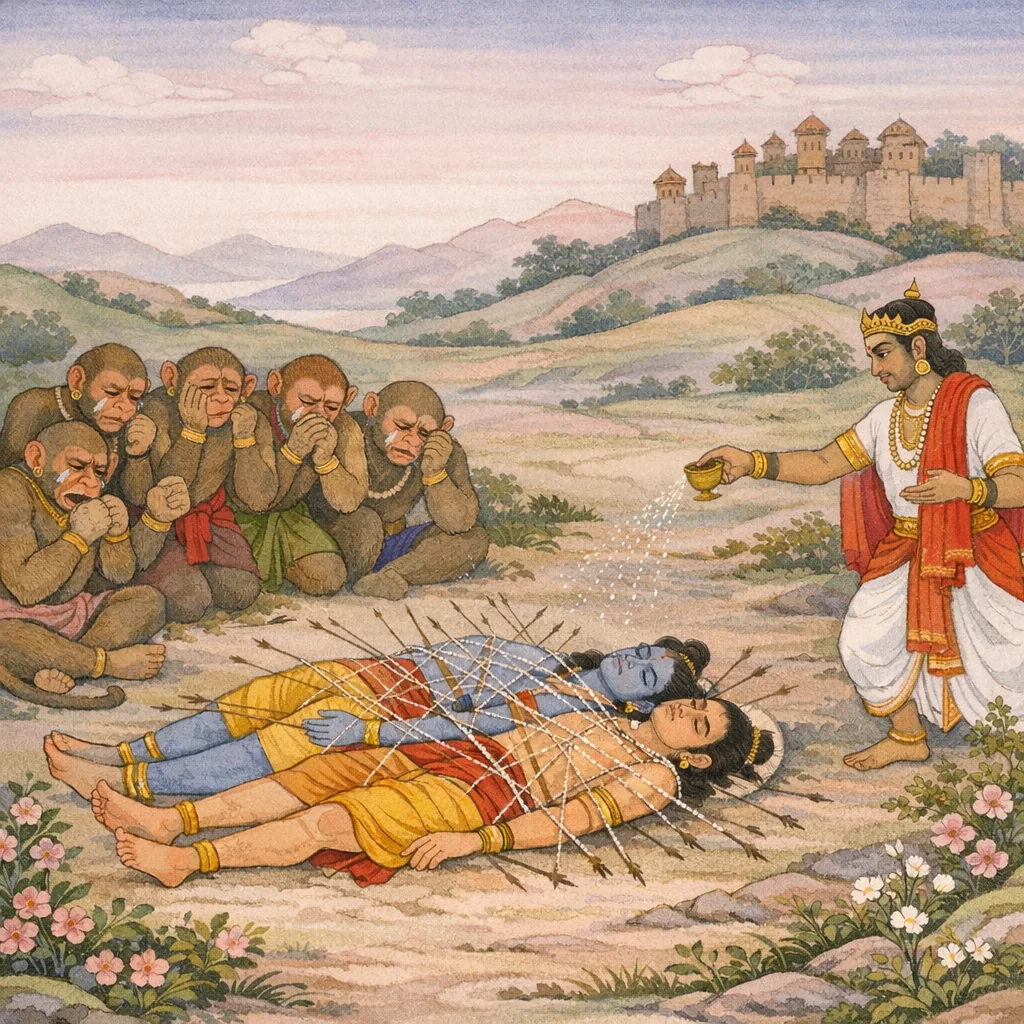
Sarga 46 depicts a critical reversal in the Laṅkā war. Vanara leaders search the sky and ground and find Rāma and Lakṣmaṇa lying motionless, bodies riddled by a sustained network of arrows (śara-bandha), producing collective grief and tactical shock. Indrajit, concealed by māyā, is perceived only by Vibhīṣaṇa through a boon-enabled insight; Indrajit then exults, declaring the brothers—slayers of Khara and Dūṣaṇa—struck and, in his rhetoric, beyond liberation even by an assembly of sages and gods. He compounds panic by wounding leading Vanaras (Nīla, Mainda, Dvivida, Jāmbavān, Hanumān, Gavākṣa, Śarabha, and Aṅgada) and publicly invites the Rākṣasas to witness the bound princes, triggering loud celebration under the mistaken belief that Rāma is dead. After Indrajit withdraws to Laṅkā, Sugrīva is overtaken by fear; Vibhīṣaṇa performs a calming, quasi-ritual act with consecrated water, counsels against faint-heartedness, and insists that Rāma is not destined to die, urging the army’s morale management. The chapter closes with Indrajit reporting “victory” to Rāvaṇa, who embraces him and hears the account of the princes’ loss of splendor under the arrow-net.
Shlokas
Verse 1
ततोद्यांपृथिवींचैववीक्षमाणावनौकसः ।ददृशुःसन्ततौबाणैर्भ्रातरौरामलक्ष्मणौ ।।6.46.1।।
Then the Vānara leaders, scanning both sky and earth, saw the two brothers Rāma and Lakṣmaṇa, pierced all over by arrows.
Verse 2
वृष्टवेवोपरतेदेवेकृतकर्मणिराक्षसे ।आजगामाथतंदेशंससुग्रीवोविभीषणः ।।6.46.2।।
When the rākṣasa had finished his undertaking and withdrawn—like a cloud that withdraws after raining—Vibhīṣaṇa, accompanied by Sugrīva, then arrived at that very place.
Verse 3
नीलद्विविदमैन्दाश्चसुषेणःकुमुदाङ्गदा: ।तूर्णंहनुमतासार्धमन्वशोचन्तराघवौ ।।6.46.3।।
Nīla, Dvivida, Mainda, Suṣeṇa, Kumuda, and Aṅgada—together with Hanumān—were swiftly overcome with grief as they looked upon the two Rāghavas.
Verse 4
अचेष्टौमन्दनिश्श्वासौशोणितौघपरिप्लुतौ ।शरजालाचितौस्तब्दौशयानौशरतल्पयोः ।।6.46.4।।निःश्वसन्तौयथासर्पौनिश्चेष्टौमन्दविक्रमौ ।रुधिरस्राद्विग्धाङ्गौतापनीयाविवध्वजौ ।।6.46.5।।तौवीरशयनेवीरौशयानौमन्दचेष्टितौ ।यूथपैस्तै: परिवृतौबाष्पव्याकुललोचनैः ।।6.46.6।।राघवौपतितौदृष्टवाशरजालसमावृतौ ।बभूवुर्वेर्व्यथितास्सर्वेवानरास्सविभीषणाः ।।6.46.7।।
Both lay motionless, breathing faintly, drenched in streams of blood, their bodies packed with a net of arrows; stunned, they lay upon a bed of shafts. Sighing like serpents, powerless and inert, their limbs smeared with blood, they seemed like two golden standards brought low. Those two heroes lay on that hero’s couch, scarcely stirring, surrounded by their troop-leaders with tear-troubled eyes. Seeing the two Rāghavas fallen and covered by a mesh of arrows, all the Vānara warriors—Vibhīṣaṇa among them—were shaken with anguish and dread.
Verse 5
अचेष्टौमन्दनिश्श्वासौशोणितौघपरिप्लुतौ ।शरजालाचितौस्तब्दौशयानौशरतल्पयोः ।।6.46.4।।निःश्वसन्तौयथासर्पौनिश्चेष्टौमन्दविक्रमौ ।रुधिरस्राद्विग्धाङ्गौतापनीयाविवध्वजौ ।।6.46.5।।तौवीरशयनेवीरौशयानौमन्दचेष्टितौ ।यूथपैस्तै: परिवृतौबाष्पव्याकुललोचनैः ।।6.46.6।।राघवौपतितौदृष्टवाशरजालसमावृतौ ।बभूवुर्वेर्व्यथितास्सर्वेवानरास्सविभीषणाः ।।6.46.7।।
Breathing faintly like serpents, motionless and with their strength diminished, their limbs smeared with flowing blood, the two appeared like golden standards grown dull.
Verse 6
अचेष्टौमन्दनिश्श्वासौशोणितौघपरिप्लुतौ ।शरजालाचितौस्तब्दौशयानौशरतल्पयोः ।।6.46.4।।निःश्वसन्तौयथासर्पौनिश्चेष्टौमन्दविक्रमौ ।रुधिरस्राद्विग्धाङ्गौतापनीयाविवध्वजौ ।।6.46.5।।तौवीरशयनेवीरौशयानौमन्दचेष्टितौ ।यूथपैस्तै: परिवृतौबाष्पव्याकुललोचनैः ।।6.46.6।।राघवौपतितौदृष्टवाशरजालसमावृतौ ।बभूवुर्वेर्व्यथितास्सर्वेवानरास्सविभीषणाः ।।6.46.7।।
Those two heroes lay upon a hero’s bed, their movements faint, surrounded by the troop-leaders whose eyes were clouded with tears.
Verse 7
अचेष्टौमन्दनिश्श्वासौशोणितौघपरिप्लुतौ ।शरजालाचितौस्तब्दौशयानौशरतल्पयोः ।।6.46.4।।निःश्वसन्तौयथासर्पौनिश्चेष्टौमन्दविक्रमौ ।रुधिरस्राद्विग्धाङ्गौतापनीयाविवध्वजौ ।।6.46.5।।तौवीरशयनेवीरौशयानौमन्दचेष्टितौ ।यूथपैस्तै: परिवृतौबाष्पव्याकुललोचनैः ।।6.46.6।।राघवौपतितौदृष्टवाशरजालसमावृतौ ।बभूवुर्वेर्व्यथितास्सर्वेवानरास्सविभीषणाः ।।6.46.7।।
Seeing the two Rāghavas fallen and covered in a net of arrows, all the vānara forces—together with Vibhīṣaṇa—were plunged into anguish.
Verse 8
अन्तरिक्षंनिरीक्षन्तोदिशस्सर्वाश्चवानराः ।नचैनंमाययाछन्नंददृशूरावणिःरणे ।।6.46.8।।
Scanning the sky and every direction, the vānara warriors could not see Rāvaṇi, concealed by his māyā upon the battlefield.
Verse 9
तंतुमायाप्रतिच्छन्नंमाययैवविभीषणः ।वीक्षमाणोददर्शाथभ्रातुःपुत्रमवस्थितम् ।।6.46.9।।
But Vibhīṣaṇa, searching with counter-māyā, then beheld his brother’s son standing there, though concealed by illusion.
Verse 10
तमप्रतिकर्माणमप्रतिद्वन्द्वमाहवे ।ददर्शान्तर्हितंवीरंवरदानाद्विभीषणः ।।6.46.10।।तेजसायशसाचैवविक्रमेणचसम्युतम् ।
Vibhīṣaṇa—radiant, renowned, and mighty in valor—by virtue of a boon perceived that hidden hero Indrajit, unrivalled in battle and incomparable in action.
Verse 11
इन्द्रजित्त्वात्मनःकर्मतौशयानौसमीक्ष्यच ।।6.46.11।।उवाचपरमप्रीतोहर्षयन् सर्वनैरृतान् ।
Seeing the two heroes lying fallen as a result of his own deed, Indrajit—overjoyed—spoke, delighting all the Rākṣasas.
Verse 12
दूषणस्यचहन्तारौखरस्यचमहाबलौ ।।6.46.12।।सादितौमामकैर्बाणैर्भ्रातरौरामलक्ष्मणौ ।
“Those two mighty brothers—Rāma and Lakṣmaṇa—slayers of Dūṣaṇa and Khara, have now been struck down by my arrows.”
Verse 13
नेमौमोक्षयितुंशक्यावेतस्मादिषुबन्धनात् ।।6.46.13।।सर्वैरपिसमागम्यसर्षिसङ्घैस्सुरासुरैः ।
“Even if all beings assembled together—companies of sages, gods, and asuras alike—these two cannot be freed from this bondage of arrows.”
Verse 14
यत्कृतेचिन्तयानस्यशोकार्तस्यपितुर्मम ।।6.46.14।।अस्पृष्टवाशयनंगात्रैस्त्रियामायातिशर्वरी ।त्स्नेयंयत्कृतेलङ्कानदीवर्षास्विवाकुला ।।6.46.15।।सोऽयंमूलहरोऽनर्थःसर्वेषांनिहतोमया ।
“Because of him my father, tormented by grief and brooding, passes the night’s three watches without even touching the bed with his limbs. Because of him all Laṅkā is thrown into turmoil, like a river in the rains. That very root-cause of our calamity has now been slain by me.”
Verse 15
यत्कृतेचिन्तयानस्यशोकार्तस्यपितुर्मम ।।6.46.14।।अस्पृष्टवाशयनंगात्रैस्त्रियामायातिशर्वरी ।त्स्नेयंयत्कृतेलङ्कानदीवर्षास्विवाकुला ।।6.46.15।।सोऽयंमूलहरोऽनर्थःसर्वेषांनिहतोमया ।
“Because of him my father, tormented by grief and brooding, passes the night’s three watches without even touching the bed with his limbs. Because of him all Laṅkā is thrown into turmoil, like a river in the rains. That very root-cause of our calamity has now been slain by me.”
Verse 16
रामस्यलक्ष्मणस्यैवसर्वेषांचवनौकसाम् ।विक्रमानिष्फलाःसर्वेयथाशरदितोयदाः ।।6.46.16।।
“The valor of Rāma, of Lakṣmaṇa, and indeed of all the Vānara hosts has become fruitless—like clouds in autumn that yield no rain.”
Verse 17
एवमुक्त्वातुतान् सर्वान्राक्षसान्परिपार्श्वतः ।।6.46.17।।यूथपानपितान्सर्वांस्ताडयामासरावणिः ।
After speaking thus to the Rākṣasas gathered around him, Rāvaṇi (Indrajit) then began striking down all the troop-leaders as well.
Verse 18
नीलंनवभिराहत्यमैन्दंचद्विविदंतथा ।।6.46.18।।त्रिभिस्त्रिभिरमित्रघ्नस्ततापप्रवरेषुभिः ।
The foe-slayer Indrajit struck Nīla with nine arrows, and likewise assailed Mainda and Dvivida with three arrows each—fine and deadly shafts.
Verse 19
जाम्बवन्तंमहेष्वासोविद् ध्वाबाणेनवक्षसि ।।6.46.19।।हनूमतोवेगवतोविससर्जशरान्दश ।
That great archer Indrajit pierced Jāmbavān in the chest with an arrow, and then discharged ten arrows at swift Hanumān.
Verse 20
गवाक्षंशरभंचैवद्वावप्यमिततेजसौ ।।6.46.20।।द्वाभ्यांद्वाभ्यांमहावेगोविव्याधयुधिरावणिः ।
Then Rāvaṇa’s son, swift in battle, struck the two mighty ones—Gavākṣa and Śarabha—piercing each of them with two arrows.
Verse 21
गोलाङ्गूलेश्वरंचैववालिपुत्रमथाङ्गदम् ।।6.46.21।।विव्याधबहुभिर्बाणैस्त्वरमाणोऽथरावणिः ।
Then Rāvaṇa’s son, acting swiftly, pierced the lord of the Golāṅgūlas—Aṅgada, Vāli’s son—with many arrows.
Verse 22
तान्वानरवरान्भित्त्वाशरैरग्निशिखोपमैः ।।6.46.22।।ननादबलवांस्तत्रमहासत्त्वस्सरावणिः ।
Having pierced those foremost of vānaras with arrows like tongues of fire, that mighty and formidable Rāvaṇi roared aloud there.
Verse 23
तानर्धयित्वाबाणौघैस्त्रासयित्वाचवानरान् ।।6.46.23।।प्रजहासमहाबाहुर्वचनंचेदमब्रवीत् ।
Having smitten them with showers of arrows and thrown the vānaras into fear, the strong-armed one laughed and spoke these words.
Verse 24
शरशब्देनघोरेणमयाबद्धौचमूमुखे ।।6.46.24।।सहितौभ्रातरवेतौनिशामयतराक्षसाः ।
"O rākṣasas, behold these two brothers together—bound by me with dreadful arrow-force—lying in the very forefront of the host."
Verse 25
एवमुक्तास्तुतेसर्वेराक्षसाःकूटयोधिनः ।।6.46.25।।परंविस्मयामाजग्मुःकर्मणातेनहर्षिताः ।
Thus addressed, all those rākṣasas—fighters of deceit—were seized with great astonishment, delighted by that deed.
Verse 26
विनेदुश्चमहानादान् सर्वेतेजलदोपमाः ।।6.46.26।।हतोरामइतिज्ञात्वारावणिंसमपूजयन् ।
All of them, cloud-like, raised great roaring cries; believing that "Rāma has been slain," they honoured Rāvaṇa’s son with reverent acclaim.
Verse 27
निष्पन्दौतुतदादृष्टवाभ्रातरौरामलक्ष्मणौ ।।6.46.27।।वसुधायांनिरुच्छवासौहतावित्यन्वमन्यत ।
Seeing then the two brothers, Rāma and Lakṣmaṇa, motionless and without breath upon the earth, he concluded, "They are slain."
Verse 28
हर्षेणतुसमाविष्टइन्द्रजित्समितिञ्जयः ।।6.46.28।।प्रविवेशपुरींलङ्कांहर्षयन् सर्वनैर्वृतान् ।
Indrajit, conqueror in battle, filled with exultation, entered the city of Laṅkā, gladdening all the rākṣasas.
Verse 29
रामलक्ष्मणयोर्दृष्टवाशरीरेसायकैश्चिते ।।6.46.29।।सर्वाणिचाङ्गोपाङ्गानिसुग्रीवंभयमाविशत् ।
Seeing the bodies of Rāma and Lakṣmaṇa riddled with arrows—wounded across every limb—Sugrīva was seized by fear.
Verse 30
रामलक्ष्मणयोर्दृष्टवाशरीरेसायकैश्चिते ।।6.46.29।।सर्वाणिचाङ्गोपाङ्गानिसुग्रीवंभयमाविशत् ।
Seeing the bodies of Rāma and Lakṣmaṇa riddled with arrows—wounded across every limb—Sugrīva was seized by fear.
Verse 31
रामलक्ष्मणयोर्दृष्टवाशरीरेसायकैश्चिते ।।6.46.29।।सर्वाणिचाङ्गोपाङ्गानिसुग्रीवंभयमाविशत् ।
Seeing the bodies of Rāma and Lakṣmaṇa riddled with arrows—wounded across every limb—Sugrīva was seized by fear.
Verse 32
रामलक्ष्मणयोर्दृष्टवाशरीरेसायकैश्चिते ।।6.46.29।।सर्वाणिचाङ्गोपाङ्गानिसुग्रीवंभयमाविशत् ।
Seeing the bodies of Rāma and Lakṣmaṇa riddled with arrows—wounded across every limb—Sugrīva was seized by fear.
Verse 33
पर्यवस्थापयात्मानमनाथंमांचवानर ।।6.46.33।।सत्यधर्माभिरक्तानांनास्तिमृत्युकृतंभयम् ।
“Compose yourself, O Vānara, and steady me as well—left helpless in this moment; for those devoted to truth and dharma, fear born of death does not prevail.”
Verse 34
एवमुक्त्वाततस्तस्यजलक्लन्नेनपाणिना ।।6.46.34।।सुग्रीवस्यशुभेनेत्रेप्रममार्जविभीषणः ।
Having spoken thus, Vibhīṣaṇa then, with his hand moistened with water, gently wiped Sugrīva’s beautiful eyes, clearing them.
Verse 35
ततस्सलिलमादायविद्ययापरिजप्यच ।।6.46.35।।सुग्रीवनेत्रेधर्मात्मासममार्जविभीषणः ।
Then the righteous-souled Vibhīṣaṇa took water, sanctified it with a consecrating formula, and wiped Sugrīva’s eyes again, restoring clarity.
Verse 36
विमृज्यवदनंतस्यकपिराजस्यधीमतः ।।6.46.36।।अब्रवीत्कालसम्प्राप्तसम्भ्रान्तमिदंवचः ।
After wiping the face of that wise king of monkeys, he spoke these words—timely and urgent for the moment.
Verse 37
नकालःकपिराजेन्द्रवैक्लब्यमवलम्बितुम् ।।6.46.37।।अतिस्नेहोऽप्यकालेऽस्मिन्मरणायोपकल्पते ।
“O lord of monkey-kings, this is not the time to give way to faint-heartedness; even excessive attachment, when untimely, becomes a cause leading toward death.”
Verse 38
तस्मादुत्सृज्यवैक्लब्यंसर्वकार्यविनाशनम् ।।6.46.38।।हितंरामपुरोगणांसैन्यानानुचिन्त्यताम् ।
Therefore, cast away faint-heartedness, which ruins every undertaking; and, keeping Rama at the fore, reflect on what is truly for the welfare of the troops.
Verse 39
अथवारक्ष्यतांरामोयावत्संज्ञाविपर्ययः ।।6.46.39।।लब्धसंज्ञौहिकाकुत्स्थौभयंनौव्यपनेष्यतः ।
Or else, let Rama be guarded until this loss of consciousness passes; for when the two Kakutstha princes regain awareness, they will dispel our fear.
Verse 40
नैतत्किञ्चनरामस्यनचरामोमुमूर्षति ।।6.46.40।।नह्येनंहास्यतेलक्ष्मीद्दुर्लभायागतायुषाम् ।
This is no cause for despair regarding Rama, nor is Rama destined to die; for Fortune—so hard to attain for those whose lifespan is spent—will not abandon him.
Verse 41
तस्मादाश्वासयात्मानंबलंचाश्वासयस्वकम् ।।6.46.41।।यावत्कार्याणिसर्वाणिपुनःसंस्थापयाम्यहम् ।
Therefore, steady yourself—and steady your own forces as well—until I set all our necessary undertakings back in order again.
Verse 42
एतेहिफुल्लनयनास्त्रासादागतसाध्वसाः ।।6.46.42।।कर्णेकर्णेप्रकथिताहरयोहरिसत्तम ।
For these monkeys—eyes widened in fright, seized by fear—are whispering from ear to ear, O best of the Vānara lords.
Verse 43
मांतुदृष्टवाप्रधावन्तमनीकंसम्प्रहर्षितुम् ।।6.46.43।।त्यजस्तुहरयस्त्रासंभुक्तपूर्वामिवस्रजम् ।
But when the monkeys see me rushing forth to hearten the ranks, let them cast off their fear—like a garland already enjoyed and then thrown aside.
Verse 44
समाश्वास्यतुसुग्रीवंराक्षसेन्द्रोविभीषणः ।।6.46.44।।विद्रुतंवानरानीकंतत्समाश्वासयत्पुनः ।
Having reassured Sugrīva, Vibhīṣaṇa—the lord among the Rākṣasas—then again reassured that Vānara host which had begun to scatter in panic.
Verse 45
इन्द्रजित्तुमहामायःसर्वसैन्यसमावृतः ।।6.46.45।।विवेशनगरींलङ्कांपितरंचाभ्युपागमत् ।
But Indrajit, wielder of great illusion, surrounded by all his forces, entered the city of Laṅkā and went to his father.
Verse 46
तत्ररावणमासाद्यअभिवाद्यकृताञ्जलिः ।।6.46.46।।आचचक्षेप्रियंपित्रेनिहतौरामलक्ष्मणौ ।
There, reaching Rāvaṇa, he saluted him with joined palms and reported pleasing news to his father: “Rāma and Lakṣmaṇa are slain.”
Verse 47
उत्पपातततोहृष्टःपुत्रंचपरिषस्वजे ।।6.46.47।।रावणोरक्षसांमध्येश्रुत्वाशत्रूनिपातितौ ।
In the midst of the rākṣasas, Rāvaṇa—hearing that his enemies had been struck down—rose up in delight and embraced his son.
Verse 48
उपाघ्रायचतंमूद् र्नेनंपप्रच्छप्रीतमानसः ।।6.46.48।।पृच्छतेचयथावृत्तंपित्रेतस्मैसर्वंन्यवेदयत् ।यथातौशरबन्धेननिश्चेष्टौनिष्प्रभौकृतौ ।।6.46.49।।
Pleased at heart, he kissed him upon the head and questioned him further.
Verse 49
उपाघ्रायचतंमूद् र्नेनंपप्रच्छप्रीतमानसः ।।6.46.48।।पृच्छतेचयथावृत्तंपित्रेतस्मैसर्वंन्यवेदयत् ।यथातौशरबन्धेननिश्चेष्टौनिष्प्रभौकृतौ ।।6.46.49।।
When his father asked for the full account, he reported everything in detail—how the two of them, bound in a net of arrows, had been rendered motionless and their radiance dimmed.
Verse 50
सहर्षवेगानुगतान्तरात्माश्रुत्वावचस्तस्यमहारथस्य ।जहौज्वरंदाशरथेःसमुत्थितंप्रहृष्यवाचाऽभिननन्दपुत्रम् ।।6.46.50।।
Hearing the words of that great chariot-warrior, his heart surged with joy; the fever of fear arising from Dāśarathi left him, and—rejoicing—he greeted his son with glad speech.
Frequently Asked Questions
The battlefield community faces a leadership dilemma: whether grief and panic at the apparent fall of Rāma and Lakṣmaṇa should dictate action, or whether disciplined composure and protective duty must prevail until certainty and recovery are achieved.
Vibhīṣaṇa’s counsel frames fear as strategically and ethically corrosive: excessive attachment and faint-heartedness at the wrong moment can become self-defeating, while steadfast adherence to truth and dharma sustains collective resilience.
The action pivots between the Laṅkā battlefield (where the princes lie on a ‘bed of arrows’) and the city of Laṅkā (where Indrajit returns to report to Rāvaṇa), underscoring the war’s movement from frontline spectacle to royal court validation.