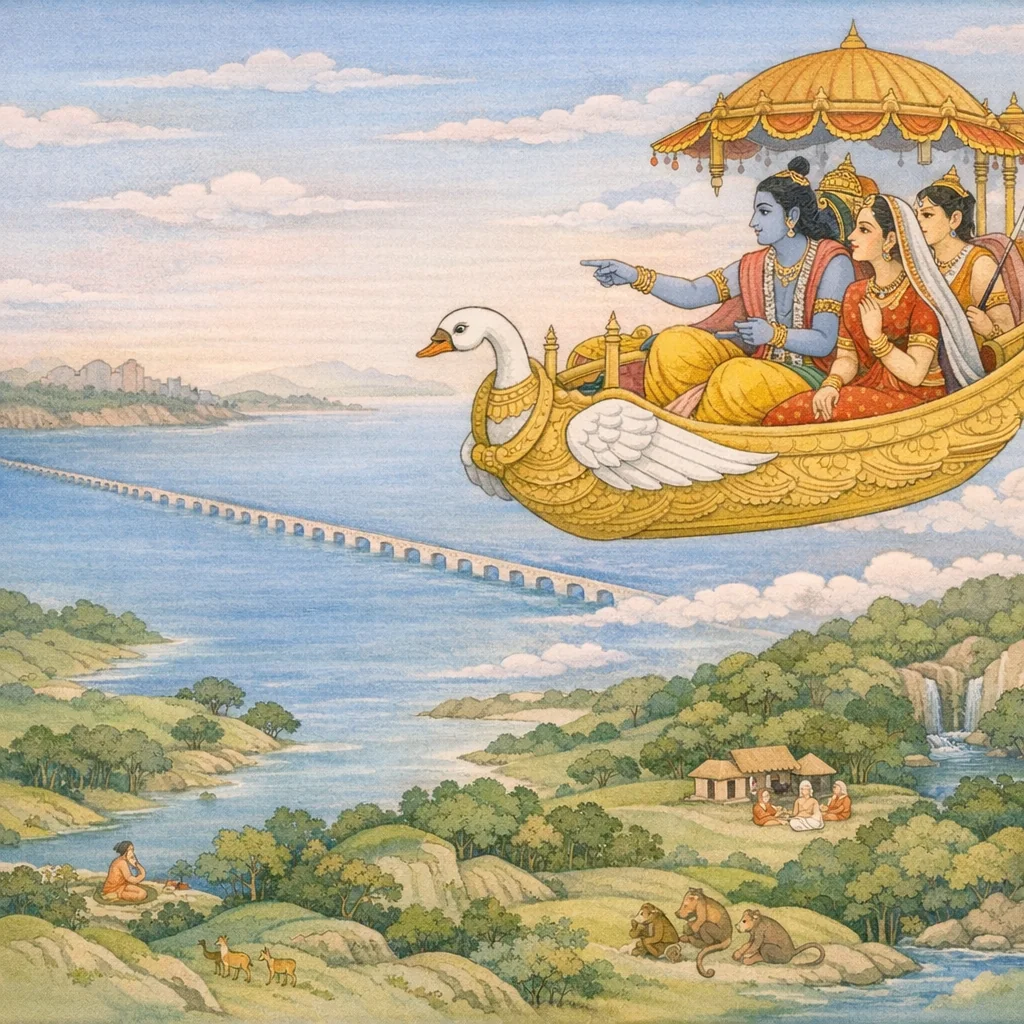
Sarga 126
पुष्पकविमानयात्रा—सेतुबन्धादि-दर्शनम् (Pushpaka Aerial Journey and Survey of Sacred Landmarks)
युद्धकाण्ड
Sarga 126 presents a post-war aerial itinerary in the Puṣpaka vimāna, framed as Rāma’s guided recollection for Sītā. With Rāma’s permission, the swan-like, sonorous Puṣpaka rises and becomes a moving vantage-point from which sites of conflict and memory are identified. Rāma indicates the blood-soaked battlefield and enumerates prominent rākṣasa casualties and their slayers, functioning as a formal register of the war’s closure and accountability. The narrative then pivots to a sacred-geographical map: the seashore of the crossing, Nala’s bridge (Nalasetu), the roaring ocean as Varuṇa’s abode, the resting mountain associated with Hanumān’s passage, and the Sethubandha tīrtha praised as tri-loka-venerated and sin-destroying. The flight continues across Kiṣkindhā and Ṛṣyamūka, Pampa and Śabarī’s locale, Janasthāna and Jatāyu’s fall, the hermitage region (Khara–Dūṣaṇa–Triśiras episode), Godāvarī and Agastya’s āśrama, Sutikṣṇa and Śarabhanga’s hermitages, Atri’s abode, Virādha’s region, Citrakūṭa, Yamunā and Bharadvāja’s āśrama, Gaṅgā, Śṛṅgibera (Guha), Sarayū, and finally Ayodhyā—seen like Amarāvatī—prompting Sītā’s reverent salutation. Parallel action shows Sītā requesting that Tara and other vānarī women accompany them to Ayodhyā; Rāma approves, Sugrīva mobilizes the households, and the women ascend the vimāna eager to see Sītā.
Shlokas
Verse 1
अनुज्ञातंतुरामेणतद्विमानमनुत्तमम् ।हंसयुक्तंमहानादमुत्पपातविहायसम् ।।।।
With Rāma’s permission, that unsurpassed aerial car—yoked with swans and resounding loudly—rose up into the sky.
Verse 2
पातयित्वाततश्चक्षुस्सर्वतोरघुनन्दनः ।अब्रवीन्मैथिलींसीतांरामश्शशिनिभाननाम् ।।।।
Then Rāma, the delight of the Raghu line, casting his eyes all around, spoke to Sītā of Mithilā, whose face shone like the moon.
Verse 3
कैलासशिखराकारेत्रिकूटशिखरेस्थिताम् ।लङ्कामीक्षस्ववैदेहीनिर्मितांविश्वकर्मणा ।।।।
“O Vaidehī, behold Laṅkā, set upon the peak of Trikūṭa, shaped like the summit of Kailāsa, and fashioned by Viśvakarman.”
Verse 4
एतदायोधनंपश्यमांसशोणितकर्दमम् ।हरीणांराक्षसानां च सीते विशसनंमहत् ।।।।
“Sītā, behold this battlefield—turned into mire of flesh and blood—the great carnage of Vānaras and Rākṣasas alike.”
Verse 5
अत्रदत्तवरश्शेतेप्रमाथीराक्षसेश्वरः ।तवहेतोर्विशालाक्षीनिहतोरावणोमया ।।।।
Here lies the tormentor, the lord of rākṣasas—granted boons—Rāvaṇa, slain by me for your sake, O wide-eyed one.
Verse 6
कुम्भकर्णोऽऽत्रनिहतःप्रहस्तश्चनिशाचरः ।धूम्राक्षश्चात्रनिहतोवानरेणहनूमता ।।।।
Here lies Kumbhakarṇa slain; here too Prahasta, that night-roaming warrior; and here Dhūmrākṣa, slain by the Vānara Hanūmān.
Verse 7
विद्युन्मालीहतश्चात्रसुषेणेनमहात्मना ।लक्ष्मणेनेन्द्राजिच्चात्ररावणिर्निहितोरणे ।।।।
Here Vidyunmālī was slain by the great-souled Suṣeṇa; and here in battle Indrajit—the son of Rāvaṇa—was laid low by Lakṣmaṇa.
Verse 8
अङ्गदेनात्रनिहतोविकटोनामराक्षसः ।विरूपाक्षश्चदुर्धर्षोमहापार्श्वमहोदरौ ।।।।अकम्पनश्चनिहतोबलिनोऽऽन्ये च राक्षसाः ।त्रिशिराश्चातिकायश्चदेवान्तकनरान्तकौ ।।।।
Here the Rākṣasa named Vikaṭa was slain by Aṅgada; also the formidable Virūpākṣa, and Mahāpārśva and Mahodara. Akampana too was slain, and other mighty Rākṣasas—Triśiras, Atikāya, and Devāntaka and Narāntaka.
Verse 9
अङ्गदेनात्रनिहतोविकटोनामराक्षसः ।विरूपाक्षश्चदुर्धर्षोमहापार्श्वमहोदरौ ।।6.126.8।।अकम्पनश्चनिहतोबलिनोऽऽन्ये च राक्षसाः ।त्रिशिराश्चातिकायश्चदेवान्तकनरान्तकौ ।।6.126.9।।
Here the Rākṣasa named Vikaṭa was slain by Aṅgada; also the formidable Virūpākṣa, and Mahāpārśva and Mahodara. Akampana too was slain, and other mighty Rākṣasas—Triśiras, Atikāya, and Devāntaka and Narāntaka.
Verse 10
युद्धोन्मत्तश्चमत्तश्चराक्षसप्रवरावुभौ ।निकुम्भश्चैवकुम्भश्चकुम्भकर्णात्मजौबली ।।।।वज्रदंष्ट्रश्चदंष्ट्रश्चबहवोराक्षसाहताः ।मकराक्षश्चदुर्धर्षोमयायुधिनिपातितः ।।।।
Yuddhonmatta and Matta—both foremost among the Rākṣasas—as well as Nikumbha and Kumbha, the strong sons of Kumbhakarṇa, were slain.
Verse 11
युद्धोन्मत्तश्चमत्तश्चराक्षसप्रवरावुभौ ।निकुम्भश्चैवकुम्भश्चकुम्भकर्णात्मजौबली ।।6.126.10।।वज्रदंष्ट्रश्चदंष्ट्रश्चबहवोराक्षसाहताः ।मकराक्षश्चदुर्धर्षोमयायुधिनिपातितः ।।6.126.11।।
Vajradaṃṣṭra and Daṃṣṭra too were slain, along with many other Rākṣasas; and the hard-to-face Makarākṣa was struck down by me in battle.
Verse 12
अकम्पनश्चनिहतःशोणिताक्षश्चवीर्यवान् ।यूपाक्षश्चप्रजङ्घश्चनिहतौतुमहाहवे ।।।।
Akampana was slain, and Śoṇitākṣa, famed for valor; and in that great battle Yūpākṣa and Prajaṅgha too were killed.
Verse 13
विद्युज्जिह्वोऽऽत्रनिहतोराक्षसोभीमदर्शनः ।यज्ञशत्रुश्चनिहतःसुप्तघ्नश्चमहाबलः ।।।।सूर्यशत्रुश्चनिहतोब्रह्मशत्रुस्तथापरः ।
Here Vidyujjihva, a Rākṣasa of dreadful appearance, was slain; Yajñaśatru was slain as well, and the mighty Suptaghna. Sūryaśatru too was killed, and likewise another—Brahmaśatru.
Verse 14
अत्रमन्दोदरीनामभार्यातंपर्यदेवयत् ।।।।सपत्नीनांसहस्रेणसाग्रेणपरिवारिता ।
Here Mandodarī by name—his wife—was lamenting for him, surrounded on the shore by a thousand co-wives.
Verse 15
तत्तुदृश्यतेतीर्थंसमुद्रस्यवरानने ।।।।यत्रसागरमुत्तीर्यतांरात्रिमुषितावयम् ।
O fair-faced lady, that shore of the ocean is to be seen there—the place where, having crossed the sea, we spent that night.
Verse 16
एषसेतुर्मयाबद्धस्सागरेसलिलार्णवे ।।।।तवहेतोर्विशालाक्षिनलसेतुःसुदुष्करः ।
O large-eyed one, here is the bridge bound across the ocean, the salt-water flood—Nala’s bridge, a deed most difficult—built for your sake.
Verse 17
पश्यसागरमक्षोभ्यंवैदेहिवरुणालयम् ।।।।अपारमभिगर्जन्तंशङ्खशुक्तिसमाकुलम् ।
Vaidehī, behold the ocean—Varuṇa’s abode—imperturbable, seemingly shoreless, roaring aloud, and teeming with conches and shells.
Verse 18
हिरण्यनाभंशैलेन्द्रंकाञ्चनंपश्यमैथिलि ।।।।विश्रमार्थंहनुमतोभित्त्वासागरमुत्थितम् ।
Maithilī, behold that golden king of mountains, Hiraṇyanābha—risen after cleaving the sea—so that Hanumān might rest while crossing.
Verse 19
एततत्कुक्षौसमुद्रस्यस्कन्धावारनिवेशनम् ।।।।अत्रपूर्वंमहादेवःप्रसादमकरोत्प्रभुः ।
Here, in the ocean’s hollow, is the place where the army once encamped; and here, long ago, the Lord Mahādeva graciously showed me his favor.
Verse 20
एतत्तुदृश्यतेतीर्थंसागरस्यमहात्मनः ।।।।सेतुबन्दइतिख्यातंत्रैलोक्येन च पूजितम् ।एतत्पवित्रंपरमंमहापातकनाशनम् ।।।।अत्रराक्षसराजोऽऽयमाजगामविभीषणः ।
See this sacred ford of the great Ocean—renowned as Setubandha and revered in the three worlds. Supremely pure, it destroys even great sins. It was here that this rākṣasa king, Vibhīṣaṇa, came to me.
Verse 21
एतत्तुदृश्यतेतीर्थंसागरस्यमहात्मनः ।।6.126.20।।सेतुबन्दइतिख्यातंत्रैलोक्येन च पूजितम् ।एतत्पवित्रंपरमंमहापातकनाशनम् ।।6.126.21।।अत्रराक्षसराजोऽऽयमाजगामविभीषणः ।
Sītā, there you see Kiṣkindhā with its varied woods—Sugrīva’s lovely city—where Vālī was slain by me.
Verse 22
एषासादृश्यतेसीतेकिष्किन्धाचित्रकानना ।।।।सुग्रीवस्यपुरीरम्यायत्रवालीमयाहतः ।
Sītā, there you see Kiṣkindhā with its varied woods—Sugrīva’s lovely city—where Vālī was slain by me.
Verse 23
अथदृष्टवापुरींसीताकिष्किन्धांवालिपालिताम् ।।।।अब्रवीत्पश्रितंवाक्यंरामंप्रणतसाध्वसा ।
Then Sītā, seeing Kiṣkindhā, the city once guarded by Vālī, spoke to Rāma with gentle, loving timidity, her words resting upon him with reverence.
Verse 24
सुग्रीवप्रियभार्याभिस्ताराप्रमुखतोनृप ।।।।अन्येषांवानरेन्द्राणांस्त्रीभिःपरिवृताह्यहम् ।गन्तुमिच्छेसहायोध्यांराजधानींत्वयासह ।।।।
O King, I wish to go with you to Ayodhyā, the royal capital—accompanied by Tārā and the other dear wives of Sugrīva, and surrounded by the women of the other Vānara lords.
Verse 25
सुग्रीवप्रियभार्याभिस्ताराप्रमुखतोनृप ।।6.126.24।।अन्येषांवानरेन्द्राणांस्त्रीभिःपरिवृताह्यहम् ।गन्तुमिच्छेसहायोध्यांराजधानींत्वयासह ।।6.126.25।।
“O tiger among the Vānaras, tell all the foremost Vānaras: let them all, accompanied by their women, go to Ayodhyā with Sītā.”
Verse 26
एवमुक्तोऽऽथवैदेह्याराघवःप्रत्युवाचताम् ।एवमस्त्वितिकिष्किन्धांप्राप्यसंस्थाप्यराघवः ।।।।विमानंप्रेक्ष्यसुग्रीवंवाक्यमेतदुवाच ह ।
Thus addressed by Vaidehī, Rāghava replied to her, “So be it.” Reaching Kiṣkindhā, he halted the aerial car; then, looking toward Sugrīva, Rāghava spoke these words.
Verse 27
ब्रूहिवानरशूर्दूल सर्वान्वानरपुङ्गवान् ।।।।स्त्रीभिःपरिवृताःसर्वेह्ययोध्यांयान्तुसीतया ।
“O tiger among the Vānaras, tell all the foremost Vānaras: let them all, accompanied by their women, go to Ayodhyā with Sītā.”
Verse 28
तथात्वमपिसर्वाभिस्स्त्ीभिस्सहमहाबल ।।।।अभित्वरस्वसुग्रीव गच्छामःप्लवगाधिप ।
“So you too, O mighty one—together with all the women—make haste, Sugrīva, lord of the monkeys; we must depart.”
Verse 29
एवमुक्तस्तुसुग्रीवोरामेणामिततेजसा ।।।।वानराधिपतिश्रीमांस्स्सैश्चसर्वैस्समावृतः ।प्रविश्यान्तःपुरंशीघ्रंतारामुवदीक्ष्यसोऽऽब्रवीत् ।।।।
Thus addressed by Rāma of immeasurable splendor, Sugrīva—the prosperous lord of the Vānaras—surrounded by them all, quickly entered the inner apartments; and, looking at Tārā, he spoke.
Verse 30
एवमुक्तस्तुसुग्रीवोरामेणामिततेजसा ।।6.126.29।।वानराधिपतिश्रीमांस्स्सैश्चसर्वैस्समावृतः ।प्रविश्यान्तःपुरंशीघ्रंतारामुवदीक्ष्यसोऽऽब्रवीत् ।।6.126.30।।
“Hurry; gather the vānarī-wives. Taking them, we shall go and show them Ayodhyā, and behold all the women of Daśaratha’s household.”
Verse 31
प्रिये त्वंसहनाराभिर्वानराणांमहात्मनाम् ।राघवेणाभ्यनुज्ञातामैथिलीप्रियकाम्यया ।।।।
“Beloved, you have been duly permitted by Rāghava to go along with the great-souled Vānaras and their women, for the sake of pleasing Maithilī.”
Verse 32
त्वरत्वमभिगच्छामोगृह्यवानरयोषितः ।अयोध्यांदर्शयिष्यामःसर्वादशरथस्त्रियः ।।।।
“Hurry; gather the vānarī-wives. Taking them, we shall go and show them Ayodhyā, and behold all the women of Daśaratha’s household.”
Verse 33
सुग्रीवस्य व चःश्रुत्वातारासर्वाङ्गशोभना ।आहूयचाब्रवीत्सर्वावानराणांतुयोषितः ।।।।
Hearing Sugrīva’s words, Tārā—beautiful in every limb—summoned all the vānarī-wives and addressed them.
Verse 34
सुग्रीवेणाभ्यनुज्ञातागन्तुंसर्वैश्चवानरैः ।ममचापिप्रियंकार्यमयोध्यादर्वनेन च ।।।।
“Sugrīva has granted leave for all the Vānaras to go together (with their households). And for me too, dear ones, a cherished wish will be fulfilled—by the sight of Ayodhyā.”
Verse 35
प्रवेशंचैवरामस्यपौरजानपदैस्सह ।विभूतिंचैवसर्वासांस्त्रीणांदशरथस्य च ।।।।
“We shall witness Rāma’s entry as well—together with the townsfolk and countryside people—and also behold the splendor of Daśaratha’s women and all that glory.”
Verse 36
तारयाचाभ्यनुज्ञातास्सर्वावानरयोषितः ।नेपथ्यविधिपूर्वंतुकृत्वाचापिप्रदक्षिणम् ।।।।अध्यारोहन्विमानंतत्सीतादर्शनकाङ्क्षया ।
With Tārā’s permission, all the vānarī-wives, having adorned themselves according to custom and having circumambulated (in reverence), then boarded that aerial chariot, eager for the sight of Sītā.
Verse 37
ताभिःसहोत्थितंशीघ्रंविमानंप्रेक्ष्यराघवः ।।।।ऋष्यमूकसमीपेतुवैदेहींपुनरब्रवीत् ।
When the aerial car had swiftly risen with them aboard, and as it came near Ṛṣyamūka, Rāghava looked on and spoke once more to Vaidehī.
Verse 38
दृश्यतेऽऽसौमहान्सीते सविद्युदिवतोयदः ।।।।ऋष्यमूकोगिरिवरःकाञ्चनैर्धातुभिर्वृतः ।
“Sītā, that great Ṛṣyamūka—best among mountains—can be seen, streaked with golden minerals, shining like a rain-cloud lit by lightning.”
Verse 39
त्राहंवानरेन्द्रेणसुग्रीवेणसमागतः ।।।।समयश्चकृतःसीतेवधार्थंवालिनोमया ।
“Here, Sītā, I met Sugrīva, lord of the Vānaras, and I made an agreement for the slaying of Vālin.”
Verse 40
एषासादृश्यतेपम्पानलिनीचित्रकानना ।। ।।त्वयाविहीनोयत्राहंविललापसुदुःखितः ।
“There is that Pampā—its lotus-filled waters and varied woods—where, bereft of you, I lamented in bitter grief.”
Verse 41
अस्यास्तीरेमयादृष्टाशबरीधर्मचारिणी ।।।।अत्रयोजनबाहुश्चकबन्धोनिहतोमया ।
“On its bank I met Śabarī, devoted to righteousness; and here too I slew Kabandha, whose arms stretched a yojana in length.”
Verse 42
दृश्यतेऽऽसौजनस्थानेश्रीमान्सीते वनस्पतिः ।।।।जटायुश्चमहातेजास्तवहेतोर्विलासिनि ।रावणेनहतोयत्रपक्षिणांप्रवरोबली ।।।।
“Sītā, in Janasthāna that splendid lord of trees is seen. And there, O graceful one, the mighty Jaṭāyu—foremost among birds, radiant with great energy—was slain by Rāvaṇa for your sake.”
Verse 43
दृश्यतेऽऽसौजनस्थानेश्रीमान्सीते वनस्पतिः ।।6.126.42।।जटायुश्चमहातेजास्तवहेतोर्विलासिनि ।रावणेनहतोयत्रपक्षिणांप्रवरोबली ।।6.126.43।।
“O fair-limbed lady, this is that place where Khara was slain, where Dūṣaṇa was struck down, and where the great warrior Triśiras fell to my straight-flying arrows. This is our hermitage-site; the leaf-thatched hut, charming to behold, is still seen—where you were carried off by force by Rāvaṇa, lord of the Rākṣasas.”
Verse 44
खरश्चनिहतोयत्रदूषणश्चनिपातितः ।त्रिशिराश्चमहावीर्योमयाबाणैरजिह्मगैः ।।।।एतत्तदाश्रममदमस्माकंवरवर्णिनि ।पर्णशालातथाचित्रादृश्यतेशुभदर्शने ।।।।यत्रत्वंराक्षसेन्द्रेणरावणेनहृताबलात् ।
“O fair-limbed lady, this is that place where Khara was slain, where Dūṣaṇa was struck down, and where the great warrior Triśiras fell to my straight-flying arrows. This is our hermitage-site; the leaf-thatched hut, charming to behold, is still seen—where you were carried off by force by Rāvaṇa, lord of the Rākṣasas.”
Verse 45
खरश्चनिहतोयत्रदूषणश्चनिपातितः ।त्रिशिराश्चमहावीर्योमयाबाणैरजिह्मगैः ।।6.126.44।।एतत्तदाश्रममदमस्माकंवरवर्णिनि ।पर्णशालातथाचित्रादृश्यतेशुभदर्शने ।।6.126.45।।यत्रत्वंराक्षसेन्द्रेणरावणेनहृताबलात् ।
O noble lady of excellent complexion, this is that very spot of our hermitage; the leaf-thatched hut, charming in appearance, is seen here—an auspicious place to behold.
Verse 46
एषागोदावरीरम्याप्रसन्नसलिलाशुभा ।।।।अगस्त्यस्याश्रमश्चैव दृश्यते कदलीवृतः ।
Here is the lovely Godāvarī, auspicious and clear with tranquil waters; and there too is seen Agastya’s hermitage, encircled by banana groves.
Verse 47
दीप्तशैवाश्रमोह्येषसुतीक्षणस्यमहात्मनः ।।।।वैदेहिदृश्यतेचैवशरभङ्गाश्रमोमहान् ।उपयातःसहस्राक्षोयत्रशक्रःपुरन्दरः ।।।।
See—this is the radiant hermitage of the great sage Sutīkṣṇa. And, Vaidehī, there is also seen the great hermitage of Śarabhaṅga, where Śakra (Indra), the thousand-eyed Purandara, once came in person.
Verse 48
दीप्तशैवाश्रमोह्येषसुतीक्षणस्यमहात्मनः ।।6.126.47।।वैदेहिदृश्यतेचैवशरभङ्गाश्रमोमहान् ।उपयातःसहस्राक्षोयत्रशक्रःपुरन्दरः ।।6.126.48।।
O slender-waisted one, these are indeed the dwellings of ascetics to be seen here; and there is the patriarch Atri—radiant like the sun and like fire.
Verse 49
एतेहितापसावासादृश्यन्तेतनुमध्यमे ।अत्रिःकुलपतिर्यत्रसूर्यवैश्वानरोपमः ।।।।
O slender-waisted one, these are indeed the dwellings of ascetics to be seen here; and there is the patriarch Atri—radiant like the sun and like fire.
Verse 50
अस्मिन् देशेमहाकायोविराधोनिहतोमया ।अत्रसीते त्वयादृष्टवातापसीधर्मचारिणी ।।।।
In this region I slew the gigantic Virādha; and here, Sītā, you saw the ascetic woman who lived by Dharma.
Verse 51
असौसुतनुशैलेन्द्रत्रकूटःप्रकाशते ।अत्रमांकैकयीपुत्रप्रसादयितुमागतः ।।।।
O fair-limbed one, there shines yonder Citrakūṭa, best of mountains; here Kaikeyī’s son came to persuade me (to return and accept the kingdom).
Verse 52
एषासायमुनारम्यादृश्यतेचित्रकानना ।भरद्वाजाश्रमःश्रीमान्दृश्यतेचैषमैथिलि ।।।।
Maithilī, there is seen that lovely Yamunā with its wondrous forests; and here too is seen the splendid hermitage of Bharadvāja.
Verse 53
इयं च दृश्यतेगङ्गापुण्यात्रिपथगानदी ।नानाद्विजगणाकीर्णासम्प्रपुष्पितकानना ।।।।
And here is seen the Gaṅgā—sacred, the river that flows through the three paths—thronged with flocks of many kinds of birds, its groves filled with blossoms.
Verse 54
शृङ्गिबेरपुरंचैतद्गुहोयत्रसखामम ।एषासादृश्यतेसीतेसरयूर्यूपमालिनी ।।।।नानातरुशताकीर्णासम्प्रपुष्पितकानना ।
And that is Śṛṅgiverapura, where my friend Guha lived. And, Sītā, there is seen that Sarayū adorned with rows of sacrificial posts, crowded with hundreds of varied trees, its groves fully in bloom.
Verse 55
एषासादृश्यतेसीतेराजधानीपितुर्मम ।।।।अयोध्यांकुरुवैदेहिप्रणामंपुनरागता ।
Sītā, look—there appears my father’s capital. O Vaidehī, now that you have returned again, offer your reverent salutations to Ayodhyā.
Verse 56
ततस्तेवानरास्सर्वेराक्षसास्सविभीषणाः ।।।।उत्पत्योत्पत्यसम्हृष्टास्तांपुरींददृशुस्तदा ।
Then all those Vānaras—and the Rākṣasas too, with Vibhīṣaṇa among them—leaping up again and again in delight, beheld that city.
Verse 57
ततस्तुतांपाण्डुरहर्म्यमालिनींविशालकक्ष्यांगजवाजिभिर्वृताम् ।पुरीमपश्यन्प्लवगास्सराक्षसाःपुरींमहेन्द्रस्ययथामरावतीम् ।।।।
Then the Vānara hosts, together with the Rākṣasas, looked upon that city—adorned with rows of pale-white mansions, with broad avenues, and filled with elephants and horses—like Amarāvatī, the city of Mahendra.
Frequently Asked Questions
The chapter’s pivotal action is commemorative accountability: Rāma publicly identifies sites and names of the fallen (both rākṣasa leaders and allied heroes), converting victory into an ethical record rather than mere triumphalism.
The sarga teaches that dharma is preserved through remembrance and right narration: places become moral archives, and leadership includes acknowledging sacrifice, sanctifying reconciliation, and orienting return (to Ayodhyā) as restoration, not conquest.
Key landmarks include Sethubandha tīrtha and Nalasetu on the ocean, Laṅkā’s Trikūṭa, Kiṣkindhā and Ṛṣyamūka, Pampā and Śabarī’s bank, Janasthāna and Jatāyu’s fall, Godāvarī and Agastya’s āśrama, Citrakūṭa, Yamunā–Bharadvāja āśrama, Gaṅgā, Śṛṅgibera (Guha), Sarayū, and the final vision of Ayodhyā.