Sarga 111
रावणवधः — The Slaying of Ravana (Brahmāstra Discharge)
युद्धकाण्ड
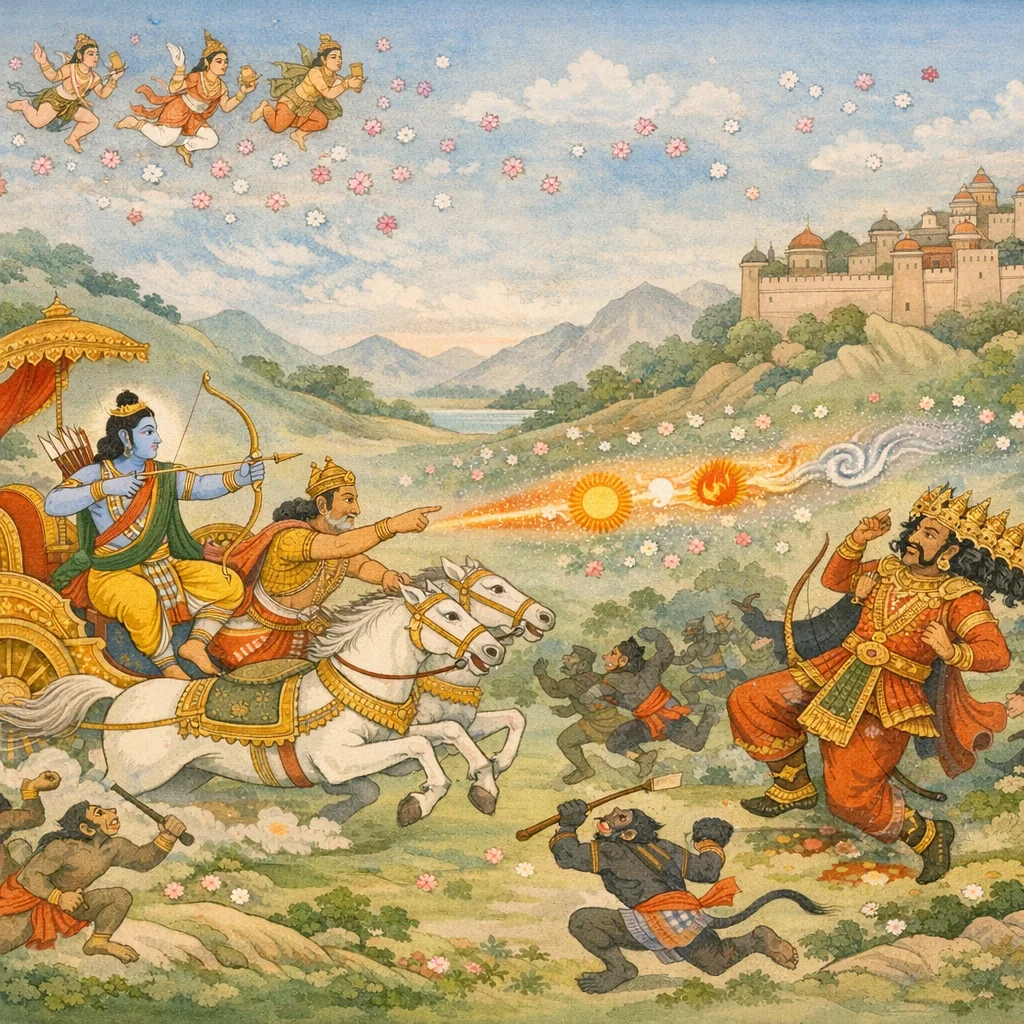
Sarga 111 concentrates the epic’s decisive act into a tightly staged sequence: Mātali, acting as a charioteer-counsellor, prompts Rāma to employ the Paitāmaha/Brahma-bestowed missile at the destined moment of Rāvaṇa’s destruction (6.111.1–2). Rāma then takes up the great arrow earlier transmitted through Agastya, and the text dwells on its cosmological construction—wind, fire, sun, mountains, and sky as presiding principles—thereby presenting weaponry as a ritual-ethical technology rather than mere violence (6.111.3–12). With Vedic procedure (veda-prokta vidhi) and deliberate charging of power, Rāma fits the arrow; the earth trembles and beings are terrified, marking the act as world-significant (6.111.13–15). In controlled fury he releases the shaft; it strikes Rāvaṇa’s chest like Indra’s thunderbolt, rends the vital core, steals the life-breath, and returns quietly to the quiver after completing its task (6.111.16–20). The fallen king’s bow drops, rākṣasas scatter, vānaras surge in triumph, and the heavens respond with drums, flowers, fragrant winds, and acclamations of “sādhu” (6.111.21–29). The cosmos regains equilibrium—earth steadies, directions brighten, sun stabilizes—while allies approach and honor Rāma, who shines like Indra among the gods (6.111.30–34).
Shlokas
Verse 1
अथसंस्मारयामासमातलिराघवंतदा ।अजानन्निवकिंवीरत्वमेनमनुवर्तसे ।।।।
Then Mātali admonished Rāghava: “O hero, why do you follow this course as though you did not know?”
Verse 2
विसृजास्मैवधायत्वमस्त्रंपैतामहंप्रभो ।विनाशकालःकथितोःयःसुरैःसोऽद्यवर्तते ।।।।
“O lord, release upon him—so that he may be slain—the Paitāmaha weapon. The time of destruction foretold by the gods has now arrived.”
Verse 3
ततःसंस्मारितोरामस्तेनवाक्येनमातलेः ।जग्राह स शरंदीप्तंनिःश्वसन्तमिवोरगम् ।।।।यंतस्मैप्रथमंप्रादादगस्त्योभगवानृषिः ।ब्रह्मदत्तंमहाबाणममोघंयुधिवीर्यवान् ।।।।
Then Rāma—reminded by Mātali’s words—took up that blazing shaft, like a serpent breathing hard. It was the unfailing great arrow, bestowed by Brahmā, which the mighty sage Agastya had formerly given to him.
Verse 4
ततःसंस्मारितोरामस्तेनवाक्येनमातलेः ।जग्राह स शरंदीप्तंनिःश्वसन्तमिवोरगम् ।।6.111.3।।यंतस्मैप्रथमंप्रादादगस्त्योभगवानृषिः ।ब्रह्मदत्तंमहाबाणममोघंयुधिवीर्यवान् ।।6.111.4।।
The valiant one took up that unfailing great arrow—Brahmā’s gift—which the blessed sage Agastya had first bestowed upon him for use in war.
Verse 5
ब्रह्मणानिर्मितंपूर्वमिन्द्रार्थममितौजसा ।दत्तंसुरपतेःपूर्वंत्रिलोकजयकाङ्क्षिणः ।।।।
Earlier, Brahmā—of immeasurable power—fashioned it for Indra’s sake, and in former times bestowed it upon the lord of the gods when he sought victory over the three worlds.
Verse 6
यस्यवाजेषुपवनःफलेपावकभास्करौ ।शरीरमाकाशमयंगौरवेमेरुमन्दरौ ।।।।
Of that arrow, the Wind presided over its feathers; Fire and the Sun presided over its head; its body was sky-like, and Meru and Mandara were set as its weight and gravity.
Verse 7
जाज्वल्यमानंवपुषासुपुङ्खंहेमभूषितम् ।तेजसासर्वभूतानांकृतंभास्करवर्चसम् ।।।।
Blazing in form, with excellent fletching and adorned with gold, it was fashioned with the brilliance of all beings, radiant with the splendor of the Sun.
Verse 8
सधूममिवकालानगिंदीप्तमाशीविषोपमम् ।नरनागाश्ववृद्धानांभेदनंक्षिप्रकारिणम् ।।।।
Smoking like the fire of the final age, blazing and like a venomous serpent, it swiftly shattered masses of enemy men, elephants, and horses.
Verse 9
द्वाराणांपरिघाणां च गिरीणांचापिभेदनम् ।नानारुधिरदिग्धाङ्गंमेदोदिग्धंसुदारुणम् ।।।।
It was capable of splitting city-gates, iron bars, even mountains—its body smeared with the blood of many foes, and dreadful, bespattered with fat and marrow.
Verse 10
वज्रसारंमहानादंनानासमितिदारणम् ।सर्ववित्रासनंभीमंश्वसन्तमिवपन्नगम् ।।।।
Hard as a thunderbolt, roaring loudly, shattering many battle-formations, terrifying all beings—dreadful like a serpent that hisses as it breathes.
Verse 11
कङ्कगृध्रबकानां च गोमायुगणरक्षसाम् ।नित्यंभक्षप्रदंयुद्धेयमरूपंभयापहम् ।।।।
In war it becomes a constant provider of food for buzzards, vultures, and herons, and for packs of jackals and Rākṣasas—terrifying, bearing the very form of Yama.
Verse 12
नन्दनंवानरेन्द्राणांरक्षसामवसादनम् ।वाजितंविविधैर्वाजैश्चारुचित्रैर्गरुत्मतः ।।।।
It was a delight to the lords of the Vānaras, yet a cause of ruin to the Rākṣasas—an arrow adorned with many splendid feathers, beautifully patterned like those of Garuḍa.
Verse 13
तमुत्तमेषुंलोकानामिक्ष्वाकुभयनाशनम् ।द्विषतांकीर्तिहरणंप्रहर्षकरमात्मनः ।।।।अभिम्नत्यततोरामस्तंमहेषुंमहाबलः ।वेदप्रोक्तेनविधिनासन्दधेकार्मुकेबली ।।।।
That supreme arrow—destroyer of fear for the Ikṣvāku line, robber of the enemies’ fame, and a source of uplift to its wielder—Rāma, mighty and steadfast, consecrated with mantra; then, following the rite taught in the Veda, he set that great missile upon his bow.
Verse 14
तमुत्तमेषुंलोकानामिक्ष्वाकुभयनाशनम् ।द्विषतांकीर्तिहरणंप्रहर्षकरमात्मनः ।।6.111.13।।अभिम्नत्यततोरामस्तंमहेषुंमहाबलः ।वेदप्रोक्तेनविधिनासन्दधेकार्मुकेबली ।।6.111.14।।
This verse is a Southern Recension duplication/overlap of the preceding pādas: Rāma, mighty and resolute, consecrated the supreme arrow with mantra and, according to the Veda-taught rite, set it upon his bow—an arrow that dispels fear for the Ikṣvāku line and strips enemies of their glory.
Verse 15
तस्मिन् सधनीयमानेतुराघवेणशरोत्तमे ।सर्वभूतानिसन्त्रेसुश्चचाल च वसुन्धरा ।।।।
As Rāghava was fitting that finest of arrows, all beings were seized with dread, and even the earth itself trembled.
Verse 16
स रावणायसङ्रुद्धोभृशमायम्यकार्मुकम् ।चिक्षेपपरमायत्तःशरंमर्मविदारणम् ।।।।
Enraged against Rāvaṇa, he drew his bow to its full stretch and, fully composed for the act, launched an arrow that could tear through vital points.
Verse 17
स वज्रइवदुर्धर्षोवज्रिबाहुविसर्जितः ।कृतान्तइवचावार्योन्यपतद्रावणोरसि ।।।।
Like Indra’s thunderbolt, irresistible and hard to withstand—like Death itself, impossible to ward off—that arrow fell upon Rāvaṇa’s chest.
Verse 18
स विसृष्टोमहावेगश्शरीरान्तकरश्शरः ।चिच्छेदहृदयंतस्यरावणस्यदुरात्मनः ।।।।
Loosed with tremendous speed, that body-ending arrow split the heart of Rāvaṇa, the evil-minded one.
Verse 19
रुधिराक्तस्सवेगेनशरीरान्तकरःशरः ।रावणस्यहरन्प्राणान्विवेशधरणीतलम् ।।।।
Smeared with blood, that death-dealing arrow, speeding onward, carried away Rāvaṇa’s life-breaths and plunged into the earth.
Verse 20
स शरोरावणंहत्वारुधिरार्द्रीकृतच्छविः ।कृतकर्मानिभृतवत्स्वतूणींपुनराविशत् ।।।।
That arrow, having slain Rāvaṇa and darkened its own sheen with blood, its task accomplished, quietly returned once more into its own quiver.
Verse 21
तस्यहस्ताद्धतस्याशुकार्मुकं च ससायकम् ।निपपातसहप्राणैर्भ्रश्यमानस्यजीवितात् ।।।।
As he was slain and his life slipped away, the bow and the arrow in his hand at once dropped down—falling, as it were, together with his very life-breath.
Verse 22
गतासुर्भीमवेगस्तुनैरृतेन्द्रोमहाद्युतिः ।पपातस्यन्दनाद्भूमौवृत्रोवज्रहतोयथा ।।।।
Bereft of life, the lord of the rākṣasas—terrible in speed and radiant in might—fell from his chariot to the earth, like Vṛtra struck down by Indra’s thunderbolt.
Verse 23
तंदृष्टवापतितंभूमौहतशेषानिशाचराः ।हतनाधाभयत्रस्तास्सर्वतस्सम्प्रदुद्रुवुः ।।।।
Seeing him fallen on the ground, the remaining night-rangers—leaderless now that their lord was slain—panicked and fled in all directions.
Verse 24
सर्वतश्चाभिपेतुस्तान्वानराद्रुमयोधिनः ।दशग्रीववधंदृष्टवावानराजितकाशिनः ।।।।
From every side the vānaras—fighters wielding trees—rushed upon them; seeing Daśagrīva slain, they moved about in triumph.
Verse 25
अर्दितावानरैर्भ्रष्टालङ्कामभ्यपतन् भयात् ।हताश्रयात्वात्करुणैर्भाष्पप्रस्रवणैर्मुखैः ।।।।
Wounded by the vānaras and broken in battle, they fled in fear toward Laṅkā; their refuge was gone, and with piteous faces their tears streamed forth.
Verse 26
ततोविनेदुःसम्हृष्टावानराःजितकाशिनः ।वदन्तोराघवजयंरावणस्य ज तद्वधम् ।।।।
Then the vānaras, exultant and wearing the look of victory, raised loud cries—proclaiming Rāghava’s triumph and Rāvaṇa’s death.
Verse 27
अथान्तरिक्षेव्यनदत्सौम्यस्त्रिदशदुन्धुभिः ।दिव्यगन्धशहस्तत्रमारुतस्सुसुकोववौ ।।।।
Then in the sky the auspicious drums of the gods resounded, and there a gentle breeze—bearing divine fragrance—blew pleasantly.
Verse 28
निपपातान्तरिक्षाच्चपुष्पवृष्टिस्तदाभुवि ।किरन्तीराघवरथंदुरवापामनोहरा ।।।।
Then from the sky a captivating shower of flowers fell upon the earth, scattering over and covering Rāghava’s chariot—marvellous and seemingly from an unknown source.
Verse 29
राघवस्तवसंयुक्तागगने च विशुश्रुवे ।साधुसाध्वितिवागग्य्रादेवतानांमहात्मनाम् ।।।।
From the heavens there was clearly heard the foremost praise of the great-souled gods—words lauding Rāghava: “Well done! Well done!”
Verse 30
अविवेशमहान् हर्षोदेवानांचारणैःसह ।रावणेनिहतेरौद्रेसर्वलोकभयङ्करे ।।।।
When Rāvaṇa—fierce and a terror to all the worlds—was slain, great joy filled the Devas together with the Cāraṇas.
Verse 31
ततःसकामंसुग्रीवमङ्गदं च विभीषणम् ।चकारराघवःप्रीतोहत्वाराक्षसपुङ्गवम् ।।।।
Then Rāghava, pleased at having slain the foremost of the Rākṣasas, fulfilled the desires of Sugrīva, Aṅgada, and Vibhīṣaṇa, and made them glad.
Verse 32
ततःप्रजग्मुःप्रशमंमरुद्गणादिशःप्रसेदुर्विमलंनभोऽभवत् ।महीचकम्पे न च मारुतोववौस्थिरप्रभश्चाप्यभवद्दिवाकरः ।।।।
Then the Marut hosts grew calm; the quarters brightened; the sky became clear. The earth ceased to tremble, the wind no longer blew wildly, and even the Sun shone with steady radiance.
Verse 33
ततस्तुसुग्रीवविभीषणाङ्गदाःसुहृद्विशिष्टास्सहलक्ष्मणास्तदा ।समेत्यहृष्टाविजयेनराघवंरणेऽभिरामंविधिनाभ्यपूजयन् ।।।।
Then Sugrīva, Vibhīṣaṇa, and Aṅgada—together with Lakṣmaṇa and other eminent friends—came together, rejoicing in the victory, and honored Rāghava, charming in battle, according to due rite.
Verse 34
स तुनिहतरिपुस्स्थिरप्रतिज्ञःस्वजनबलाभिवृतोरणेरराज ।रघुकुलनृपनन्दनोमहौजास्त्रिदशगणैरभिसंवृतोयथेन्द्रः ।।।।
With his enemy slain, steadfast in his vow, and surrounded by his own people and army, he shone on the battlefield—Rāma, the delight of the kings of Raghu’s line, mighty in splendor—like Indra encompassed by the hosts of the gods.
Frequently Asked Questions
The pivotal action is the sanctioned use of the Paitāmaha/Brahmāstra against Rāvaṇa at the foretold “time of destruction.” The text frames this not as escalation for its own sake but as a dharmically authorized terminal act, executed only after counsel (Mātali) and with ritual correctness, indicating controlled force rather than uncontrolled vengeance.
Power is legitimate only when aligned with right procedure and right purpose: the Vedic charging of the arrow and its return to the quiver after completing its task symbolize disciplined agency—violence confined to necessity, culminating in the re-stabilization of the cosmos (earth steadies, sky clears, directions brighten).
Laṅkā functions as the implied war-theatre, while the sarga emphasizes cultural-ritual landmarks: Veda-prokta vidhi (Vedic protocol), celestial acclamation (divine drums, flower-shower), and cosmological “landmarks” (Meru, Mandara, sun, wind, fire) embedded in the arrow’s description to map the event onto a universe-scale register.