Sarga 110
रामरावणयोर्युद्धवैषम्यं तथा रावणशिरश्छेदनम् (Rama–Ravana Duel Intensifies; Ravana’s Heads Severed and Reappear)
युद्धकाण्ड
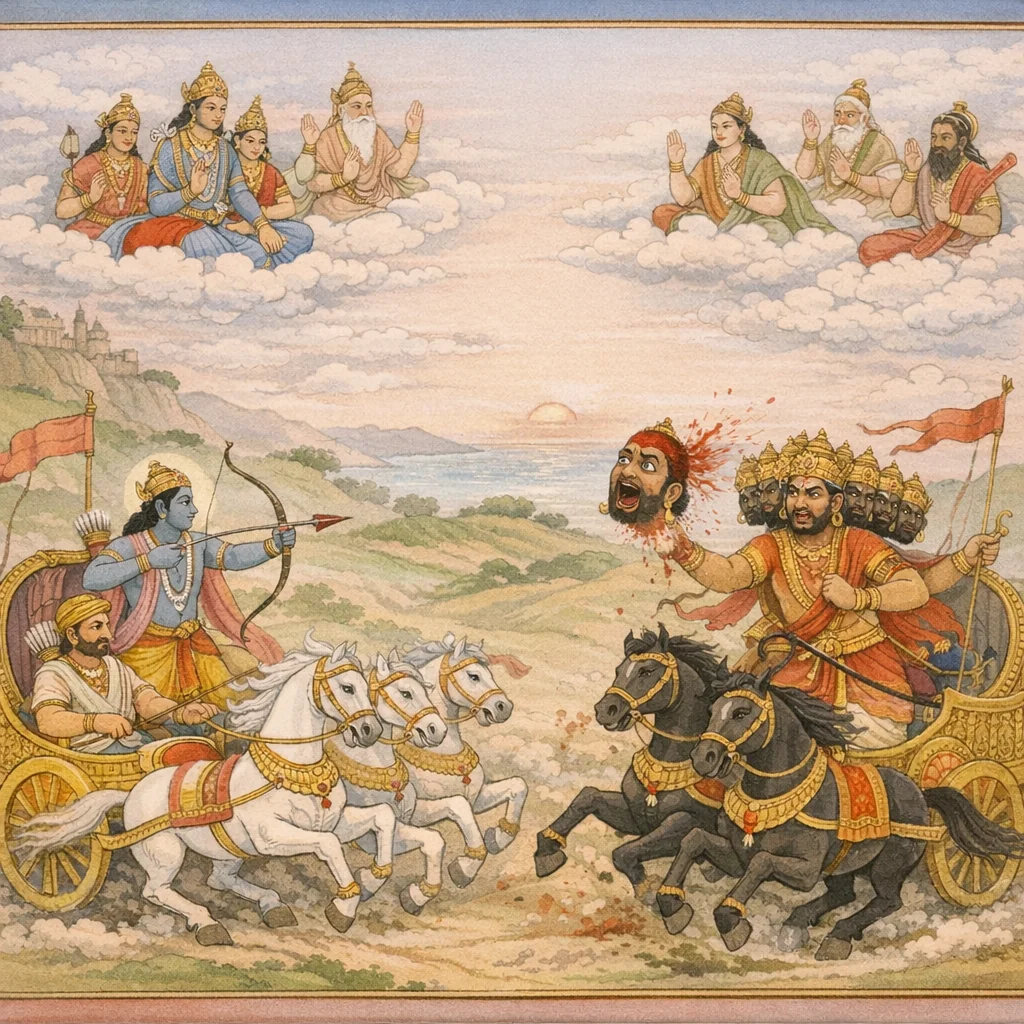
Sarga 110 depicts the duel of Rāma and Rāvaṇa escalating into a spectacle witnessed by all beings, with celestial communities observing in astonishment and anxiety. The combat is described through rapid chariot maneuvers—circling, advancing, retreating—showcasing charioteer skill and the symmetry of retaliation. Rāvaṇa targets Rāma’s charioteer Mātali with thunder-like arrows, yet Mātali remains unshaken; Rāma’s response is framed as principled wrath directed at the affront to his ally rather than personal pain. A tumultuous exchange of arrows and heavy weapons (maces, mallets, iron bars) produces cosmic disturbance: seas churn, subterranean beings are distressed, the earth trembles, the sun dims, and the wind stills. Devas and ṛṣis chant auspicious blessings for cows and brāhmaṇas and invoke Rāma’s victory, emphasizing the war’s dharmic horizon. Rāma severs a head of Rāvaṇa, but another immediately arises; repeated decapitations fail to end the rākṣasa king, prompting Rāma—expert in all astras—to reflect on why his previously decisive arrows now appear ineffective. The chapter closes with the battle continuing without pause and Mātali preparing to speak, anticipating a strategic revelation about Rāvaṇa’s life-force and the proper means to conclude the conflict.
Shlokas
Verse 1
तौतथायुध्यमानौतुसमरेरामरावणौ ।ददृशुस्सर्वभूतानिविस्मितेनान्तरात्मना ।।।।
As Rāma and Rāvaṇa fought thus in battle, all beings beheld them, inwardly astonished.
Verse 2
अर्धयन्तौतुसमरेतयोस्तौस्यन्दनोत्तमौ ।परस्परमभिक्रुद्धौपरस्परमभिद्रुतौ ।।।।
In that battle, the two superb chariots of those combatants pressed toward each other; both warriors, enraged, drove straight at one another with unwavering resolve.
Verse 3
परस्परवधेयुक्तौघोररूपौबभूवतुः ।मण्डलानि च वीधीश्चगतप्रत्यागतानि च ।।।।दर्शयन्तौबहुविधांसूतसामर्थ्यजांगतिम् ।
Locked in mutual attempts to strike each other down, the two assumed a terrible aspect. They wheeled in circles, advanced and withdrew in turns, displaying many kinds of movement born of a charioteer’s skill.
Verse 4
अर्धयन्रावणंरामोराघवंचापिरावणः ।।।।गतिवेगंसमापन्नौप्रतिवेगप्रवर्तने ।
Rāma struck down Rāvaṇa, and Rāvaṇa in turn struck at Rāghava; in that exchange of swift retaliation, the battle surged with the full speed and force of their missiles.
Verse 5
क्षिपतोश्शरजालानितयोस्तौस्यन्दनोत्तमौ ।।।।चेरतुस्सम्युगमहीं सासारौ जलदाविव ।
As both loosed dense nets of arrows, those two splendid chariots moved across the battlefield like twin rain-clouds pouring down their streams.
Verse 6
दर्शयित्वातदातौतुगतिंबहुविधांरणे ।।।।परस्परस्याभिमुखौपुनरेव च तस्थतुः ।
Having displayed many kinds of maneuvers in the battle, the two once again halted, facing one another directly.
Verse 7
धुरंधुरेणरथयोर्वक्त्रंवक्त्रेणवाजिनाम् ।।।।पताकाश्चपताकाभिस्समीयुस्स्थितयोस्तदा ।
When they halted, the two chariots pressed close—axle to axle; the horses’ faces nearly met face to face; and flag met flag, as though the two were joined together.
Verse 8
रावणस्यततोरामोधनुर्मुस्तैश्शितैश्शरैः ।।।।चतुर्भिश्चतुरोदीप्तान्हयान्प्रत्यपसर्पयत् ।
Then Rāma, gripping and drawing his bow, shot four keen, blazing arrows and forced back Rāvaṇa’s four horses.
Verse 9
सक्रोधवशमापन्नोहयानामपसर्पणे ।।।।मुमोचनिशितान्बाणान्राघवायदशाननः ।
Enraged at the horses’ retreat, Daśānana released sharp arrows at Rāghava.
Verse 10
सोतिविद्धोबलवतादशग्रीवेणराघवः ।।।।जगाम न विकारं च न चापिव्यथितोऽभवत् ।
Though grievously pierced by the mighty Daśagrīva, Rāghava showed no change of composure, nor did he become distressed.
Verse 11
चिक्षेप च पुनर्भाणान्वज्रपातसमस्वनान् ।।।।सारथिंवज्रहस्तस्यसमुद्दिश्यदशाननः ।
Then Daśānana (Rāvaṇa), whose hands were like thunderbolts, again hurled arrows that roared like lightning-strikes—aiming at the charioteer (Mātali) of the thunderbolt-armed warrior (Rāma).
Verse 12
मातलेस्तुमहावेगाश्शरीरेपतिताश्शराः ।।।।न सूक्ष्ममपिसम्मोहंव्यथांवाप्रददुर्युधि ।
Though swift, forceful arrows fell upon Mātali’s body, they caused him in battle neither the slightest confusion nor any pain.
Verse 13
तयाधर्षणयाक्रुद्धोमातलेर्नतथात्मनः ।।।।चकारशरजालेनराघवोविमुखंरिपुम् ।
Rāghava grew wrathful at that affront to Mātali—more than at any injury to himself—and with a net of arrows he forced the enemy to turn away.
Verse 14
विंशतिंत्रिंशतिंषष्टिंशतशोऽथसहस्रशः ।।।।मुमोचराघवोवीरस्सायकान्स्यन्दनेरिपोः ।
Then the heroic Rāghava loosed shafts in twenties, thirties, sixties—then by hundreds and by thousands—against the enemy’s chariot.
Verse 15
रावणोऽपिततःक्रुद्धोरथस्थराक्षसेश्वरः ।।।।गदामुसलवर्षेणरामंप्रत्यर्दयद्रणे ।
Then Rāvaṇa too—enraged, the rākṣasa-lord standing on his chariot—pressed Rāma back in battle with a rain of maces and mallets.
Verse 16
तत्प्रवृतंपुनर्युद्धंतुमुलंरोमहर्षणम् ।।।।गदानांमुसलानां च परिघाणांचनिस्स्वनैः ।शराणांपुङ्खवातैश्चक्षुभितास्सप्तसागराः ।।।।
Once again the battle surged—tumultuous and hair-raising; by the clangor of maces, mallets, and iron bars, and by the gusts raised by arrow-feathers, even the seven seas were thrown into agitation.
Verse 17
तत्प्रवृतंपुनर्युद्धंतुमुलंरोमहर्षणम् ।।6.110.16।।गदानांमुसलानां च परिघाणांचनिस्स्वनैः ।शराणांपुङ्खवातैश्चक्षुभितास्सप्तसागराः ।।6.110.17।।
Once again the battle surged—tumultuous and hair-raising; by the clangor of maces, mallets, and iron bars, and by the gusts raised by arrow-feathers, even the seven seas were thrown into agitation.
Verse 18
क्षुब्दानांसागराणां च पातालतलवासिनः ।व्यथितादानवाःसर्वेपन्नगाश्चसहस्रशः ।।।।
As the seas churned, the beings dwelling in the nether regions grew distressed—every Dānava, and serpents by the thousands.
Verse 19
चकम्पेमेदिनीकृत्स्नासशैलवनकानना ।भास्करोनिष्प्रभश्चासीन्नवनौचापिमारुतः ।।।।
The whole earth shook—with its mountains, forests, and groves; the sun seemed to lose its radiance, and even the wind did not blow.
Verse 20
ततोदेवास्सगन्धर्वास्सिद्धाश्चपरमर्षयः ।चिन्तामापेदिरेसर्वेसकिन्नरमहोरगाः ।।।।
Then the Devas—together with the Gandharvas, the Siddhas, the great sages, the Kinnaras, and the mighty serpents—were all seized by anxiety as they watched the course of the battle.
Verse 21
स्वस्तिगोब्राह्मणेभ्योऽस्तुलोकास्तिष्ठन्तुशाश्वताः ।जयतांराघयसङ्ख्येरावणंराक्षसेश्वरम् ।।।।एवंजपन्तोऽपश्यंस्तेदेवास्सर्षिगणास्तदा ।रामरावणयोर्युद्धंसुघोरंरोमहर्षणम् ।।।।
"May there be well-being for cows and brāhmaṇas; may the worlds stand firm forever; may Rāghava conquer Rāvaṇa, lord of the Rākṣasas, in battle." Chanting thus, the Devas along with the companies of seers beheld then the exceedingly dreadful, hair-raising war between Rāma and Rāvaṇa.
Verse 22
स्वस्तिगोब्राह्मणेभ्योऽस्तुलोकास्तिष्ठन्तुशाश्वताः ।जयतांराघयसङ्ख्येरावणंराक्षसेश्वरम् ।।6.110.21।।एवंजपन्तोऽपश्यंस्तेदेवास्सर्षिगणास्तदा ।रामरावणयोर्युद्धंसुघोरंरोमहर्षणम् ।।6.110.22।।
Thus chanting, the Devas and the hosts of seers beheld at that time the extremely dreadful, hair-raising battle between Rāma and Rāvaṇa.
Verse 23
गन्धर्वाप्सरसांसङ्घादृष्टवायुद्धमनूपमम् ।गगनंगगनाकारंसागरस्सागरोपमः ।।।।रामरावणयोर्युद्धंरामरावणयोरिव ।एवंब्रुवन्तोददृशुस्तद्युद्धंरामरावणम् ।।।।
The companies of Gandharvas and Apsarases, seeing that incomparable battle, exclaimed: “The sky is like the sky alone; the ocean is comparable only to the ocean”—implying that this combat admits no true parallel.
Verse 24
गन्धर्वाप्सरसांसङ्घादृष्टवायुद्धमनूपमम् ।गगनंगगनाकारंसागरस्सागरोपमः ।।6.110.23।।रामरावणयोर्युद्धंरामरावणयोरिव ।एवंब्रुवन्तोददृशुस्तद्युद्धंरामरावणम् ।।6.110.24।।
“The battle of Rāma and Rāvaṇa is like the battle of Rāma and Rāvaṇa alone.” Saying so, they kept gazing upon that very combat between Rāma and Rāvaṇa.
Verse 25
ततःक्रोधान्महाबासूरघूणांकीर्तिवर्धनः ।सन्धायधनुषारामश्शरमाशीविषोपमम् ।।।।रावणस्यशिरोऽच्छिन्दच्छ्रीमज्ज्वलितकुण्डलम् ।तछचिरःपतितंभूमौदृष्टंइलोकैस्त्रिभिस्तदा ।।।।
Then Rāma—mighty-armed, the enhancer of the Raghu line’s fame—angered, set to his bow an arrow like a venomous serpent and severed Rāvaṇa’s head, splendid with blazing earrings. That head, fallen upon the earth, was then seen by the three worlds.
Verse 26
ततःक्रोधान्महाबासूरघूणांकीर्तिवर्धनः ।सन्धायधनुषारामश्शरमाशीविषोपमम् ।।6.110.25।।रावणस्यशिरोऽच्छिन्दच्छ्रीमज्ज्वलितकुण्डलम् ।तछचिरःपतितंभूमौदृष्टंइलोकैस्त्रिभिस्तदा ।।6.110.26।।
He severed Rāvaṇa’s head, splendid with blazing earrings; and that head, fallen upon the earth, was then beheld by the three worlds.
Verse 27
तस्यैवसदृशंचान्यद्रावणस्योत्थितंशिरः ।तत्क्षिप्तंक्षिप्रहस्तेनरामेणक्षिप्रकारिणा ।।।।
Another head, resembling the former, rose again upon Rāvaṇa; but swift-handed Rāma—quick in action—struck it down at once.
Verse 28
द्वितीयंरावणशिरश्छिन्नंसम्यतिसायकैः ।छिन्नमात्रं च तच्चीर्षंपुनरेवप्रदृश्यते ।।।।
Though the second head of Rāvaṇa was cut off in the fight by arrows, as soon as it was severed that head was seen to appear again.
Verse 29
तदप्यशनिसङ्काशैश्छिन्नंरामस्यसायकैः ।एवमेवशतंछिन्नंशिरसांतुल्यवर्चसाम् ।।।।
That head too was severed by Rāma’s arrows, brilliant as Indra’s thunderbolt; and in this very manner a hundred heads—equal in splendor—were cut off.
Verse 30
न चैवरावणस्यान्तोदृश्यतेजीवितक्षये ।ततस्सर्वास्त्रविद्वीरःकौसल्यानन्दवर्धनः ।।।।मार्गणैर्बहुभिर्युक्तश्चिन्तयामासराघवः ।
Yet Rāghava could not see the end of Rāvaṇa’s life drawing near. Then that valiant master of every weapon—who ever increased Kausalyā’s joy—though furnished with many missiles, began to reflect.
Verse 31
मारीचोनिहतोयैस्तुखरोयैस्तुसदूषणः ।।।।क्रौञ्चावनेविराधस्तुकबन्धोदण्डकेवने ।यैस्सालागिरयोभग्नावाली च क्षुभितोऽम्बुधिः ।।।।त इमेसायकास्सर्वेयुद्धेप्रात्ययिकाममकिनुतत्कारणंयेनरावणेमन्दतेजसः ।।।।
“With those very arrows by which Mārīca was slain, and by which Khara along with Dūṣaṇa fell—”
Verse 32
मारीचोनिहतोयैस्तुखरोयैस्तुसदूषणः ।।6.110.31।।क्रौञ्चावनेविराधस्तुकबन्धोदण्डकेवने ।यैस्सालागिरयोभग्नावाली च क्षुभितोऽम्बुधिः ।।6.110.32।।त इमेसायकास्सर्वेयुद्धेप्रात्ययिकाममकिनुतत्कारणंयेनरावणेमन्दतेजसः ।।6.110.33।।
“—and by which Virādha fell in the Krauñca-wood, and Kabandha in the Daṇḍaka forest; by which the Sāla trees and even mountains were shattered; by which Vālī was struck down and the ocean was made to surge—”
Verse 33
मारीचोनिहतोयैस्तुखरोयैस्तुसदूषणः ।।6.110.31।।क्रौञ्चावनेविराधस्तुकबन्धोदण्डकेवने ।यैस्सालागिरयोभग्नावाली च क्षुभितोऽम्बुधिः ।।6.110.32।।त इमेसायकास्सर्वेयुद्धेप्रात्ययिकाममकिनुतत्कारणंयेनरावणेमन्दतेजसः ।।6.110.33।।
“Those same arrows of mine—always dependable in battle—now fail to take effect. What, then, is the cause because of which, against Rāvaṇa of diminished splendour, they do not succeed?”
Verse 34
इतिचिन्तापरश्चासीदप्रमत्तश्चसम्युगे ।ववर्षशरवर्षाणीराघवोरावणोरसि ।।।।
Even while he reflected thus, Rāghava remained fully vigilant in the combat and poured down showers of arrows upon Rāvaṇa’s chest.
Verse 35
रावणोऽपिततःक्रुद्धोरथस्थोराक्षसेश्वरः ।गदामुसलवर्षेणरामंप्रत्यर्दयद्रणे ।।।।
Then Rāvaṇa too, enraged and standing upon his chariot—the lord of the rākṣasas—pressed Rāma hard in the fight with a storm of maces and clubs.
Verse 36
तत्प्रवृत्तंमहद्युद्धंतुमुलंरोमहर्षणम् ।अन्तरिक्षे च भूमौ च पुनश्चगिरिमूर्धनि ।।।।
That mighty battle, fierce and hair-raising, surged on—now in the open sky, now upon the earth, and again upon the mountain’s crest.
Verse 37
देवदानवयक्षाणांपिशाचोरगरक्षसाम् ।पश्यतांतन्महायुद्धंसप्तरात्रमवर्तत ।।।।
While Devas, Dānavas, Yakṣas, Piśācas, Nāgas, and Rākṣasas looked on, that great war rolled on for seven nights.
Verse 38
नैव रात्रिं न दिवसंमुहूर्तं न च क्षणम् ।रामरावणयोर्युद्धंविराममुपगच्छति ।।।।
Neither by night nor by day—neither for an hour nor even for an instant—did the battle between Rāma and Rāvaṇa come to a pause.
Verse 39
दशरथसुतराक्षसेन्द्रयोर्जयमनवेक्ष्यरणे स राघवस्य ।सुरवररथसारथिर्महात्मारणरतराममुवाचवाक्यमाशु ।।।।
Seeing the duel between Daśaratha’s son and the lord of the Rākṣasas, and wishing to behold Rāghava’s victory, the great charioteer of the gods’ king spoke swiftly to Rāma, who was intent on battle.
Frequently Asked Questions
Rāma’s pivotal action is his controlled wrath: he becomes furious at the torment inflicted on Mātali (an ally and charioteer) rather than reacting to his own wounds, illustrating retaliation guided by duty and protection rather than ego-driven anger.
The chapter teaches that power alone is not sufficient without right knowledge of causality: even a master of astras must discern the hidden condition sustaining adharma (Rāvaṇa’s continued life), and must align force with insight to restore order.
The text emphasizes cosmic-geographical markers rather than a single cityscape: the sapta-sāgarāḥ (seven seas) churn, pātāla-dwellers are distressed, and the whole earth with mountains and forests trembles—signaling that the duel is treated as a world-order event.