Sarga 1
प्रथमः सर्गः — Rama Praises Hanuman; Anxiety over Crossing the Ocean
युद्धकाण्ड
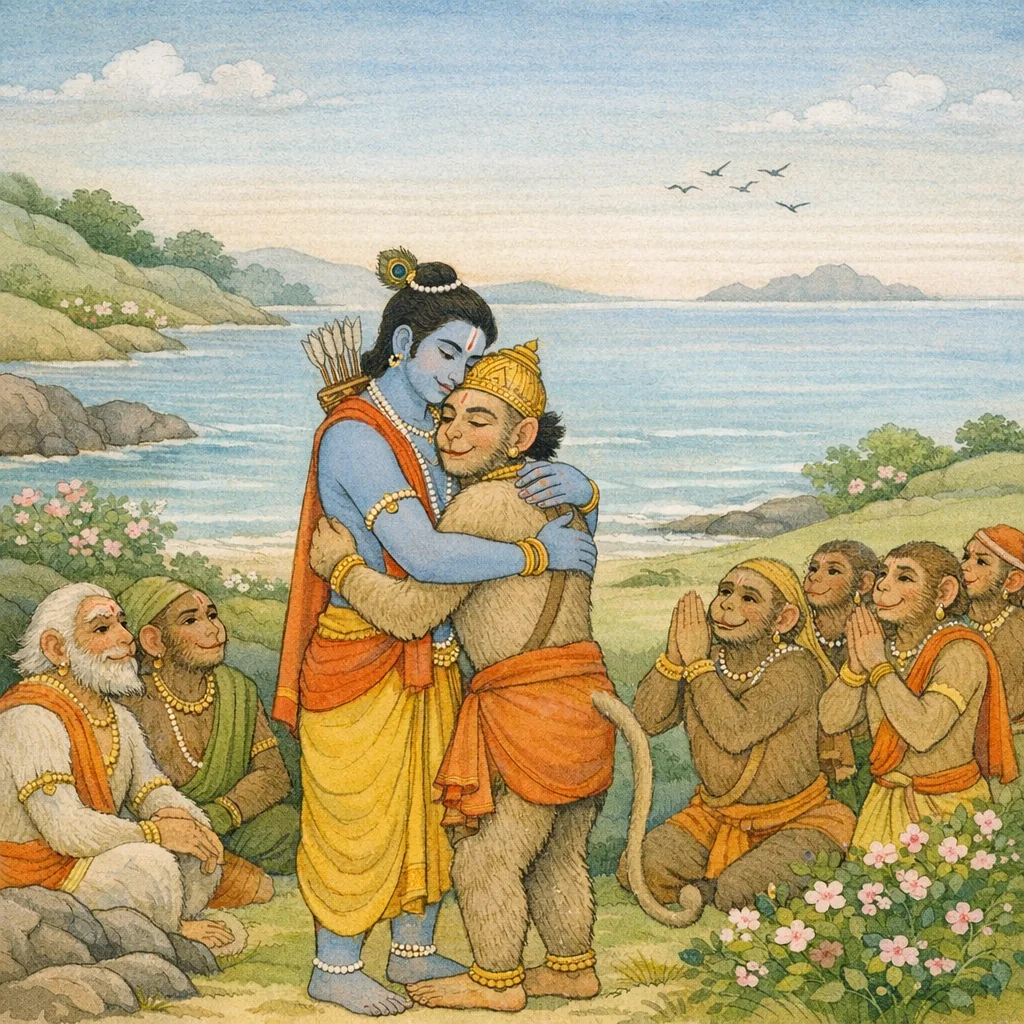
This sarga opens with Rāma listening to Hanumān’s report and responding with visible affection and formal praise. Rāma elevates Hanumān’s achievement as nearly unparalleled—crossing the great ocean and entering the heavily guarded city of Laṅkā—framing it as an exemplar of ideal service (bhṛtya-dharma). A graded ethical typology of servants is articulated: the best performs difficult tasks with devotion; the mediocre fails to anticipate what is dear to the king; the base fails even at the entrusted duty. Rāma then acknowledges that Hanumān’s success safeguards the Raghu line by confirming Vaidehī’s whereabouts, yet he expresses a poignant inability to repay such pleasing speech and service adequately, offering an embrace as “all he can give” at that moment. The discourse pivots from celebration to strategy: despite successful intelligence, Rāma’s mind becomes agitated by the logistical and existential challenge of crossing the vast, difficult-to-ford ocean with the assembled vānaras. The chapter closes with Rāma, sorrow-stirred yet resolute, turning toward reflection and consultation centered on Hanumān and the impending ocean-crossing problem.
Shlokas
Verse 1
श्रुत्वा हनुमतो वाक्यं यथावदभिभाषितम् ।रामः प्रीतिसमायुक्तो वाक्यमुत्तरमब्रवीत् ।।।।
Having heard Hanumān’s words spoken properly and in due order, Rāma—filled with affection—gave his reply.
Verse 2
कृतं हनुमता कार्यं सुमहद्भुवि दुर्लभम् ।मनसापि यदन्येन न शक्यं धरणीतले ।।।।
Rāma said: “Hanumān, you have accomplished a truly great task—rare in this world—one that no other being on this earth could accomplish, even in thought.”
Verse 3
न हि तं परिपश्यामि यस्तरेत महार्णवम् ।अन्यत्र गरुडाद्वायोरन्यत्र च हनूमतः ।।।।
Indeed, I see none who could cross the great ocean—except Garuḍa, or Vāyu, and except Hanumān.
Verse 4
देवदानवयक्षाणां गन्धर्वोरगरक्षसाम् ।अप्रधृष्यां पुरीं लङ्कां रावणेन सुरक्षिताम् ।प्रवष्ट स्सत्त्वमाश्रित्यश्वसन्को नाम निष्क्रमेत् ।।।।
Laṅkā—securely guarded by Rāvaṇa—is unassailable even for devas, dānavas, yakṣas, gandharvas, nāgas, and rākṣasas. Having entered it by relying on sheer courage, who indeed could come out alive?
Verse 5
को विशेत्सुदुराधर्षां राक्षसैश्च सुरक्षिताम् ।यो वीर्यबलसम्पन्नो न समस्याद्धनूमतः ।।।।
Who could enter that utterly inaccessible Laṅkā, guarded by rākṣasas—except one endowed with such valor and strength as Hanumān?
Verse 6
भृत्यकार्यं हनुमता सुग्रीवस्य कृतंमहत् ।स्वयं विधाय स्वबलं सदृशं विक्रमस्य च ।।।।
Hanumān has accomplished a great servant’s duty for Sugrīva—acting on his own initiative and bringing forth strength befitting his valor.
Verse 7
यो हि भृत्यो नियुक्तस्सन्भर्त्रा कर्मणि दुष्करे ।कुर्यात्तदनुरागेण तमाहुः पुरुषोत्तमम् ।।।।
He is called the best of men who—though a servant assigned by his master to a difficult task—performs it with genuine devotion.
Verse 8
नियुक्तोय: परं कार्यं न कुर्यान्नृपतेः प्रियम् ।भृत्योऽभृत्यस्समर्थोऽपि तमाहुर्मध्यमं नरम् ।।।।
Even if capable, a servant who—though appointed—does not also carry out what is dear and beneficial to the king (beyond the bare assignment), is called a middling man.
Verse 9
नियुक्तो नृपतेः कार्यं न कुर्याद्यस्समाहितः ।भृत्यो युक्तस्समर्थश्च तमाहुः पुरुषाधमम् ।।।।
But a servant who is competent and able—having accepted the king’s commission—yet does not carry out that task, is called the lowest of men.
Verse 10
तन्नियोगे नियुक्तेन कृतं कृत्यं हनूमता ।न चात्मा लघुतां नीतस्सुग्रीवश्चापि तोषितः ।।।।
Having heard Hanumān’s words spoken properly and in due order, Rāma—filled with affection—gave his reply.
Verse 11
अहं च रघुवंशश्च लक्ष्मणश्च महाबलः ।वैदेह्या दर्शनेनाद्य धर्मतः परिरक्षिताः ।।।।
“By Vaidehī’s being seen today, I—along with Lakṣmaṇa the mighty, and the whole Raghu lineage—stand safeguarded in righteousness.”
Verse 12
इदं तु मम दीनस्य मनो भूयः प्रकर्षति ।यदिहास्य प्रियाख्यातुर्न कुर्मि सदृशं प्रियम् ।।।।
“Yet my mind, in my helplessness, is pained again and again—because I cannot return a fitting kindness to him who has spoken such welcome, heartening words.”
Verse 13
एष सर्वस्वभूते परिष्वङ्गो हनूमतः ।मया कालमिमं प्राप्य दत्तस्तस्य महात्मनः ।।।।
“This embrace is, as it were, everything I can offer to Hanumān. Having gained this moment, I give it to that great-souled one.”
Verse 14
इत्युक्त्वा प्रीतिहृष्टाङ्गो रामस्तं परिषस्वजे ।हनूमन्तं कृतात्मानं कृतकार्यमुपागतम् ।।।।
Having spoken thus, Rāma—his whole body thrilled with affectionate joy—embraced Hanumān, the self-possessed hero who had returned after completing his mission.
Verse 15
ध्यात्वा पुनरुवाचेदं वचनं रघुनन्दनः ।हरीणामीश्वरस्यापि सुग्रीवस्योपशृण्वतः ।।।।
Then Rāma, the delight of the Raghu line, reflected and spoke again these words—while Sugrīva, lord of the vānaras, listened closely.
Verse 16
सर्वथा सुकृतं तावत्सीतायाः परिमार्गणम् ।सागरं तु समासाद्य पुनर्नष्टं मनो मम ।।।।
“In every way, the search for Sītā has been well accomplished. Yet, on reaching the ocean, my mind falters again—troubled by what lies ahead.”
Verse 17
कथं नाम समुद्रस्य दुष्पारस्य महाम्भसः ।हरयो दक्षिणं पारं गमिष्यन्ति समागताः ।।।।
“How indeed will the gathered vānaras cross to the southern shore of this vast ocean—so difficult to pass?”
Verse 18
यद्यप्येष तु वृत्तान्तो वैदेह्या गदितो मम ।समुद्रपारगमने हरीणां किमिहोत्तरम् ।।।।
“Even though Vaidehī has conveyed this account to me, one question remains here: what answer is there for the vānaras’ crossing of the ocean?”
Verse 19
इत्युक्तवा शोकसम्भ्रान्तो राम श्शत्रुनिबर्हणः ।हनूमन्तं महाबाहुस्ततो ध्यानमुपागमत् ।।।।
Having spoken thus, Rāma—mighty-armed, destroyer of foes, yet shaken by grief—turned toward Hanumān and then fell into deep reflection.
Frequently Asked Questions
The sarga presents the dilemma of reciprocity and reward: Rāma feels grief that he cannot adequately repay Hanumān’s extraordinary service, and he resolves it through a symbolic yet intimate act—offering his embrace—while also shifting to the practical duty of planning the ocean crossing.
Service is evaluated not merely by capacity but by devotion and completion of entrusted duty; the ideal servant performs difficult work with love and anticipates what benefits the cause. Leadership, in turn, must acknowledge merit with gratitude while remaining anchored to strategic responsibility.
Key landmarks include Laṅkā (as an almost impregnable fortified polity under Rāvaṇa) and the vast ocean (samudra/mahārṇava) as the central logistical barrier; these function as both physical geography and narrative symbols of seemingly insurmountable obstacles overcome through disciplined effort.