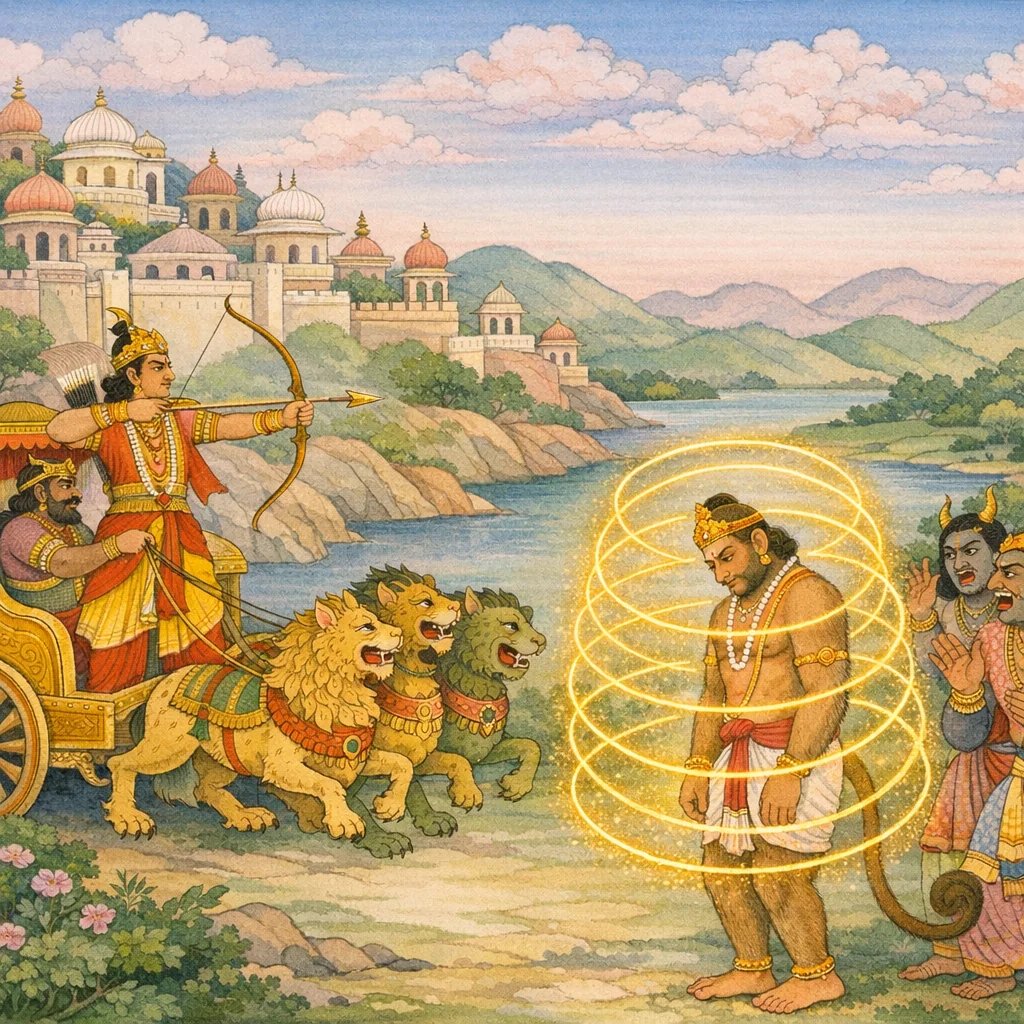
Sarga 48
इन्द्रजित्प्रेषणम्—ब्रह्मास्त्रबन्धः, हनूमद्ग्रहणं, रावणसभाप्रवेशः (Indrajit’s Deployment—Brahmāstra Binding, Hanuman’s Capture, Entry into Ravana’s Court)
सुन्दरकाण्ड
अक्षवधात् अनन्तरं रक्षोधिपतिः रावणः क्रोधं निगृह्य इन्द्रजितं समादिशति—सेनानाशं विना शत्रुनिग्रहः, आत्मबल-परबल-पर्यालोचनं, तथा अस्त्रविद्यायाः युक्तप्रयोगः। इन्द्रजित् (पैतामहास्त्र-सम्पन्नः) दिव्यरथेन, चतुर्व्याळयुत-रथेन, हनूमन्तं प्रति प्रस्थितः। उभयोः वेगसम्पन्नयोः युद्धं सर्वभूतमनोग्राहि भवति; इन्द्रजितस्य ‘अमोघ’ शराः अपि लक्ष्यं विहन्यन्ते, ततोऽसौ निग्रहार्थं ‘अवध्यत्व’बुद्ध्या ब्रह्मास्त्रं योजयति। हनूमान् ब्रह्मास्त्रबन्धं ज्ञात्वा, स्वविमोक्षशक्तिं स्मृत्वापि पितामहाज्ञामनुवर्तते—रणनीतिक-लाभाय राक्षसेन्द्र-दर्शनं साधयितुम्। राक्षसैः शणवल्क-द्रुमचीरैः बन्धने कृते ब्रह्मास्त्रबन्धः निवर्तते (अस्त्रबन्धस्य अन्यबन्ध-असहिष्णुता)। इन्द्रजित् हनूमन्तं सभायां नयति; राक्षसाः विविधदण्डविचारान् कुर्वन्ति; रावणः मन्त्रिवृद्धान् हनूमद्विषये पृच्छति; हनूमान् स्वपरिचयं दत्त्वा ‘हरीश्वरस्य दूतः’ इति निवेदयति।
Shlokas
Verse 1
ततस्तु रक्षोधिपतिर्महात्मा हनूमताक्षे निहते कुमारे।मनस्समाधाय सदेवकल्पं समादिदेशेन्द्रजितं सरोषः।।।।
Then the lord of rākṣasas, great in power—angered at Prince Akṣa being slain by Hanumān—composed his mind and commanded Indrajit, who was like a god.
Verse 2
त्वमस्त्रविच्छस्त्रविदां वरिष्ठस्सुरासुराणामपि शोकदाता।सुरेषु सेन्द्रेषु च दृष्टकर्मा पितामहाराधनसञ्चितास्त्रः।।।।
You are a master of divine missiles (astras) and the foremost among weapon-experts. You have caused grief even to gods and demons alike. Your prowess has been proven in battle even against the gods with Indra at their head; and by propitiating the Grandfather, Brahmā, you have obtained a store of powerful missiles.
Verse 3
तवास्त्रबलमासाद्य ससुराः समरुद्गणाः।न शेकुस्समरे स्थातुं सुरेश्वरसमाश्रिताः।।।।
Confronted with the might of your missiles, even the gods—together with the Marut hosts—though aligned with Indra, could not stand firm against you in battle.
Verse 4
न कश्चित्त्रिषु लोकेषु संयुगेन गतश्रमः।भुजवीर्याभिगुप्तश्च तपसा चाभिरक्षितः।।।।देशकालविभागज्ञस्त्वमेव मतिसत्तमः।
In the three worlds there is none who, like you, remains unwearied in battle; you are guarded by the strength of your arms and protected by austerity, and you alone—best in intellect—know how to judge the proper place and time for action.
Verse 5
न तेऽस्त्यशक्यं समरेषु कर्मणा न तेऽस्त्यकार्यं मतिपूर्वमन्त्रणे।न सोऽस्ति कश्चित्त्रिषु सङ्ग्रहेषु वै न वेद यस्तेऽस्त्रबलं बलं च ते।।।।
“In battle there is nothing you cannot accomplish; with your foresight and counsel, no undertaking seems beyond you. Indeed, in the three worlds there is no one who does not know the strength of your weapons—and your own strength as well.”
Verse 6
ममानुरूपं तपसो बलं च ते पराक्रमश्चास्त्रबलं च संयुगे।न त्वां समासाद्य रणावमर्दे मनश्श्रमं गच्छति निश्चितार्थम्।।।।
Your ascetic power, your valor, and your mastery of weapons in battle are equal to my own. Facing you in the crush of war, my mind does not fall into doubt—for the outcome is certain.
Verse 7
निहताः किङ्करास्सर्वे जम्बुमाली च राक्षसः।अमात्यपुत्रा वीराश्च पञ्च सेनाग्रयायिनः।।।।बलानि सुसमृद्धानि साश्वनागरथानि च।
“All the Kiṅkaras have been slain—along with the rākṣasa Jambumālī; the heroic sons of ministers, and the five foremost leaders of the army. Even well-equipped troops, with horses, elephants, and chariots, have been destroyed.”
Verse 8
सहोदरस्ते दयितः कुमारोऽक्षश्च सूदितः।।।।न हि तेष्वेव मे सारो यस्त्वय्यरिनिषूदन।
“Your dear younger brother, the prince Akṣa too, has been killed. O slayer of foes, my trust does not rest in them—it rests in you.”
Verse 9
इदं हि दृष्ट्वा मतिमन्महद्बलं कपेः प्रभावं च पराक्रमं च।त्वमात्मनश्चापि समीक्ष्य सारं कुरुष्व वेगं स्वबलानुरूपम्।।।।
“O wise one, having seen this monkey’s great strength, his power and valor, assess your own true capacity as well, and then apply your speed and force in a way that matches your strength.”
Verse 10
बलावमर्थस्तयि सन्निकृष्टे यथा गते शाम्यति शान्तशत्रौ।तथा समीक्ष्यात्मबलं परं च समारभस्वास्त्रविदां वरिष्ठ।।।।
O foremost among the masters of missiles, when you close in, gauge the enemy’s strength so that he is subdued without further devastation. Having weighed your own power and that of the foe, then begin the fight.
Verse 11
न वीरसेना गणशोच्यवन्ति न वज्रमादाय विशालसारम्।न मारुतस्यास्य गतेः प्रमाणं न चाग्निकल्पः करणेन हन्तुम्।।।।
Do not deploy masses of heroic troops—against this monkey of immense vigor it will be in vain. Even a thunderbolt would not avail; his speed is like the Wind’s, beyond measure, and like fire he cannot be struck down by ordinary weapons.
Verse 12
तमेवमर्थं प्रसमीक्ष्य सम्यक् स्वकर्मसाम्याद्धि समाहितात्मा।स्मरंश्च दिव्यं धनुषोऽस्त्रवीर्यं व्रजाक्षतं कर्म समारभस्व।।।।
Having rightly examined this matter with a steady mind and sound judgment, recall the divine power of your bow and missiles; proceed, and undertake the deed in a way that you are not ruined mid-course.
Verse 13
न खल्वियं मतिश्श्रेष्ठा यत्त्वां सम्प्रेषयाम्यहम्।इयं च राजधर्माणां क्षत्रियस्य मतिर्मता।।।।
This is not, indeed, the best course of mind—that I send you forth. Yet this is held to be the proper resolve of a kṣatriya in accordance with the duties of kingship.
Verse 14
नानाशस्त्रेषु सङ्ग्रामे वैशारद्यमरिन्दम।अवश्यमेव बोद्धव्यं काम्यश्च विजयो रणे।।।।
O subduer of foes, you possess mastery in battle with many kinds of weapons. Therefore understand this for certain: in war I seek your victory alone.
Verse 15
ततः पितुस्तद्वचनं निशम्य प्रदक्षिणं दक्षसुतप्रभावः।चकार भर्तारमदीनसत्त्वो रणाय वीरः प्रतिपन्नबुद्धिः।।।।
Then, hearing his father’s words, the hero—undaunted in spirit and mighty as Dakṣa’s son—circled his lord-father in reverence, his resolve set upon battle.
Verse 16
ततस्तै स्स्वगणैरिष्टैरिन्द्रजित् प्रतिपूजितः।युद्धोद्धतः कृतोत्साहस्सङ्ग्रामं प्रत्यपद्यत।।।।
Then Indrajit, honored by his own beloved kinsmen, stirred for war and—his energy roused—advanced toward the battlefield.
Verse 17
श्रीमान्पद्मपलाशाक्षो राक्षसाधिपतेस्सुतः।निर्जगाम महातेजास्समुद्र इव पर्वसु।।।।
The illustrious, lotus-petal-eyed son of the lord of rākṣasas—radiant with great splendor—came forth like the ocean swelling on a festival/full-moon tide.
Verse 18
स पक्षिराजोपमतुल्यवेगैर्व्याळैश्चतुर्भिः सिततीक्षणदंष्ट्रैः।रथं समायुक्तमसहयवेगं समारुरोहेन्द्रजिदिन्द्रकल्पः।।।।
Indrajit, like Indra himself, mounted a chariot yoked with four fierce beasts, white and sharp-fanged, swift as Garuḍa; the chariot surged with an irresistible speed.
Verse 19
स रथी धन्विनां श्रेष्ठः शस्त्रज्ञोस्त्रविदां वरः।रथेनाभिययौ क्षिप्रं हनुमान्यत्र सोऽभवत्।।।।
That charioteer—foremost among bowmen, skilled in weapons, and best among the knowers of missiles—sped by chariot to where Hanumān was stationed.
Verse 20
स तस्य रथनिर्घोषं ज्यास्वनं कार्मुकस्य च।निशम्य हरिवीरोऽसौ संप्रहृष्टतरोऽभवत्।।।।
Hearing the rumble of his chariot and the twang of his bowstring, that heroic leader among the monkeys became even more exhilarated.
Verse 21
सुमहच्चापमादाय शितशल्यांश्च सायकान्।हनुमन्तमभिप्रेत्य जगाम रणपण्डितः।।।।
The battle-expert took up his exceedingly powerful bow and sharp-pointed arrows, and advancing with Hanumān in view, moved forward to fight.
Verse 22
तस्मिंस्ततः संयति जातहर्षे रणाय निर्गच्छति चापपाणौ।दिशश्च सर्वाः कलुषा बभूवु र्मृगाश्च रौद्रा बहुधा विनेदुः।।।।
As he went forth to battle, elated and bow in hand, all directions grew dark and troubled; and wild beasts howled in many terrifying ways.
Verse 23
समागतास्तत्र तु नागयक्षा महर्षयश्चक्रचराश्च सिद्धाः।नभस्समावृत्य च पक्षिसङ्घा विनेदुरुच्चैः परमप्रहृष्टाः।।।।
There assembled the Nāgas and Yakṣas, the great seers, and the Siddhas who move along the heavenly courses; and flocks of birds filled the sky, crying out loudly in great excitement.
Verse 24
आयान्तं सरथं दृष्ट्वा तूर्णमिन्द्रजितं कपिः।विननाद महानादं व्यवर्धत च वेगवान्।।।।
Seeing Indrajit swiftly approaching in his chariot, the monkey—swift as the wind—expanded his body and let out a mighty roar.
Verse 25
इन्द्रजित्तु रथं दिव्यमास्थितश्चित्रकार्मुकः।धनुर्विष्फारयामास तटिदूर्जितन्निस्स्वनम्।।।।
Indrajit, mounted on his divine chariot and bearing a splendid bow, snapped his bowstring so that it thundered like lightning.
Verse 26
ततस्समेतावतितीक्ष्णवेगौ महाबलौ तौ रणनिर्विशङ्कौ।कपिश्च रक्षोधिपतेस्तनूजः सुरासुरेन्द्राविव बद्धवैरौ।।।।
Then those two—Hanumān and the son of the lord of the Rākṣasas—swift beyond measure, mighty in strength, and fearless in battle, met like the leaders of gods and demons, bound in mutual enmity.
Verse 27
स तस्य वीरस्य महारथस्य धनुष्मतः संयति सम्मतस्य।शरप्रवेगं व्यहनत्प्रवृद्ध श्चचार मार्गे पितुरप्रमेयः।।।।
He—Hanumān, immeasurable in might—expanded in size and moved along the path of his father, the Wind; and he rendered futile the rushing flight of arrows shot by that heroic, renowned chariot-warrior and expert bowman in battle.
Verse 28
ततश्शरानायततीक्ष्णशल्यान् सुपत्रिणः काञ्चनचित्रपुङ्खान्।मुमोच वीरः परवीरहन्ता सुसन्नतान् वज्रनिपातवेगान्।।।।
Then the hero—slayer of enemy warriors—released long, razor-sharp arrows, well-feathered and adorned with golden, splendid shafts; slightly curved, they fell with the speed of a lightning-bolt’s strike.
Verse 29
ततस्तु तत्स्यन्दननिस्स्वनं च मृदङ्गभेरीपटहस्वनं च।विकृष्यमाणस्य च कार्मुकस्य निशम्य घोषं पुनरुत्पपात।।।।
Then, hearing the rumble of the chariot, the beat of drums—mṛdaṅgas, bhērīs, and paṭahas—and also the loud twang of a bow being drawn, Hanumān sprang up once again.
Verse 30
शराणामन्तरेष्वाशु व्यवर्तत महाकपिः।हरिस्तस्याभिलक्ष्यस्य मोघयन्लक्ष्यसंग्रहम्।।।।
The great monkey swiftly moved through the gaps between the arrows, frustrating the archer’s aim and making his targeted volleys fail.
Verse 31
शराणामग्रतस्तस्य पुनः समभिवर्तत।प्रसार्य हस्तौ हनुमानुत्पपातानिलात्मजः।।।।
Again he came right before those arrows; Hanumān, son of the Wind-god, stretched out his hands and leapt upward.
Verse 32
तावुभौ वेगसम्पन्नौ रणकर्मविशारदौ।सर्वभूतमनोग्राहि चक्रतुर्युद्धमुत्तमम्।।।।
Both of them—swift and expert in the work of war—waged an excellent battle that held the attention of all beings.
Verse 33
हनुमतो वेद न राक्षसोऽन्तरं न मारुतिस्तस्य महात्मनोऽन्तरम्।परस्परं निर्विषहौ बभूवतुः समेत्य तौ देवसमानविक्रमौ।।।।
The rākṣasa found no opening against Hanumān, nor did Māruti find an opening against that great warrior. Meeting thus—both equal to the gods in prowess—they became mutually unendurable to one another.
Verse 34
ततस्तु लक्ष्ये स विहन्यमाने शरेष्वमोघेषु च संपतत्सु।जगाम चिन्तां महतीं महात्मा समाधिसंयोगसमाहितात्मा।।।।
Then, as his target kept slipping away and even his unfailing arrows flew forth in vain, the great warrior fell into deep reflection, his mind gathered into concentrated contemplation.
Verse 35
ततो मतिं राक्षसराजसूनु श्चकार तस्मिन् हरिवीरमुख्ये।अवध्यतां तस्य कपेस्समीक्ष्य कथं निगच्छेदिति निग्रहार्थम्।।।।
Then the son of the rākṣasa-king set his mind upon that foremost hero among monkeys: seeing that the ape should not be slain, he considered how to restrain and capture him.
Verse 36
ततः पैतामहं वीरः सोऽस्त्रमस्त्रविदां वरः।संदधे सुमहत्तेजा: तं हरिप्रवरं प्रति।।।।
Then that radiant hero—best among those who know weapons—set in motion the Paitāmaha weapon, directing it against the foremost of monkeys.
Verse 37
अवध्योऽयमिति ज्ञात्वा तमस्त्रेणास्त्रतत्त्ववित्।निजग्राह महाबाहुर्मारुतात्मजमिन्द्रजित्।।।।
Knowing, “This one is not to be slain,” Indrajit—mighty-armed and versed in the true principles of missiles—bound and seized the son of the Wind-god with that weapon.
Verse 38
तेन बद्धस्ततोऽस्त्रेण राक्षसेन स वानरः।अभवन्निर्विचेष्टश्च पपात स महीतले ।।।।
Then that monkey—Hanuman—bound by the rākṣasa’s missile, became unable to move and fell down upon the ground.
Verse 39
ततोऽथ बुद्ध्वा स तदस्त्रबन्धं प्रभोः प्रभावाद्विगतात्मवेगः।पितामहानुग्रहमात्मनश्च विचिन्तयामास हरिप्रवीरः।।।।
Then the foremost of monkeys, realizing that this bondage of the missile had checked his own natural speed by the Lord’s power, began to reflect on Brahmā’s favor and the boon granted to him.
Verse 40
तत स्स्वायम्बुवैर्मन्त्रैर्ब्रह्मास्त्रमभिमन्त्रितम्।हनुमांश्चिन्तयामास वरदानं पितामहात्।।।।
Then Hanumān reflected that the Brahmāstra had been empowered by the mantras of Svayambhū (Brahmā), and he called to mind the boon granted to him by the Grandsire.
Verse 41
न मेऽस्त्रबन्धस्य च शक्तिरस्ति विमोक्षणे लोकगुरोः प्रभावात्।इत्येव मत्वा विहितोऽस्त्रबन्धो मयात्मयोनेरनुवर्तितव्यः।।।।
“I have no power to release this bondage of the missile, for it stands through the might of the Guru of the worlds. Understanding thus, this missile-bond, ordained by the Self-born (Brahmā), must be complied with by me.”
Verse 42
स वीर्यमस्त्रस्य कपिर्विचार्य पितामहानुग्रहमात्मनश्च।विमोक्षशक्तिं परिचिन्तयित्वा पितामहाज्ञामनुवर्तते स्म।।।।
Considering the power of the missile, that monkey reflected on Brahmā’s favor and on his own ability to free himself; and, having weighed it, he chose to follow the command of Pitāmaha (Brahmā).
Verse 43
अस्त्रेणापि हि बद्धस्य भयं मम न जायते।पितामहमहेन्द्राभ्यां रक्षितस्यानिलेन च।।।।
“Even though I am bound by a missile, fear does not arise in me—for I am protected by Pitāmaha (Brahmā), by Mahendra (Indra), and also by the Wind-god.”
Verse 44
ग्रहणे चापि रक्षोभिर्महन्मे गुणदर्शनम्।राक्षसेन्द्रेण संवादस्तस्माद्गृह्णन्तु मां परे।।।।
“Even being seized by the rākṣasas will be of great value to me—it will let them witness my qualities; and it will give me an occasion to speak with the lord of rākṣasas. Therefore, let the enemies take me.”
Verse 45
स निश्चितार्थः परवीरहन्ता समीक्ष्यकारी विनिवृत्तचेष्टः।परैः प्रसह्याभिगतैर्निगृह्य ननाद तैस्त्रै: परिभर्त्स्यमानः।।।।
Resolved in purpose—slayer of enemy champions, and one who acts only after due consideration—he checked his own movements; and when the foes approached and forcibly seized him, abusing him with threats and weapons, he roared.
Verse 46
ततस्तं राक्षसा दृष्ट्वा निर्विचेष्टमरिंदमम्।बबन्धुश्शणवल्कैश्च द्रुमचीरैश्च संहतैः।।।।
Then the rākṣasas, seeing him—motionless, the subduer of foes—bound him tightly with hempen cords and with strong strips of bark-cloth.
Verse 47
स रोचयामास परैश्च बन्धनं प्रसह्य वीरैरभिनिग्रहं च।कौतूहलान्मां यदि राक्षसेन्द्रो द्रष्टुं व्यवस्येदिति निश्चितार्थः।।।।
Hanumān willingly accepted being bound and forcibly seized by the enemy warriors, firmly deciding: “If the lord of the rākṣasas chooses to see me out of curiosity, let it be so.”
Verse 48
स बद्धस्तेन वल्केन विमुक्तोऽस्त्रेण वीर्यवान्।अस्त्रबन्धः स चान्यं हि न बन्धमनुवर्तते।।।।
Though the valiant one was tied with those bark-ropes, he was in fact released from the bond of the weapon; for a binding imposed by a divine missile does not remain alongside another ordinary binding.
Verse 49
अथेन्द्रजित्तु द्रुमचीरबद्धं विचार्य वीरः कपिसत्तमं तम्।विमुक्तमस्त्रेण जगाम चिन्तां नान्येन बद्धो ह्यनुवर्ततेऽस्त्रम्।।।।
Then the hero Indrajit, reflecting on that best of monkeys bound with bark-ropes yet freed from the weapon’s bond, fell into thought: “Indeed, when another binding is applied, the astra’s binding does not persist.”
Verse 50
अहो महत्कर्म कृतं निरर्थकम्कं न राक्षसैर्मन्त्रगतिर्विमृष्टा।पुनश्च मन्त्रे विहतेऽस्त्रमन्यत्प्रवर्तते संशयिता स्स्मसर्वे।।।।
“Alas—this great feat has turned futile, for the rākṣasas did not consider the working of the mantra. When the mantra’s force is thwarted, no other astra can properly take effect again; all of us are thereby placed in peril.”
Verse 51
अस्त्रेण हनुमान्मुक्तो नात्मानमवबुध्यत।कृष्यमाणस्तु रक्षोभि स्तौश्च बन्धैर्निपीडितः।।।।
Freed from the weapon’s bond, Hanumān did not realize it; dragged along by the rākṣasas and pained by those bindings, he endured in silence.
Verse 52
हन्यमानस्ततः क्रूरै राक्षसैः काष्ठमुष्टिभिः।समीपं राक्षसेन्द्रस्य प्राकृष्यत स वानरः।।।।
Then, struck by cruel rākṣasas with sticks and fists, that vānara was dragged close to the lord of the rākṣasas.
Verse 53
अथेन्द्रजित्तं प्रसमीक्ष्य मुक्तमस्त्रेण बद्धं द्रुमचीरसूत्रैः।न्यदर्शयत्तत्र महाबलं तं हरिप्रवीरं सगणाय राज्ञे।।।।
Then Indrajit, seeing that mighty foremost of monkeys—freed from the weapon’s bond yet tied with bark-ropes—presented him there to the king in the assembly, together with his attendants.
Verse 54
तं मत्तमिव मातङ्गं बद्धं कपिवरोत्तमम्।राक्षसा राक्षसेन्द्राय रावणाय न्यवेदयन्।।।।
The rākṣasas presented to Rāvaṇa, lord of the rākṣasas, that best of monkeys—bound, yet like a rutting elephant in irresistible might.
Verse 55
कोऽयं कस्य कुतोवात्र किं कार्यं को व्यपाश्रयः।इति राक्षसवीराणां तत्र सञ्जज्ञिरे कथाः।।।।
“Who is this? Whose is he? From where has he come here? What is his purpose, and on whom does he rely?”—such talk arose there among the rākṣasa heroes.
Verse 56
हन्यतां दह्यतां वापि भक्ष्यतामिति चापरे।राक्षसास्तत्र सङ्क्रुद्धा: परस्परमथाब्रुवन्।।।।
Then other rākṣasas, enraged, said among themselves: “Let him be killed, or burned, or even devoured.”
Verse 57
अतीत्य मार्गं सहसा महात्मा स तत्र रक्षोधिपपादमूले।ददर्श राज्ञः परिचारवृद्धान् गृहं महारत्नविभूषितं च।।।।
Swiftly crossing the way, the great-souled one reached the place near the demon-king’s feet, and there he saw the king’s aged attendants and the palace adorned with great jewels.
Verse 58
स ददर्श महातेजा रावणः कपिसत्तमम्।रक्षोभिर्विकृताकारैः कृष्यमाणमितस्ततः।।।।
The mighty, radiant Rāvaṇa saw the foremost of monkeys being dragged here and there by grotesque-looking rākṣasas.
Verse 59
राक्षसाधिपतिं चापि ददर्श कपिसत्तमः।तेजोबलसमायुक्तं तपन्तमिव भास्करम्।।।।
Hanumān, the best of monkeys, also saw the lord of rākṣasas—endowed with splendor and strength—blazing like the sun.
Verse 60
सरोषसम्वर्तितताम्रदृष्टिर्दशाननस्तं कपिमन्ववेक्ष्य।अथोपविष्टान् कुलशीलवृद्धान् समादिशत्तं प्रति मन्त्रिमुख्यान्।।।।
Daśānana, his copper-red eyes rolling with fury, stared fixedly at that monkey; then he ordered the chief ministers—aged men of noble lineage and conduct—to question him about the matter.
Verse 61
यथाक्रमं तैस्स कपिर्विपृष्टः कार्यार्थमर्धस्य च मूलमादौ।निवेदयामास हरीश्वरस्य दूतः सकाशादहमागतोऽस्मि।।।।
Questioned by them in due order—first about his origin and the purpose of his mission—the monkey reported: “I have come from the presence of the lord of monkeys as his messenger.”
Frequently Asked Questions
हनूमान् ब्रह्मास्त्रेण बद्धः सन् स्वशक्त्या विमोक्तुं शक्नोति, किन्तु पितामहाज्ञाम् अनुवर्तते तथा राक्षसेन्द्र-दर्शन-लाभाय ‘ग्रहणम्’ स्वीकुरुते—बलप्रयोगः बनाम कार्यसिद्धि (दूतकार्यस्य रणनीतिः) इति धर्म-सङ्कटः।
रावणस्य उपदेशरूपेण उक्तिः ‘आत्मबलं परं च समीक्ष्य’ इति—शक्तेः प्रयोगः विवेकपूर्वकः; तथा हनूमतः अन्तर्मन्थनं दर्शयति यत् उच्चतर-धर्मादेशः (ब्रह्मास्त्र-नियमः) स्वातन्त्र्येऽपि मान्यः, यदा कार्यसिद्धिः तेन साध्यते।
लङ्कायां रावणस्य ‘महारत्नविभूषित’ राजगृहं/सभा, युद्धवाद्य-परम्परा (मृदङ्ग-भेरी-पटह), तथा दिव्यास्त्र-संस्कृतिः (ब्रह्मास्त्र-मन्त्रप्रयोगः, रथ-ध्वज-चिह्न) प्रमुखतया प्रकाश्यन्ते।