Sarga 47
अक्षवधः (The Slaying of Prince Aksha) — Sundarakāṇḍa Sarga 47
सुन्दरकाण्ड
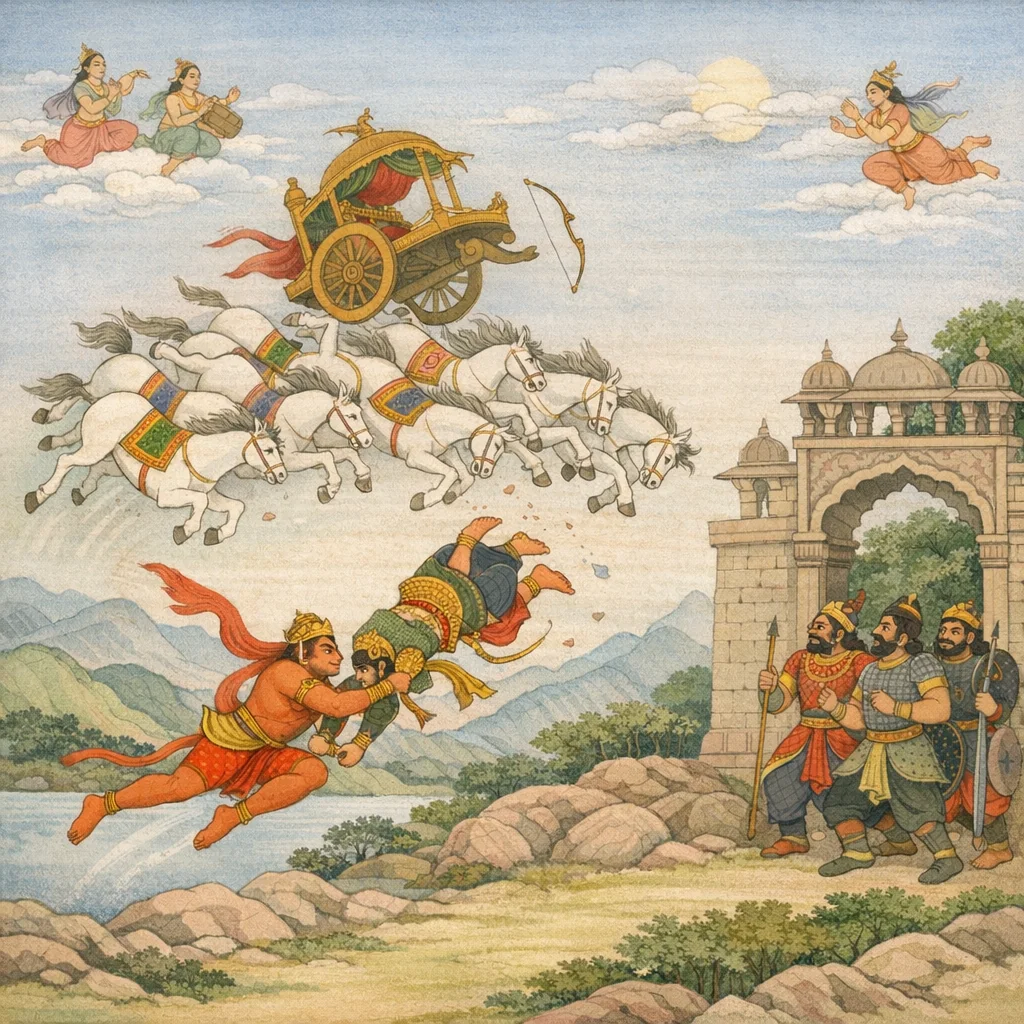
This sarga depicts a decisive escalation in Laṅkā’s response to Hanumān. After the report that five senāpatis (with followers and vehicles) have been destroyed, Rāvaṇa silently signals his son Akṣa to engage. Akṣa rises from the royal assembly, armed with a gold-inlaid bow, and advances on a radiant, weapon-filled chariot yoked to eight swift horses; the text lingers on the chariot’s aerial mobility, armaments, and splendor as a marker of royal power. In combat, Akṣa initiates with three sharp, poison-smeared arrows that strike Hanumān’s head; cosmic portents amplify the duel’s magnitude (earth’s cry, dimmed sun, still wind, shaking mountains, agitated ocean). Hanumān—admiring Akṣa’s youth, focus, and martial skill—briefly reflects on the ethics of killing a worthy, youthful opponent, then concludes that unchecked valor grows like neglected fire. He strikes down the eight horses, crashes the chariot, seizes Akṣa midair by the legs, whirls and smashes him to the ground, producing terror in Rāvaṇa and astonishment among sages and celestial beings. The chapter closes with Hanumān returning to the gateway (toraṇa) like a death-deity poised for further destruction, signaling the breakdown of conventional defense.
Shlokas
Verse 1
सेनापतीन्पञ्च स तु प्रमापितान् हनूमता सानुचरान्सवाहनान्।समीक्ष्य राजा समरोद्धतोन्मुखं कुमारमक्षं प्रसमैक्षताग्रतः।।5.47.1।।
Seeing that five army-generals—together with their followers and vehicles—had been slain by Hanumān, the king fixed his gaze upon Prince Akṣa, who stood eager to take up battle.
Verse 2
स तस्य दृष्ट्यर्पणसम्प्रचोदितः प्रतापवान्काञ्चनचित्रकार्मुकः।समुत्पपाताथ सदस्युदीरितो द्विजातिमुख्यैर्हविषेव पावकः।।5.47.2।।
Urged on by Rāvaṇa’s mere glance, the glorious Akṣa—bearing a splendid bow inlaid with gold—sprang up from the royal assembly, like fire flaring up when eminent Brāhmaṇas pour oblations into the sacred flame.
Verse 3
ततो महद्बालदिवाकरप्रभं प्रतप्तजाम्बूनदजालसन्ततम्।रथं समास्थाय ययौ स वीर्यवान्महाहरिं तं प्रति नैरृतर्षभः।।5.47.3।।
Then the valiant bull among the rākṣasas mounted a great chariot, radiant like the rising sun and overlaid with networks of glowing Jāmbūnada gold, and advanced toward that mighty vanara.
Verse 4
ततस्तपस्सङ्ग्रहसञ्चयार्जितं प्रतप्तजाम्बूनदजालशोभितम्।पताकिनं रत्नविभूषितध्वजं मनोजवाष्टाश्ववरैः सुयोजितम्।।5.47.4।।
Then there appeared the chariot, won by the amassed power of austerities—splendid with a network of refined Jāmbūnada-gold, bearing banners, its standard adorned with jewels, and well-yoked to eight excellent horses swift as thought.
Verse 5
सुरासुराधृष्यमसङ्गचारिणं रविप्रभं व्योमचरं समाहितम्।सतूणमष्टासिनिबद्धबन्धुरं यथाक्रमावेशितशक्तितोमरम्।।5.47.5।।
Unassailable even to gods and asuras, moving without contact, radiant like the sun and able to course through the sky, it stood fully equipped—bearing quivers, fitted with eight swords, and with spears and maces arranged in proper order.
Verse 6
विराजमानं प्रतिपूर्णवस्तुना सहेमदाम्ना शशिसूर्यवर्चसा।दिवाकराभं रथमास्थितस्ततस्स निर्जगामामरतुल्यविक्रमः।।5.47.6।।
Then he—whose valor matched that of the gods—mounted that sun-bright chariot, radiant with golden garlands and the combined luster of moon and sun, fully furnished with its equipment, and rode forth.
Verse 7
स पूरयन्खं च महीं च साचलां तुरङ्गमातङ्गमहारथस्वनैः।बलैस्समेतैस्सहि तोरणस्थितं समर्थमासीनमुपागमत्कपिम्।।5.47.7।।
Filling sky and earth—mountains included—with the thunder of horses, elephants, and great chariots, he advanced with his forces and came to the capable ape stationed at the gateway.
Verse 8
स तं समासाद्य हरिं हरीक्षणो युगान्तकालाग्निमिव प्रजाक्षये।अवस्थितं विस्मितजातसम्भ्रम स्समैक्षताक्षो बहुमानचक्षुषा।।5.47.8।।
Reaching the ape, the lion-eyed Akṣa beheld him standing like the fire of Time at the end of an age—at the ruin of beings; amazed and shaken, he looked upon him with respectful attention.
Verse 9
स तस्य वेगं च कपेर्महात्मनः पराक्रमं चारिषु पार्थिवात्मजः।विचारयन्स्वं च बलं महाबलो हिमक्षये सूर्य इवाभिवर्धते।।5.47.9।।
That mighty prince, weighing the great-souled ape’s speed and prowess against enemies—and measuring it against his own strength—grew in confidence, like the sun waxing in brilliance when winter ends.
Verse 10
स जातमन्युः प्रसमीक्ष्य विक्रमं स्थिरं स्थिरस्सम्यति दुर्निवारणम्।समाहितात्मा हनुमन्तमाहवे प्रचोदयामास शरैस्त्रिभि श्शितैः।।5.47.10।।
Recognizing Hanumān’s steady and irresistible prowess in battle, Akṣa grew angry; composed and focused, he challenged him in combat and loosed three sharp arrows.
Verse 11
ततः कपिं तं प्रसमीक्ष्य गर्वितं जितश्रमं शत्रुपराजयोर्जितम्।अवैक्षताक्षस्समुदीर्णमानसस्सबाणपाणिः प्रगृहीतकार्मुकः।।5.47.11।।
Then Akṣa looked upon that monkey—proud, unwearied, intent on the enemy’s defeat. With bow drawn and arrows in hand, his resolve surged as he measured him.
Verse 12
स हेमनिष्काङ्गदचारुकुण्डल स्समाससादाऽशुपराक्रमः कपिम्।तयोर्बभूवाप्रतिमस्समागम स्सुरासुराणामपि सम्भ्रमप्रदः।।5.47.12।।
Wearing golden ornaments—armlets and fine earrings—Akṣa, swift in prowess, rushed to meet the monkey. Their encounter became a matchless clash, stirring awe even among gods and demons.
Verse 13
ररास भूमिर्न तताप भानुमा न्वनौ न वायुः प्रचाचल चाचलः।कपेः कुमारस्य च वीक्ष्य संयुगं ननाद च द्यौरुदधिश्च चुक्षुभे।।5.47.13।।
Beholding the battle between the monkey and the prince, the earth seemed to cry out; the sun did not blaze, the wind did not blow in the forests, and even the mountains shook. The sky roared, and the ocean too was churned in agitation.
Verse 14
ततस्स वीरस्सुमुखान् पतत्रिणस्सुवर्णपुङ्खान्सविषानिवोरगान्।समाधिसम्योगविमोक्षतत्त्वविच्छरानथ त्रीन्कपिमूर्ध्न्यपातयत्।।5.47.14।।
Then the heroic Akṣa—skilled in releasing missiles with concentrated aim—struck the monkey’s head with three well-feathered, golden-shafted arrows, poison-smeared like serpents.
Verse 15
स तै श्शरैर्मूर्ध्नि समं निपातितैः क्षरन्नसृग्दिग्धविवृत्तलोचनः।नवोदितादित्यनिभ श्शरांशुमान् व्यराजतादित्य इवांशुमालिकः।।5.47.15।।
With those arrows striking his head all at once, blood flowed and his eyes were reddened; yet, with the arrows gleaming like rays, he shone like the newly risen sun, garlanded with light.
Verse 16
ततस्स पिङ्गाधिपमन्त्रिसत्तमः समीक्ष्य तं राजवरात्मजं रणे।उदग्रचित्रायुधचित्रकार्मुकं जहर्ष चापूर्यत चाहवोन्मुखः।।5.47.16।।
Then Hanumān—the foremost minister of the tawny-eyed lord (Sugrīva)—observed in battle that prince, the king’s son, wielding a splendid, variegated bow and weapons. He rejoiced and readied himself, turning fully toward the fight.
Verse 17
स मन्दराग्रस्थ इवांशुमालिको विवृद्धकोपो बलवीर्यसंयुतः।कुमारमक्षं सबलं सवाहनं ददाह नेत्राग्निमरीचिभिस्तदा।।5.47.17।।
His anger swelling and his strength and valor fully roused, Hanumān looked like the sun poised on Mandara’s peak; then he seemed to burn Prince Akṣa—together with his troops and vehicles—with the fiery rays of his eyes.
Verse 18
ततस्स बाणासनचित्रकार्मुक श्शरप्रवर्षो युधि राक्षसाम्बुदः।शरान्मुमोचाशु हरीश्वराचले वलाहको वृष्टिमिवाचलोत्तमे।।5.47.18।।
Then that demon-prince—equipped with quiver and a wondrous bow—poured down a swift rain of arrows in battle upon the mountain-like lord of monkeys, just as a cloud showers rain upon a lofty mountain.
Verse 19
ततः कपिस्तं रणचण्डविक्रमं विवृद्धतेजोबलवीर्यसंयुतम्।कुमारमक्षं प्रसमीक्ष्य संयुगे ननाद हर्षाद् घनतुल्यविक्रमम्।।5.47.19।।
Then Hanumān, seeing Prince Akṣa in the thick of battle—fierce in valor and endowed with heightened radiance, strength, and energy—roared with joy, his might like that of a thundercloud.
Verse 20
स बालभावाद्युधि वीर्यदर्पितः प्रवृद्धमन्युः क्षतजोपमेक्षणः।समाससादाप्रतिमं कपिं रणे गजो महाकूपमिवावृतं तृणैः।।5.47.20।।
Young and puffed up with pride in his prowess, his anger swelling and his eyes blood-red, Akṣa rushed in battle at the matchless Hanumān—like an elephant charging toward a great pitfall hidden by grass.
Verse 21
स तेन बाणैः प्रसभं निपातितैश्चकार नादं घननादनिस्स्वनः।समुत्पपाताशु नभस्स मारुतिर्भुजोरुविक्षेपणघोरदर्शनः।।5.47.21।।
Struck violently by Akṣa’s arrows, Hanumān gave a roar like the rumble of a thundercloud and at once leapt into the sky, appearing fearsome as he flung out his arms and thighs in mighty motion.
Verse 22
समुत्पतन्तं समभिद्रवद्बली स राक्षसानां प्रवरः प्रतापवान्।रथी रथिश्रेष्ठतमः किरन्शरैः पयोधरश्शैलमिवाश्मवृष्टिभिः।।5.47.22।।
As Hanumān sprang upward, that mighty and renowned leader among the Rākṣasas—the foremost of chariot-warriors—charged after him, pelting him with arrows like a cloud striking a mountain with a shower of hailstones.
Verse 23
स तान्शरांस्तस्य हरिर्विमोक्षयंश्चचार वीरः पथि वायुसेविते।शरान्तरे मारुतवद्विनिष्पतन्मनोजवस्संयति चण्डविक्रमः।।5.47.23।।
That heroic Hanumān—swift as thought and fierce in battle—moved through the wind-swept path of the sky, slipping out like the wind between the intervals of Akṣa’s arrows, letting them pass without finding their mark.
Verse 24
तमात्तबाणासनमाहवोन्मुखं खमास्तृणन्तं विशिखैश्शरोत्तमैः।अवैक्षताक्षं बहुमानचक्षुषा जगाम चिन्तां च स मारुतात्मजः।।5.47.24।।
Seeing Akṣa—quiver in hand, facing the battle, and filling the sky with superb arrows—Hanumān, the son of the Wind, looked on with admiration; yet reflection arose in him as to what should be done next.
Verse 25
ततश्शरैर्भिन्नभुजान्तरः कपिः कुमारवीरेण महात्मना नदन्।महाभुजः कर्मविशेषतत्त्ववि द्विचिन्तयामास रणे पराक्रमम्।।5.47.25।।
Then Hanumān, his arms wounded by the prince-hero’s arrows, roared aloud; and that mighty-armed one—knowing what actions are fitting in special circumstances—began to consider his next decisive move in the battle.
Verse 26
अबालवद्बालदिवाकरप्रभः करोत्ययं कर्म महन्महाबलः।न चास्य सर्वाहवकर्मशोभिनः प्रमापणे मे मतिरत्र जायते।।5.47.26।।
“Though still a youth, he acts with the skill of one mature; radiant like the rising sun and possessed of great strength, he performs mighty feats. Since he shines in every art of battle, my mind here does not turn toward destroying him.”
Verse 27
अयं महात्मा च महांश्च वीर्यत स्समाहितश्चातिसहश्च संयुगे।असंशयं कर्मगुणोदयादयं सनागयक्षैर्मुनिभिश्च पूजितः।।5.47.27।।
This one is high-souled and truly great in valor—steady in battle and exceedingly enduring. Without doubt, because of the excellence of his deeds and virtues, he is honored even by nāgas, yakṣas, and sages.
Verse 28
पराक्रमोत्साहविवृद्धमानस स्समीक्षते मां प्रमुखाग्रतःस्थितः।पराक्रमो ह्यस्य मनांसि कम्पयेत्सुरासुराणामपि शीघ्रगामिनः।।5.47.28।।
His spirit swells with valor and bold energy; standing face-to-face before me, he meets my gaze. Indeed, the prowess of this swift-moving warrior could shake the hearts even of devas and asuras.
Verse 29
न खल्वयं नाभिभवेदुपेक्षितः पराक्रमो ह्यस्य रणे विवर्धते।प्रमापणं त्वेव ममाद्य रोचते न वर्धमानोऽग्निरुपेक्षितुं क्षमः।।5.47.29।।
Truly, if he is ignored, he will not fail to overpower me—his prowess grows in battle. Therefore, it seems right to me to strike him down now; a fire that is spreading cannot be left unattended.
Verse 30
इति प्रवेगं तु परस्य चिन्तयन्स्वकर्मयोगं च विधाय वीर्यवान्।चकार वेगं तु महाबलस्तदा मतिं च चक्रेऽस्य वधे महाकपिः।।5.47.30।।
Thus, considering the enemy’s speed and arranging his own plan of action, the mighty and valiant great ape increased his pace and resolved upon the foe’s death.
Verse 31
स तस्य तानष्टहयान्महाजवान् समाहितान्भारसहान्विवर्तने।जघान वीरः पथि वायुसेविते तलप्रहारैः पवनात्मजः कपिः।।5.47.31।।
On the wind-swept course of the sky, the brave son of the Wind struck down with blows of his palm those eight horses—swift, steady, and able to bear heavy strain even in turning.
Verse 32
ततस्तलेनाभिहतो महारथ स्स तस्य पिङ्गाधिपमन्त्रिनिर्जितः।प्रभग्ननीडः परिमुक्तकूबरः पपात भूमौ हतवाजिरम्बरात्।।5.47.32।।
Then, struck by Hanumān’s palm, that great chariot—overpowered by the minister of the tawny-eyed lord (Sugrīva)—its seat shattered, its yoke-frame loosened, and its horses slain, fell from the sky to the earth.
Verse 33
स तं परित्यज्य महारथो रथं सकार्मुकः खङ्गधरः खमुत्पतन्। तपोऽभियोगादृषिरुग्रवीर्यवान्विहाय देहं मरुतामिवालयम्।।5.47.33।।
Abandoning that chariot, the great warrior sprang into the sky, bow in hand and sword-bearing—like a sage of fierce ascetic power rising heavenward, leaving the body behind as though it were merely the dwelling of the winds.
Verse 34
ततः कपिस्तं विचरन्तमम्बरे पतत्रिराजानिलसिद्धसेविते।समेत्य तं मारुततुल्यविक्रमः क्रमेण जग्राह स पादयोर्दृढम्।।5.47.34।।
Then the ape, whose prowess matched the wind, reached him as he moved through the sky—haunted by Garuḍa, the Wind, and the Siddhas—and firmly seized him by both feet.
Verse 35
स तं समाविध्य सहस्रशः कपिर्महोरगं गृह्य इवाण्डजेश्वरः।मुमोच वेगात्पितृतुल्यविक्रमो महीतले संयति वानरोत्तमः।।5.47.35।।
That foremost of vanaras, equal to his father in valor, whirled him and struck him again and again—like Garuḍa seizing a great serpent—and then, with force, released him onto the earth in the midst of battle.
Verse 36
स भग्नबाहूरुकटीशिरोधरः क्षरन्नसृङिनर्मथितास्थिलोचनः।सम्भग्नसन्धि: प्रविकीर्णबन्धनो हतः क्षितौ वायुसुतेन राक्षसः।।5.47.36।।
Struck down by Vāyu’s son (Hanumān), the rākṣasa fell upon the earth—his arms, thighs, hips, and neck shattered; blood streaming; bones crushed and eyes protruding; joints dislocated and sinews scattered.
Verse 37
महाकपिर्भूमितले निपीड्य तं चकार रक्षोधिपतेर्महद्भयम्।महर्षिभिश्चक्रचरैर्महाव्रतै स्समेत्य भूतैश्च सयक्षपन्नगैः।।5.47.37।।सुरैश्च सेन्द्रैर्भृशजातविस्मयै र्हते कुमारे स कपिर्निरीक्षितः।
When the mighty ape crushed him down upon the earth, great fear seized the lord of rākṣasas. And when the prince lay slain, sages who traverse the worlds, beings of many orders—yakṣas and serpents—and even the gods with Indra, astonished, gathered and looked upon that ape in awe.
Verse 38
निहत्य तं वज्रिसुतोपमप्रभं कुमारमक्षं क्षतजोपमेक्षणम्।तमेव वीरोऽभिजगाम तोरणं कृतक्षणः काल इव प्रजाक्षये।।5.47.38।।
Having slain Prince Akṣa—radiant like Indra’s son and with eyes reddened like blood—the hero went again to the gateway, standing resolved like Death itself at the world’s destruction.
Frequently Asked Questions
Hanumān confronts a dharma-tension: Akṣa is young yet exceptionally skilled and worthy of respect, prompting hesitation about killing him; however, Hanumān decides that growing martial threat must be subdued promptly, likening neglected valor to an unchecked spreading fire.
The sarga teaches that compassion and admiration need not negate duty: ethical agency includes reflective judgment, but decisive action is justified when delay enables adharma or escalates harm—restraint becomes meaningful only when paired with timely responsibility.
The Laṅkā gateway (toraṇa) functions as a strategic landmark marking control of the city’s thresholds; the aerial battlefield (ambara) and cosmic witnesses universalize the duel; similes invoke Mount Mandara and Garuḍa’s sphere to frame the combat in pan-Indic mythic geography.