Sarga 45
मन्त्रिणां सुतयुद्धम् — Battle with the Sons of the Ministers
सुन्दरकाण्ड
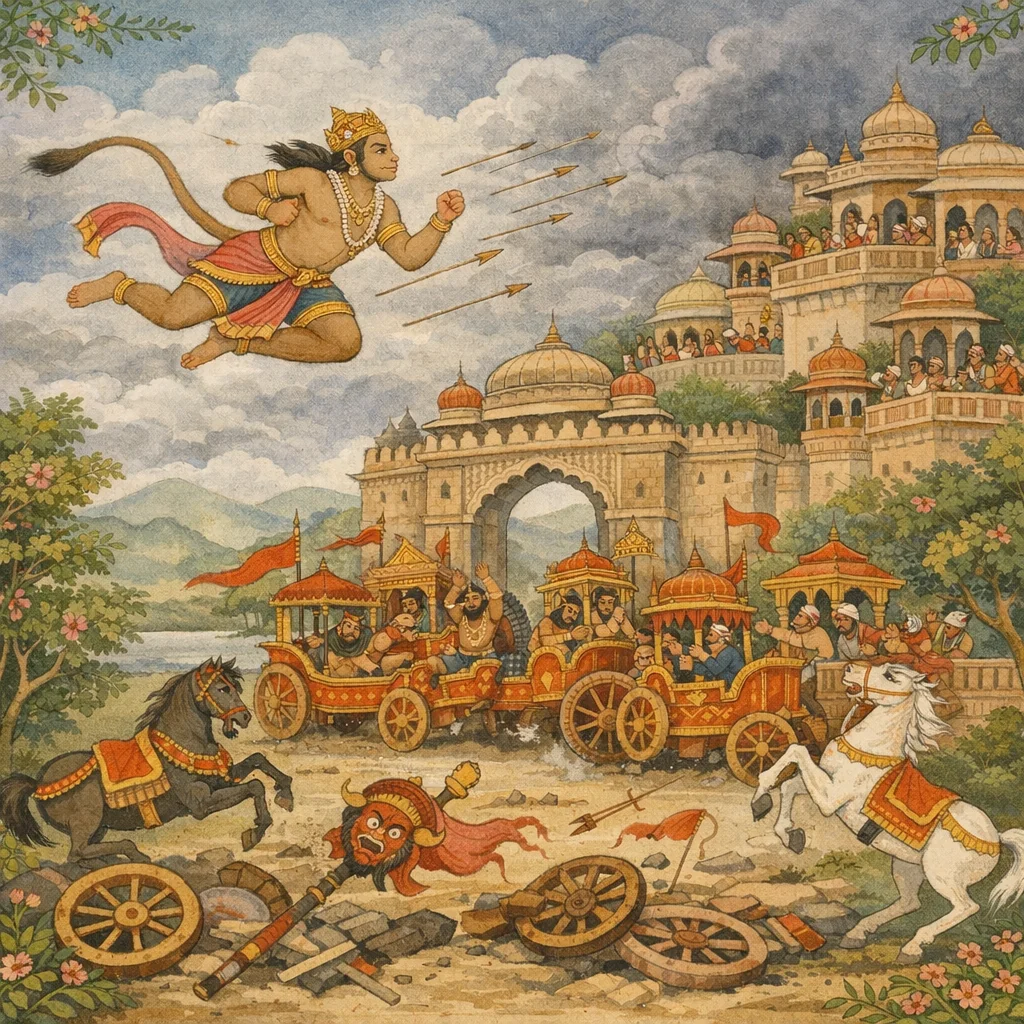
In this chapter Ravana escalates the defense of Lanka by dispatching seven ministerial sons—portrayed as fire-bright, heavily armed, and competitively valorous—who sortie from the palace in horse-yoked chariots adorned with golden mesh, flags, and identifying staffs. Their approach is rendered through storm imagery: chariot-roar like thunderclouds and bows glittering like lightning. They attack Hanuman at the city’s main archway (toraṇa), releasing torrents of arrows that momentarily shroud him. Hanuman counters through aerial mobility, nullifying both missile volleys and chariot momentum, and appears in the sky like the Wind-god amid clouds. He then shifts to close-quarters combat, striking with palm, feet, fist, nails, chest, and thighs; the ministerial sons fall, and their army breaks and flees in all directions. The aftermath is marked by panic among mounts and war-gear—elephants trumpet discordantly, horses collapse, and broken chariots litter the ground—while Lanka resounds with horrific cries and blood-streams. Having slain these strong adversaries, Hanuman advances again toward the toraṇa, seeking further engagement, underscoring the sarga’s lesson on morale-collapse and the tactical superiority of controlled speed over ornamented might.
Shlokas
Verse 1
ततस्ते राक्षसेन्द्रेण चोदिता मन्त्रिणस्सुताः।निर्ययुर्भवनात्तस्मात्सप्तसप्तार्चिवर्चसः।।।।महाबलपरीवारा धनुष्मन्तो महाबलाः।कृतास्त्रास्त्रविदां श्रेष्ठाः परस्परजयैषिणः।।।।हेमजालपरिक्षिप्तैर्ध्वजवद्भिः पताकिभिः।तोयदस्वननिर्घोषैर्वाजियुक्तैर्महारथैः।।।।तप्तकाञ्चनचित्राणि चापान्यमितविक्रमाः।विस्फारयन्तस्संहृष्टास्तटित्वन्त इवाम्बुदाः।।।।
Then, urged on by the lord of the Rakshasas, the seven sons of the ministers—blazing like sevenfold fire—rode out from the palace. Surrounded by great forces, mighty and skilled with bows, accomplished in weapons and foremost among weapon-knowers, each eager to outdo the other in victory, they advanced in great horse-yoked chariots. Those chariots were netted with gold, bearing standards and flags, rumbling like storm-clouds; and the warriors, exultant, twanged their bows inlaid with molten-gold brilliance, like thunderclouds flashing with lightning.
Verse 2
ततस्ते राक्षसेन्द्रेण चोदिता मन्त्रिणस्सुताः।निर्ययुर्भवनात्तस्मात्सप्तसप्तार्चिवर्चसः।।5.45.1।।महाबलपरीवारा धनुष्मन्तो महाबलाः।कृतास्त्रास्त्रविदां श्रेष्ठाः परस्परजयैषिणः।।5.45.2।।हेमजालपरिक्षिप्तैर्ध्वजवद्भिः पताकिभिः।तोयदस्वननिर्घोषैर्वाजियुक्तैर्महारथैः।।5.45.3।।तप्तकाञ्चनचित्राणि चापान्यमितविक्रमाः।विस्फारयन्तस्संहृष्टास्तटित्वन्त इवाम्बुदाः।।5.45.4।।
Then, urged on by the lord of the Rakshasas, the seven sons of the ministers—blazing like sevenfold fire—rode out from the palace. Surrounded by great forces, mighty and skilled with bows, accomplished in weapons and foremost among weapon-knowers, each eager to outdo the other in victory, they advanced in great horse-yoked chariots. Those chariots were netted with gold, bearing standards and flags, rumbling like storm-clouds; and the warriors, exultant, twanged their bows inlaid with molten-gold brilliance, like thunderclouds flashing with lightning.
Verse 3
ततस्ते राक्षसेन्द्रेण चोदिता मन्त्रिणस्सुताः।निर्ययुर्भवनात्तस्मात्सप्तसप्तार्चिवर्चसः।।5.45.1।।महाबलपरीवारा धनुष्मन्तो महाबलाः।कृतास्त्रास्त्रविदां श्रेष्ठाः परस्परजयैषिणः।।5.45.2।।हेमजालपरिक्षिप्तैर्ध्वजवद्भिः पताकिभिः।तोयदस्वननिर्घोषैर्वाजियुक्तैर्महारथैः।।5.45.3।।तप्तकाञ्चनचित्राणि चापान्यमितविक्रमाः।विस्फारयन्तस्संहृष्टास्तटित्वन्त इवाम्बुदाः।।5.45.4।।
Then, urged on by the lord of the Rakshasas, the seven sons of the ministers—blazing like sevenfold fire—rode out from the palace. Surrounded by great forces, mighty and skilled with bows, accomplished in weapons and foremost among weapon-knowers, each eager to outdo the other in victory, they advanced in great horse-yoked chariots. Those chariots were netted with gold, bearing standards and flags, rumbling like storm-clouds; and the warriors, exultant, twanged their bows inlaid with molten-gold brilliance, like thunderclouds flashing with lightning.
Verse 4
ततस्ते राक्षसेन्द्रेण चोदिता मन्त्रिणस्सुताः।निर्ययुर्भवनात्तस्मात्सप्तसप्तार्चिवर्चसः।।5.45.1।।महाबलपरीवारा धनुष्मन्तो महाबलाः।कृतास्त्रास्त्रविदां श्रेष्ठाः परस्परजयैषिणः।।5.45.2।।हेमजालपरिक्षिप्तैर्ध्वजवद्भिः पताकिभिः।तोयदस्वननिर्घोषैर्वाजियुक्तैर्महारथैः।।5.45.3।।तप्तकाञ्चनचित्राणि चापान्यमितविक्रमाः।विस्फारयन्तस्संहृष्टास्तटित्वन्त इवाम्बुदाः।।5.45.4।।
Then, urged on by the lord of the Rakshasas, the seven sons of the ministers—blazing like sevenfold fire—rode out from the palace. Surrounded by great forces, mighty and skilled with bows, accomplished in weapons and foremost among weapon-knowers, each eager to outdo the other in victory, they advanced in great horse-yoked chariots. Those chariots were netted with gold, bearing standards and flags, rumbling like storm-clouds; and the warriors, exultant, twanged their bows inlaid with molten-gold brilliance, like thunderclouds flashing with lightning.
Verse 5
जनन्यस्तु ततस्तेषां विदित्वा किङ्करान्हतान्।बभूवुश्शोकसम्भ्रान्तास्सबान्धवसुहृज्जनाः।।।।
Then their mothers—together with kinsmen and friends—became shaken with grief upon learning that the kinkaras had been slain.
Verse 6
ते परस्परसङ्घर्षात्तप्तकाञ्चनभूषणाः।अभिपेतुर्हनूमन्तं तोरणस्थमवस्थितम्।।।।
Jostling one another, their heated-gold ornaments flashing, they rushed to attack Hanumān, who stood stationed at the archway.
Verse 7
सृजन्तो बाणवृष्टिं ते रथगर्जितनिस्स्वनाः।वृष्टिमन्त इवांभोदा विचेरुर्नैऋताम्बुदाः।।।।
With the roar and rumble of their chariots, they moved about like rain-laden stormclouds—those demon ‘clouds’—pouring down a shower of arrows.
Verse 8
अवकीर्णस्ततस्ताभिर्हनुमान्शरवृष्टिभिः।अभवत्संवृताकारश्शैलराडिव वृष्टिभिः।।।।
Then Hanumān, struck all over by their showers of arrows, appeared with his form wholly covered—like the king of mountains when enveloped by heavy rain.
Verse 9
स शरान्मोघयामास तेषामाशुचरः कपिः।रथवेगं च वीराणां विचरन्विमलेऽम्बरे।।।।
That swift-moving monkey, ranging through the clear sky, rendered futile both the heroes’ arrows and the rush of their chariots.
Verse 10
स तैः क्रीडन्धनुष्मद्भिर्व्योम्नि वीरः प्रकाशते।धनुष्मद्भिर्यथा मेघैर्मारुतः प्रभुरम्बरे।।।।
Sporting in the sky amid those bow-bearing warriors, that hero shone—like the mighty Wind moving through the heavens among cloud-masses that bear the rainbow.
Verse 11
स कृत्वा निनदं घोरं त्रासयंस्तां महाचमूम्।चकार हनुमान्वेगं तेषु रक्षस्सु वीर्यवान्।।।।
Raising a dreadful roar that terrified that great host, the valiant Hanuman launched himself with swift force upon those Rakshasas.
Verse 12
तलेनाभ्यहनत्कांश्चित्पादैः कांश्चित्परन्तपः।मुष्टिनाभ्यहनत्कांश्चिन्नखैः कांश्चिद्व्यदारयत्।।।।
The scourge of foes struck some with his palm, some with his feet, some with his fist, and tore others with his nails.
Verse 13
प्रममाथोरसा कांश्चिदूरुभ्यामपरान्कपिः।केचित्तस्य निनादेन तत्रैव पतिता भुवि।।।।
That monkey crushed some with his chest and others with his thighs; and some, struck down by the sheer terror of his roar, fell there itself upon the ground.
Verse 14
ततस्तेष्ववसन्नेषु भूमौ निपतितेषु च।तत्सैन्यमगमत्सर्वं दिशोदश भयार्दितम्।।।।
When those (seven) minister’s sons collapsed and fell upon the ground, their entire army—struck with terror—fled away in all ten directions.
Verse 15
विनेदुर्विस्वरं नागा निपेतुर्भुवि वाजिनः।भग्ननीडध्वजच्छत्रैर्भूश्च कीर्णाऽभवद्रथैः।।।।
Elephants blared discordantly, horses toppled to the ground, and the earth became strewn with chariots whose seats, banners, and parasols had been shattered.
Verse 16
स्रवता रुधिरेणाथ स्रवन्त्यो दर्शिताः पथि।विविधैश्च स्वरैर्लङ्का ननाद विकृतं तदा।।।।
Then, with blood flowing in streams visible along the roads, Laṅkā rang out at that time with many kinds of distorted, dreadful cries.
Verse 17
स तान्प्रवृद्धान्विनिहत्य राक्षसान् महाबलश्चण्डपराक्रमः कपिः।युयुत्सुरन्यैः पुनरेव राक्षसै स्तमेव वीरोऽभिजगाम तोरणम्।।।।
Having slain those seasoned rākṣasas, that heroic monkey—mighty and fierce in valor—still eager to fight the remaining demons, advanced once again to the very archway.
Frequently Asked Questions
The chapter foregrounds calibrated action rather than a verbal dilemma: Hanuman transitions from evasion (rendering arrows and chariot-speed futile) to decisive hand-to-hand force only after being attacked, illustrating proportionate violence used to protect a higher mission—Sita’s security and Rama’s cause.
Through narrative (not debate), the sarga teaches that ornamented power and numerical force collapse when confronted by disciplined speed, clarity of purpose, and fearlessness; victory is portrayed as an outcome of focused agency aligned to duty, not mere display of martial wealth.
The key landmark is Lanka’s toraṇa (main archway/gateway), a tactical choke-point where defenders converge and where Hanuman repeatedly positions himself; the palace-to-gateway sortie route, chariot insignia (flags, emblem-staffs), and parasols also reflect royal martial culture and identification practices.