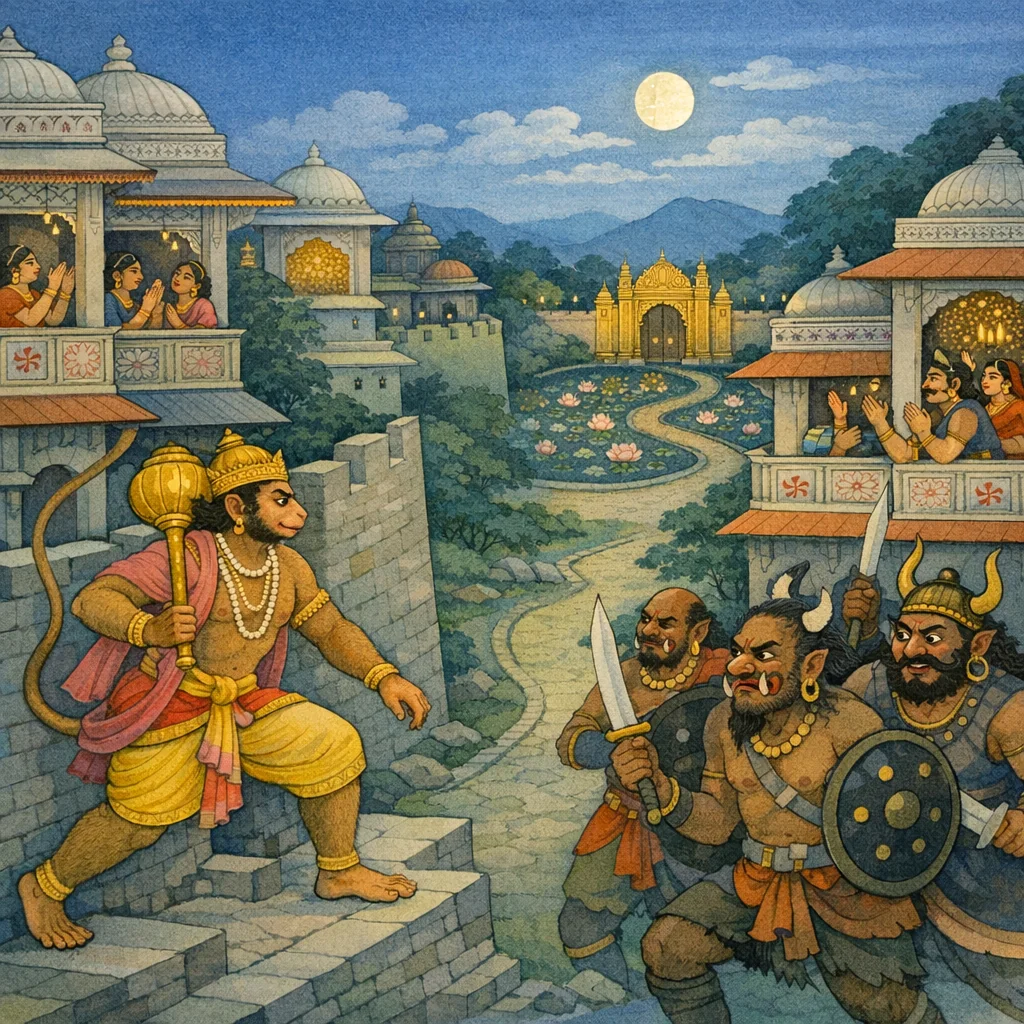
Sarga 4
लङ्काप्रवेशः — Hanuman’s Stealth Entry and Survey of Lanka
सुन्दरकाण्ड
After subduing Laṅkā’s presiding guardian deity (kāmarūpiṇī), Hanumān crosses the city’s boundary wall via a rear approach, signaling a tactical, non-ceremonial entry into hostile space (5.4.1). Entering at night, he deliberately places the left foot first—an adversarial omen and a conventional marker of intent to overcome the enemy’s domain (5.4.2–5.4.4). The chapter then shifts into an acoustic and architectural mapping of Laṅkā: pearl-like floral adornments along the highway, diamond-latticed mansions, painted façades with lotus and svastika motifs, and the city’s luminous skyline (5.4.3–5.4.7). Hanumān’s reconnaissance is multi-sensory: he hears melodious songs in tri-sthāna and tri-svara registers, jewelry and anklet sounds, footsteps on stairways, clapping, and joking across elite residences (5.4.10–5.4.11). He also detects ritual life inside rākṣasa houses—mantra recitation, svādhyāya, and loud praise of Rāvaṇa—indicating a complex cultural ecosystem rather than mere militarism (5.4.12–5.4.13). The survey escalates to security intelligence: demon troops line the main road, spies are stationed mid-city, and diverse armed contingents appear with distinctive physiognomies, banners, and weapons (5.4.14–5.4.22). Finally, Hanumān reaches the fortified royal sector: a hundred-thousand-strong guard before the harem, a golden archway, lotus-filled moats, enclosing walls, and a heaven-like interior filled with vehicles, horses, elephants, ornaments, and guarded entrances—culminating in his entry into Rāvaṇa’s antaḥpura for the next phase of the mission (5.4.23–5.4.29).
Shlokas
Verse 1
स निर्जित्य पुरीं श्रेष्ठां लङ्कां तां कामरूपिणीम्।विक्रमेण महातेजा हनुमान् कपिसत्तमः।।।।अद्वारेण च महाबाहुः प्राकारमभिपुप्लुवे।
Having overcome the presiding power of that excellent city Laṅkā—she who could assume forms at will—the mighty, radiant Hanumān, best of the Vānaras, by his valor leapt over the rampart at a gate-less (unguarded) point.
Verse 2
प्रविश्य नगरीं लङ्कां कपिराजहितंकरः।।।।चक्रेऽथ पादं सव्यं च शत्रूणां स तु मूर्धनि।
Entering the city of Laṅkā for the welfare of the king of monkeys, Hanumān then set his left foot first upon the enemy’s ‘head’—a deliberate, ominous gesture of conquest as he stepped into hostile ground.
Verse 3
प्रविष्टः सत्त्वसम्पन्नो निशायां मारुतात्मजः।।।।स महापथमास्थाय मुक्तापुष्पविराजितम्।ततस्तु तां पुरीं लङ्कां रम्यामभिययौ कपिः।।।।
At night, the Wind-god’s son—steadfast and strong—entered the enchanting city of Laṅkā. Taking to the great highway, resplendent as though strewn with pearl-flowers, the monkey moved forward on his mission for Rāghava.
Verse 4
प्रविष्टः सत्त्वसम्पन्नो निशायां मारुतात्मजः।।5.4.3।।स महापथमास्थाय मुक्तापुष्पविराजितम्।ततस्तु तां पुरीं लङ्कां रम्यामभिययौ कपिः।।5.4.4।।
Taking to the great highway, gleaming as though adorned with pearl-flowers, the monkey pressed onward into the beautiful city of Laṅkā.
Verse 5
हसितोत्कृष्टनिनदैस्तूर्यघोषपुरस्सरैः।वज्रांकुशनिकाशैश्च वज्रजालविभूषितैः।।।।गृहमेघैः पुरी रम्या बभासे द्यौरिवाम्बुदैः।
That lovely city shone like the sky filled with clouds—its mansion ‘clouds’ echoing with laughter and the blare of instruments, adorned with diamond-like fittings and lattices of vajra-splendour.
Verse 6
प्रजज्वाल ततो लङ्का रक्षोगणगृहैः शुभैः।।।।सिताभ्रसदृशैश्चित्रैः पद्मस्वस्तिकसंस्थितैः।वर्धमानगृहैश्चापि सर्वतः सुविभूषिता।।।।
Then Laṅkā glittered everywhere with the auspicious mansions of the rākṣasa hosts—painted and patterned, like white clouds, marked with lotus and svastika designs, and rising in lofty tiers.
Verse 7
प्रजज्वाल ततो लङ्का रक्षोगणगृहैः शुभैः।।5.4.6।।सिताभ्रसदृशैश्चित्रैः पद्मस्वस्तिकसंस्थितैः।वर्धमानगृहैश्चापि सर्वतः सुविभूषिता।।5.4.7।।
Then Laṅkā glittered everywhere with the auspicious mansions of the rākṣasa hosts—painted and patterned, like white clouds, marked with lotus and svastika designs, and rising in lofty tiers.
Verse 8
तां चित्रमाल्याभरणां कपिराजहितङ्करः।राघवार्थं चरन् श्रीमान् ददर्श च ननन्द च।।।।
Glorious Hanumān—well-wisher of the king of monkeys—beheld that city adorned with varied garlands and ornaments; moving through it for Rāghava’s purpose, he observed it and felt a measured delight.
Verse 9
भवनाद्भवनं गच्छन् ददर्श पवनात्मजः।विविधाकृतिरूपाणि भवनानि ततस्ततः।।।।
Moving from one residence to another, Hanumān—the son of the Wind—saw, here and there, mansions of many different forms and designs.
Verse 10
शुश्राव मधुरं गीतं त्रिस्थानस्वरभूषितम्।स्त्रीणां मदसमृद्धानां दिवि चाप्सरसामिव।।।।
He heard sweet singing—adorned with well-placed tones in the three registers—sung by women flushed with intoxication, like the songs of Apsarases in heaven.
Verse 11
शुश्राव काञ्चीनिनदं नूपुराणां च, निःस्वनम्।सोपाननिनदांश्चैव भवनेषु महात्मनाम्।।।।अस्फोटितनिनादांश्च क्ष्वेलितांश्च ततस्ततः।
He heard the jingling of waist-bells and the sounds of anklets, and also the noise of footsteps on stairways in the mansions of the great. From here and there, he further heard clapping sounds and playful banter.
Verse 12
शुश्राव जपतां तत्र मन्त्रान् रक्षोगृहेषु वै।।।।स्वाध्यायनिरतांश्चैव यातुधानान् ददर्श सः।रावणस्तवसंयुक्तान् गर्जतो राक्षसानपि।।।।
There he heard the chanting of mantras in the dwellings of the Rākṣasas. He also saw the Yātudhānas engaged in Vedic recitation, and even Rākṣasas roaring as they sang hymns in praise of Rāvaṇa.
Verse 13
शुश्राव जपतां तत्र मन्त्रान् रक्षोगृहेषु वै।।5.4.12।।स्वाध्यायनिरतांश्चैव यातुधानान् ददर्श सः।रावणस्तवसंयुक्तान् गर्जतो राक्षसानपि।।5.4.13।।
There he heard the chanting of mantras in the dwellings of the Rākṣasas. He also saw the Yātudhānas engaged in Vedic recitation, and even Rākṣasas roaring as they sang hymns in praise of Rāvaṇa.
Verse 14
राजमार्गं समावृत्य स्थितं रक्षोबलं महत्।ददर्श मध्यमे गुल्मे रावणस्य चरान् बहून्।।।।
He saw great forces of Rākṣasas posted so as to cover the royal road; and in the city’s central quarters he observed many spies of Rāvaṇa.
Verse 15
दीक्षितान् जटिलान् मुण्डान् गोजिनाम्बरवाससः।दर्भमुष्टिप्रहरणानग्निकुण्डायुघांस्तथा।।।।कूटमुद्गरपाणींश्च दण्डायुधधरानपि।एकाक्षानेककर्णांश्च लम्बोदरपयोधरान्।।।।करालान् भुग्नवक्त्रांश्च विकटान् वामनांस्तथा।धन्विनः खङ्गिनश्चैव शतघ्नीमुसलायुधान्।।।।परिघोत्तमहस्तांश्च विचित्रकवचोज्ज्वलान्।नातिस्थूलान्नातिकृशान्नातिदीर्घातिह्रस्वकान्।।।।नातिगौरान्नातिकृष्णान्नातिकुब्जान्न वामनान्।विरूपान् बहुरूपांश्च सुरूपांश्च सुवर्चसः।।।ध्वजीन् पताकिनश्चैव ददर्श विविधायुधान्।
He saw Rākṣasas of many types—some consecrated for rites, some with matted hair, some shaven-headed, some clad in cowhide; some wielding fistfuls of darbha-grass, others bearing implements of fire-sacrifice as weapons. He saw some holding iron mallets, others armed with staves; some one-eyed or one-eared, some with pendulous bellies and breasts; some dreadful, some bent-faced, some misshapen, and some dwarfish. He saw archers and swordsmen, and others armed with heavy clubs and missiles; some with iron-bar-like hands, shining in varied armor. He saw those neither overly stout nor thin, neither too tall nor too short, neither too fair nor too dark, neither hunchbacked nor dwarfed—some ugly, some of many forms, and some handsome and radiant—bearing banners and flags, equipped with diverse weapons.
Verse 16
दीक्षितान् जटिलान् मुण्डान् गोजिनाम्बरवाससः।दर्भमुष्टिप्रहरणानग्निकुण्डायुघांस्तथा।।5.4.15।।कूटमुद्गरपाणींश्च दण्डायुधधरानपि।एकाक्षानेककर्णांश्च लम्बोदरपयोधरान्।।5.4.16।।करालान् भुग्नवक्त्रांश्च विकटान् वामनांस्तथा।धन्विनः खङ्गिनश्चैव शतघ्नीमुसलायुधान्।।5.4.17।।परिघोत्तमहस्तांश्च विचित्रकवचोज्ज्वलान्।नातिस्थूलान्नातिकृशान्नातिदीर्घातिह्रस्वकान्।।5.4.18।।नातिगौरान्नातिकृष्णान्नातिकुब्जान्न वामनान्।विरूपान् बहुरूपांश्च सुरूपांश्च सुवर्चसः।5.4.19।।ध्वजीन् पताकिनश्चैव ददर्श विविधायुधान्।
He saw Rākṣasas of many types—some consecrated for rites, some with matted hair, some shaven-headed, some clad in cowhide; some wielding fistfuls of darbha-grass, others bearing implements of fire-sacrifice as weapons. He saw some holding iron mallets, others armed with staves; some one-eyed or one-eared, some with pendulous bellies and breasts; some dreadful, some bent-faced, some misshapen, and some dwarfish. He saw archers and swordsmen, and others armed with heavy clubs and missiles; some with iron-bar-like hands, shining in varied armor. He saw those neither overly stout nor thin, neither too tall nor too short, neither too fair nor too dark, neither hunchbacked nor dwarfed—some ugly, some of many forms, and some handsome and radiant—bearing banners and flags, equipped with diverse weapons.
Verse 17
दीक्षितान् जटिलान् मुण्डान् गोजिनाम्बरवाससः।दर्भमुष्टिप्रहरणानग्निकुण्डायुघांस्तथा।।5.4.15।।कूटमुद्गरपाणींश्च दण्डायुधधरानपि।एकाक्षानेककर्णांश्च लम्बोदरपयोधरान्।।5.4.16।।करालान् भुग्नवक्त्रांश्च विकटान् वामनांस्तथा।धन्विनः खङ्गिनश्चैव शतघ्नीमुसलायुधान्।।5.4.17।।परिघोत्तमहस्तांश्च विचित्रकवचोज्ज्वलान्।नातिस्थूलान्नातिकृशान्नातिदीर्घातिह्रस्वकान्।।5.4.18।।नातिगौरान्नातिकृष्णान्नातिकुब्जान्न वामनान्।विरूपान् बहुरूपांश्च सुरूपांश्च सुवर्चसः।5.4.19।।ध्वजीन् पताकिनश्चैव ददर्श विविधायुधान्।
He saw Rākṣasas of many types—some consecrated for rites, some with matted hair, some shaven-headed, some clad in cowhide; some wielding fistfuls of darbha-grass, others bearing implements of fire-sacrifice as weapons. He saw some holding iron mallets, others armed with staves; some one-eyed or one-eared, some with pendulous bellies and breasts; some dreadful, some bent-faced, some misshapen, and some dwarfish. He saw archers and swordsmen, and others armed with heavy clubs and missiles; some with iron-bar-like hands, shining in varied armor. He saw those neither overly stout nor thin, neither too tall nor too short, neither too fair nor too dark, neither hunchbacked nor dwarfed—some ugly, some of many forms, and some handsome and radiant—bearing banners and flags, equipped with diverse weapons.
Verse 18
दीक्षितान् जटिलान् मुण्डान् गोजिनाम्बरवाससः।दर्भमुष्टिप्रहरणानग्निकुण्डायुघांस्तथा।।5.4.15।।कूटमुद्गरपाणींश्च दण्डायुधधरानपि।एकाक्षानेककर्णांश्च लम्बोदरपयोधरान्।।5.4.16।।करालान् भुग्नवक्त्रांश्च विकटान् वामनांस्तथा।धन्विनः खङ्गिनश्चैव शतघ्नीमुसलायुधान्।।5.4.17।।परिघोत्तमहस्तांश्च विचित्रकवचोज्ज्वलान्।नातिस्थूलान्नातिकृशान्नातिदीर्घातिह्रस्वकान्।।5.4.18।।नातिगौरान्नातिकृष्णान्नातिकुब्जान्न वामनान्।विरूपान् बहुरूपांश्च सुरूपांश्च सुवर्चसः।5.4.19।।ध्वजीन् पताकिनश्चैव ददर्श विविधायुधान्।
He saw Rākṣasas of many types—some consecrated for rites, some with matted hair, some shaven-headed, some clad in cowhide; some wielding fistfuls of darbha-grass, others bearing implements of fire-sacrifice as weapons. He saw some holding iron mallets, others armed with staves; some one-eyed or one-eared, some with pendulous bellies and breasts; some dreadful, some bent-faced, some misshapen, and some dwarfish. He saw archers and swordsmen, and others armed with heavy clubs and missiles; some with iron-bar-like hands, shining in varied armor. He saw those neither overly stout nor thin, neither too tall nor too short, neither too fair nor too dark, neither hunchbacked nor dwarfed—some ugly, some of many forms, and some handsome and radiant—bearing banners and flags, equipped with diverse weapons.
Verse 19
दीक्षितान् जटिलान् मुण्डान् गोजिनाम्बरवाससः।दर्भमुष्टिप्रहरणानग्निकुण्डायुघांस्तथा।।5.4.15।।कूटमुद्गरपाणींश्च दण्डायुधधरानपि।एकाक्षानेककर्णांश्च लम्बोदरपयोधरान्।।5.4.16।।करालान् भुग्नवक्त्रांश्च विकटान् वामनांस्तथा।धन्विनः खङ्गिनश्चैव शतघ्नीमुसलायुधान्।।5.4.17।।परिघोत्तमहस्तांश्च विचित्रकवचोज्ज्वलान्।नातिस्थूलान्नातिकृशान्नातिदीर्घातिह्रस्वकान्।।5.4.18।।नातिगौरान्नातिकृष्णान्नातिकुब्जान्न वामनान्।विरूपान् बहुरूपांश्च सुरूपांश्च सुवर्चसः।5.4.19।।ध्वजीन् पताकिनश्चैव ददर्श विविधायुधान्।
He saw Rākṣasas of many types—some consecrated for rites, some with matted hair, some shaven-headed, some clad in cowhide; some wielding fistfuls of darbha-grass, others bearing implements of fire-sacrifice as weapons. He saw some holding iron mallets, others armed with staves; some one-eyed or one-eared, some with pendulous bellies and breasts; some dreadful, some bent-faced, some misshapen, and some dwarfish. He saw archers and swordsmen, and others armed with heavy clubs and missiles; some with iron-bar-like hands, shining in varied armor. He saw those neither overly stout nor thin, neither too tall nor too short, neither too fair nor too dark, neither hunchbacked nor dwarfed—some ugly, some of many forms, and some handsome and radiant—bearing banners and flags, equipped with diverse weapons.
Verse 20
शक्तिवृक्षायुधांश्चैव पट्टिसाशनिधारिणः।।।।क्षेपणीपाशहस्तांश्च ददर्श स महाकपिः।स्रग्विणस्त्वनुलिप्तांश्च वराभरणभूषितान्।।।।नानावेषसमायुक्तान् यथास्स्वैरगतान् बहून्।तीक्ष्णशूलधरांश्चैव वज्रिणश्च महाबलान्।।।।
That great monkey saw some armed with lances and even trees as weapons; others bearing spears and missiles, and others with slings and nooses in their hands.
Verse 21
शक्तिवृक्षायुधांश्चैव पट्टिसाशनिधारिणः।।5.4.20।।क्षेपणीपाशहस्तांश्च ददर्श स महाकपिः।स्रग्विणस्त्वनुलिप्तांश्च वराभरणभूषितान्।।5.4.21।।नानावेषसमायुक्तान् यथास्स्वैरगतान् बहून्।तीक्ष्णशूलधरांश्चैव वज्रिणश्च महाबलान्।।5.4.22।।
He saw some wearing garlands, their bodies anointed with fragrant unguents, adorned with excellent ornaments.
Verse 22
शक्तिवृक्षायुधांश्चैव पट्टिसाशनिधारिणः।।5.4.20।।क्षेपणीपाशहस्तांश्च ददर्श स महाकपिः।स्रग्विणस्त्वनुलिप्तांश्च वराभरणभूषितान्।।5.4.21।।नानावेषसमायुक्तान् यथास्स्वैरगतान् बहून्।तीक्ष्णशूलधरांश्चैव वज्रिणश्च महाबलान्।।5.4.22।।
He saw many moving about freely, dressed in various guises—some bearing sharp tridents, others armed with thunderbolt-like weapons, all of great strength.
Verse 23
शतसाहस्रमव्यग्रमारक्षं मध्यमं कपिः।रक्षोधिपतिनिर्दिष्टं ददर्शान्तःपुराग्रतः।।।।
In front of the inner apartments, the monkey saw a vigilant guard-force of a hundred thousand—troops of middling rank—stationed by order of the lord of the rākṣasas.
Verse 24
स तदा तद्गृहं दृष्ट्वा महाहाटकतोरणम्।राक्षसेन्द्रस्य विख्यातमद्रिमूर्ध्नि प्रतिष्ठितम्।।।।पुण्डरीकावतंसाभिः परिखाभिरलङ्कृतम्।प्राकारावृतमत्यन्तं ददर्श स महाकपिः।।।।
Then, seeing that renowned palace of the rākṣasa-king—set upon the mountain’s summit—he beheld its vast golden gateway-arch.
Verse 25
स तदा तद्गृहं दृष्ट्वा महाहाटकतोरणम्।राक्षसेन्द्रस्य विख्यातमद्रिमूर्ध्नि प्रतिष्ठितम्।।5.4.24।।पुण्डरीकावतंसाभिः परिखाभिरलङ्कृतम्।प्राकारावृतमत्यन्तं ददर्श स महाकपिः।।5.4.25।।
The great monkey saw it adorned with moats like ear-ornaments of white lotuses, and thoroughly enclosed by protective ramparts and walls.
Verse 26
त्रिविष्टपनिभं दिव्यं दिव्यनादनिनादितम्।वाजिहेषितसङ्घुष्टं नादितं भूषणैस्तथा।।।।रथैर्यानैर्विमानैश्च तथा हयगजैः शुभैः।वारणैश्च चतुर्थन्तैः श्वेताभ्रनिचयोपमैः।।।।भूषितं रुचिरद्वारं मत्तैश्च मृगपक्षिभिः।रक्षितं सुमहावीर्यैर्यातुधानैः सहस्रशः।राक्षसाधिपतेर्गुप्तमाविवेश महाकपिः।।।।
The great monkey entered the lord of the rākṣasas’ guarded mansion—heavenlike and splendid—resounding with delightful sounds, with the clamor of neighing horses and the jingling of ornaments. It was filled with chariots, carriages, aerial vehicles, auspicious horses and elephants, and even four-tusked elephants like heaps of white clouds. Its lovely gateway was richly adorned and crowded with intoxicated animals and birds, while thousands of mighty yātudhānas stood guard.
Verse 27
त्रिविष्टपनिभं दिव्यं दिव्यनादनिनादितम्।वाजिहेषितसङ्घुष्टं नादितं भूषणैस्तथा।।5.4.26।।रथैर्यानैर्विमानैश्च तथा हयगजैः शुभैः।वारणैश्च चतुर्थन्तैः श्वेताभ्रनिचयोपमैः।।5.4.27।।भूषितं रुचिरद्वारं मत्तैश्च मृगपक्षिभिः।रक्षितं सुमहावीर्यैर्यातुधानैः सहस्रशः।राक्षसाधिपतेर्गुप्तमाविवेश महाकपिः।।5.4.28।।
The great monkey entered the lord of the rākṣasas’ guarded mansion—heavenlike and splendid—resounding with delightful sounds, with the clamor of neighing horses and the jingling of ornaments. It was filled with chariots, carriages, aerial vehicles, auspicious horses and elephants, and even four-tusked elephants like heaps of white clouds. Its lovely gateway was richly adorned and crowded with intoxicated animals and birds, while thousands of mighty yātudhānas stood guard.
Verse 28
त्रिविष्टपनिभं दिव्यं दिव्यनादनिनादितम्।वाजिहेषितसङ्घुष्टं नादितं भूषणैस्तथा।।5.4.26।।रथैर्यानैर्विमानैश्च तथा हयगजैः शुभैः।वारणैश्च चतुर्थन्तैः श्वेताभ्रनिचयोपमैः।।5.4.27।।भूषितं रुचिरद्वारं मत्तैश्च मृगपक्षिभिः।रक्षितं सुमहावीर्यैर्यातुधानैः सहस्रशः।राक्षसाधिपतेर्गुप्तमाविवेश महाकपिः।।5.4.28।।
The great monkey entered the lord of the rākṣasas’ guarded mansion—heavenlike and splendid—resounding with delightful sounds, with the clamor of neighing horses and the jingling of ornaments. It was filled with chariots, carriages, aerial vehicles, auspicious horses and elephants, and even four-tusked elephants like heaps of white clouds. Its lovely gateway was richly adorned and crowded with intoxicated animals and birds, while thousands of mighty yātudhānas stood guard.
Verse 29
सहेमजाम्बूनदचक्रवालं महार्हमुक्तामणिभूषितान्तम्।परार्थ्यकालागुरुचन्दनाक्तं स रावणान्तःपुरमाविवेश।।।।
He entered Rāvaṇa’s inner palace—encircled by walls gleaming with refined gold, adorned throughout with precious pearls and gems, and anointed with the finest black agaru and sandal paste.
Frequently Asked Questions
Hanumān conducts covert entry and intelligence gathering without indiscriminate violence—after neutralizing the city’s guardian, he prioritizes mission integrity (finding Sītā) over conquest, using stealth and restraint.
Effective power is dharma-constrained: the text frames strength as meaningful when governed by purpose, discipline, and service—Hanumān’s prowess is consistently subordinated to Rāma’s cause and moral order.
Laṅkā’s royal highway and mansion districts, the guarded rajamārga with stationed troops and spies, and the fortified royal compound—golden archway, lotus-filled moats, enclosing walls, and Rāvaṇa’s antaḥpura—are mapped as key urban nodes.