Sarga 37
हनूमत्सीतासंवादः — Hanuman’s Offer of Rescue and Sita’s Dharmic Refusal
सुन्दरकाण्ड
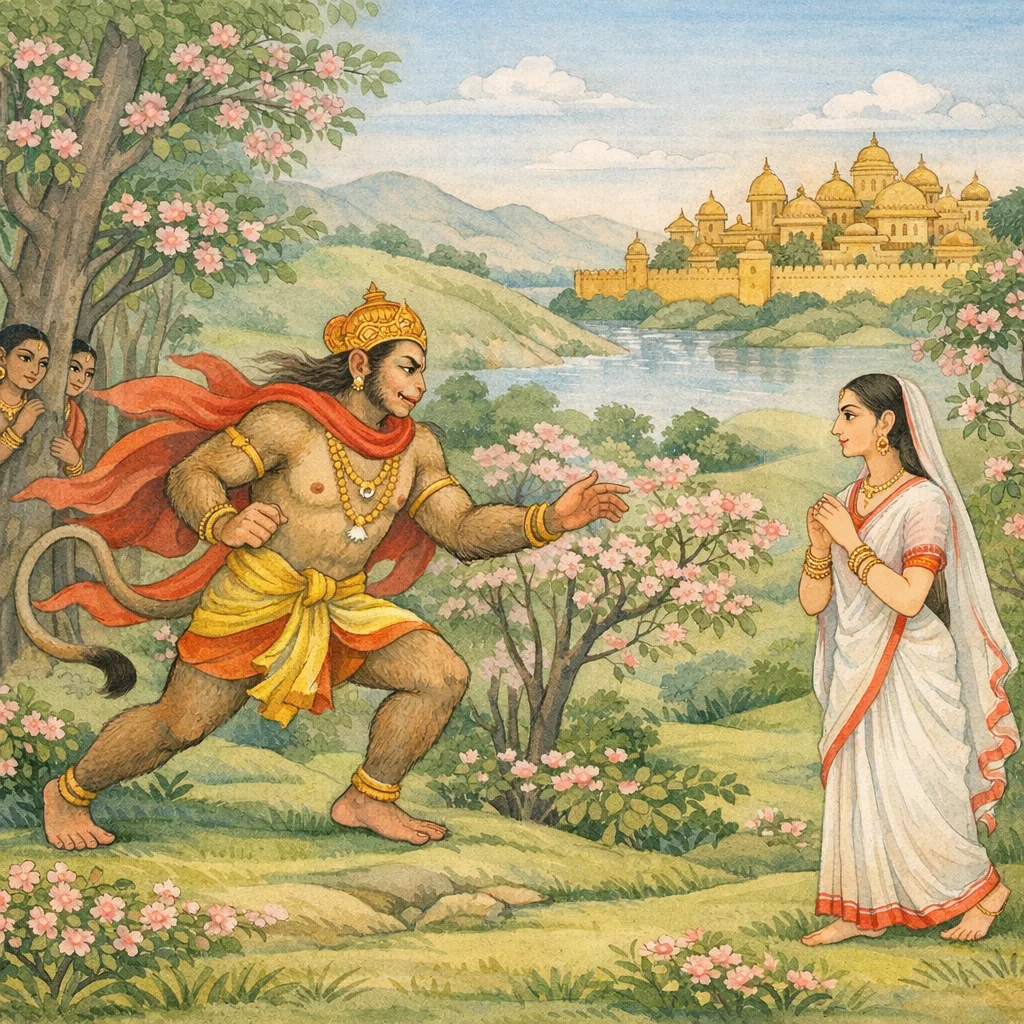
Sītā responds to Hanumān’s report of Rāma’s grief with a dharma-grounded reply: she affirms Rāma’s virtues and inevitable victory, notes the time-limit imposed by Rāvaṇa, and references counsel within Laṅkā (including news conveyed by Nālā, Vibhīṣaṇa’s daughter). Hanumān proposes immediate extraction—inviting Sītā to ride on his back across the ocean—asserting his capacity to bear even Laṅkā. Sītā, initially astonished, questions the feasibility given his apparent small form; Hanumān then reveals an immense, mountain-like body to establish credibility. Sītā acknowledges his power and speed yet refuses the plan on ethical and strategic grounds: risk of falling, interception by armed rākṣasas, uncertainty of aerial battle, and the possibility that Hanumān’s solo victory would diminish Rāma’s rightful fame. She insists propriety requires Rāma himself to defeat Rāvaṇa and retrieve her, preserving royal maryādā and the moral narrative of justice. The sarga concludes with Sītā’s request that Hanumān quickly bring Rāma (with Lakṣmaṇa and the vānaras) to Laṅkā, transforming private despair into coordinated action.
Shlokas
Verse 1
सीता तद्वचनं श्रुत्वा पूर्णचन्द्रनिभानना।हनूमन्तमुवाचेदं धर्मार्थसहितं वचः।।।।
Hearing his words, Sītā—whose face was like the full moon—spoke to Hanumān these words, aligned with dharma and wise purpose.
Verse 2
अमृतं विषसंसृष्टं त्वया वानर भाषितम्।यच्च नान्यमना रामो यच्च शोकपरायणः ।।।।
O Vānara, what you have spoken is like nectar mixed with poison: that Rāma’s mind does not turn to anyone else, and yet that he remains wholly given over to grief.
Verse 3
ऐश्वर्ये वा सुविस्तीर्णे व्यसने वा सुदारुणे।रज्ज्वेव पुरुषं बद्ध्वा कृतान्तः परिकर्षति।।।।
“Whether one is spread out in vast prosperity or plunged into terrible adversity, Death drags a man along as if he were bound with a rope.”
Verse 4
विधिर्नूनमसंहार्यः प्राणिनां प्लवगोत्तम।सौमित्रिं मां च रामं च व्यसनै: पश्य मोहितान्।।।।
O best of monkeys, destiny is surely irresistible for living beings. Look—Saumitri, Rāma, and I myself are all bewildered and burdened by calamity.
Verse 5
शोकस्यास्य कदा पारं राघवोऽधिगमिष्यति।प्लवमानः परिश्रान्तो हतनौ स्सागरे यथा।।।।
When will Rāghava reach the far shore of this grief? Like a man, exhausted, trying to swim after being shipwrecked in the ocean.
Verse 6
राक्षसानां वधं कृत्वा सूदयित्वा च रावणम्।लङ्कामुन्मूलितां कृत्वा कदा द्रक्ष्यति मां पतिः।।।।
When will my husband see me—after slaying the rākṣasas, killing Rāvaṇa, and uprooting Laṅkā itself?
Verse 7
स वाच्यस्संत्वरस्वेति यावदेव न पूर्यते।अयं संवत्सरः कालस्तावद्धि मम जीवितम्।।।।
He must be told, ‘Hasten!’—before this allotted year is completed; for only so long, indeed, will my life endure.
Verse 8
वर्तते दशमो मासो द्वौ तु शेषौ प्लवङ्गम।रावणेन नृशंसेन समयो यः कृतो मम।।।।
O Vānara, the tenth month is now passing; only two months remain—such is the deadline that the cruel Rāvaṇa has set for me.
Verse 9
विभीषणेन च भ्रात्रा मम निर्यातनं प्रति।अनुनीतः प्रयत्नेन न च तत्कुरुते मतिम्।।।।
And by his brother Vibhīṣaṇa he was earnestly and gently urged toward my release; yet he does not set his mind to that course.
Verse 10
मम प्रतिप्रदानं हि रावणस्य न रोचते।रावणं मार्गते संख्ये मृत्युः कालवशं गतम्।।।।
Rāvaṇa does not wish to give me back; for him, Death—having come under the dominion of Time—lies in wait, seeking Rāvaṇa on the battlefield.
Verse 11
ज्येष्ठा कन्या नला नाम विभीषणसुता कपे।तया ममेदमाख्यातं मात्रा प्रहितया स्वयम्।।।।
O monkey, Vibhīṣaṇa’s eldest daughter—named Nalā—came in person, sent by her mother, and reported this matter to me.
Verse 12
असंशयं हरिश्रेष्ठ क्षिप्रं मां प्राप्स्यते पतिः।अन्तरात्मा च मे शुद्धस्तस्मिंश्च बहवो गुणाः।।।।
O best of monkeys, without doubt my husband will soon reach me. My inner conscience is pure—and in him there are many virtues.
Verse 13
उत्साहः पौरुषं सत्त्वमानृशंस्यं कृतज्ञता।विक्रमश्च प्रभावश्च सन्ति वानर राघवे।।।।
O monkey, in Rāghava are found perseverance, manly courage, strength of character, compassion, gratitude, heroic prowess, and commanding power.
Verse 14
चतुर्दशसहस्राणि राक्षसानां जघान यः।जनस्थाने विना भ्रात्रा शत्रुः कस्तस्य नोद्विजेत् ।।।।
He who, at Jana-sthāna, slew fourteen thousand Rākṣasas even without his brother—what enemy of his would not tremble?
Verse 15
न स शक्यस्तुलयितुं व्यसनैः पुरुषर्षभः।अहं तस्य प्रभावज्ञा शक्रस्येव पुलोमजा ।।।।
That bull among men cannot be weighed down by calamities. I know his might—just as Pulomā’s daughter (Śacī) knows the power of Śakra (Indra).
Verse 16
शरजालांशुमान्शूरः कपे रामदिवाकरः।शत्रुरक्षोमयं तोयमुपशोषं नयिष्यति।।।।
O monkey, the valiant Rāma—like the sun—will, with the dazzling rays of his arrow-showers, dry up the watery flood that is the enemy Rākṣasa host.
Verse 17
इति सञ्जल्पमानां तां रामार्थे शोककर्शिताम्।आश्रुसम्पूर्णनयनामुवाच वचनं कपिः।।।।
As she spoke thus—worn down by grief for Rāma, her eyes brimming with tears—the monkey addressed her with words.
Verse 18
श्रुत्वैव तु वचो मह्यं क्षिप्रमेष्यति राघवः।चमूं प्रकर्षन्महतीं हर्यृक्षगणसङ्कुलाम्।।।।
Once he hears my message, Rāghava will come swiftly, leading a vast army crowded with troops of monkeys and bears.
Verse 19
अथवा मोचयिष्यामि त्वामद्यैव वरानने।अस्माद्धुःखादुपारोह मम पृष्ठमनिन्दिते।।।।
Or else, O fair-faced lady, I will free you this very day from this sorrow. Mount my back, O blameless one.
Verse 20
त्वां हि पृष्ठगतां कृत्वा सन्तरिष्यामि सागरम्।शक्तिरस्ति हि मे वोढुं लङ्कामपि सरावणाम् ।।।।
If I place you upon my back, I will cross the ocean. Indeed, I have the strength even to carry Lanka itself—Rāvaṇa along with it.
Verse 21
अहं प्रस्रवणस्थाय राघवायाद्य मैथिलि।प्रापयिष्यामि शक्राय हव्यं हुतमिवानलः।।।।
O Maithilī, today I will deliver you to Rāghava who waits on Prasravaṇa—just as the sacred fire conveys offerings to Śakra (Indra).
Verse 22
द्रक्ष्यस्यद्वैव वैदेहि राघवं सहलक्ष्मणम्।व्यवसायसमायुक्तं विष्णुं दैत्यवधे यथा।।।।
O Vaidehī, you will see Rāghava with Lakṣmaṇa this very day—steadfast in resolve, like Viṣṇu when he sets about the slaying of the demons.
Verse 23
त्वद्दर्शनकृतोत्साहमाश्रमस्थं महाबलम्।पुरन्दरमिवासीनं नागराजस्य मूर्धनि।।।।
Mighty Rāma—dwelling at the hermitage—will be roused to fresh courage by seeing you, like Purandara (Indra) seated upon the head/back of the lord of elephants.
Verse 24
पृष्ठमारोह मे देवि मा विकाङ्क्षस्व शोभने।योगमन्विच्छ रामेण शशाङ्केनेव रोहिणी।।।।
O divine lady, O beautiful one—mount my back; do not hesitate. Seek union with Rāma, as Rohiṇī is joined with the Moon.
Verse 25
कथयन्तीव चन्द्रेण सूर्येण च महार्चिषा।मत्पृष्ठमधिरुह्य त्वं तराकाशमहार्णवौ।।।।
Climb upon my back and cross the great ocean and the vast expanse of sky—appearing as though you converse with the Moon and the Sun of blazing radiance.
Verse 26
न हि मे सम्प्रयातस्य त्वामितो नयतोऽङ्गने।अनुगन्तुं गतिं शक्तास्सर्वे लङ्कानिवासिनः।।।।
O fair lady, when I set forth carrying you away from here, all the inhabitants of Laṅkā together will not be able to follow my course or match my speed.
Verse 27
यथैवाहमिह प्राप्तस्तथैवाहमसंशयः।यास्यामि पश्य वैदेहि त्वामुद्यम्य विहायसम्।।।।
O Vaidehī, just as I arrived here, so too—without doubt—I shall depart, lifting you and taking to the open sky. See for yourself.
Verse 28
मैथिली तु हरिश्रेष्ठाच्छ्रुत्वा वचनमद्भुतम्।हर्षविस्मितसर्वाङ्गी हनुमन्तमथाब्रवीत्।।।।
But Maithilī, hearing the wondrous words of that best of Vānara heroes, felt joy and astonishment thrill through her whole body; then she spoke to Hanumān.
Verse 29
हनुमन्दूरमध्वानं कथं मां वोढुमिच्छसि।तदेव खलु ते मन्ये कपित्वं हरियूथप।।।।
“Hanumān, how do you intend to carry me over so long a journey? I suppose this is indeed your impulsive monkey-nature, O leader of the vanara-host.”
Verse 30
कथं वाल्पशरीरस्त्वं मामितो नेतुमिच्छसि।सकाशं मानवेन्द्रस्य भर्तुर्मे प्लवगर्षभ।।।।
“How can you, with so small a body, intend to take me from here into the presence of my husband, the lord among men, O bull among monkeys?”
Verse 31
सीताया वचनं श्रुत्वा हनुमान्मारुतात्मजः।चिन्तयामास लक्ष्मीवान्नवं परिभवं कृतम्।।।।
Hearing Sītā’s words, Hanumān—the illustrious son of the Wind—reflected on the fresh slight that had been spoken.
Verse 32
न मे जानाति सत्त्वं वा प्रभावं वाऽसितेक्षणा।तस्मात्पश्यतु वैदेही यद्रूपं मम कामतः।।।।
“Black-eyed Sītā does not know my strength or my power; therefore let Vaidehī see the form I can assume at will.”
Verse 33
इति सञ्चिन्त्य हनुमांस्तदा प्लवगसत्तमः।दर्शयामास वैदेह्यास्स्वरूपमरिमर्दनः।।।।
Having thought thus, Hanumān—the best of the vanaras, crusher of foes—then showed Vaidehī his true form.
Verse 34
स तस्मात्पादपाद्धीमानाप्लुत्य प्लवगर्षभः।ततो वर्धितुमारेभे सीताप्रत्ययकारणात्।।।।
Then the wise bull among monkeys leapt down from the tree and began to increase his size, in order to create confidence in Sītā.
Verse 35
मेरुमन्दरसङ्काशो बभौ दीप्तानलप्रभः।अग्रतो व्यवतस्थे च सीताया वानरोत्तमः।।।।
The foremost of the vanaras appeared like Meru or Mandara, blazing like a bright fire, and stood before Sītā.
Verse 36
हरिः पर्वतसङ्काशस्ताम्रवक्त्रो महाबलः।वज्रदंष्ट्रनखो भीमो वैदेहीमिदमब्रवीत्।।।।
In that dreadful, mountain-like form—red-faced, immensely strong, with teeth and nails like diamond—the vanara spoke these words to Vaidehī.
Verse 37
सपर्वतवनोद्देशां साट्टप्राकारतोरणाम्।लङ्कामिमां सनाथां वा नयितुं शक्तिरस्ति मे।।।।
“I have the power to carry away this very Laṅkā—together with its king—complete with its mountains and groves, its ramparts, walls, and gateways.”
Verse 38
तदवस्थाप्यतां बुद्धिरलं देवि विकाङ्क्षया।विशोकं कुरु वैदेहि राघवं सहलक्ष्मणम्।।।।
O queen, enough of this unworthy despair. Steady your mind, O Vaidehī, and free Rāghava—together with Lakṣmaṇa—from sorrow.
Verse 39
तं दृष्ट्वा भीमसङ्काशमुवाच जनकात्मजा।पद्मपत्रविशालाक्षी मारुतस्यौरसं सुतम्।।।।
Seeing him in a formidable aspect, Janaka’s daughter—large-eyed like lotus petals—addressed the true-born son of Māruta.
Verse 40
तव सत्त्वं बलं चैव विजानामि महाकपे।वायोरिव गतिं चैव तेजश्चाग्नेरिवाद्भुतम्।।।।
O great monkey, I understand your steadfast strength and power: your speed is like the Wind, and your blazing splendor is wondrous like fire.
Verse 41
प्राकृतोऽन्यः कथं चेमां भूमिमागन्तुमर्हति।उदधेरप्रमेयस्य पारं वानरपुङ्गव।।।।
O chief of monkeys, how could any ordinary being be fit to reach this land—the far shore of an immeasurable ocean?
Verse 42
जानामि गमने शक्तिं नयने चापि ते मम।अवश्यं सम्प्रधार्याशु कार्यसिद्धिर्महात्मनः।।।।
I know you have the power both to travel and to carry me. Yet the great-souled one’s mission must be considered rightly—then success will surely come swiftly.
Verse 43
अयुक्तं तु कपिश्रेष्ठ मम गन्तुं त्वयाऽनघ।वायुवेगसवेगस्य वेगो मां मोहयेत्तव।।।।
But, O foremost of monkeys, O sinless one, it is not proper for me to go with you. Your wind-like speed would overwhelm me and make me lose consciousness.
Verse 44
अहमाकाशमापन्ना ह्युपर्युपरि सागरम्।प्रपतेयं हि ते पृष्ठाद्भयाद्वेगेव गच्छतः।।।।
As you speed through the sky above the ocean, I might, out of fear, fall from your back.
Verse 45
पतिता सागरे चाहं तिमिनक्रझषाकुले।भवेयमाशु विवशा यादसामन्नमुत्तमम्।।5.37.45।।
If I were to fall into the ocean teeming with whales, crocodiles, and fish, I would quickly become helpless—an excellent prey for the creatures of the waters.
Verse 46
न च शक्ष्ये त्वया सार्धं गन्तुं शत्रुविनाशन।कलत्रवति सन्देहस्त्वय्यपि स्यादसंशयः।।।।
And I cannot go with you, O destroyer of foes. Burdened with a woman, you too would surely face doubt and danger.
Verse 47
ह्रियमाणां तु मां दृष्ट्वा राक्षसा भीमविक्रमाः।अनुगच्छेयुरादिष्टा रावणेन दुरात्मना।।।।
If the rākṣasas of dreadful prowess see me being carried away, they will pursue you—acting under the orders of the wicked-minded Rāvaṇa.
Verse 48
तैस्त्वं परिवृतश्शूरैश्शूलमुद्गरपाणिभिः।भवेस्त्वं संशयं प्राप्तो मया वीर कलत्रवान्।।।।
Surrounded by those warriors bearing spears and maces, you would be driven into mortal peril because of me, O hero—one who has a wife.
Verse 49
सायुधा बहवो व्योम्नि राक्षसास्त्वं निरायुधः।कथं शक्ष्यसि संयातुं मां चैव परिरक्षितुम्।।।।
Many armed rākṣasas would confront you in the sky, while you are without weapons. How could you fight and also keep me protected?
Verse 50
युध्यमानस्य रक्षोभिस्तव तैः क्रूरकर्मभिः।प्रपतेयं हि ते पृष्ठाद्भयार्ता कपिसत्तम।।।।
While you are fighting those rākṣasas of cruel deeds, O best of monkeys, I—overcome by fear—might slip and fall from your back.
Verse 51
अथ रक्षांसि भीमानि महान्ति बलवन्ति च।कथञ्चित्सांपराये त्वां जयेयुः कपिसत्तम।।।।
And then, O best of monkeys, those rākṣasas—fearsome, huge, and strong—might, in the press of battle, defeat you somehow.
Verse 52
अथवा युध्यमानस्य पतेयं विमुखस्य ते।पतितां च गृहीत्वा मां नयेयुः पापराक्षसाः।।।।
Or else, while you are fighting and your attention turns away, I might fall; and once I have fallen, those sinful rākṣasas could seize me and carry me off again.
Verse 53
मां वा हरेयुस्त्वद्धस्ताद्विशसेयुरथापि वा।अव्यवस्थौ हि दृश्येते युद्धे जयपराजयौ।।।।
They might snatch me from your hands—or even cut me down. For in war, victory and defeat are seen to be uncertain.
Verse 54
अहं वापि विपद्येयं रक्षोभिरभितर्जिता।त्वत्प्रयत्नो हरिश्रेष्ठ भवेन्निष्फल एव तु।।।।
Or I might perish, terrorized by the rākṣasas; and then, O best of monkeys, your effort would indeed become fruitless.
Verse 55
कामं त्वमसि पर्याप्तो निहन्तुं सर्वराक्षसान्।राघवस्य यशो हीयेत्त्वया शस्तैस्तु राक्षसैः।।।।
Even if you are fully capable of slaying all the rākṣasas, Rāghava’s fame would be diminished if those rākṣasas were killed by you.
Verse 56
अथवाऽदाय रक्षांसि न्यसेयुस्सम्वृते हि माम्।यत्र ते नाभिजानीयुर्हरयो नापि राघवौ।।।।
Or else, the rākṣasas might seize me and hide me away in some concealed place—one that neither you Vānaras nor even the two Rāghavas could discover.
Verse 57
आरम्भस्तु मदर्थोऽयं ततस्तव निरर्थकः।त्वया हि सह रामस्य महानागमने गुणः।।।।
Then this undertaking, begun for my sake, would become useless; rather, it is of great value that Rāma should come here together with you.
Verse 58
मयि जीवितमायत्तं राघवस्य महात्मनः।भ्रात्रूणां च महाबाहो तव राजकुलस्य च।।।।
O mighty-armed one, the very life of the great-souled Rāghava—and of his brothers, and of your king’s entire royal house—hangs upon my survival.
Verse 59
तौ निराशौ मदर्थं तु शोकसन्तापकर्शितौ।सह सर्वर्क्षहरिभिस्त्यक्ष्यतः प्राणसङ्ग्रहम्।।।।
Those two, stripped of hope because of me and wasted by grief and anguish, would abandon their lives—together with all the bears and Vānaras.
Verse 60
भर्तुर्भक्तिं पुरस्कृत्य रामादन्यस्य वानर।न स्पृशामि शरीरं तु पुंसो वानरपुङ्गव।।।।
O leader among Vānaras, holding fast to devotion to my husband, I will not touch the body of any man other than Rāma.
Verse 61
यदहं गात्रसंस्पर्शं रावणस्य बलाद्गता।अनीशा किं करिष्यामि विनाथा विवशा सती।।।।
If I was made to endure the touch of Rāvaṇa’s limbs by sheer force—powerless, unprotected, and helpless as I was—what could I possibly do?
Verse 62
यदि रामो दशग्रीवमिह हत्त्वा सबान्धवम्।मामितो गृह्य गच्छेत तत्तस्य सदृशं भवेत्।।।।
It would be fitting if Rāma were to come here, kill Daśagrīva together with his kinsmen, and then take me away from this place.
Verse 63
श्रुता हि दृष्टाश्च मया पराक्रमा महात्मनस्तस्य रणावमर्दिनः।न देवगन्धर्वभुजङ्गराक्षसा भवन्ति रामेण समा हि संयुगे।।।।
I have both heard of and witnessed the mighty deeds of that great-souled crusher of foes; in battle, neither gods nor Gandharvas, nor Nāgas, nor rākṣasas are truly equal to Rāma.
Verse 64
समीक्ष्य तं संयति चित्रकार्मुकम् महाबलं वासवतुल्यविक्रमम्।सलक्ष्मणं को विषहेत राघवं हुताशनं दीप्तमिवानिलेरितम्।।।।
Facing him in battle—Rāghava of wondrous bow, vast strength, and valor equal to Vāsava—who could endure him when he stands with Lakṣmaṇa, like a blazing fire driven by the wind?
Verse 65
सलक्ष्मणं राघवमाजिमर्दनं दिशागजं मत्तमिव व्यवस्थितम्।सहेत को वानरमुख्य संयुगे युगान्तसूर्यप्रतिमं शरार्चिषम्।।।।
O chief of the Vānaras—who in battle could endure Rāghava, with Lakṣmaṇa beside him: the crusher of foes, standing firm like a rut-maddened quarter-elephant, whose arrow-flashes resemble the sun at the world’s end?
Verse 66
स मे हरिश्रेष्ठ सलक्ष्मणं पतिं सयूथपं क्षिप्रमिहोपपादय।चिराय रामं प्रति शोककर्शितां कुरुष्व मां वानरमुख्य हर्षिताम्।।।।
Therefore, O best of Vānaras, bring my lord here quickly—Rāma with Lakṣmaṇa, together with the leader of the troops. O chief of Vānaras, make me happy—me who for so long have been wasted by sorrow for Rāma.
Frequently Asked Questions
Whether Sītā should accept immediate physical rescue by Hanumān versus awaiting Rāma’s arrival. The dilemma balances compassion and capability against maryādā: Sītā concludes that retrieval must occur through Rāma’s just conquest of Rāvaṇa, not by a surrogate extraction that could compromise propriety and narrative justice.
Power is ethically meaningful only when aligned with dharma and rightful agency. Sītā models discernment: she honors Hanumān’s devotion and strength yet prioritizes moral order (Rāma’s duty as husband-king), mission success, and the safeguarding of collective purpose over expedient solutions.
Laṅkā and the ocean-crossing (sāgara) define the logistical boundary; Prasravaṇa Mountain is named as Rāma’s station point; cultural-religious imagery includes Indra/Airāvata, Rohiṇī with the Moon, and the Sun metaphor for Rāma—used to map virtue and power onto recognizable cosmological symbols.