Sarga 24
सीताभर्त्सना — The Ogresses’ Threats to Sita and Her Vow of Fidelity
सुन्दरकाण्ड
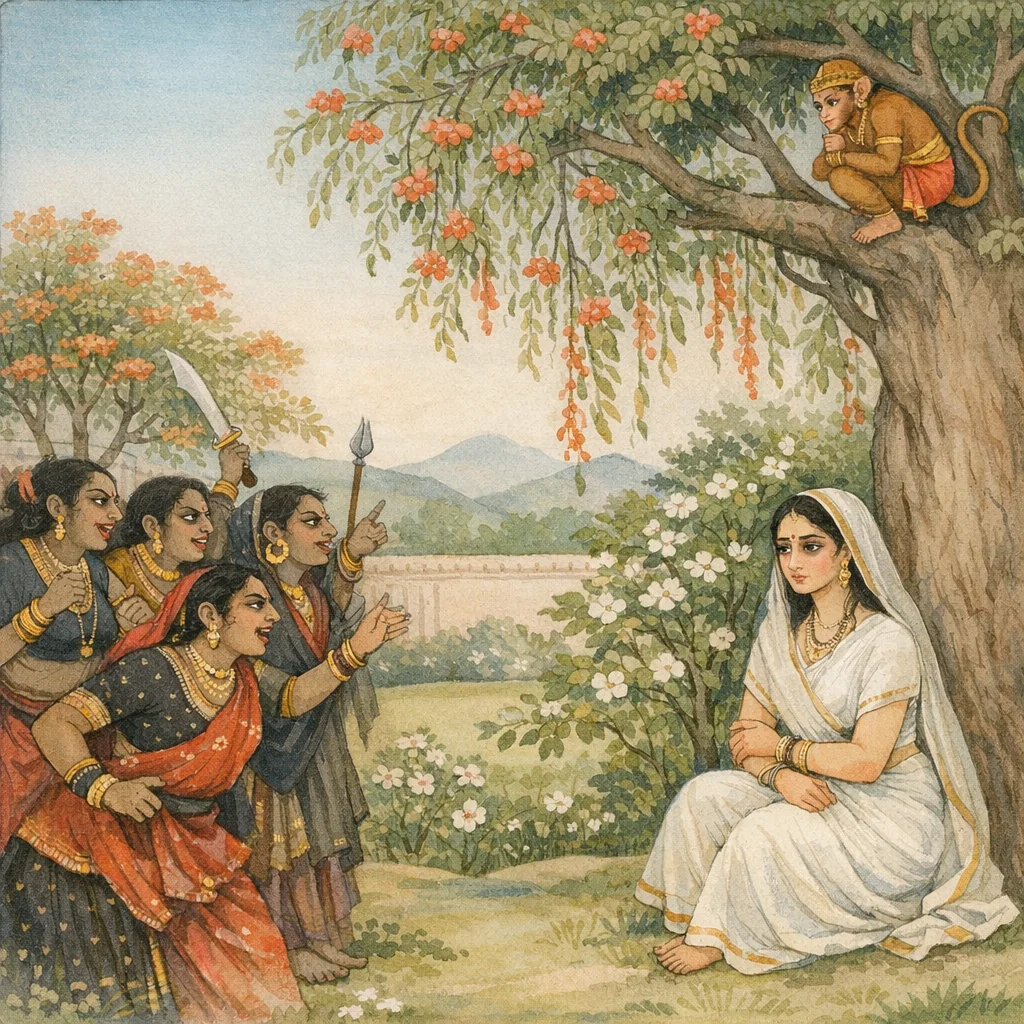
Sarga 24 stages a coercive dialogue in Aśoka-vana where multiple rākṣasīs, acting under Rāvaṇa’s command, attempt to break Sītā’s resolve through alternating persuasion and terror. The chapter opens with a collective approach and harsh speech, urging Sītā to accept residence in the inner apartments and to choose Rāvaṇa as husband, amplifying claims of wealth, pleasure, and political inevitability. Sītā replies with moral refusal: a human woman should not become wife to a rākṣasa; even if threatened with death, she will not abandon Rāma. She articulates a dharma-based definition of marriage—Rāma remains her guru and lawful spouse whether impoverished or dethroned—and reinforces this with exempla of ideal marital devotion (Śacī–Indra, Arundhatī–Vasiṣṭha, Rohiṇī–Candra, Lopāmudrā–Agastya, Sukanyā–Cyavana, Sāvitrī–Satyavān, Damayantī–Nala, and others). Enraged, the rākṣasīs escalate to explicit violence (axes, trident), fantasies of dismemberment and cannibalism, and threats of immediate execution, while Sītā retreats weeping toward the śiṃśupā tree. Hanumān, concealed and speechless, listens—positioning the scene as both ethical testimony and tactical intelligence for the rescue mission.
Shlokas
Verse 1
ततः सीतामुपागम्य राक्षस्यो विकृताननाः।परुषं परुषा नार्य ऊचुस्तां वाक्यमप्रियम्।।5.24.1।।
Then the ogresses with distorted faces approached Sītā and, harsh women speaking harshly, addressed her with unpleasant words.
Verse 2
किं त्वमन्तःपुरे सीते सर्वभूतमनोहरे।महार्हशयनोपेते न वासमनुमन्यसे।।5.24.2।।
“Sītā, why do you not consent to live in the inner palace—charming to all beings, furnished with costly beds?”
Verse 3
मानुषी मानुषस्यैव भार्यात्वं बहुमन्यसे।प्रत्याहर मनो रामान्न त्वं जातु भविष्यसि।।5.24.3।।
You are but a human woman, yet you prize being the wife of a mere human. Turn your mind away from Rāma—otherwise you will not live.
Verse 4
त्रैलोक्यवसुभोक्तारं रावणं राक्षसेश्वरम्। भर्तारमुपसङ्गम्य विहरस्व यथासुखम्।।5.24.4।।
Unite with Rāvaṇa—the lord of the rākṣasas, the enjoyer of the wealth of the three worlds—and live at ease, sporting as you please.
Verse 5
मानुषी मानुषं तं तु राममिच्छसि शोभने।राज्याद्भ्र्रष्टमसिद्धार्थं विक्लबं त्वमनिन्दिते।।5.24.5।।
“O lovely, blameless woman—though you are a woman yourself, you still long for that mere human, Rāma: cast out from his kingdom, unsuccessful in his aims, and broken in spirit.”
Verse 6
राक्षसीनां वचः श्रुत्वा सीता पद्मनिभेक्षणा। नेत्राभ्यामश्रुपूर्णाभ्यामिदं वचनमब्रवीत्।।5.24.6।।
Hearing the words of the ogresses, Sītā—lotus-eyed—her two eyes brimming with tears, spoke these words in reply.
Verse 7
यदिदं लोकविद्विष्टमुदाहरथ सङ्गताः। नैतन्मनसि वाक्यं मे किल्बिषं प्रतिभाति वः।।5.24.7।।
“All of you, gathered together, have uttered words that the world condemns; your sinful counsel does not find acceptance in my mind.”
Verse 8
न मानुषी राक्षसस्य भार्या भवितुमर्हति। कामं खादत मां सर्वा न करिष्यामि वो वचः।।5.24.8।।
“A human woman ought not to become the wife of a rākṣasa. Eat me if you wish—all of you; I will not do as you say.”
Verse 9
दीनो वा राज्यहीनो वा यो मे भर्ता स मे गुरुः।तं नित्यमनुरक्तास्मि यथा सूर्यं सुवर्चला।।5.24.9।।
“Be he afflicted or bereft of kingdom, he who is my husband is my lord. I am ever devoted to him, as Suvarcalā is devoted to the Sun.”
Verse 10
यथा शची महाभागा शक्रं समुपतिष्ठति।अरुन्धती वसिष्ठं च रोहिणी शशिनं यथा।।5.24.10।।लोपामुद्रा यथागस्त्यं सुकन्या च्यवनं यथा।सावित्री सत्यवन्तं च कपिलं श्रीमती यथा।।5.24.11।।सौदासं मदयन्तीव केशिनी सगरं यथा।नैषधं दमयन्तीव भैमी पतिमनुव्रता।।5.24.12।।तथाऽहमिक्ष्वाकुवरं रामं पतिमनुव्रता।
As noble Śacī stands devoted to Śakra, as Arundhatī to Vasiṣṭha, and Rohiṇī to the Moon; as Lopāmudrā to Agastya, Sukanyā to Cyavana, Sāvitrī to Satyavān, and Śrīmatī to Kapila; as Madayantī to Saudāsa, Keśinī to Sagara, and Damayantī—Bhīma’s daughter—faithful to her husband Nala of Niṣadha: so too am I devoted to my husband Rāma, the best of the Ikṣvāku line.
Verse 11
यथा शची महाभागा शक्रं समुपतिष्ठति।अरुन्धती वसिष्ठं च रोहिणी शशिनं यथा।।5.24.10।।लोपामुद्रा यथागस्त्यं सुकन्या च्यवनं यथा।सावित्री सत्यवन्तं च कपिलं श्रीमती यथा।।5.24.11।।सौदासं मदयन्तीव केशिनी सगरं यथा।नैषधं दमयन्तीव भैमी पतिमनुव्रता।।5.24.12।।तथाऽहमिक्ष्वाकुवरं रामं पतिमनुव्रता।
As noble Śacī stands devoted to Śakra, as Arundhatī to Vasiṣṭha, and Rohiṇī to the Moon; as Lopāmudrā to Agastya, Sukanyā to Cyavana, Sāvitrī to Satyavān, and Śrīmatī to Kapila; as Madayantī to Saudāsa, Keśinī to Sagara, and Damayantī—Bhīma’s daughter—faithful to her husband Nala of Niṣadha: so too am I devoted to my husband Rāma, the best of the Ikṣvāku line.
Verse 12
यथा शची महाभागा शक्रं समुपतिष्ठति।अरुन्धती वसिष्ठं च रोहिणी शशिनं यथा।।5.24.10।।लोपामुद्रा यथागस्त्यं सुकन्या च्यवनं यथा।सावित्री सत्यवन्तं च कपिलं श्रीमती यथा।।5.24.11।।सौदासं मदयन्तीव केशिनी सगरं यथा।नैषधं दमयन्तीव भैमी पतिमनुव्रता।।5.24.12।।तथाऽहमिक्ष्वाकुवरं रामं पतिमनुव्रता।
As noble Śacī stands devoted to Śakra, as Arundhatī to Vasiṣṭha, and Rohiṇī to the Moon; as Lopāmudrā to Agastya, Sukanyā to Cyavana, Sāvitrī to Satyavān, and Śrīmatī to Kapila; as Madayantī to Saudāsa, Keśinī to Sagara, and Damayantī—Bhīma’s daughter—faithful to her husband Nala of Niṣadha: so too am I devoted to my husband Rāma, the best of the Ikṣvāku line.
Verse 13
सीताया वचनं श्रुत्वा राक्षस्यः क्रोधमूर्छिताः।।5.24.13।। भर्त्सयन्ति स्म परुषैर्वाक्यै रावणचोदिताः।
Hearing Sītā’s words, the rākṣasī women—urged on by Rāvaṇa and overcome with anger—began again to browbeat her with harsh speech.
Verse 14
अवलीनः स निर्वाक्यो हनूमान् शिंशुपाद्रुमे।।5.24.14।।यसीतां सन्तर्जयन्तीस्ता राक्षसीरशृणोत् कपिः।
Hidden in the śiṃśupā tree and holding his tongue, Hanumān the monkey listened as the rākṣasīs threatened Sītā.
Verse 15
तामभिक्रम्य सङ्कृद्धा वेपमानां समन्ततः।।5.24.15।।भृशं संलिलिहुर्दीप्तान् प्रलम्बान् दशनच्छदान्।
Closing in on her from every side as she trembled, the enraged rākṣasīs repeatedly licked their hanging lips, gleaming with menace.
Verse 16
ऊचुश्च परमक्रुद्धाः प्रगृह्याशु परश्वधान्।।5.24.16।।नेयमर्हति भर्तारं रावणं राक्षसाधिपम्।
Seething with rage, they quickly seized their axes and cried, “This woman is not fit to have Rāvaṇa, lord of the rākṣasas, as her husband!”
Verse 17
सा भर्त्स्यमाना भीमाभी राक्षसीभिर्वरानना।।5.24.17।।सबाष्पमप सर्पन्ती शिंशुपां तामुपागमत्।
Threatened by the terrifying rākṣasīs, the lovely-faced Sītā, with tears welling up, drew back and moved toward that śiṃśupā tree.
Verse 18
ततस्तां शिंशुपां सीता राक्षसीभिः समावृता।।5.24.18।।अभिगम्य विशालाक्षी तस्थौ शोकपरिप्लुता।
Then Sītā, wide-eyed and flooded with grief, reached that śiṃśupā tree and stood there, surrounded by the rākṣasīs.
Verse 19
तां कृशां दीनवदनां मलिनाम्बरधारिणीम्।।5.24.19।।भर्त्सयाञ्चक्रिरे सीतां राक्षस्यस्तां समन्ततः।
All around, the rākṣasīs harassed Sītā—thin, downcast in face, and clothed in soiled garments.
Verse 20
ततस्तां विनता नाम राक्षसी भीमदर्शना।।5.24.20।।अब्रवीत्कुपिताकारा कराला निर्णतोदरी।
Then a frightful rākṣasī named Vinatā—grim in form, dark and dreadful, with a sunken belly—spoke to her.
Verse 21
सीते पर्याप्तमेतावद्भर्तुः स्नेहो निदर्शितः।।5.24.21।।सर्वात्रातिकृतं भद्रे व्यसनायोपकल्पते
“Sītā, you have shown enough love for your husband—up to this point. Auspicious lady, excess in anything, anywhere, becomes the cause of calamity.”
Verse 22
परितुष्टास्मि भद्रं ते मानुषस्ते कृतो विधिः।।5.24.22।।ममापि तु वचः पथ्यं ब्रुवन्त्याः कुरु मैथिलि।
O Maithilī, be at ease—I am satisfied. You have done what is expected of a human being. Now, however, follow my counsel as well, for I speak what is wholesome for you.
Verse 23
रावणं भज भर्तारं भर्तारं सर्वरक्षसाम्।।5.24.23।। विक्रान्तं रूपवन्तं च सुरेशमिव वासवम्। दक्षिणं त्यागशीलं च सर्वस्य प्रियदर्शनम्।।5.24.24।।
Accept Rāvaṇa as your husband—Rāvaṇa, the lord of all the rākṣasas.
Verse 24
रावणं भज भर्तारं भर्तारं सर्वरक्षसाम्।।5.24.23।। विक्रान्तं रूपवन्तं च सुरेशमिव वासवम्। दक्षिणं त्यागशीलं च सर्वस्य प्रियदर्शनम्।।5.24.24।।
He is valiant and handsome, like Vāsava (Indra), lord of the gods—generous, given to giving, and pleasing to behold for all.
Verse 25
मानुषं कृपणं रामं त्यक्त्वा, रावणमाश्रय।दिव्याङ्गरागा वैदेहि दिव्याभरणभूषिता।।5.24.25।।अद्यप्रभृति सर्वेषां लोकानामीश्वरी भव।
Abandon the pitiable human Rāma and take refuge in Rāvaṇa. O Vaidehī, anointed with divine unguents and adorned with heavenly ornaments, from today become the sovereign lady of all these worlds.
Verse 26
अग्नेः स्वाहा यथा देवी शची वेन्द्रस्य शोभने।।5.24.26।। किं ते रामेण वैदेहि कृपणेन गतायुषा।
O fair one, as Svāhā is queen to Fire and Śacī to Indra, so should you be (to Rāvaṇa). What use is Rāma to you—pitiable and as good as doomed?
Verse 27
एतदुक्तं च मे वाक्यं यदि त्वं न करिष्यसि।।5.24.27।।अस्मिन्मुहूर्ते सर्वास्त्वां भक्षयिष्यामहे वयम्।
If you will not do as I have said, then this very moment we all shall devour you.
Verse 28
अन्या तु विकटा नाम लम्बमानपयोधरा।।5.24.28।।अब्रवीत्कुपिता सीतां मुष्टिमुद्यम्य गर्जती।
Then another—named Vikaṭā, her breasts hanging low—angrily spoke to Sītā, raising her fist and roaring.
Verse 29
बहून्यप्रियरूपाणि वचनानि सुदुर्मते।।5.24.29।। अनुक्रोशान्मृदुत्वाच्च सोढानि तव मैथिलि।
O ill-minded Maithilī, we have endured many harsh and unpleasant words of yours, out of pity and out of our gentleness.
Verse 30
न च नः कुरुषे वाक्यं हितं कालपुरस्कृतम्।।5.24.30।।आनीतासि समुद्रस्य पारमन्यैर्दुरासदम्।रावणान्तःपुरं घोरं प्रविष्टा चासि मैथिलि।।5.24.31।।
Yet you do not accept our words—advice meant for your good and offered at the proper time.
Verse 31
न च नः कुरुषे वाक्यं हितं कालपुरस्कृतम्।।5.24.30।।आनीतासि समुद्रस्य पारमन्यैर्दुरासदम्।रावणान्तःपुरं घोरं प्रविष्टा चासि मैथिलि।।5.24.31।।
O Maithilī, you have been carried to the far shore of the ocean—hard for others to reach—and you have entered the dreadful inner apartments of Rāvaṇa.
Verse 32
रावणस्य गृहे रुद्धामस्माभिस्तु सुरक्षिताम्।न त्वां शक्तः परित्रातुमपि साक्षात्पुरन्दरः।।5.24.32।।
You are confined in Rāvaṇa’s house and guarded well by us; even Purandara (Indra) himself would not be able to rescue you.
Verse 33
कुरुष्व हितवादिन्या वचनं मम मैथिलि।अलमश्रुप्रपातेन त्यज शोकमनर्थकम्।।5.24.33।।
O Maithilī, follow my words as one who speaks for your ‘good’; enough of this flood of tears—cast off this fruitless sorrow.
Verse 34
भज प्रीतिं च हर्षं च त्यजैतां नित्यदैन्यताम्।सीते राक्षसराजेन सह क्रीड यथासुखम्।।5.24.34।।
O Sītā, take to affection and delight; abandon this constant misery. Play and enjoy as you wish in the company of the rākṣasa-king.
Verse 35
जानासि हि यथा भीरु स्त्रीणां यौवनमध्रुवम्।यावन्न ते व्यतिक्रामेत्तावत्सुखमवाप्नुहि।।5.24.35।।
O timid one, you know how a woman’s youth is unstable and fleeting; before it passes you by, enjoy pleasure while it lasts.
Verse 36
उद्यानानि च रम्याणि पर्वतोपवनानि च।सह राक्षसराजेन चर त्वं मदिरेक्षणे।।5.24.36।।
O woman of intoxicating eyes, wander with the rākṣasa-king through delightful gardens and the mountain-groves.
Verse 37
स्त्री सहस्राणि ते सप्त वशे स्थास्यन्ति सुन्दरि।रावणं भज भर्तारं भर्तारं सर्वरक्षसाम्।।5.24.37।।
O beautiful one, seven thousand women will remain under your command; accept Rāvaṇa as your husband—the lord of all rākṣasas.
Verse 38
उत्पाट्य वा ते हृदयं भक्षयिष्यामि मैथिलि।यदि मे व्याहृतं वाक्यं न यथावत्करिष्यसि।।5.24.38।।
O Maithilī, if you do not carry out my spoken command properly, I will tear out your heart and devour it.
Verse 39
ततश्चण्डोदरी नाम राक्षसी क्रोधमूर्छिता।भ्रामयन्ती महच्छूलमिदं वचनमब्रवीत्।।5.24.39।।
Then an ogress named Caṇḍodarī, overcome with rage, whirling a great trident, spoke these words.
Verse 40
इमां हरिणलोलाक्षीं त्रासोत्कम्पिपयोधराम्।रावणेन हृतां दृष्टवा दौहृदो मे महानभूत्।।5.24.40।।
“Seeing this woman—doe-eyed, her bosom trembling in terror, carried off by Rāvaṇa—within me a great craving has arisen.”
Verse 41
यकृत्प्लीहमथोत्पीडं हृदयं च सबन्धनम्।आन्त्राण्यपि तथा शीर्षं खादेयमिति मे मतिः।।5.24.41।।
“My thought is to eat her—liver and spleen, the heart with its attachments, the intestines, and likewise the head.”
Verse 42
ततस्तु प्रघसा नाम राक्षसी वाक्यमब्रवीत्।कण्ठमस्या नृशंसायाः पीडयाम किमास्यते।।5.24.42।।
Then the rākṣasī named Praghasā spoke: “Why are we sitting idle? Let us squeeze the throat of this ruthless woman.”
Verse 43
निवेद्यतां ततो राज्ञे मानुषी सा मृतेति ह।नात्र कश्चन संदेहः खादतेति स वक्ष्यति।।5.24.43।।
“Then let it be reported to the king that the human woman is dead; there is no doubt—he will say, ‘Eat her.’”
Verse 44
ततस्त्वजामुखी नाम राक्षसी वाक्यमब्रवीत्।विशस्येमां ततः सर्वाः समान् कुरुत पिण्डकान्।।5.24.44।।
Then the rākṣasī named Ajāmukhī said: “Cut her up, and then all of you make equal portions.”
Verse 45
विभजाम ततः सर्वा विवादो मे न रोचते।पेयमानीयतां क्षिप्रं लेह्यमुच्चावचं बहु।।5.24.45।।
“Then we will all divide (the shares). I do not like quarrels about it. Quickly bring drinks, and many kinds of lickable foods as accompaniments.”
Verse 46
ततः शूर्पणखा नाम राक्षसी वाक्यमब्रवीत्।अजामुख्या यदुक्तं हि तदेव मम रोचते।।5.24.46।।
Then the rākṣasī named Śūrpaṇakhā said: “What Ajāmukhī has said—indeed, that alone pleases me.”
Verse 47
सुरा चानीयतां क्षिप्रं सर्वशोकविनाशिनी।मानुषं मांसमास्वाद्य नृत्यामोऽथ निकुम्भिलाम्।।5.24.47।।
“Bring wine quickly—the destroyer of all sorrow. After tasting human flesh, then we shall dance at Nikumbhilā.”
Verse 48
एवं संभर्त्स्यमाना सा सीता सुरसुतोपमा।राक्षसीभिः सुघोराभिर्दैर्यमुत्सृज्य रोदिति।।5.24.48।।
Thus threatened in this way by the exceedingly dreadful ogresses, Sītā—like the daughter of a god—gave up her composure and wept.
Frequently Asked Questions
Sītā faces a dharma-sankat: whether to submit to coercive ‘marriage’ with Rāvaṇa for safety and luxury or to uphold lawful marital fidelity to Rāma despite threats of torture and death; she chooses unwavering refusal.
The chapter teaches that dharma is not contingent on power, comfort, or fear: legitimate relational duties (pativratā commitment) and moral speech remain binding even under intimidation, and exempla tradition can function as ethical reasoning.
The śiṃśupā tree becomes a focal landmark (Sītā’s refuge and Hanumān’s concealment), while references to Rāvaṇa’s antaḥpura and Nikumbhilā situate the coercion within Laṅkā’s courtly and ritual culture.