Sarga 17
सप्तदशः सर्गः — Hanuman Beholds Sita in the Ashoka Grove
सुन्दरकाण्ड
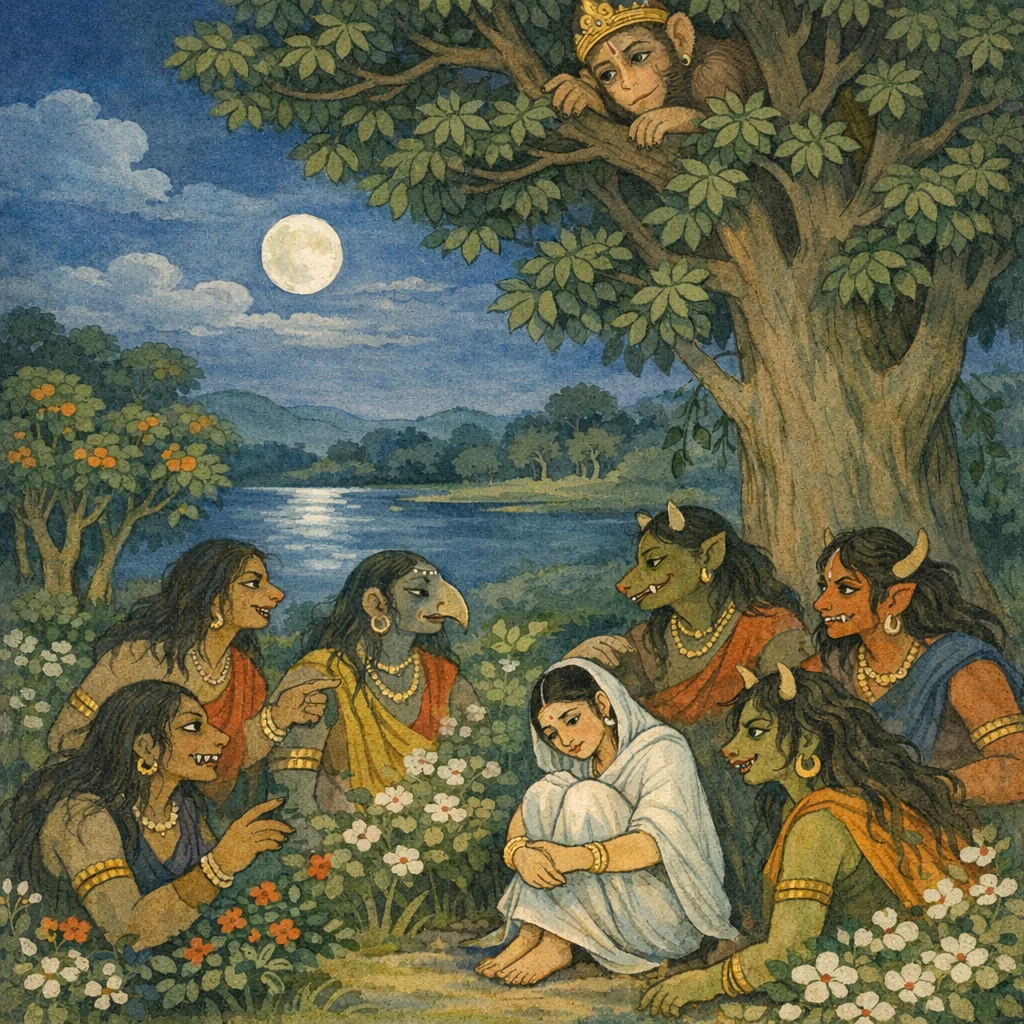
Sarga 17 stages a deliberate shift from cosmic calm to moral horror and finally to recognition. The moon rises in a stainless, cooling radiance, described through layered similes (moon as a swan in blue water), and its light appears to “minister” to Hanumān, underscoring the epic’s alignment of nature with righteous purpose. Hanumān, seeking Vaidehī, first observes the immediate security environment: a dense catalogue of rākṣasīs marked by grotesque physiognomy, animal-faced hybridity, and iron weaponry (śūla, mudgara), seated around a massive tree trunk—an archival inventory that conveys intimidation as a system, not a single antagonist. Beneath that tree, he finally identifies Sītā: lustreless, dust-stained, and grief-stricken, yet ethically radiant through chastity and steadfast love for her husband. Multiple similes articulate her condition—meteor fallen to earth, crescent moon veiled by autumn clouds, an unused lute—while affirming that her inner dharma remains intact despite external deprivation. Hanumān’s response is controlled joy: tears of relief, inward salutations to Rāma and Lakṣmaṇa, and concealment in the foliage to continue the mission without compromising Sītā’s safety.
Shlokas
Verse 1
ततः कमुदषण्डाभो निर्मलं निर्मलोदयः।प्रजगाम नभश्चन्द्रो हंसो नीलमिवोदकम्।।।।
Thereafter the stainless moon, rising in spotless splendor, moved across the clear sky—like a swan gliding upon blue water.
Verse 2
साचिव्यमिव कुर्वन् स प्रभया निर्मलप्रभः।चन्द्रमा रश्मिभिश्शीतैस्सिषेवे पवनात्मजम्।।।।
The moon, shining with spotless brilliance, seemed as though rendering assistance: with his cool rays he refreshed Hanumān, the son of the Wind, as the search for truth continued through the night.
Verse 3
स ददर्श ततः सीतां पूर्णचन्द्रनिभाननाम्।शोकभारैरिव न्यस्तां भारैर्नावमिवाम्भसि।।।।
Then he saw Sītā, her face like the full moon—yet weighed down as though pressed by loads of sorrow, like a boat in water burdened with heavy cargo.
Verse 4
दिदृक्षमाणो वैदेहीं हनुमान्मारुतात्मजः।स ददर्शाविदूरस्था राक्षसीर्घोरदर्शनाः।।।।एकाक्षीमेककर्णां च कर्णप्रावरणां तथा।अकर्णां शङ्कुकर्णां च मस्तकोच्छ्वासनासिकाम्।।।।अतिकायोत्तमाङ्गीं च तनुदीर्घशिरोधराम्।ध्वस्तकेशीं तथाऽकेशीं केशकम्बलधारिणीम्।।।।लम्बकर्णललाटां च लम्बोदरपयोधराम्।लम्बोष्ठीं चुबुकोष्ठीं च लम्बास्यां लम्बजानुकाम्।।।।ह्रस्वां दीर्घां तथा कुब्जां विकटां वामनां तथा।करालां भुग्नवक्त्रां च पिङ्गाक्षीं विकृताननाम्।।।।
Eager to behold Vaidehī (Sītā), Hanumān—the son of the Wind—saw, close by, rākṣasī-guards of dreadful appearance.
Verse 5
दिदृक्षमाणो वैदेहीं हनुमान्मारुतात्मजः।स ददर्शाविदूरस्था राक्षसीर्घोरदर्शनाः।।5.17.4।।एकाक्षीमेककर्णां च कर्णप्रावरणां तथा।अकर्णां शङ्कुकर्णां च मस्तकोच्छ्वासनासिकाम्।।5.17.5।।अतिकायोत्तमाङ्गीं च तनुदीर्घशिरोधराम्।ध्वस्तकेशीं तथाऽकेशीं केशकम्बलधारिणीम्।।5.17.6।।लम्बकर्णललाटां च लम्बोदरपयोधराम्।लम्बोष्ठीं चुबुकोष्ठीं च लम्बास्यां लम्बजानुकाम्।।5.17.7।।ह्रस्वां दीर्घां तथा कुब्जां विकटां वामनां तथा।करालां भुग्नवक्त्रां च पिङ्गाक्षीं विकृताननाम्।।5.17.8।।
He saw one who was one-eyed, another with only one ear, another whose ears seemed to cover her body; one without ears, one with spike-like ears, and one who breathed through a nostril set upon her head.
Verse 6
दिदृक्षमाणो वैदेहीं हनुमान्मारुतात्मजः।स ददर्शाविदूरस्था राक्षसीर्घोरदर्शनाः।।5.17.4।।एकाक्षीमेककर्णां च कर्णप्रावरणां तथा।अकर्णां शङ्कुकर्णां च मस्तकोच्छ्वासनासिकाम्।।5.17.5।।अतिकायोत्तमाङ्गीं च तनुदीर्घशिरोधराम्।ध्वस्तकेशीं तथाऽकेशीं केशकम्बलधारिणीम्।।5.17.6।।लम्बकर्णललाटां च लम्बोदरपयोधराम्।लम्बोष्ठीं चुबुकोष्ठीं च लम्बास्यां लम्बजानुकाम्।।5.17.7।।ह्रस्वां दीर्घां तथा कुब्जां विकटां वामनां तथा।करालां भुग्नवक्त्रां च पिङ्गाक्षीं विकृताननाम्।।5.17.8।।
He saw one with an enormous body and head, one with a thin, long neck; one with ruined hair, another hairless, and one whose hair hung like a blanket.
Verse 7
दिदृक्षमाणो वैदेहीं हनुमान्मारुतात्मजः।स ददर्शाविदूरस्था राक्षसीर्घोरदर्शनाः।।5.17.4।।एकाक्षीमेककर्णां च कर्णप्रावरणां तथा।अकर्णां शङ्कुकर्णां च मस्तकोच्छ्वासनासिकाम्।।5.17.5।।अतिकायोत्तमाङ्गीं च तनुदीर्घशिरोधराम्।ध्वस्तकेशीं तथाऽकेशीं केशकम्बलधारिणीम्।।5.17.6।।लम्बकर्णललाटां च लम्बोदरपयोधराम्।लम्बोष्ठीं चुबुकोष्ठीं च लम्बास्यां लम्बजानुकाम्।।5.17.7।।ह्रस्वां दीर्घां तथा कुब्जां विकटां वामनां तथा।करालां भुग्नवक्त्रां च पिङ्गाक्षीं विकृताननाम्।।5.17.8।।
He saw one whose ears hung down over her forehead, one with a pendulous belly and breasts; one with drooping lips, one whose lips reached to her chin; one long-faced, and one with long, protruding knees.
Verse 8
दिदृक्षमाणो वैदेहीं हनुमान्मारुतात्मजः।स ददर्शाविदूरस्था राक्षसीर्घोरदर्शनाः।।5.17.4।।एकाक्षीमेककर्णां च कर्णप्रावरणां तथा।अकर्णां शङ्कुकर्णां च मस्तकोच्छ्वासनासिकाम्।।5.17.5।।अतिकायोत्तमाङ्गीं च तनुदीर्घशिरोधराम्।ध्वस्तकेशीं तथाऽकेशीं केशकम्बलधारिणीम्।।5.17.6।।लम्बकर्णललाटां च लम्बोदरपयोधराम्।लम्बोष्ठीं चुबुकोष्ठीं च लम्बास्यां लम्बजानुकाम्।।5.17.7।।ह्रस्वां दीर्घां तथा कुब्जां विकटां वामनां तथा।करालां भुग्नवक्त्रां च पिङ्गाक्षीं विकृताननाम्।।5.17.8।।
He saw one short, one tall, one hunchbacked, one hideous, and one dwarfish; one with a gaping mouth, one with a twisted face, one with tawny eyes, and one with a deformed visage.
Verse 9
विकृताः पिङ्गलाः कालीः क्रोधनाः कलहप्रियाः।कालायसमहाशूलकूटमुद्गरधारिणीः।।।।वराहमृगशार्दूलमहिषाजशिवामुखीः।गजोष्ट्रहयपादीश्च निखातशिरसोऽपराः।।।।एकहस्तैकपादाश्च खरकर्ण्यश्वकर्णिकाः।गोकर्णीर्हस्तिकर्णीश्च हरिकर्णीस्तथापराः।।।।अनासा अतिनासाश्च तिर्यङ्नासा विनासिकाः।गजसन्निभनासाश्च ललाटोच्छवासनासिकाः।।।।हस्तिपादा महापादा गोपादाः पादचूलिकाः।अतिमात्रशिरोग्रीवा अतिमात्रकुचोदरीः।।।।अतिमात्रास्यनेत्राश्च दीर्घजिह्वानखास्तथा।अजामुखीर्हस्तिमुखीर्गोमुखीस्सूकरीमुखीः।।।।हयोष्ट्रखरवक्त्राश्च राक्षसीर्घोरदर्शनाः।शूलमुद्गरहस्ताश्च क्रोधनाः कलहप्रियाः।।।।कराला धूम्रकेशीश्च राक्षसीर्विकृताननाः।पिबन्ती: सततं पानं सदा मांससुराप्रियाः।।।।मांसशोणितदिग्धाङ्गीर्मांसशोणितभोजनाः।ता ददर्श कपिश्रेष्ठो रोमहर्षणदर्शनाः।।।।स्कन्धवन्तमुपासीनाः परिवार्य वनस्पतिम्।
Hanumān beheld rākṣasī-women—misshapen, tawny or dark, wrathful and quarrelsome—bearing great iron spears, hammers, and mallets. Some had faces like boars, deer, tigers, buffaloes, goats, or jackals; some had feet like elephants, camels, or horses; some had their heads sunk into their shoulders. Some had but one hand or one foot; some had ears like donkeys, horses, cows, elephants, or monkeys. Some were noseless, some had enormous noses, some crooked noses, some without nostrils; some had elephant-like trunks, and some breathed through nostrils set upon the forehead. Some had elephant-feet, huge feet, cow-hooves, or hair upon their feet; some had oversized heads and necks, enormous breasts and bellies, and huge mouths and eyes; some had long tongues and nails. Some had the faces of goats, elephants, cows, or pigs; others had faces like horses, camels, or donkeys. Terrifying to behold, armed with tridents and clubs, always angry and fond of strife—smoke-haired, gaping-mouthed, and distorted-faced—they drank constantly, delighting in meat and liquor, their bodies smeared with flesh and blood, feeding on flesh and blood. The foremost of monkeys saw them—horripilating in appearance—seated all around a great tree-trunk.
Verse 10
विकृताः पिङ्गलाः कालीः क्रोधनाः कलहप्रियाः।कालायसमहाशूलकूटमुद्गरधारिणीः।।5.17.9।।वराहमृगशार्दूलमहिषाजशिवामुखीः।गजोष्ट्रहयपादीश्च निखातशिरसोऽपराः।।5.17.10।।एकहस्तैकपादाश्च खरकर्ण्यश्वकर्णिकाः।गोकर्णीर्हस्तिकर्णीश्च हरिकर्णीस्तथापराः।।5.17.11।।अनासा अतिनासाश्च तिर्यङ्नासा विनासिकाः।गजसन्निभनासाश्च ललाटोच्छवासनासिकाः।।5.17.12।।हस्तिपादा महापादा गोपादाः पादचूलिकाः।अतिमात्रशिरोग्रीवा अतिमात्रकुचोदरीः।।5.17.13।।अतिमात्रास्यनेत्राश्च दीर्घजिह्वानखास्तथा।अजामुखीर्हस्तिमुखीर्गोमुखीस्सूकरीमुखीः।।5.17.14।।हयोष्ट्रखरवक्त्राश्च राक्षसीर्घोरदर्शनाः।शूलमुद्गरहस्ताश्च क्रोधनाः कलहप्रियाः।।5.17.15।।कराला धूम्रकेशीश्च राक्षसीर्विकृताननाः।पिबन्ती: सततं पानं सदा मांससुराप्रियाः।।5.17.16।।मांसशोणितदिग्धाङ्गीर्मांसशोणितभोजनाः।ता ददर्श कपिश्रेष्ठो रोमहर्षणदर्शनाः।।5.17.17।।स्कन्धवन्तमुपासीनाः परिवार्य वनस्पतिम्।
Hanumān saw the rākṣasī-guards—horrifying in appearance—seated around a great tree-trunk: disfigured, tawny or dark, angry and quarrelsome; bearing black-iron tridents, spikes, and mallets; some with faces like boar, deer, tiger, buffalo, goat, or jackal; some with feet like elephant, camel, or horse; some with sunken heads, some one-handed or one-legged; with ears like donkey, horse, cow, elephant, or monkey; noseless or huge-nosed, crooked-nosed, nostril-less, elephant-nosed, even breathing through nostrils set on the forehead; with elephant feet or enormous feet, cow-hoof feet, or hair upon their feet; with oversized heads and necks, heavy breasts and bellies; with enormous mouths and eyes, long tongues and nails; with goat-, elephant-, cow-, pig-faces, and mouths like horse, camel, or donkey—terrific to behold, armed with tridents and mallets, ever drinking, fond of meat and liquor, smeared with flesh and blood, feeding on flesh and blood.
Verse 11
विकृताः पिङ्गलाः कालीः क्रोधनाः कलहप्रियाः।कालायसमहाशूलकूटमुद्गरधारिणीः।।5.17.9।।वराहमृगशार्दूलमहिषाजशिवामुखीः।गजोष्ट्रहयपादीश्च निखातशिरसोऽपराः।।5.17.10।।एकहस्तैकपादाश्च खरकर्ण्यश्वकर्णिकाः।गोकर्णीर्हस्तिकर्णीश्च हरिकर्णीस्तथापराः।।5.17.11।।अनासा अतिनासाश्च तिर्यङ्नासा विनासिकाः।गजसन्निभनासाश्च ललाटोच्छवासनासिकाः।।5.17.12।।हस्तिपादा महापादा गोपादाः पादचूलिकाः।अतिमात्रशिरोग्रीवा अतिमात्रकुचोदरीः।।5.17.13।।अतिमात्रास्यनेत्राश्च दीर्घजिह्वानखास्तथा।अजामुखीर्हस्तिमुखीर्गोमुखीस्सूकरीमुखीः।।5.17.14।।हयोष्ट्रखरवक्त्राश्च राक्षसीर्घोरदर्शनाः।शूलमुद्गरहस्ताश्च क्रोधनाः कलहप्रियाः।।5.17.15।।कराला धूम्रकेशीश्च राक्षसीर्विकृताननाः।पिबन्ती: सततं पानं सदा मांससुराप्रियाः।।5.17.16।।मांसशोणितदिग्धाङ्गीर्मांसशोणितभोजनाः।ता ददर्श कपिश्रेष्ठो रोमहर्षणदर्शनाः।।5.17.17।।स्कन्धवन्तमुपासीनाः परिवार्य वनस्पतिम्।
Some had only one hand and one foot; some had ears like a donkey’s or a horse’s. Others had ears like a cow’s, some like an elephant’s, and still others like a monkey’s.
Verse 12
विकृताः पिङ्गलाः कालीः क्रोधनाः कलहप्रियाः।कालायसमहाशूलकूटमुद्गरधारिणीः।।5.17.9।।वराहमृगशार्दूलमहिषाजशिवामुखीः।गजोष्ट्रहयपादीश्च निखातशिरसोऽपराः।।5.17.10।।एकहस्तैकपादाश्च खरकर्ण्यश्वकर्णिकाः।गोकर्णीर्हस्तिकर्णीश्च हरिकर्णीस्तथापराः।।5.17.11।।अनासा अतिनासाश्च तिर्यङ्नासा विनासिकाः।गजसन्निभनासाश्च ललाटोच्छवासनासिकाः।।5.17.12।।हस्तिपादा महापादा गोपादाः पादचूलिकाः।अतिमात्रशिरोग्रीवा अतिमात्रकुचोदरीः।।5.17.13।।अतिमात्रास्यनेत्राश्च दीर्घजिह्वानखास्तथा।अजामुखीर्हस्तिमुखीर्गोमुखीस्सूकरीमुखीः।।5.17.14।।हयोष्ट्रखरवक्त्राश्च राक्षसीर्घोरदर्शनाः।शूलमुद्गरहस्ताश्च क्रोधनाः कलहप्रियाः।।5.17.15।।कराला धूम्रकेशीश्च राक्षसीर्विकृताननाः।पिबन्ती: सततं पानं सदा मांससुराप्रियाः।।5.17.16।।मांसशोणितदिग्धाङ्गीर्मांसशोणितभोजनाः।ता ददर्श कपिश्रेष्ठो रोमहर्षणदर्शनाः।।5.17.17।।स्कन्धवन्तमुपासीनाः परिवार्य वनस्पतिम्।
Some of those rākṣasīs were noseless; some had excessively large noses; some had noses turned sideways; some were without nostrils. Some had noses like an elephant’s trunk, and some seemed to breathe through nostrils set upon the forehead.
Verse 13
विकृताः पिङ्गलाः कालीः क्रोधनाः कलहप्रियाः।कालायसमहाशूलकूटमुद्गरधारिणीः।।5.17.9।।वराहमृगशार्दूलमहिषाजशिवामुखीः।गजोष्ट्रहयपादीश्च निखातशिरसोऽपराः।।5.17.10।।एकहस्तैकपादाश्च खरकर्ण्यश्वकर्णिकाः।गोकर्णीर्हस्तिकर्णीश्च हरिकर्णीस्तथापराः।।5.17.11।।अनासा अतिनासाश्च तिर्यङ्नासा विनासिकाः।गजसन्निभनासाश्च ललाटोच्छवासनासिकाः।।5.17.12।।हस्तिपादा महापादा गोपादाः पादचूलिकाः।अतिमात्रशिरोग्रीवा अतिमात्रकुचोदरीः।।5.17.13।।अतिमात्रास्यनेत्राश्च दीर्घजिह्वानखास्तथा।अजामुखीर्हस्तिमुखीर्गोमुखीस्सूकरीमुखीः।।5.17.14।।हयोष्ट्रखरवक्त्राश्च राक्षसीर्घोरदर्शनाः।शूलमुद्गरहस्ताश्च क्रोधनाः कलहप्रियाः।।5.17.15।।कराला धूम्रकेशीश्च राक्षसीर्विकृताननाः।पिबन्ती: सततं पानं सदा मांससुराप्रियाः।।5.17.16।।मांसशोणितदिग्धाङ्गीर्मांसशोणितभोजनाः।ता ददर्श कपिश्रेष्ठो रोमहर्षणदर्शनाः।।5.17.17।।स्कन्धवन्तमुपासीनाः परिवार्य वनस्पतिम्।
Some had feet like elephants; some had enormous feet; some had cow-like hooves; and some had hair growing upon their feet. Some had disproportionately huge heads and necks, and some had excessively large breasts and bellies.
Verse 14
विकृताः पिङ्गलाः कालीः क्रोधनाः कलहप्रियाः।कालायसमहाशूलकूटमुद्गरधारिणीः।।5.17.9।।वराहमृगशार्दूलमहिषाजशिवामुखीः।गजोष्ट्रहयपादीश्च निखातशिरसोऽपराः।।5.17.10।।एकहस्तैकपादाश्च खरकर्ण्यश्वकर्णिकाः।गोकर्णीर्हस्तिकर्णीश्च हरिकर्णीस्तथापराः।।5.17.11।।अनासा अतिनासाश्च तिर्यङ्नासा विनासिकाः।गजसन्निभनासाश्च ललाटोच्छवासनासिकाः।।5.17.12।।हस्तिपादा महापादा गोपादाः पादचूलिकाः।अतिमात्रशिरोग्रीवा अतिमात्रकुचोदरीः।।5.17.13।।अतिमात्रास्यनेत्राश्च दीर्घजिह्वानखास्तथा।अजामुखीर्हस्तिमुखीर्गोमुखीस्सूकरीमुखीः।।5.17.14।।हयोष्ट्रखरवक्त्राश्च राक्षसीर्घोरदर्शनाः।शूलमुद्गरहस्ताश्च क्रोधनाः कलहप्रियाः।।5.17.15।।कराला धूम्रकेशीश्च राक्षसीर्विकृताननाः।पिबन्ती: सततं पानं सदा मांससुराप्रियाः।।5.17.16।।मांसशोणितदिग्धाङ्गीर्मांसशोणितभोजनाः।ता ददर्श कपिश्रेष्ठो रोमहर्षणदर्शनाः।।5.17.17।।स्कन्धवन्तमुपासीनाः परिवार्य वनस्पतिम्।
They had excessively large mouths and eyes, and likewise long tongues and nails; some bore the faces of goats, some of elephants, some of cows, and some of pigs.
Verse 15
विकृताः पिङ्गलाः कालीः क्रोधनाः कलहप्रियाः।कालायसमहाशूलकूटमुद्गरधारिणीः।।5.17.9।।वराहमृगशार्दूलमहिषाजशिवामुखीः।गजोष्ट्रहयपादीश्च निखातशिरसोऽपराः।।5.17.10।।एकहस्तैकपादाश्च खरकर्ण्यश्वकर्णिकाः।गोकर्णीर्हस्तिकर्णीश्च हरिकर्णीस्तथापराः।।5.17.11।।अनासा अतिनासाश्च तिर्यङ्नासा विनासिकाः।गजसन्निभनासाश्च ललाटोच्छवासनासिकाः।।5.17.12।।हस्तिपादा महापादा गोपादाः पादचूलिकाः।अतिमात्रशिरोग्रीवा अतिमात्रकुचोदरीः।।5.17.13।।अतिमात्रास्यनेत्राश्च दीर्घजिह्वानखास्तथा।अजामुखीर्हस्तिमुखीर्गोमुखीस्सूकरीमुखीः।।5.17.14।।हयोष्ट्रखरवक्त्राश्च राक्षसीर्घोरदर्शनाः।शूलमुद्गरहस्ताश्च क्रोधनाः कलहप्रियाः।।5.17.15।।कराला धूम्रकेशीश्च राक्षसीर्विकृताननाः।पिबन्ती: सततं पानं सदा मांससुराप्रियाः।।5.17.16।।मांसशोणितदिग्धाङ्गीर्मांसशोणितभोजनाः।ता ददर्श कपिश्रेष्ठो रोमहर्षणदर्शनाः।।5.17.17।।स्कन्धवन्तमुपासीनाः परिवार्य वनस्पतिम्।
Hanumān saw fearsome rākṣasī-women, some with faces like horses, camels, and donkeys. Armed with tridents and clubs, they were quick to anger and fond of quarrelling—an atmosphere of violence and adharma surrounding Sītā.
Verse 16
विकृताः पिङ्गलाः कालीः क्रोधनाः कलहप्रियाः।कालायसमहाशूलकूटमुद्गरधारिणीः।।5.17.9।।वराहमृगशार्दूलमहिषाजशिवामुखीः।गजोष्ट्रहयपादीश्च निखातशिरसोऽपराः।।5.17.10।।एकहस्तैकपादाश्च खरकर्ण्यश्वकर्णिकाः।गोकर्णीर्हस्तिकर्णीश्च हरिकर्णीस्तथापराः।।5.17.11।।अनासा अतिनासाश्च तिर्यङ्नासा विनासिकाः।गजसन्निभनासाश्च ललाटोच्छवासनासिकाः।।5.17.12।।हस्तिपादा महापादा गोपादाः पादचूलिकाः।अतिमात्रशिरोग्रीवा अतिमात्रकुचोदरीः।।5.17.13।।अतिमात्रास्यनेत्राश्च दीर्घजिह्वानखास्तथा।अजामुखीर्हस्तिमुखीर्गोमुखीस्सूकरीमुखीः।।5.17.14।।हयोष्ट्रखरवक्त्राश्च राक्षसीर्घोरदर्शनाः।शूलमुद्गरहस्ताश्च क्रोधनाः कलहप्रियाः।।5.17.15।।कराला धूम्रकेशीश्च राक्षसीर्विकृताननाः।पिबन्ती: सततं पानं सदा मांससुराप्रियाः।।5.17.16।।मांसशोणितदिग्धाङ्गीर्मांसशोणितभोजनाः।ता ददर्श कपिश्रेष्ठो रोमहर्षणदर्शनाः।।5.17.17।।स्कन्धवन्तमुपासीनाः परिवार्य वनस्पतिम्।
He saw rākṣasīs with gaping mouths, smoke-coloured hair, and distorted faces—ever drinking, always fond of meat and liquor—portraying a life ruled by appetite rather than righteousness.
Verse 17
विकृताः पिङ्गलाः कालीः क्रोधनाः कलहप्रियाः।कालायसमहाशूलकूटमुद्गरधारिणीः।।5.17.9।।वराहमृगशार्दूलमहिषाजशिवामुखीः।गजोष्ट्रहयपादीश्च निखातशिरसोऽपराः।।5.17.10।।एकहस्तैकपादाश्च खरकर्ण्यश्वकर्णिकाः।गोकर्णीर्हस्तिकर्णीश्च हरिकर्णीस्तथापराः।।5.17.11।।अनासा अतिनासाश्च तिर्यङ्नासा विनासिकाः।गजसन्निभनासाश्च ललाटोच्छवासनासिकाः।।5.17.12।।हस्तिपादा महापादा गोपादाः पादचूलिकाः।अतिमात्रशिरोग्रीवा अतिमात्रकुचोदरीः।।5.17.13।।अतिमात्रास्यनेत्राश्च दीर्घजिह्वानखास्तथा।अजामुखीर्हस्तिमुखीर्गोमुखीस्सूकरीमुखीः।।5.17.14।।हयोष्ट्रखरवक्त्राश्च राक्षसीर्घोरदर्शनाः।शूलमुद्गरहस्ताश्च क्रोधनाः कलहप्रियाः।।5.17.15।।कराला धूम्रकेशीश्च राक्षसीर्विकृताननाः।पिबन्ती: सततं पानं सदा मांससुराप्रियाः।।5.17.16।।मांसशोणितदिग्धाङ्गीर्मांसशोणितभोजनाः।ता ददर्श कपिश्रेष्ठो रोमहर्षणदर्शनाः।।5.17.17।।स्कन्धवन्तमुपासीनाः परिवार्य वनस्पतिम्।
The best of monkeys saw them—women smeared with flesh and blood, feeding on flesh and blood, horrific to behold—seated around a great tree-trunk, encircling it like a grim ring of watchfulness.
Verse 18
तस्याधस्ताच्च तां देवीं राजपुत्रीमनिन्दिताम्।।।।लक्षयामास लक्ष्मीवान् हनुमान् जनकात्मजाम्।
Beneath that tree, the illustrious Hanumān at last discerned the blameless princess—Janaka’s daughter, Sītā—his search guided by fidelity to truth and duty.
Verse 19
निष्प्रभां शोकसन्तप्तां मलसङ्कुलमूर्धजाम्।।।।क्षीणपुण्यां च्युतां भूमौ तारां निपतितामिव।
She was without radiance, scorched by grief, her hair disordered and dusty—like a star fallen to the earth, as though her merits were spent; thus did Sītā appear in captivity.
Verse 20
चारित्रव्यपदेशाढ्यां भर्तृदर्शनदुर्गताम्।।।।भूषणैरुत्तमैर्हीनां भर्तृवात्सल्यभूषणाम्।
Though renowned for her spotless conduct, she was distressed with longing to see her husband. Deprived of fine ornaments, she was yet truly adorned—by her love and fidelity to her lord.
Verse 21
राक्षसाधिपसंरुद्धां बन्धुभिश्च विना कृताम्।।।।वियूथां सिंहसंरुद्धां बद्धां गजवधूमिव।
Hemmed in by the lord of rākṣasas and cut off from her kin, she seemed like a she-elephant bound, separated from her herd, and beset by lions—power confronting innocence.
Verse 22
चन्द्ररेखां पयोदान्ते शारदाभ्रैरिवावृताम्।।।।क्लिष्टरूपामसंस्पर्शादयुक्तामिव वल्लकीम्।
She was like the moon’s slender crescent veiled by autumn clouds at the end of the rains. Worn and faint from being untouched by her husband’s presence, she resembled a lute left unused, its harmony diminished.
Verse 23
सीतां भर्तृवशे युक्तामयुक्तां राक्षसीवशे।।।।अशोकवनिकामथ्ये शोकसागरमाप्लुताम्।ताभिः परिवृतां तत्र सग्रहामिव रोहिणीम्।।।।ददर्श हनुमान् देवीं लतामकुसुमामिव।
Hanumān saw the noble Sītā—fit to dwell under her husband’s protection, yet forced under the power of rākṣasīs—sitting in the midst of the Aśoka grove, drowned in an ocean of sorrow. Surrounded by those women, she was like Rohiṇī hemmed in by baleful planets, and like a creeper without blossoms.
Verse 24
सीतां भर्तृवशे युक्तामयुक्तां राक्षसीवशे।।5.17.23।।अशोकवनिकामथ्ये शोकसागरमाप्लुताम्।ताभिः परिवृतां तत्र सग्रहामिव रोहिणीम्।।5.17.24।।ददर्श हनुमान् देवीं लतामकुसुमामिव।
In the midst of the Aśoka grove, Hanumān saw the noble lady Sītā—drowned in an ocean of grief, surrounded there by those women—like Rohiṇī hemmed in by baleful planets, like a creeper without blossoms.
Verse 25
सा मलेन च दिग्धाङ्गी वपुषा चाप्यलङ्कृता।।।।मृणाली पङ्कदिग्धेव विभाति न विभाति च।
Her limbs were smeared with grime, and her body was bereft of adornment; yet she both shone and did not shine—like a lotus-fibre stained with mud.
Verse 26
मलिनेन तु वस्त्रेण परिक्लिष्टेन भामिनीम्।।।।संवृतां मृगशाबाक्षीं ददर्श हनुमान् कपिः।तां देवीं दीनवदनामदीनां भर्तृतेजसा।।।।रक्षितां स्वेन शीलेन सीतामसितलोचनाम्।
Hanumān the vānara saw the lovely, fawn-eyed lady, covered in a soiled and worn garment.
Verse 27
मलिनेन तु वस्त्रेण परिक्लिष्टेन भामिनीम्।।5.17.26।।संवृतां मृगशाबाक्षीं ददर्श हनुमान् कपिः।तां देवीं दीनवदनामदीनां भर्तृतेजसा।।5.17.27।।रक्षितां स्वेन शीलेन सीतामसितलोचनाम्।
That noble Sītā—her face downcast with sorrow, yet not inwardly broken because of her husband’s glory—was guarded by her own conduct; the dark-eyed lady remained protected by her virtue.
Verse 28
तां दृष्ट्वा हनुमान् सीतां मृगशाबनिभेक्षणाम्।मृगकन्यामिव त्रस्तां वीक्षमाणां समन्ततः।।।।दहन्तीमिव निःश्वासैर्वृक्षान् पल्लवधारिणः।संघातमिव शोकानां दुःखस्योर्मिमिवोत्थिताम्।।।।
Seeing Sītā, doe-eyed like a fawn, Hanumān beheld her frightened like a young deer, looking about in every direction; with her sighs she seemed to scorch the tender-leaved trees—like a solid mass of sorrows, like a wave of suffering risen high.
Verse 29
तां दृष्ट्वा हनुमान् सीतां मृगशाबनिभेक्षणाम्।मृगकन्यामिव त्रस्तां वीक्षमाणां समन्ततः।।5.17.28।।दहन्तीमिव निःश्वासैर्वृक्षान् पल्लवधारिणः।संघातमिव शोकानां दुःखस्योर्मिमिवोत्थिताम्।।5.17.29।।
Seeing Sītā, doe-eyed like a fawn, Hanumān beheld her frightened like a young deer, looking about in every direction; with her sighs she seemed to scorch the tender-leaved trees—like a solid mass of sorrows, like a wave of suffering risen high.
Verse 30
तां क्षमां सुविभक्ताङ्गी विनाभरणशोभिनीम्।।।।प्रहर्षमतुलं लेभे मारुतिः प्रेक्ष्य मैथिलीम्।
Beholding Maithilī—patient, well-proportioned in form, and radiant even without ornaments—Māruti attained immeasurable joy.
Verse 31
हर्षजानि च सोऽश्रूणि तां दृष्ट्वा मदिरेक्षणाम्।मुमुचे हनुमांस्तत्र नमश्चक्रे च राघवम्।।।।
Seeing her—lovely-eyed—Hanumān shed tears born of joy, and there he offered reverent salutation to Rāghava (Rāma).
Verse 32
नमस्कृत्वा च रामाय लक्ष्मणाय च वीर्यवान्।सीतादर्शनसंहृष्टो हनुमान् संवृतोऽभवत्।।।।
Having paid homage to Rāma and to Lakṣmaṇa, the heroic Hanumān—thrilled at the sight of Sītā—kept himself concealed and remained (waiting).
Frequently Asked Questions
Hanumān must balance urgency with non-exposure: after locating Sītā, he restrains immediate contact, offers inward salutations, and conceals himself—prioritizing her safety and mission integrity over emotional impulse.
True strength is ethical steadiness: Sītā’s dharma remains luminous despite physical degradation, and Hanumān’s devotion is validated through disciplined, non-disruptive action guided by purpose rather than reaction.
Aśokavanikā (Ashoka Grove) as the captivity landscape; the guarding rākṣasī-circle around a large tree trunk as a security motif; and the vallakī (lute) and Rohiṇī simile as cultural-astral references used to encode Sītā’s condition and isolation.