Sarga 15
अशोकवनिकायां सीतादर्शनम् (Sita Seen in the Ashoka Grove)
सुन्दरकाण्ड
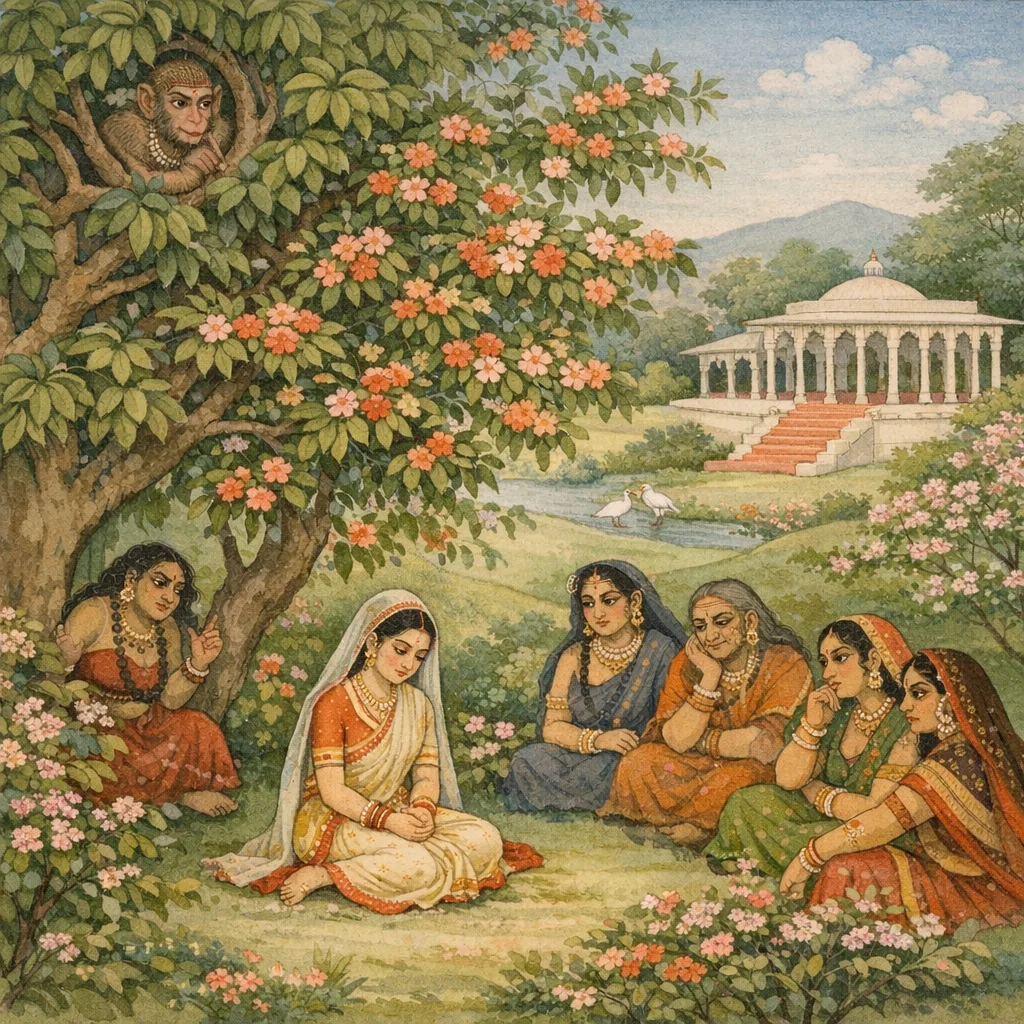
अस्मिन् पञ्चदश-सर्गे हनूमन् सिम्शुपा-वृक्षात् अशोकवनिकां सर्वतः निरीक्षते (5.15.1), उद्यानस्य अलङ्कार-समृद्धिं, पुष्प-प्रभा-वैचित्र्यं, नन्दन-चैत्ररथ-उपमानं, तथा सहस्रशः अशोक-वृक्षान् वर्णयति (5.15.10–14)। मध्ये चैत्यप्रासाद-सदृशं उच्छ्रितं, सहस्र-स्तम्भ-समाश्रितं, कैलास-पाण्डुर-प्रभं, प्रवाल-सोपान-तप्तकाञ्चन-वेदिकायुक्तं भवनं पश्यति (5.15.15–17)। ततः राक्षसी-परिवृतां, मलिन-वसनां, उपवास-कृशां, पुनः पुनः निःश्वसन्तीं स्त्रीं ददर्श (5.15.18–23) तथा उपमा-श्रृङ्खलाभिः तस्याः शोक-स्थितिं निरूपयति—धूमावृत-शिखा, मेघावृत-चन्द्र-प्रभा, रोहिणी-पीडन-उपमा इत्यादि। हनूमतः ‘सीतेति’ निश्चयः क्रमशः कारण-लक्षणैः दृढीभवति (5.15.26, 5.15.40), रामेण पूर्वं वर्णित-आभरण-चिह्नानां निरीक्षणेन प्रमाणं लभते (5.15.41–44) तथा अपविद्ध-वस्त्र-भूषण-स्मरणं कथानक-प्रमाण-शृङ्खलां पूरयति (5.15.45–47)। अन्ते स सीतादर्शनात् हृष्टः, मनसा रामं गत्वा तं प्रभुं प्रशंसति (5.15.55)—अत्र दूतस्य ‘प्रमाण-सङ्ग्रहः’ (verification) तथा करुणा-विवेकयोः सहवासः सर्गस्य मुख्य-शिक्षा।
Shlokas
Verse 1
स वीक्षमाणस्तत्रस्थो मार्गमाणश्च मैथिलीम्।अवेक्षमाणश्च महीं सर्वां तामन्ववैक्षत।।।।
Stationed there, he kept looking—searching for Maithilī—and, gazing down, he carefully surveyed the entire ground below.
Verse 2
सन्तानकलताभिश्च पादपैरुपशोभिताम्।दिव्यगन्धरसोपेतां सर्वतस्समलङ्कृताम्।।।।तां स नन्दनसङ्काशां मृगपक्षिभिरावृताम्।हर्म्यप्रासादसम्बाधां कोकिलाकुलनिस्स्वनाम्।।।।काञ्चनोत्पलपद्माभिर्वापीभिरुपशोभिताम्।बह्वासनकुथोपेतां बहुभूमिगृहायुताम्।।।।सर्वर्तुकुसुमै रम्यां फलवद्भिश्च पादपैः।पुष्पितानामशोकानां श्रिया सूर्योदयप्रभाम्।।।।प्रदीप्तामिव तत्रस्थो मारुतिस्समुदैक्षत।निष्पत्रशाखां विहगैः क्रियमाणामिवासकृत्।।।।विनिष्पतद्भिः शतशश्चित्रैः पुष्पावतंसकैः।आमूलपुष्पनिचितैरशोकैश्शोकनाशनैः।।।।पुष्पभारातिभारैश्च स्पृशद्भिरिव मेदिनीम्।कर्णिकारैः कुसुमितैः किंशुकैश्च सुपुष्पितैः।।।।
From where he stood, Māruti (Hanumān) surveyed that Aśoka-grove—adorned with creepers and trees, pervaded by divine fragrance, and decorated on every side. It looked like Indra’s Nandana garden: filled with deer and birds, resonant with the calls of cuckoos, and crowded with mansions and lofty palaces, with even many subterranean chambers. Its ponds shone with golden lotuses and lilies; it was furnished with many seats and rich coverings; and it was delightful with trees bearing fruits and flowers of every season. The blooming Aśoka trees, radiant like the light of sunrise, made the whole place seem as though it were ablaze. Again and again it appeared leafless—its branches made so by birds in their hundreds, like colorful floral ornaments—while the Aśokas were heaped with blossoms down to their very roots, as though made to banish sorrow. Heavy with flowers, they seemed to touch the ground; and the grove was further brightened by blossoming karṇikāra and fully-flowered kiṃśuka trees.
Verse 3
सन्तानकलताभिश्च पादपैरुपशोभिताम्।दिव्यगन्धरसोपेतां सर्वतस्समलङ्कृताम्।।5.15.2।।तां स नन्दनसङ्काशां मृगपक्षिभिरावृताम्।हर्म्यप्रासादसम्बाधां कोकिलाकुलनिस्स्वनाम्।।5.15.3।।काञ्चनोत्पलपद्माभिर्वापीभिरुपशोभिताम्।बह्वासनकुथोपेतां बहुभूमिगृहायुताम्।।5.15.4।।सर्वर्तुकुसुमै रम्यां फलवद्भिश्च पादपैः।पुष्पितानामशोकानां श्रिया सूर्योदयप्रभाम्।।5.15.5।।प्रदीप्तामिव तत्रस्थो मारुतिस्समुदैक्षत।निष्पत्रशाखां विहगैः क्रियमाणामिवासकृत्।।5.15.6।।विनिष्पतद्भिः शतशश्चित्रैः पुष्पावतंसकैः।आमूलपुष्पनिचितैरशोकैश्शोकनाशनैः।।5.15.7।।पुष्पभारातिभारैश्च स्पृशद्भिरिव मेदिनीम्।कर्णिकारैः कुसुमितैः किंशुकैश्च सुपुष्पितैः।।5.15.8।।
He beheld that grove, like Indra’s Nandana garden—filled with deer and birds, crowded with mansions and lofty palaces, and resonant with the calls of many cuckoos.
Verse 4
सन्तानकलताभिश्च पादपैरुपशोभिताम्।दिव्यगन्धरसोपेतां सर्वतस्समलङ्कृताम्।।5.15.2।।तां स नन्दनसङ्काशां मृगपक्षिभिरावृताम्।हर्म्यप्रासादसम्बाधां कोकिलाकुलनिस्स्वनाम्।।5.15.3।।काञ्चनोत्पलपद्माभिर्वापीभिरुपशोभिताम्।बह्वासनकुथोपेतां बहुभूमिगृहायुताम्।।5.15.4।।सर्वर्तुकुसुमै रम्यां फलवद्भिश्च पादपैः।पुष्पितानामशोकानां श्रिया सूर्योदयप्रभाम्।।5.15.5।।प्रदीप्तामिव तत्रस्थो मारुतिस्समुदैक्षत।निष्पत्रशाखां विहगैः क्रियमाणामिवासकृत्।।5.15.6।।विनिष्पतद्भिः शतशश्चित्रैः पुष्पावतंसकैः।आमूलपुष्पनिचितैरशोकैश्शोकनाशनैः।।5.15.7।।पुष्पभारातिभारैश्च स्पृशद्भिरिव मेदिनीम्।कर्णिकारैः कुसुमितैः किंशुकैश्च सुपुष्पितैः।।5.15.8।।
He saw that grove made splendid by pools adorned with golden lilies and lotuses, furnished with many seats and fine coverings, and provided with many subterranean chambers.
Verse 5
सन्तानकलताभिश्च पादपैरुपशोभिताम्।दिव्यगन्धरसोपेतां सर्वतस्समलङ्कृताम्।।5.15.2।।तां स नन्दनसङ्काशां मृगपक्षिभिरावृताम्।हर्म्यप्रासादसम्बाधां कोकिलाकुलनिस्स्वनाम्।।5.15.3।।काञ्चनोत्पलपद्माभिर्वापीभिरुपशोभिताम्।बह्वासनकुथोपेतां बहुभूमिगृहायुताम्।।5.15.4।।सर्वर्तुकुसुमै रम्यां फलवद्भिश्च पादपैः।पुष्पितानामशोकानां श्रिया सूर्योदयप्रभाम्।।5.15.5।।प्रदीप्तामिव तत्रस्थो मारुतिस्समुदैक्षत।निष्पत्रशाखां विहगैः क्रियमाणामिवासकृत्।।5.15.6।।विनिष्पतद्भिः शतशश्चित्रैः पुष्पावतंसकैः।आमूलपुष्पनिचितैरशोकैश्शोकनाशनैः।।5.15.7।।पुष्पभारातिभारैश्च स्पृशद्भिरिव मेदिनीम्।कर्णिकारैः कुसुमितैः किंशुकैश्च सुपुष्पितैः।।5.15.8।।
It was delightful with blossoms of every season and with fruit-bearing trees; and by the radiance of the flowering aśoka trees it shone like the splendor of sunrise.
Verse 6
सन्तानकलताभिश्च पादपैरुपशोभिताम्।दिव्यगन्धरसोपेतां सर्वतस्समलङ्कृताम्।।5.15.2।।तां स नन्दनसङ्काशां मृगपक्षिभिरावृताम्।हर्म्यप्रासादसम्बाधां कोकिलाकुलनिस्स्वनाम्।।5.15.3।।काञ्चनोत्पलपद्माभिर्वापीभिरुपशोभिताम्।बह्वासनकुथोपेतां बहुभूमिगृहायुताम्।।5.15.4।।सर्वर्तुकुसुमै रम्यां फलवद्भिश्च पादपैः।पुष्पितानामशोकानां श्रिया सूर्योदयप्रभाम्।।5.15.5।।प्रदीप्तामिव तत्रस्थो मारुतिस्समुदैक्षत।निष्पत्रशाखां विहगैः क्रियमाणामिवासकृत्।।5.15.6।।विनिष्पतद्भिः शतशश्चित्रैः पुष्पावतंसकैः।आमूलपुष्पनिचितैरशोकैश्शोकनाशनैः।।5.15.7।।पुष्पभारातिभारैश्च स्पृशद्भिरिव मेदिनीम्।कर्णिकारैः कुसुमितैः किंशुकैश्च सुपुष्पितैः।।5.15.8।।
Standing there, Māruti (Hanumān) surveyed it as though it were ablaze; again and again it seemed as if the birds were making its branches leafless.
Verse 7
सन्तानकलताभिश्च पादपैरुपशोभिताम्।दिव्यगन्धरसोपेतां सर्वतस्समलङ्कृताम्।।5.15.2।।तां स नन्दनसङ्काशां मृगपक्षिभिरावृताम्।हर्म्यप्रासादसम्बाधां कोकिलाकुलनिस्स्वनाम्।।5.15.3।।काञ्चनोत्पलपद्माभिर्वापीभिरुपशोभिताम्।बह्वासनकुथोपेतां बहुभूमिगृहायुताम्।।5.15.4।।सर्वर्तुकुसुमै रम्यां फलवद्भिश्च पादपैः।पुष्पितानामशोकानां श्रिया सूर्योदयप्रभाम्।।5.15.5।।प्रदीप्तामिव तत्रस्थो मारुतिस्समुदैक्षत।निष्पत्रशाखां विहगैः क्रियमाणामिवासकृत्।।5.15.6।।विनिष्पतद्भिः शतशश्चित्रैः पुष्पावतंसकैः।आमूलपुष्पनिचितैरशोकैश्शोकनाशनैः।।5.15.7।।पुष्पभारातिभारैश्च स्पृशद्भिरिव मेदिनीम्।कर्णिकारैः कुसुमितैः किंशुकैश्च सुपुष्पितैः।।5.15.8।।
Standing there, Māruti beheld the aśoka trees—dispelling grief—strewn with blossoms down to their very bases, while hundreds of brilliantly colored birds kept darting about, like floral ornaments adorning the grove.
Verse 8
सन्तानकलताभिश्च पादपैरुपशोभिताम्।दिव्यगन्धरसोपेतां सर्वतस्समलङ्कृताम्।।5.15.2।।तां स नन्दनसङ्काशां मृगपक्षिभिरावृताम्।हर्म्यप्रासादसम्बाधां कोकिलाकुलनिस्स्वनाम्।।5.15.3।।काञ्चनोत्पलपद्माभिर्वापीभिरुपशोभिताम्।बह्वासनकुथोपेतां बहुभूमिगृहायुताम्।।5.15.4।।सर्वर्तुकुसुमै रम्यां फलवद्भिश्च पादपैः।पुष्पितानामशोकानां श्रिया सूर्योदयप्रभाम्।।5.15.5।।प्रदीप्तामिव तत्रस्थो मारुतिस्समुदैक्षत।निष्पत्रशाखां विहगैः क्रियमाणामिवासकृत्।।5.15.6।।विनिष्पतद्भिः शतशश्चित्रैः पुष्पावतंसकैः।आमूलपुष्पनिचितैरशोकैश्शोकनाशनैः।।5.15.7।।पुष्पभारातिभारैश्च स्पृशद्भिरिव मेदिनीम्।कर्णिकारैः कुसुमितैः किंशुकैश्च सुपुष्पितैः।।5.15.8।।
The grove seemed to brush the very earth under the excessive weight of its flowers, adorned with blossoming karṇikāra trees and fully-flowered kiṃśuka blooms.
Verse 9
स देशः प्रभया तेषां प्रदीप्त इव सर्वतः।पुन्नागास्सप्तपर्णाश्च चम्पकोद्दालकास्तथा।।।।विवृद्धमूला बहवश्शोभन्ते स्म सुपुष्पिताः।
That place, radiant with the glow of those trees, looked as though it were aflame on every side; punnāga and saptaparṇa, as well as campaka and uddālaka—many with deep-spreading roots—were shining there in full bloom.
Verse 10
शातकुम्भनिभाः केचित्केचिदग्निशिखोपमाः।।।।नीलाञ्जननिभाः केचित्तत्राशोकास्सहस्रशः।
There were thousands of Aśoka trees there—some gleaming like gold, some like tongues of flame, and some dark like collyrium.
Verse 11
नन्दनं विविधोद्यानं चित्रं चैत्ररथं यथा।।।।अतिवृत्तमिवाचिन्त्यं दिव्यं रम्यं श्रिया वृतम्।वितीयमिव चाकाशं पुष्पज्योतिर्गणायुतम्।।।।पुष्परत्नशतैश्चित्रं द्वितीयं सागरं यथा।सर्वर्तुपुष्पैर्निचितं पादपैर्मधुगन्धिभिः।।।।नानानिनादैरुद्यानं रम्यं मृगगणैर्द्विजैः।अनेकगन्धप्रवहं पुण्यगन्धं मनोरमम्।।।।
That diverse, splendid garden looked like Indra’s Nandana and Kubera’s Caitraratha—surpassing imagination, divine and delightful, radiant with beauty. It seemed like a second sky filled with star-like lights of blossoms, and like another ocean adorned with hundreds of jewel-like flowers. It was thick with trees bearing flowers of every season, sweet with honeyed fragrance; charming with many sounds from herds of animals and flocks of birds, and made lovely by streams of varied, sacred scents.
Verse 12
नन्दनं विविधोद्यानं चित्रं चैत्ररथं यथा।।5.15.11।।अतिवृत्तमिवाचिन्त्यं दिव्यं रम्यं श्रिया वृतम्।वितीयमिव चाकाशं पुष्पज्योतिर्गणायुतम्।।5.15.12।।पुष्परत्नशतैश्चित्रं द्वितीयं सागरं यथा।सर्वर्तुपुष्पैर्निचितं पादपैर्मधुगन्धिभिः।।5.15.13।।नानानिनादैरुद्यानं रम्यं मृगगणैर्द्विजैः।अनेकगन्धप्रवहं पुण्यगन्धं मनोरमम्।।5.15.14।।
It seemed to surpass all measure—unthinkable in splendour, divine and delightful, encircled by brilliance; like a second sky, it was filled with countless lights—the radiance of blossoms.
Verse 13
नन्दनं विविधोद्यानं चित्रं चैत्ररथं यथा।।5.15.11।।अतिवृत्तमिवाचिन्त्यं दिव्यं रम्यं श्रिया वृतम्।वितीयमिव चाकाशं पुष्पज्योतिर्गणायुतम्।।5.15.12।।पुष्परत्नशतैश्चित्रं द्वितीयं सागरं यथा।सर्वर्तुपुष्पैर्निचितं पादपैर्मधुगन्धिभिः।।5.15.13।।नानानिनादैरुद्यानं रम्यं मृगगणैर्द्विजैः।अनेकगन्धप्रवहं पुण्यगन्धं मनोरमम्।।5.15.14।।
It looked wondrous, like a second ocean glittering with hundreds of jewel-like flowers—densely filled with trees bearing blossoms of every season, sweet with honeyed fragrance.
Verse 14
नन्दनं विविधोद्यानं चित्रं चैत्ररथं यथा।।5.15.11।।अतिवृत्तमिवाचिन्त्यं दिव्यं रम्यं श्रिया वृतम्।वितीयमिव चाकाशं पुष्पज्योतिर्गणायुतम्।।5.15.12।।पुष्परत्नशतैश्चित्रं द्वितीयं सागरं यथा।सर्वर्तुपुष्पैर्निचितं पादपैर्मधुगन्धिभिः।।5.15.13।।नानानिनादैरुद्यानं रम्यं मृगगणैर्द्विजैः।अनेकगन्धप्रवहं पुण्यगन्धं मनोरमम्।।5.15.14।।
That enchanting garden resounded with many kinds of calls—filled with herds of animals and flocks of birds; breezes carried varied fragrances, a sacred perfume that delighted the heart.
Verse 15
शैलेन्द्रमिव गन्धाढ्यं द्वितीयं गन्धमादनम्।अशोकवनिकायां तु तस्यां वानरपुङ्गवः।।।।स ददर्शाविदूरस्थं चैत्यप्रासादमुच्छ्रितम्।मथ्ये स्तम्भसहस्रेण स्थितं कैलासपाण्डुरम्।।।।प्रवालकृतसोपानं तप्तकाञ्चनवेदिकम्।मुष्णन्तमिव चक्षूंषि द्योतमानमिव श्रिया।।।।विमलं प्रांशुभावत्वादुल्लिखन्तमिवाम्बरम्।
In that Ashoka grove, the foremost of monkeys beheld a fragrance-rich sight—like a second Gandhamādana mountain, like a lordly peak.
Verse 16
शैलेन्द्रमिव गन्धाढ्यं द्वितीयं गन्धमादनम्।अशोकवनिकायां तु तस्यां वानरपुङ्गवः।।5.15.15।।स ददर्शाविदूरस्थं चैत्यप्रासादमुच्छ्रितम्।मथ्ये स्तम्भसहस्रेण स्थितं कैलासपाण्डुरम्।।5.15.16।।प्रवालकृतसोपानं तप्तकाञ्चनवेदिकम्।मुष्णन्तमिव चक्षूंषि द्योतमानमिव श्रिया।।5.15.17।।विमलं प्रांशुभावत्वादुल्लिखन्तमिवाम्बरम्।
Not far away he saw a lofty, shrine-like palace; set in the middle upon a thousand pillars, it gleamed white like Mount Kailāsa.
Verse 17
शैलेन्द्रमिव गन्धाढ्यं द्वितीयं गन्धमादनम्।अशोकवनिकायां तु तस्यां वानरपुङ्गवः।।5.15.15।।स ददर्शाविदूरस्थं चैत्यप्रासादमुच्छ्रितम्।मथ्ये स्तम्भसहस्रेण स्थितं कैलासपाण्डुरम्।।5.15.16।।प्रवालकृतसोपानं तप्तकाञ्चनवेदिकम्।मुष्णन्तमिव चक्षूंषि द्योतमानमिव श्रिया।।5.15.17।।विमलं प्रांशुभावत्वादुल्लिखन्तमिवाम्बरम्।
Its steps were fashioned of coral, its platforms of glowing gold; shining with splendour, it seemed to steal the very eyes of those who looked upon it.
Verse 18
ततो मलिनसंवीतां राक्षसीभिस्समावृताम्।।।।उपवासकृशां दीनां निश्श्वसन्तीं पुनः पुनः।ददर्श शुक्लपक्षादौ चन्द्ररेखामिवामलाम्।।।।
Then he saw her—clad in soiled garments, surrounded by rākṣasī women; emaciated by fasting, wretched, sighing again and again—pale like the crescent moon at the start of the bright fortnight.
Verse 19
ततो मलिनसंवीतां राक्षसीभिस्समावृताम्।।5.15.18।।उपवासकृशां दीनां निश्श्वसन्तीं पुनः पुनः।ददर्श शुक्लपक्षादौ चन्द्ररेखामिवामलाम्।।5.15.19।।
Then he saw her—clad in soiled garments, surrounded by rākṣasī women; emaciated by fasting, wretched, sighing again and again—pale like the crescent moon at the start of the bright fortnight.
Verse 20
मन्दप्रख्यायमानेन रूपेण रुचिरप्रभाम्।पिनद्धां धूमजालेन शिखामिव विभावसोः।।।।
Her form was only faintly discernible, yet she still bore a lovely radiance—like a flame’s tip, wrapped over by a net of smoke.
Verse 21
पीतेनैकेन संवीतां क्लिष्टेनोत्तमवाससा।सपङ्कामनलङ्कारां विपद्मामिव पद्मिनीम्।।।।
She was clad in a single excellent yellow garment, now worn and soiled. Unadorned and dust-stained, she looked like a lotus-pond turned muddy and bereft of lotuses.
Verse 22
व्रीडितां दुःखसन्तप्तां परिम्लानां तपस्विनीम्।ग्रहेणाङ्गारकेणेव पीडितामिव रोहिणीम्।।।।
Bashful, scorched by sorrow, and withered in appearance—like an ascetic woman—she seemed like Rohiṇī oppressed by the planet Aṅgāraka (Mars).
Verse 23
अश्रुपूर्णमुखीं दीनां कृशामनशनेन च।शोकध्यानपरां दीनां नित्यं दुःखपरायणाम्।।।।
Her face was filled with tears; she was dejected, and thin from fasting—ever absorbed in meditating on sorrow, continually given over to grief.
Verse 24
प्रियं जनमपश्यन्तीं पश्यन्तीं राक्षसीगणम्।स्वगणेन मृगीं हीनां श्वगणाभिवृतामिव।।।।
Unable to see her beloved kin, and seeing only the host of rākṣasī women, she appeared like a doe separated from her herd and surrounded by a pack of hounds.
Verse 25
नीलनागाभया वेण्या जघनं गतयैकया।नीलया नीरदापाये वनराज्या महीमिव।।।।सुखार्हां दुःखसन्तप्तां व्यसनानामकोविदाम्।
With a single dark braid reaching to her hips—like a black serpent—she resembled the earth at the end of the rainy season, darkened and bordered by a forest-range. Though worthy of happiness and unacquainted with calamity, she was now scorched by grief.
Verse 26
तां समीक्ष्य विशालाक्षीमधिकं मलिनां कृशाम्।।।।तर्कयामास सीतेति कारणैरुपपादिभिः।
Having examined that large-eyed woman—soiled and exceedingly thin—Hanumān reasoned with well-grounded signs and concluded, “This indeed is Sītā.”
Verse 27
ह्रियमाणा तदा तेन रक्षसा कामरूपिणा।।।।यथारूपा हि दृष्टा वै तथारूपेयमङ्गना।
When she was being carried off by that shape-shifting rākṣasa, the form in which she was then seen—this lady bears that very same form.
Verse 28
पूर्णचन्द्राननां सुभ्रूं चारुवृत्तपयोधराम्।।।।कुर्वतीं प्रभयादेवीं सर्वा वितिमिरा दिशः।तां नीलकेशीं बिम्बोष्ठीं सुमध्यां सुप्रतिष्ठिताम्।।।।सीतां पद्मपलाशाक्षीं मन्मथस्य रतिं यथा।
Sītā—moon-faced, with graceful brows and beautiful rounded breasts—seemed, by her radiance, to make all directions free of darkness. Dark-haired, with lips red as the bimba fruit, slender-waisted and well-proportioned, lotus-petaled in her eyes, she was like Rati, beloved of Manmatha.
Verse 29
पूर्णचन्द्राननां सुभ्रूं चारुवृत्तपयोधराम्।।5.15.28।।कुर्वतीं प्रभयादेवीं सर्वा वितिमिरा दिशः।तां नीलकेशीं बिम्बोष्ठीं सुमध्यां सुप्रतिष्ठिताम्।।5.15.29।।सीतां पद्मपलाशाक्षीं मन्मथस्य रतिं यथा।
This verse is transmitted in this source as a continuation/duplicate segmentation of the preceding description: Sītā is portrayed as moon-faced and radiant, with dark hair, red bimba-like lips, a slender waist, lotus-petal eyes, and a beauty likened to Rati of Manmatha.
Verse 30
इष्टां सर्वस्य जगतः पूर्णचन्द्रप्रभामिव।।।।भूमौ सुतनुमासीनां नियतामिव तापसीम्।
Beloved to the whole world like the radiance of the full moon, that slender-waisted lady sat upon the ground, restrained like an austere ascetic.
Verse 31
निःश्वासबहुलां भीरुं भुजगेन्द्रवधूमिव।।।।शोकजालेन महता विततेन न राजतीम्।
Timid and sighing again and again like the bride of the serpent-lord, she did not shine—ensnared in a vast, spread-out web of grief.
Verse 32
संसक्तां धूमजालेन शिखामिव विभावसोः।।।।तां स्मृतीमिव सन्दिग्धामृद्धिं निपतितामिव।
She was like a flame of fire obscured by a mesh of smoke—like a memory grown uncertain, like fortune that has fallen away.
Verse 33
विहतामिव च श्रद्धामाशां प्रतिहतामिव।।।।सोपसर्गां यथा सिद्धिं बुद्धिं सकलुषामिव।
She seemed like faith shattered, like hope obstructed—like success beset by impediments, like an intellect clouded and tainted.
Verse 34
अभूतेनापवादेन कीर्तिं निपतितामिव।।।।रामोपरोधव्यथितां रक्षोहरणकर्शिताम्।
She appeared like fame cast down by a baseless slander—pained by the obstruction to reaching Rāma, and wasted away by the rākṣasa’s abduction.
Verse 35
अबलां मृगशाबाक्षीं वीक्षमाणां ततस्ततः।।।।बाष्पाम्बुपरिपूर्णेन कृष्णवक्राक्षिपक्ष्मणा।वदनेनाप्रसन्नेन निःश्वसन्तीं पुनः पुनः।।।।
The helpless, fawn-eyed lady kept looking here and there; her eyes were brimming with tear-water beneath dark, curved lashes, her face joyless, and she sighed again and again.
Verse 36
अबलां मृगशाबाक्षीं वीक्षमाणां ततस्ततः।।5.15.35।।बाष्पाम्बुपरिपूर्णेन कृष्णवक्राक्षिपक्ष्मणा।वदनेनाप्रसन्नेन निःश्वसन्तीं पुनः पुनः।।5.15.36।।
The helpless, fawn-eyed lady kept looking here and there; her eyes were brimming with tears beneath dark, curved lashes, her face joyless, and she sighed again and again.
Verse 37
मलपङ्कधरां दीनां मण्डनार्हाममण्डिताम्।प्रभां नक्षत्रराजस्य कालमेघैरिवावृताम्।।।।
Smeared with dirt and mud, wretched, though worthy of adornment yet unadorned—she was like the moon’s radiance veiled by dark clouds.
Verse 38
तस्य संदिदिहे बुद्धिर्मुहुः सीतां निरीक्ष्य तु।आम्नायानामयोगेन विद्यां प्रशिथिलामिव।।।।
Even after looking at Sītā again and again, his mind wavered in doubt—like learning from sacred tradition grown slack through lack of practice.
Verse 39
दुःखेन बुबुधे सीतां हनुमाननलङ्कृताम्।संस्कारेण यथा हीनां वाचमर्थान्तरं गताम्।।।।
With difficulty Hanumān recognized Sītā, now without adornment—just as, by prior training, one can grasp words whose sense has shifted and grown unclear through lack of refinement.
Verse 40
तां समीक्षय विशालाक्षीं राजपुत्रीमनिन्दिताम्।तर्कयामास सीतेति कारणैरुपपादिभिः।।।।
After observing that large-eyed, blameless princess, he reasoned—by well-grounded signs—and concluded: “She is Sītā.”
Verse 41
वैदेह्या यानि चाङ्गेषु तदा रामोऽन्वकीर्तयत्।तान्याभरणजालानि गात्रशोभीन्यलक्षयत्।।।।सुकृतौ कर्णवेष्टौ च श्वदंष्ट्रौ च सुसंस्थितौ।मणिविद्रुमचित्राणि हस्तेष्वाभरणानि च।।।।श्यामानि चिरयुक्तत्वात्तथा संस्थानवन्ति च।
He noticed on Vaidehī the very sets of ornaments that Rāma had once described—adornments that enhanced her limbs: well-made ear-ornaments, properly fitted śvadaṃṣṭra ornaments, and hand-jewels varied with gems and coral; darkened by long use, and leaving their familiar marks upon her body.
Verse 42
वैदेह्या यानि चाङ्गेषु तदा रामोऽन्वकीर्तयत्।तान्याभरणजालानि गात्रशोभीन्यलक्षयत्।।5.15.41।।सुकृतौ कर्णवेष्टौ च श्वदंष्ट्रौ च सुसंस्थितौ।मणिविद्रुमचित्राणि हस्तेष्वाभरणानि च।।5.15.42।।श्यामानि चिरयुक्तत्वात्तथा संस्थानवन्ति च।
He observed on Vaidehī the ornaments Rāma had described: well-crafted ear-ornaments and properly set śvadaṃṣṭra pieces, and hand-ornaments variegated with gems and coral—darkened by long wear and leaving their characteristic impressions.
Verse 43
तान्यैवेतानि मन्येऽहं यानि रामोऽन्वकीर्तयत्।।।।तत्र यान्यवहीनानि तान्यहं नोपलक्षये।यान्यस्या नावहीनानि तानीमानि न संशयः।।।।
“I believe these are indeed the very ornaments Rāma described. The ones she had dropped earlier I do not see upon her now; but those she had not dropped—these are here, without doubt.”
Verse 44
तान्यैवेतानि मन्येऽहं यानि रामोऽन्वकीर्तयत्।।5.15.43।।तत्र यान्यवहीनानि तान्यहं नोपलक्षये।यान्यस्या नावहीनानि तानीमानि न संशयः।।5.15.44।।
“These must be the same ornaments Rāma described. The ornaments known to have been dropped I do not see here; the ones not dropped are these—there is no doubt.”
Verse 45
पीतं कनकपट्टाभं स्रस्तं तद्वसनं शुभम्।उत्तरीयं नगासक्तं तदा दृष्टं प्लवङ्गमैः।।।।
“That auspicious upper garment—yellow, gleaming like golden cloth—had slipped away; and when it caught upon a tree, the monkeys saw it there.”
Verse 46
भूषणानि च मुख्यानि दृष्टानि धरणीतले।अनयैवापविद्धानि स्वनवन्ति महान्ति च।।।।
“And on the ground were seen her foremost ornaments—large and choice—cast down by her alone, sounding as they fell.”
Verse 47
इदं चिरगृहीतत्वाद्वसनं क्लिष्टवत्तरम्।तथाऽपि नूनं तद्वर्णं तथा श्रीमद्यथेतरत्।।।।
“This garment, worn for long, is more crumpled; yet surely its color and radiance remain, as though it were another—fresh and new.”
Verse 48
इयं कनकवर्णाङ्गी रामस्य महिषी प्रिया।प्रणष्टापि सती याऽस्य मनसो न प्रणश्यति।।।।
“This golden-complexioned lady is Rāma’s beloved queen—his faithful wife—who, though lost from sight, never vanishes from his heart.”
Verse 49
इयं सा यत्कृते रामश्चतुर्भिः परितप्यते।कारुण्येनानृशंस्येन शोकेन मदनेन च।।।।स्त्री प्रणष्टेति कारुण्यादाश्रितेत्यानृशंस्यतः।पत्नी नष्टेति शोकेन प्रियेति मदनेन च।।।।
She is that very woman for whose sake Rāma is tormented by fourfold suffering—compassion, tenderness, grief, and love. He feels compassion thinking, “A woman is lost”; gentle mercy thinking, “One who sought refuge is lost”; grief thinking, “My wife is lost”; and love thinking, “My beloved is lost.”
Verse 50
इयं सा यत्कृते रामश्चतुर्भिः परितप्यते।कारुण्येनानृशंस्येन शोकेन मदनेन च।।5.15.49।।स्त्री प्रणष्टेति कारुण्यादाश्रितेत्यानृशंस्यतः।पत्नी नष्टेति शोकेन प्रियेति मदनेन च।।5.15.50।।
As is the divine lady’s beauty—her limbs and features perfectly proportioned—so too is Rāma’s form; this dark-eyed woman is truly his fitting match.
Verse 51
अस्या देव्या यथा रूपमङ्गप्रत्यङ्गसौष्ठवम्।रामस्य च यथा रूपं तस्येयमसितेक्षणा।।।।
As is the divine lady’s beauty—her limbs and features perfectly proportioned—so too is Rāma’s form; this dark-eyed woman is truly his fitting match.
Verse 52
अस्या देव्या मनस्तस्मिंस्तस्य चास्यां प्रतिष्ठितम्।तेनेयं स च धर्मात्मा मुहूर्तमपि जीवति।।।।
This queen’s mind is firmly fixed on him, and his mind is fixed on her; by that mutual steadfastness, she and that righteous-souled man are able to live on, even moment by moment.
Verse 53
दुष्करं कृतवान्रामो हीनो यदनया प्रभुः।धारयत्यात्मनो देहं न शोकेनावसीदति।।।।
Rāma has done what is hard: though separated from her, that lord sustains his own body and does not collapse under grief.
Verse 54
दुष्करं कुरुते रामो य इमां मत्तकाशिनीम्।सीतां विना महाबाहुर्मुहूर्तमपि जीवति।।।।
Rāma performs what is difficult indeed: the mighty-armed hero lives on even for a moment without Sītā, whose radiance is intoxicating.
Verse 55
एवं सीतां तदा दृष्ट्वा हृष्टः पवनसम्भवः।जगाम मनसा रामं प्रशशंस च तं प्रभुम्।।।।
Seeing Sītā thus, the Wind-god’s son rejoiced; in his mind he went at once to Rāma and praised that lord.
Frequently Asked Questions
मुख्य-क्रिया ‘प्रमाणपूर्वक-निश्चयः’—हनूमन् करुणा-वेगेन शीघ्रं निष्कर्षं न गृह्णाति; स लक्षण-कारणैः (वसन-स्थिति, उपवास-कृशता, राक्षसी-परिवेष्टन, तथा राम-वर्णित-आभरण-चिह्नाः) सीतायाḥ पहचानं स्थापयति। अयं दूतधर्मस्य ‘verification before report’ इति नीति-रूपः।
शोक-दर्शनं करुणां जनयति, किन्तु कार्य-सिद्ध्यर्थं विवेकः अनिवार्यः—भावना (compassion) तथा बुद्धि (discernment) परस्परं पूरकौ। सर्गः दर्शयति यत् धर्मात्मा कार्यकर्ता प्रमाण-आधारेण निर्णयं कुर्यात्, तथा पर-पीडा-दर्शनं स्वधर्मे दृढतां वर्धयेत्।
अशोकवनिका (लङ्कायाः उद्यान-परिसरः), सिम्शुपा-वृक्ष (हनूमतः निरीक्षण-स्थानम्), तथा चैत्यप्रासाद-सदृशं सहस्र-स्तम्भ-भवनम्—एते स्थल-चिह्नानि प्रमुखानि। सांस्कृतिक-स्तरे नन्दन/चैत्ररथ-उपमानं (देव-यक्ष-उद्यान-आदर्शः) तथा आभरण-प्रकाराः (कर्णवेष्ट, श्वदंष्ट्र, मणि-विद्रुम-चित्र-हस्ताभरण) पाठे निर्दिष्टाः।