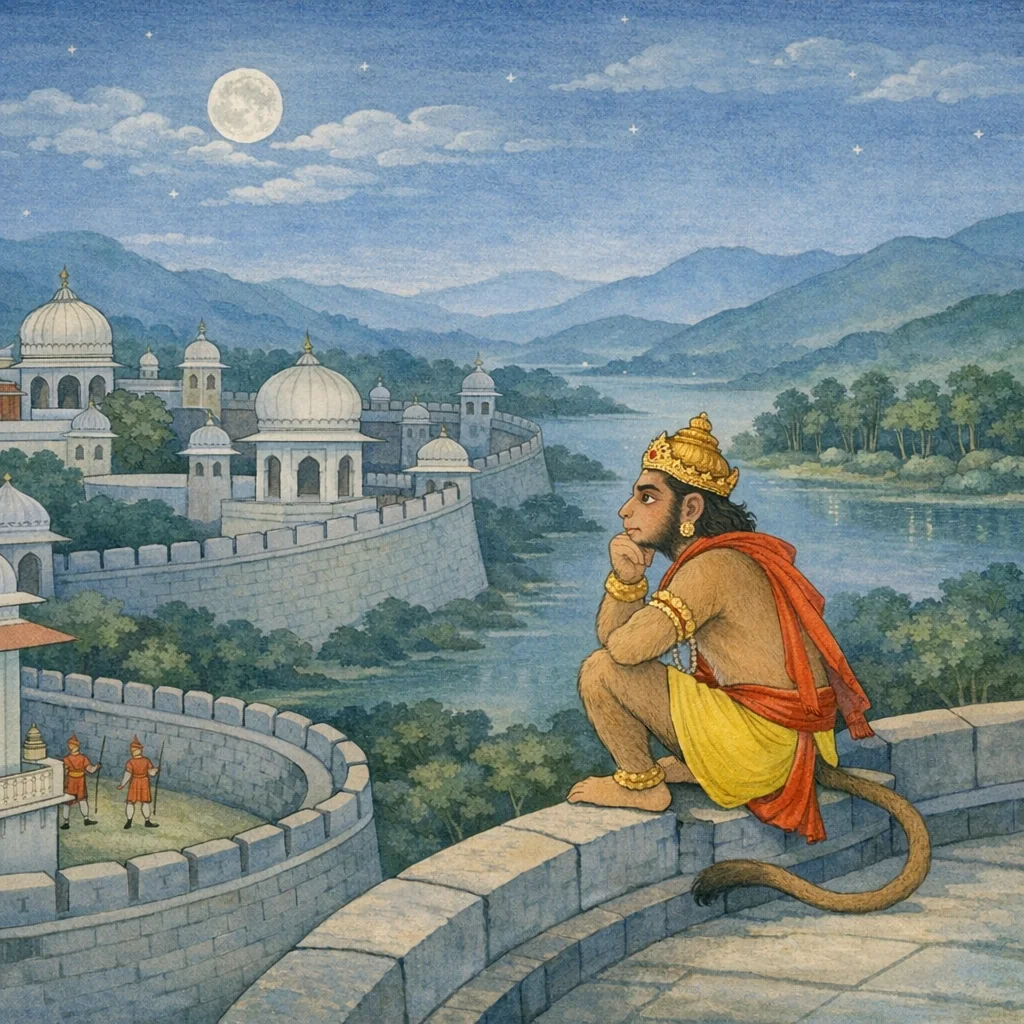
Sarga 13
रावणभवनपरिक्रमणं हनूमतः शोकविचारश्च (Hanuman’s Circuit of Ravana’s Palace and the Crisis of Deliberation)
सुन्दरकाण्ड
Sarga 13 records a methodological search turning into a structured ethical crisis. After leaping from the aerial chariot to Laṅkā’s boundary wall “like lightning in clouds” (5.13.1), Hanumān circles Rāvaṇa’s residence yet fails to locate Sītā (5.13.2–5). He enumerates plausible scenarios for her absence—falling into the sea during abduction, being killed or consumed, dying of grief while meditating on Rāma, or being imprisoned like a caged bird (5.13.7–16). The discourse then shifts from conjecture to consequence-analysis: he foresees cascading deaths if he returns without news—Rāma, Lakṣmaṇa, Bharata, Śatrughna, the queens, Sugrīva, Rumā, Tārā, Aṅgada, and the wider vānaras (5.13.20–37). Hanumān considers self-erasure (fire, drowning, fasting) but rejects suicide as adharma producing “many faults,” affirming that auspicious outcomes belong to the living (5.13.40–47). He resolves to continue the search, identifies the Aśokavanikā as an unsearched locus, offers salutations to deities and allies, and proceeds toward the grove with renewed operational clarity (5.13.52–60). The sarga closes with anticipatory reflection on the grove’s guarded sanctity and a prayer for success (5.13.61–69).
Shlokas
Verse 1
विमानात्तु सुसम्क्रम्य प्राकारं हरियूथपः।हनुमान्वेगवानासीद्यथा विद्युद्घनान्तरे।।।।
Then Hanumān, leader of the monkey-host, sprang from the aerial chariot onto the rampart—swift as lightning flashing amid clouds.
Verse 2
सम्परिक्रम्य हनुमान्रावणस्य निवेशनात्।अदृष्ट्वा जानकीं सीतामब्रवीद्वचनं कपिः।।।।
After circling through Rāvaṇa’s residence and failing to see Jānakī Sītā, Hanumān—the Vānara—spoke these words to himself.
Verse 3
भूयिष्ठं लोलिता लङ्का रामस्य चरता प्रियम्।न हि पश्यामि वैदेहीं सीतां सर्वाङ्गशोभनाम्।।।।
To please Rāma in my roaming, I have searched Laṅkā thoroughly; yet I do not see Vaidehī Sītā, whose limbs are radiant in every part.
Verse 4
पल्वलानि तटाकानि सरांसि सरितस्तथा।नद्योऽनूपवनान्ताश्च दुर्गाश्च धरणीधराः।।।।लोलिता वसुधा सर्वा न तु पश्यामि जानकीम्।
I have searched everywhere—waterlogged tracts, tanks, lakes, streams and rivers; the fringes of marsh-woods, and mountains hard to approach. The whole earth has been scoured, yet I do not see Jānakī.
Verse 5
इह सम्पातिना सीता रावणस्य निवेशने।।।।आख्याता गृध्रराजेन न च पश्यामि तामहम्।
Here, Sampāti—the king of vultures—declared that Sītā is in Rāvaṇa’s residence; yet I have still not seen her.
Verse 6
किं नु सीताऽथ वैदेही मैथिली जनकात्मजा।।।।उपतिष्ठेत विवशा रावणं दुष्टचारिणम्।
Could it be that Sītā—Vaidehī, Maithilī, Janaka’s daughter—helpless and overwhelmed, might have yielded to Rāvaṇa, that man of wicked conduct?
Verse 7
क्षिप्रमुत्पततो मन्ये सीतामादाय रक्षसः।।।।बिभ्यतो रामबाणानामन्तरा पतिता भवेत्।
I think that, while the rākṣasa was flying swiftly carrying Sītā, fearful of Rāma’s arrows, she may have been dropped midway.
Verse 8
अथवा ह्रियमाणायाः पथि सिद्धनिषेविते।।।।मन्ये पतितमार्याया हृदयं प्रेक्ष्य सागरम्।
Or else, I think that, while she was being carried away along the path frequented by siddhas, the noble lady’s heart may have collapsed on seeing the ocean, and she may have fallen.
Verse 9
रावणस्योरुवेगेन भुजाभ्यां पीडितेन च।।।।तया मन्ये विशालाक्ष्या त्यक्तं जीवितमार्यया।
I think that the noble, large-eyed lady—pressed by his arms and shaken by Rāvaṇa’s violent speed—may have renounced her very life.
Verse 10
उपर्युपरि वा नूनं सागरं क्रमतस्तदा।।।।विवेष्टमाना पतिता सागरे जनकात्मजा।
Surely then, as he flew step by step over the sea, Janaka’s daughter—wriggling to free herself—may have fallen into the ocean.
Verse 11
अहो क्षुद्रेण वाऽनेन रक्षन्ती शीलमात्मनः।।।।अबन्धुर्भक्षिता सीता रावणेन तपस्विनी।
Alas—while guarding her own chastity, Sītā, bereft of kin, that suffering woman may have been devoured by the vile Rāvaṇa.
Verse 12
अथवा राक्षसेन्द्रस्य पत्नीभिरसितेक्षणा।।।।अदुष्टा दुष्टभावाभिर्भक्षिता सा भविष्यति।
Or else, that dark-eyed Sītā—innocent and pure—may have been devoured by the rākṣasa-lord’s wives, cruel of nature.
Verse 13
सम्पूर्णचन्द्रप्रतिमं पद्मपत्रनिभेक्षणम्।।।।रामस्य ध्यायती वक्त्रं पञ्चत्वं कृपणा गता।
Or else—poor Sītā may have met death, absorbed in meditation on Rāma’s face, like the full moon, with eyes like lotus petals.
Verse 14
हा राम लक्ष्मणेत्येवं हाऽयोध्ये चेति मैथिली।।।।विलप्य बहु वैदेही न्यस्तदेहा भविष्यति।
Or perhaps Vaidehī, the princess of Mithilā, lamenting greatly—crying “Alas, Rāma! Alas, Lakṣmaṇa! Alas, Ayodhyā!”—may have cast off her life.
Verse 15
अथवा निहिता मन्ये रावणस्य निवेशने।।।।नूनं लालप्यते सीता पञ्जरस्थेव शारिका।
Or else, I think Sītā has been kept confined within Rāvaṇa’s palace—surely crying like a myna bird trapped in a cage.
Verse 16
जनकस्य सुता सीता रामपत्नी सुमध्यमा।।।।कथमुत्पलपत्राक्षी रावणस्य वशं व्रजेत्।
How could Sītā—Janaka’s daughter, Rāma’s wife, slender-waisted, lotus-eyed—ever come under Rāvaṇa’s control?
Verse 17
विनष्टा वा प्रणष्टा वा मृता वा जनकात्मजा।।।।रामस्य प्रियभार्यस्य न निवेदयितुं क्षमम्।
Whether Janaka’s daughter is lost, irretrievable, or dead—it would not be right to report such a thing to Rāma, who so dearly loves his wife.
Verse 18
निवेद्यमाने दोषस्स्याद्दोषस्स्यादनिवेदने।।।।कथं नु खलु कर्तव्यं विषमं प्रतिभाति मे।
If I report it, there may be fault; if I do not report it, there may be fault as well. What indeed should be done? The situation appears perilously difficult to me.
Verse 19
अस्मिन्नेवंगते कार्ये प्राप्तकालं क्षमं च किम्।।।।भवेदिति मतं भूयो हनुमान्प्रविचारयत्।
With matters having come to this, Hanumān again reflected: “What course would now be timely and proper?”
Verse 20
यदि सीतामदृष्ट्वाऽहं वानरेन्द्रपुरीमितः।।।।गमिष्यामि ततः को मे पुरुषार्थो भविष्यति।
If I go from here to the city of the Vānara-king without seeing Sītā, then what achievement of mine will there be?
Verse 21
ममेदं लङ्घनं व्यर्थं सागरस्य भविष्यति।।।।प्रवेशश्चैव लङ्कायाः राक्षसानां च दर्शनम्।
My crossing of the ocean will have been in vain—so too my entry into Laṅkā and my sighting of the Rākṣasas—if I cannot find Sītā.
Verse 22
किं मां वक्ष्यति सुग्रीवो हरयो वा समागताः।।।।किष्किन्धां समनुप्राप्तं तौ वा दशरथात्मजौ।
When I return to Kiṣkindhā, what will Sugrīva—or the assembled Vānaras, or even the two sons of Daśaratha—say to me?
Verse 23
गत्वा तु यदि काकुत्स्थं वक्ष्यामि परमप्रियम्।।।।न दृष्टेति मया सीता ततस्तक्ष्यति जीवितम्।
If, upon reaching Kakutstha (Rāma), I must speak the most painful truth—‘Sītā was not seen by me’—then he will abandon his life.
Verse 24
परुषं दारुणं क्रूरं तीक्ष्णमिन्द्रियतापनम्।।5.13.24।।सीतानिमित्तं दुर्वाक्यं श्रुत्वा स न भविष्यति।
Hearing harsh, dreadful, cruel, and piercing words—burning to the senses—spoken on account of Sītā, he (Rāma) will not survive.
Verse 25
तं तु कृच्छ्रगतं दृष्ट्वा पञ्चत्वगतमानसम्।।।।भृशानुरक्तो मेधावी न भविष्यति लक्ष्मणः।
Seeing him (Rāma) plunged into misery, his mind as if gone to death, the wise Lakṣmaṇa—deeply devoted—will not survive either.
Verse 26
विनष्टौ भ्रातरौ श्रुत्वा भरतोऽपि मरिष्यति।।।।भरतं च मृतं दृष्ट्वा शत्रुघ्नो न भविष्यति।
Hearing that both brothers are lost, Bharata too will die; and seeing Bharata dead, Śatrughna will not remain alive.
Verse 27
पुत्रान्मृतान्समीक्ष्याथ न भविष्यन्ति मातरः।।5.13.27।।कौसल्या च सुमित्रा च कैकेयी च न संशयः।
Then, seeing their sons dead, the mothers will not survive—Kauśalyā, Sumitrā, and Kaikeyī, without doubt.
Verse 28
कृतज्ञस्सत्यसन्धश्च सुग्रीवः प्लवगाधिपः।।।।रामं तथा गतं दृष्ट्वा ततस्त्यक्ष्यति जीवितम्।
Sugrīva, lord of the Vānaras—grateful and true to his pledge—seeing Rāma thus gone, will then give up his life.
Verse 29
दुर्मना व्यथिता दीना निरानन्दा तपस्विनी।।।।पीडिता भर्तृशोकेन रुमा त्यक्ष्यति जीवितम्।
Disheartened, pained, dejected, joyless—Rumā, the ascetic-minded woman—tormented by her husband’s grief, will give up her life.
Verse 30
वालिजेन तु दुःखेन पीडिता शोककर्शिता।।।।पञ्चत्वं च गते राज्ञि ताराऽपि न भविष्यति।
Tārā, already tormented by the sorrow born of Vāli and wasted by grief, will not survive when the king (Sugrīva) goes to death.
Verse 31
मातापित्रोर्विनाशेन सुग्रीवव्यसनेन च।।।।कुमारोऽप्यङ्गदः कस्माद्धारयिष्यति जीवितम्।
With his mother and father gone, and with Sugrīva struck by calamity, how indeed would even the young prince Aṅgada be able to go on living?
Verse 32
भर्तृजेन तु दुःखेन ह्यभिभूता वनौकसः।।।।शिरांस्यभिहनिष्यन्ति तलैर्मुष्टिभिरेव च।
Overpowered by grief arising from their lord’s fate, the forest-dwellers will strike their own heads with palms—and with fists as well.
Verse 33
सान्त्वेनानुप्रदानेन मानेन च यशस्विना।।।।लालिताः कपिराजेन प्राणांस्त्यक्ष्यन्ति वानराः।
The vānaras—nurtured by their famed king through consolation, gifts, and honor—will abandon their very lives.
Verse 34
न वनेषु न शैलेषु न निरोधेषु वा पुनः।।।।क्रीडामनुभविष्यन्ति समेत्य कपिकुञ्जराः।
Gathered together, the great chiefs among vānaras will no longer find joy in play—neither in forests, nor on mountains, nor again in caves.
Verse 35
सपुत्रदारास्सामात्या भर्तृव्यसनपीडिताः।।।।शैलाग्रेभ्यः पतिष्यन्ति समेषु विषमेषु च।
Afflicted by their lord’s calamity, they—together with sons, wives, and ministers—will leap from mountain peaks, falling upon level ground and uneven ground alike.
Verse 36
विषमुद्बन्धनं वापि प्रवेशं ज्वलनस्य वा।।।।उपवासमथो शस्त्रं प्रचरिष्यन्ति वानराः।
The vānaras will seek death by poison, or by hanging, or by entering fire; or else by fasting—or by weapons.
Verse 37
घोरमारोदनं मन्ये गते मयि भविष्यति।।।।इक्ष्वाकुकुलनाशश्च नाशश्चैव वनौकसाम्।
I think that if I return (unsuccessful), there will be dreadful lamentation—ruin for the Ikṣvāku line, and ruin as well for the forest-dwellers.
Verse 38
सोऽहं नैव गमिष्यामि किष्किन्धां नगरीमितः।।।।न च शक्ष्याम्यहं द्रष्टुं सुग्रीवं मैथिलीं विना।
Therefore I will not go from here to the city of Kiṣkindhā; nor will I be able to face Sugrīva without Maithilī.
Verse 39
मय्यगच्छति चेहस्थे धर्मात्मानौ महारथौ।।।।आशया तौ धरिष्येते वानराश्च मनस्विनः।
If I do not go and remain here, those two great chariot-warriors, righteous in spirit, will endure on hope—and so too will the high-minded vānaras.
Verse 40
हस्तादानो मुखादानो नियतो वृक्षमूलिकः।।।।वानप्रस्थो भविष्यामि ह्यदृष्ट्वा जनकात्मजाम्।सागरानूपजे देशे बहुमूलफलोदके।।।।
If I do not behold Janaka’s daughter, I will live here like a forest-hermit—self-restrained, sustaining myself on whatever comes to hand and mouth, and on roots beneath the trees.
Verse 41
हस्तादानो मुखादानो नियतो वृक्षमूलिकः।।5.13.40।।वानप्रस्थो भविष्यामि ह्यदृष्ट्वा जनकात्मजाम्।सागरानूपजे देशे बहुमूलफलोदके।।5.13.41।।
—here in this coastal land by the sea, rich in roots, fruits, and water.
Verse 42
चितां कृत्वा प्रवेक्ष्यामि समिद्धमरणीसुतम्।उपविष्टस्य वा सम्यग्लिङ्गिनीं साधयिष्यतः।।।।शरीरं भक्षयिष्यन्ति वायसाः श्वापदानि च।
I will build a pyre and enter the fire kindled from the fire-sticks; or else, seated here, I will undertake the vow of fasting unto death—until crows and wild beasts consume this body.
Verse 43
इदं महर्षिभिर्दृष्टं निर्याणमिति मे मतिः।।।।सम्यगापः प्रवेक्ष्यामि न चेत्पश्यामि जानकीम्।
This, I think, is a way of departing life spoken of by great seers: I will enter the waters and end myself, if I do not behold Jānakī.
Verse 44
सुजातमूला सुभगा कीर्तिमाला यशस्विनी।।।।प्रभग्ना चिररात्रीयं मम सीतामपश्यतः।
My fame—well-rooted, fortunate, garlanded with renown and glory—has been shattered through this long night, because I have not found Sītā.
Verse 45
तापसो वा भविष्यामि नियतो वृक्षमूलिकः।।।।नेतः प्रतिगमिष्यामि तामदृष्ट्वासितेक्षणाम्।
Or I will become an ascetic—disciplined, living on roots beneath the trees; I will not return from here without seeing her, the black-eyed one.
Verse 46
यदीतः प्रतिगच्छामि सीतामनधिगम्य ताम्।।।।अङ्गदस्सह तैस्सर्वैर्वानरैर्न भविष्यति।
If I return from here without finding Sītā, then Aṅgada—together with all those monkeys—will not survive.
Verse 47
विनाशे बहवो दोषा जीवन् भद्राणि पश्यति।।।।तस्मात्प्राणान् धरिष्यामि ध्रुवो जीवितसङ्गमः।
In self-destruction there are many faults; while living, one may yet see auspicious outcomes. Therefore I shall sustain my life—for only for the living is the meeting with good fortune certain.
Verse 48
एवं बहुविधं दुःखं मनसा धरायन्मुहुः।।।।नाध्यगच्छत्तदा पारं शोकस्य कपिकुञ्चरः।
Thus, bearing manifold grief in his mind again and again, the elephant among monkeys did not then reach the far shore—the end—of his sorrow.
Verse 49
रावणं वा वधिष्यामि दशग्रीवं महाबलम्।।।।काममस्तु हृता सीता प्रत्याचीर्णं भविष्यति।
Or I will slay Rāvaṇa, the mighty ten-necked one. True, Sītā has been carried off—yet this (his death) will be a fitting requital; my purpose will be fulfilled.
Verse 50
अथवैनं समुत्क्षिप्य उपर्युपरि सागरम्।।।।रामायोपहरिष्यामि पशुं पशुपतेरिव।
Or else, lifting him up and carrying him over the ocean, I will deliver him to Rāma—like a sacrificial beast offered to Paśupati.
Verse 51
इति चिन्तां समापन्नः सीतामनधिगम्य ताम्।।।।ध्यानशोकपरीतात्मा चिन्तयामास वानरः।
Thus, failing to find Sītā, the vānara sank into anxious thought; his mind, enveloped by brooding sorrow, continued to deliberate.
Verse 52
यावत्सीतां हि पश्यामि रामपत्नीं यशस्विनीम्।।।।तावदेतां पुरीं लङ्कां विचिनोमि पुनः पुनः।
Until I actually see Sītā—Rāma’s illustrious wife—I will keep searching this city of Laṅkā again and again.
Verse 53
सम्पातिवचनाच्चापि रामं यद्यानयाम्यहम्।।।।अपश्यन् राघवो भार्यां निर्धहेत्सर्ववानरान्।
And if, relying only on Sampāti’s report, I had brought Rāma here—then, not seeing his wife, Rāghava would have burned all the vānara hosts in fury.
Verse 54
इहैव नियताहारो वत्स्यामि नियतेन्द्रियः।।।।न मत्कृते विनश्येयुः सर्वे ते नरवानराः।
I will remain right here, restraining my food and mastering my senses—so that, because of my failure, those men and vānara-s do not perish.
Verse 55
अशोकवनिका चेयं दृश्यते या महाद्रुमा।।।।इमामधिगमिष्यामि न हीयं विचिता मया।
This Aśoka-grove is visible, filled with great trees; I will go there—for I have not yet searched this place.
Verse 56
वसून्रुद्रांस्तथाऽदित्यानश्विनौ मरुतोऽपि च।।।।नमस्कृत्वा गमिष्यामि रक्षसां शोकवर्धनः।
After bowing to the Vasus, the Rudras, the Ādityas, the Aśvins, and the Maruts, I will proceed—becoming an increaser of sorrow for the rākṣasas.
Verse 57
जित्वा तु राक्षसान् सर्वानिक्ष्वाकुकुलनन्दिनीम्।।।।सम्प्रदास्यामि रामाय यथा सिद्धिं तपस्विने।
Having conquered all the rākṣasas, I will restore the delight of the Ikṣvāku line (Sītā) to Rāma—like a realized fruit of austerity granted to an ascetic.
Verse 58
सः मुहूर्तमिव ध्यात्वा चिन्तावग्रथितेन्द्रियः।।।।उदतिष्ठन्महातेजा हनुमान् मारुतात्मजः।
After reflecting for a brief moment, Hanumān—the radiant son of the Wind-god—whose senses were shaken by worry, rose up again.
Verse 59
नमोऽस्तु रामाय सलक्ष्मणाय देव्यै च तस्यै जनकात्मजायै।नमोऽस्तु रुद्रेंद्रयमानिलेभ्यो नमोऽस्तु चन्द्रार्कमरुद्गणेभ्यः।।।।
Salutations be to Rāma together with Lakṣmaṇa, and to that divine Janaka’s daughter. Salutations be to Rudra, Indra, Yama, and Vāyu; salutations also to the hosts of the Moon, the Sun, and the Maruts.
Verse 60
स तेभ्यस्तु नमस्कृत्य सुग्रीवाय च मारुतिः।दिशस्सर्वास्समालोक्य ह्यशोकवनिकां प्रति।।।।
Having bowed to them—and also to Sugrīva—Māruti looked around to all directions and then moved toward the Aśoka grove.
Verse 61
स गत्वा मनसा पूर्वमशोकवनिकां शुभाम्।उत्तरं चिन्तयामास वानरो मारुतात्मजः।।।।
Having first reached, in his mind, the auspicious Aśoka grove, the vānara—son of the Wind—began to think again about what should be done next.
Verse 62
ध्रुवं तु रक्षोबहुला भविष्यति वनाकुला।अशोकवनिका पुण्या सर्वसंस्कारसंस्कृता।।।।
Surely this sacred Aśoka grove—dense with trees—will be heavily guarded by rākṣasas and carefully maintained in every way.
Verse 63
रक्षिणश्चात्र विहिता नूनं रक्षन्ति पादपान्।भगवानपि सर्वात्मा नातिक्षोभं प्रवाति वै।।।।संक्षिप्तोऽयं मयाऽत्मा च रामार्थे रावणस्य च।
Guards are surely stationed here, protecting the trees. Even the all-pervading divine Wind is not blowing with violence. For Rāma’s purpose—and also to avoid Rāvaṇa—I have made my own body small.
Verse 64
सिद्धिं मे संविधास्यन्ति देवाः सर्षिगणास्त्विह।।।।ब्रह्मा स्वयंभूर्भगवान् देवाश्चैव दिशन्तु मे।सिद्धिमग्निश्च वायुश्च पुरुहूतश्च वज्रभृत्।।।।वरुणः पाशहस्तश्च सोमादित्यौ तथैव च।अश्विनौ च महात्मानौ मरुतः शर्व एव च।।।।सिद्धिं सर्वाणि भूतानि भूतानां चैव यः प्रभुः।दास्यन्ति मम ये चान्ये ह्यदृष्टाः पथि गोचराः।।।।
Here, may the gods together with the hosts of sages grant me success. May the self-born, blessed Brahmā and the deities of the directions bestow it on me. May Agni and Vāyu, and Indra—invoked in sacrifices, bearer of the thunderbolt—grant success. May Varuṇa with the noose in hand, and the Moon and Sun as well; the great Aśvins, the Maruts, and Śarva too. May all beings, and the Lord of beings, and even those unseen beings moving along my path, bring success to me.
Verse 65
सिद्धिं मे संविधास्यन्ति देवाः सर्षिगणास्त्विह।।5.13.64।।ब्रह्मा स्वयंभूर्भगवान् देवाश्चैव दिशन्तु मे।सिद्धिमग्निश्च वायुश्च पुरुहूतश्च वज्रभृत्।।5.13.65।।वरुणः पाशहस्तश्च सोमादित्यौ तथैव च।अश्विनौ च महात्मानौ मरुतः शर्व एव च।।5.13.66।।सिद्धिं सर्वाणि भूतानि भूतानां चैव यः प्रभुः।दास्यन्ति मम ये चान्ये ह्यदृष्टाः पथि गोचराः।।5.13.67।।
May the blessed Self-born Brahmā, and the gods as well, grant me success; and may Agni and Vāyu, and Indra—both as Puruhūta (oft-invoked) and as the wielder of the thunderbolt—bestow that success upon me.
Verse 66
सिद्धिं मे संविधास्यन्ति देवाः सर्षिगणास्त्विह।।5.13.64।।ब्रह्मा स्वयंभूर्भगवान् देवाश्चैव दिशन्तु मे।सिद्धिमग्निश्च वायुश्च पुरुहूतश्च वज्रभृत्।।5.13.65।।वरुणः पाशहस्तश्च सोमादित्यौ तथैव च।अश्विनौ च महात्मानौ मरुतः शर्व एव च।।5.13.66।।सिद्धिं सर्वाणि भूतानि भूतानां चैव यः प्रभुः।दास्यन्ति मम ये चान्ये ह्यदृष्टाः पथि गोचराः।।5.13.67।।
May Varuṇa, and the noose-bearing lord (Yama), and likewise Soma and Āditya; and the great-souled twin Aśvins, and the Maruts, and Śarva (Śiva) too—grant me success.
Verse 67
सिद्धिं मे संविधास्यन्ति देवाः सर्षिगणास्त्विह।।5.13.64।।ब्रह्मा स्वयंभूर्भगवान् देवाश्चैव दिशन्तु मे।सिद्धिमग्निश्च वायुश्च पुरुहूतश्च वज्रभृत्।।5.13.65।।वरुणः पाशहस्तश्च सोमादित्यौ तथैव च।अश्विनौ च महात्मानौ मरुतः शर्व एव च।।5.13.66।।सिद्धिं सर्वाणि भूतानि भूतानां चैव यः प्रभुः।दास्यन्ति मम ये चान्ये ह्यदृष्टाः पथि गोचराः।।5.13.67।।
May all beings grant me success—and also the Lord of beings. And may even those other beings, unseen yet moving along the path, bestow success upon me.
Verse 68
तदुन्नसं पाण्डुरदन्तमव्रणं शुचिस्मितं पद्मपलाशलोचनम्।द्रक्ष्ये तदार्यावदनं कदान्वहं प्रसन्नताराधिपतुल्यदर्शनम्।।।।
When indeed shall I behold that noble lady’s face—unwounded and unblemished, with a prominent nose, white teeth, a pure gentle smile, lotus-petal eyes, and an appearance like the serene lord of the night (the moon)?
Verse 69
क्षुद्रेण पापेन नृशंसकर्मणा सुदारुणालङ्कृतवेषधारिणा।बलाभिभूता ह्यबला तपस्विनी कथं नु मे दृष्टिपथेऽद्य सा भवेत्।।।।
Overpowered by force by that petty, sinful man of cruel deeds, wearing a dreadfully adorned guise—how can that frail, suffering, ascetic-like lady now come within the range of my sight?
Frequently Asked Questions
Hanumān confronts a dharma-sankata: informing Rāma that Sītā is not found may destroy hope and life (5.13.23–25), yet withholding information is also a fault (5.13.18). He resolves that the only ethical action is to continue evidence-based search until a reliable report is possible (5.13.52–55).
The sarga teaches that despair must be processed through discernment (viveka). Hanumān rejects self-destruction because it multiplies दोष (ethical faults) and affirms that auspicious outcomes belong to those who sustain life and duty (5.13.47), converting grief into renewed effort.
Key landmarks include Laṅkā’s boundary wall (प्राकार) and Rāvaṇa’s palace precincts as the initial search zone, the sea (सागर) as the abduction corridor invoked in Hanumān’s hypotheses, and the Aśokavanikā as the newly identified, guarded sacred grove that becomes the next operational target (5.13.55–62).