Sarga 1
समुद्रलङ्घनारम्भः — Commencement of the Ocean-Crossing
सुन्दरकाण्ड
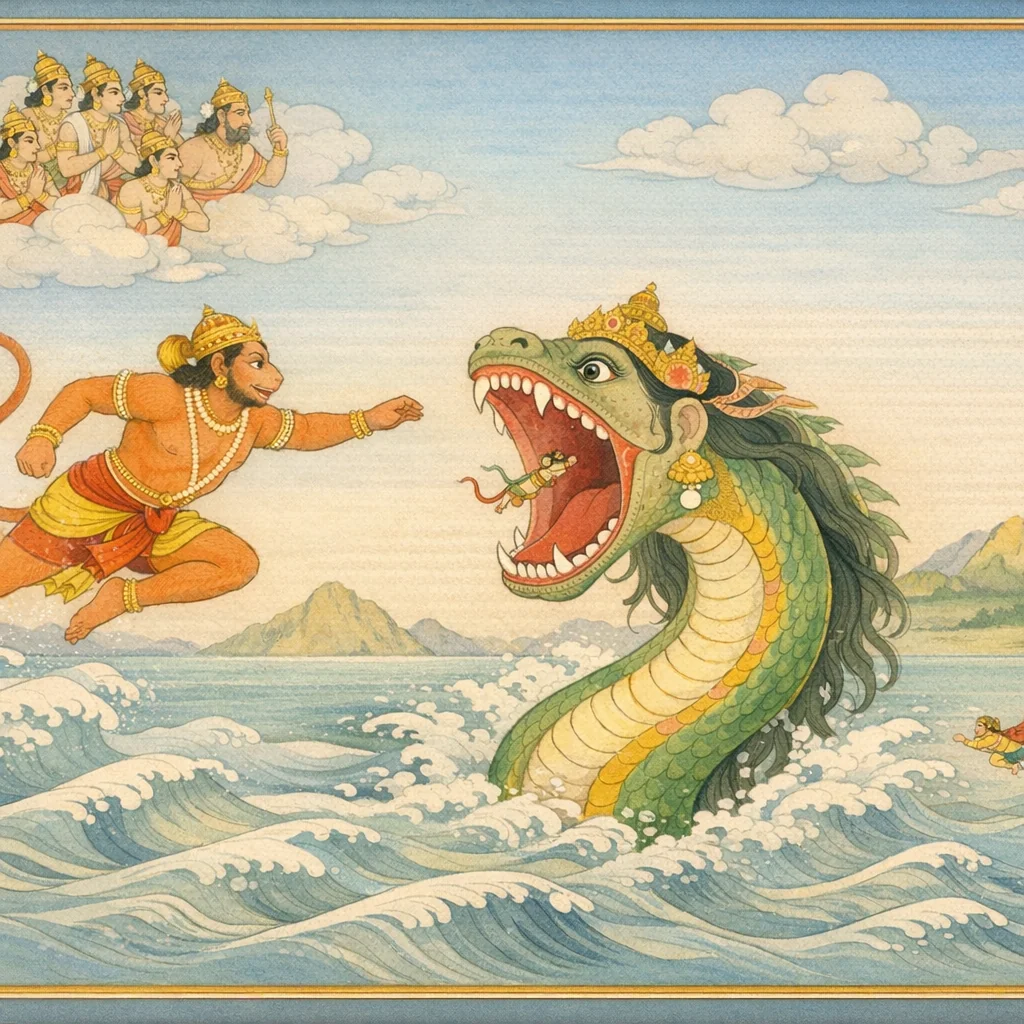
Sarga 1 inaugurates Hanumān’s transoceanic passage as a carefully staged test of resolve, scale, and discernment. Having resolved to seek Sītā’s whereabouts (5.1.1), Hanumān expands his form for Rāma’s welfare, observed by the vānaras (5.1.10–11), and launches into the aerial route associated with celestial movement. The ocean (personified through its presiding order) prompts Mount Maināka to rise as an offered resting-place; Maināka explains the ancient account of winged mountains and Indra’s severing of their wings, emphasizing reciprocal dharma and hospitality (atithi-dharma). Hanumān refuses delay due to time-bound duty and vow, yet honors the offer through courteous contact and departure. The gods then commission Surasā, mother of nāgas, to test Hanumān’s strength and ingenuity; he satisfies her boon by entering and exiting her mouth through strategic resizing, receiving her blessing to proceed. Next, Simhikā, the shadow-clutcher, attempts to seize him; Hanumān identifies the threat, enters her mouth, destroys her vital parts, and resumes flight. The sarga concludes with Hanumān reaching the far shore, reducing to a suitable form for stealth, and deliberating on the next operational steps toward Laṅkā—thus linking physical prowess to ethical restraint and mission-oriented intelligence.
Shlokas
Verse 1
ततो रावणनीतायाः सीतायाः शत्रुकर्शनः।इयेष पदमन्वेष्टुं चारणाचरिते पथि।।।।
Then Hanumān, the crusher of foes, resolved to seek the whereabouts of Sītā who had been carried off by Rāvaṇa, setting out along the route traversed by the Cāraṇas (celestial bards).
Verse 2
दुष्करं निष्प्रतिद्वन्द्वं चिकीर्षन् कर्म वानरः।समुदग्रशिरोग्रीवो गवांपतिरिवाबभौ।।।।
Intending to perform a deed formidable and beyond challenge, the monkey stood with head and neck held high, appearing like a lordly bull among cattle.
Verse 3
अथ वैडूर्यवर्णेषु शाद्वलेषु महाबलः।धीरः सलिलकल्पेषु विचचार यथासुखम्।।।।
Then the mighty and steady one moved at ease over the grassy tracts—vaidūrya-hued and marsh-like, resembling sheets of water.
Verse 4
द्विजान् वित्रासयन् धीमानुरसा पादपान् हरन्।मृगांश्च सुबहून्निघ्नन् प्रवृद्ध इव केसरी।।।।
Wise Hanumān moved like a full-grown lion—frightening birds, wrenching up trees with his chest, and trampling many animals.
Verse 5
नीललोहितमांजिष्ठपत्रवर्णैः सितासितैः।स्वभावविहितैश्चित्रैर्धातुभिः समलङ्कृतम्।।।।कामरूपिभिराविष्टमभीक्ष्णं सपरिच्छदैः।यक्षकिन्नरगन्धर्वैर्देवकल्पैश्च पन्नगैः।।।।
That mountain was adorned with wondrous minerals in their natural hues—blue, red, yellow, leaf-green, and also white and black. It was often frequented by yakṣas, kinnaras, gandharvas, and nāgas, attended by their retinues—beings able to assume forms at will, radiant like the gods.
Verse 6
नीललोहितमांजिष्ठपत्रवर्णैः सितासितैः।स्वभावविहितैश्चित्रैर्धातुभिः समलङ्कृतम्।।5.1.5।।कामरूपिभिराविष्टमभीक्ष्णं सपरिच्छदैः।यक्षकिन्नरगन्धर्वैर्देवकल्पैश्च पन्नगैः।।5.1.6।।
The mountain was adorned with wondrous minerals set by nature itself—blue, red, madder-hued, leaf-green, as well as white and black. It was often frequented by shape-shifting Yakṣas, Kinnaras, Gandharvas, and Nāgas, accompanied by their retinues, radiant like the gods.
Verse 7
स तस्य गिरिवर्यस्य तले नागवरायुते।तिष्ठन् कपिवरस्तत्र ह्रदे नाग इवाबभौ।।।।
Standing there at the foot of that excellent mountain—abounding in lordly elephants—the foremost of monkeys looked like an elephant standing in the midst of a lake.
Verse 8
स सूर्याय महेन्द्राय पवनाय स्वयंभुवे।भूतेभ्यश्चाञ्जलिं कृत्वा चकार गमने मतिम्।।।।
Having offered reverent salutations with folded hands to the Sun, to Mahendra (Indra), to the Wind-god, to Svayaṃbhū (Brahmā), and to the hosts of beings, he then resolved to depart.
Verse 9
अञ्जलिं प्राङ्मुखः कुर्वन् पवनायात्मयोनये।ततो हि ववृधे गन्तुं दक्षिणो दक्षिणां दिशम्।।।।
Facing east, he joined his palms in salutation to the Wind-god—his own sire; then, composed in spirit, he grew in size to set out toward the southern quarter.
Verse 10
प्लवङ्गप्रवरैर्दृष्टः प्लवने कृतनिश्चयः।ववृधे रामवृद्ध्यर्थं समुद्र इव पर्वसु।।।।
Watched by the foremost of the monkeys, and resolved to make the leap, Hanumān expanded in form for Rāma’s success—like the ocean swelling on the sacred lunar days.
Verse 11
निष्प्रमाणशरीरः सन् लिलङ्घयिषुरर्णवम्।बाहुभ्यां पीडयामास चरणाभ्यां च पर्वतम्।।।।
With a form grown beyond measure, wishing to cross the ocean, he pressed the mountain with his arms and with his feet—preparing to launch himself onward.
Verse 12
स चचालाचलश्चापि मुहूर्तं कपिपीडितः।तरूणां पुष्पिताग्राणां सर्वं पुष्पमशातयत्।।।।
Pressed down by the monkey, even the mountain trembled for a moment, and all the flowers from the blossoming treetops were shaken loose and fell.
Verse 13
तेन पादपमुक्तेन पुष्पौघेण सुगन्धिना।सर्वतः संवृतः शैलो बभौ पुष्पमयो यथा।।।।
Covered on all sides by fragrant masses of blossoms shaken down from the trees, the mountain looked as though it were made entirely of flowers.
Verse 14
तेन चोत्तमवीर्येण पीड्यमानः स पर्वतः।सलिलं सम्प्रसुस्राव मदं मत्त इव द्विपः।।।।
Pressed down by him of supreme strength, that mountain let streams of water flow out—like an intoxicated elephant exuding rut-fluid.
Verse 15
पीड्यमानस्तु बलिना महेन्द्रस्तेन पर्वतः।रीतीर्निर्वर्तयामास काञ्चनाञ्जनराजतीः।।।।
Pressed by the mighty Hanuman, Mount Mahendra caused streams to issue forth—gleaming with the hues of gold, dark collyrium-like mineral, and silver.
Verse 16
मुमोच च शिलाः शैलो विशालाः समनःशिलाः।मध्यमेनार्चिषा जुष्टा धूमराजीरिवानलः।।।।
And the mountain hurled forth massive rocks, streaked with mineral pigments; in its midst it blazed with flame, like fire sending up lines of smoke.
Verse 17
गिरिणा पीड्यमानेन पीड्यमानानि सर्वतः।गुहाविष्टानि भूतानि विनेदुर्विकृतैः स्वरैः।।।।
Pressed hard by the mountain and crushed from every side, the creatures dwelling in its caves shrieked with distorted, dreadful cries.
Verse 18
स महासत्त्वसन्नादः शैलपीडानिमित्तजः।पृथिवीं पूरयामास दिशश्चोपवनानि च।।।।
That mighty roar—born from the crushing of the mountain—resounded, filling the earth, the quarters, and the surrounding groves.
Verse 19
शिरोभिः पृथुभिः सर्पा व्यक्तस्वस्तिकलक्षणैः।वमन्तः पावकं घोरं ददंशुर्दशनैः शिलाः।।।।
Snakes with broad, upraised hoods—marked clearly with swastika-like signs—spewed dreadful fire and, with their fangs, bit into the rocks.
Verse 20
तास्तदा सविषैर्दष्टाः कुपितैस्तैर्महाशिलाः।जज्ज्वलुः पावकोद्दीप्ता बिभिदुश्च सहस्रधा।।।।
Then, bitten by those enraged venomous serpents, the great rocks blazed as if kindled by fire and shattered into a thousand fragments.
Verse 21
यानि चौषधजालानि तस्मिन् जातानि पर्वते।विषघ्नान्यपि नागानां न शेकुः शमितुं विषम्।।।।
Even the clusters of medicinal herbs that grew upon that mountain—though famed as antidotes—could not neutralize the poison of the serpents there.
Verse 22
भिद्यतेऽयं गिरिर्भूतैरिति मत्त्वा तपस्विनः।त्रस्ता विद्याधरास्तस्मादुत्पेतुः स्त्री गणैः सह।।।।पानभूमिगतं हित्वा हैममासवभाजनम्।पात्राणि च महार्हाणि करकांश्च हिरण्मयान्।।।लेह्यानुच्चावचान् भक्ष्यान् मांसानि विविधानि च।आर्षभाणि च चर्माणि खडगांश्च कनकत्सरून्।।।।
Thinking, “This mountain is being shattered by the beings,” even the ascetics withdrew. Terrified, the Vidyādharas sprang up into the sky with their groups of women, abandoning the golden vessels of liquor, precious dishes and goblets, many kinds of delicacies and meats, as well as bull-hides and swords sheathed in gold.
Verse 23
भिद्यतेऽयं गिरिर्भूतैरिति मत्त्वा तपस्विनः।त्रस्ता विद्याधरास्तस्मादुत्पेतुः स्त्री गणैः सह।।5.1.22।।पानभूमिगतं हित्वा हैममासवभाजनम्।पात्राणि च महार्हाणि करकांश्च हिरण्मयान्।।5.1.23।लेह्यानुच्चावचान् भक्ष्यान् मांसानि विविधानि च।आर्षभाणि च चर्माणि खडगांश्च कनकत्सरून्।।5.1.24।।
As the mountain seemed to be splitting, the Vidyādharas—frightened—rose into the sky with their womenfolk, leaving behind at the drinking grounds golden liquor-vessels, costly plates and golden goblets, and many kinds of foods, meats, hides, and gold-sheathed swords.
Verse 24
भिद्यतेऽयं गिरिर्भूतैरिति मत्त्वा तपस्विनः।त्रस्ता विद्याधरास्तस्मादुत्पेतुः स्त्री गणैः सह।।5.1.22।।पानभूमिगतं हित्वा हैममासवभाजनम्।पात्राणि च महार्हाणि करकांश्च हिरण्मयान्।।5.1.23।लेह्यानुच्चावचान् भक्ष्यान् मांसानि विविधानि च।आर्षभाणि च चर्माणि खडगांश्च कनकत्सरून्।।5.1.24।।
They left behind many sorts of lickable sweets and other foods, various meats, bull-hides, and swords fitted with golden sheaths—fleeing upward in fear as the mountain seemed to break apart.
Verse 25
कृतकण्ठगुणाः क्षीबा रक्तमाल्यानुलेपनाः।रक्ताक्षाः पुष्कराक्षाश्च गगनं प्रतिपेदिरे।।।।
Wearing neck-ornaments, intoxicated, adorned with red garlands and red unguents, with eyes reddened—lotus-eyed too—the Vidyādharas took to the sky.
Verse 26
हारनूपुरकेयूरपारिहार्यधराः स्त्रियः।विस्मिताः सस्मितास्तस्थुराकाशे रमणैः सह।।।।
Adorned with necklaces, anklets, armlets, and other ornaments, the women stood in the sky—astonished and softly smiling—together with their lovers.
Verse 27
दर्शयन्तो महाविद्यां विद्याधरमहर्षयः।सहितास्तस्थुराकाशे वीक्षाञ्चक्रुश्च पर्वतम्।।।।
The great seer-like Vidyādharas—displaying their mighty sciences—stood together in the sky and kept watch upon the mountain.
Verse 28
शुश्रुवुश्च तदा शब्दमृषीणां भावितात्मनाम्।चारणानां च सिद्धानां स्थितानां विमलेऽम्बरे।।।।
Then they heard the sound—raised by the self-disciplined seers, by the Cāraṇas, and by the Siddhas—who stood stationed in the stainless sky.
Verse 29
एष पर्वतसङ्काशो हनुमान् मारुतात्मजः।तितीर्षति महावेगस्समुद्रं मकरालयम्।।।।
“This Hanumān—son of the Wind, mountain-like in form and swift in force—seeks to cross the ocean, the dwelling-place of makaras.”
Verse 30
रामार्थं वानरार्थं च चिकीर्षन् कर्म दुष्करम्।समुद्रस्य परं पारं दुष्प्रापं प्राप्तुमिच्छति।।।।
Wishing to accomplish a deed all but impossible—for Rāma’s sake and for the Vanaras’ cause—he longs to reach the ocean’s far shore, so difficult to attain.
Verse 31
इति विद्याधराः श्रुत्वा वचस्तेषां महात्मनाम्।तमप्रमेयं ददृशुः पर्वते वानरर्षभम्।।।।
Hearing these words of the great souls, the Vidyādharas then beheld him on the mountain—Hanumān, the bull among Vanaras, immeasurable in might.
Verse 32
दुधुवे च स रोमाणि चकम्पे चाचलोपमः।ननाद सुमहानादं सुमहानिव तोयदः।।।।
Mountain-like, he shook the hair upon his body and made the earth seem to tremble; then he roared a mighty roar, like a great thundercloud.
Verse 33
आनुपूर्व्येण वृत्तं च लाङ्गूलं लोमभिश्चितम्।उत्पतिष्यन् विचिक्षेप पक्षिराज इवोरगम्।।।।
As he was about to spring upward, he swung his tail—rounded in coils and thick with hair—like the king of birds shaking a serpent.
Verse 34
तस्य लाङ्गूलमाविद्धमात्तवेगस्य पृष्ठतः।ददृशे गरुडेनेव ह्रियमाणो महोरगः।।।।
Behind him, as he gathered full speed, his tail—curled and lifted—looked like a mighty serpent being borne away by Garuḍa.
Verse 35
बाहू संस्तम्भयामास महापरिघसन्निभौ।ससाद च कपिः कट्यां चरणौ सञ्चुकोच च।।।।
The monkey braced his arms—like massive iron bars—then crouched at the waist and drew in his feet, compressing himself to spring.
Verse 36
संहृत्य च भुजौ श्रीमांस्तथैव च शिरोधराम्।तेजः सत्त्वं तथा वीर्यमाविवेश स वीर्यवान्।।।।
Glorious and valiant Hanumān drew in his shoulders and neck, and gathered within himself his radiance, steadiness of spirit, and martial vigor.
Verse 37
मार्गमालोकयन्दूरादूर्ध्वं प्रणिहितेक्षणः।रुरोध हृदये प्राणानाकाशमवलोकयन्।।।।
Looking from afar to mark the route, with eyes lifted upward, he held his breath within his chest while gazing into the sky.
Verse 38
पद्भ्यां दृढमवस्थानं कृत्वा स कपिकुञ्जरः।निकुञ्च्य कर्णौ हनुमानुत्पतिष्यन् महाबलः।।वानरान् वानरश्रेष्ठ इदं वचनमब्रवीत्।।।।
Planting his feet firmly, that elephant among monkeys—mighty Hanumān—drawing in his ears as he was about to spring, spoke these words to the vanaras.
Verse 39
यथा राघवनिर्मुक्तः शरः श्वसनविक्रमः।गच्छेत्तद्वद्गमिष्यामि लङ्कां रावणपालिताम्।।।।
As an arrow released by Rāghava speeds onward with the force of the wind, so shall I go to Laṅkā, guarded by Rāvaṇa.
Verse 40
न हि द्रक्ष्यामि यदि तां लङ्कायां जनकात्मजाम्।अनेनैव हि वेगेन गमिष्यामि सुरालयम्।।।।
If indeed I do not see Janaka’s daughter in Laṅkā, then with this very speed I shall go to the abode of the gods.
Verse 41
यदि वा त्रिदिवे सीतां न द्रक्ष्याम्यकृतश्रमः।बद्ध्वा राक्षसराजानमानयिष्यामि रावणम्।।।।
Or if, even in heaven, I do not see Sītā despite all effort, I shall bind Rāvaṇa, king of the rākṣasas, and bring him here.
Verse 42
सर्वथा कृतकार्योऽहमेष्यामि सह सीतया।आनयिष्यामि वा लङ्कां समुत्पाट्य सरावणाम्।।।।
By every means I shall return with my task accomplished—coming back with Sītā; or else I shall tear up Laṅkā itself and bring it here together with Rāvaṇa.
Verse 43
एवमुक्त्वा तु हनुमान्वानरान्वानरोत्तमः।।।।उत्पपाताथ वेगेन वेगवानविचारयन्।सुपर्णमिव चात्मानं मेने स कपिकुञ्जरः।।।।
Having spoken thus to the vanaras, Hanumān—foremost among them—sprang forth at speed, without hesitation; that great monkey felt himself like Suparṇa (Garuḍa).
Verse 44
एवमुक्त्वा तु हनुमान्वानरान्वानरोत्तमः।।5.1.43।।उत्पपाताथ वेगेन वेगवानविचारयन्।सुपर्णमिव चात्मानं मेने स कपिकुञ्जरः।।5.1.44।।
Having spoken thus to the vanaras, Hanumān—foremost among them—sprang forth at speed, without hesitation; that great monkey felt himself like Suparṇa (Garuḍa).
Verse 45
समुत्पतति तस्मिंस्तु वेगात्ते नगरोहिणः।संहृत्य विटपान् सर्वान् समुत्पेतुः समन्ततः।।।।
As he sprang up with tremendous speed, the mountain’s trees, drawing in all their branches, seemed to leap up from every side along with him.
Verse 46
स मत्तकोयष्टिमकान् पादपान् पुष्पशालिनः।उद्वहन्नूरुवेगेन जगाम विमलेऽम्बरे।।।।
He sped through the spotless sky, sweeping along flowering trees and the excited lapwings that clung to them, driven by the force of his thigh-born speed.
Verse 47
ऊरुवेगोद्धता वृक्षा मुहूर्तं कपिमन्वयुः।प्रस्थितं दीर्घमध्वानं स्वबन्धुमिव बान्धवाः।।।।
Trees, thrust forward by the force of his speed, seemed to follow the monkey for a moment—like relatives accompanying their own kinsman at the start of a long journey.
Verse 48
तमूरुवेगोन्मथिताः सालाश्चान्ये नगोत्तमाः।अनुजग्मुर्हनूमन्तं सैन्या इव महीपतिम्।।।।
Uprooted by the force of his speed, sāla trees and other great trees seemed to follow Hanumān—like an army following its king.
Verse 49
सुपुष्पिताग्रैर्बहुभिः पादपैरन्वितः कपिः।हनुमान् पर्वताकारो बभूवाद्भुतदर्शनः।।।।
Accompanied by many trees whose tops were in full bloom, Hanumān—mountain-like in form—appeared a wondrous sight.
Verse 50
सारवन्तोऽथ ये वृक्षा न्यमज्जन् लवणाम्भसि।भयादिव महेन्द्रस्य पर्वता वरुणालये।।।।
Then the massive trees sank into the salt sea—like mountains sinking into Varuṇa’s abode, as though in fear of Indra’s might.
Verse 51
स नानाकुसुमैः कीर्णः कपिः साङ्कुरकोरकैः।शुशुभे मेघसङ्काशः खद्योतैरिव पर्वतः।।।।
Strewn with many kinds of flowers, with sprouts and buds, the monkey shone—cloud-like—like a mountain glittering with fireflies.
Verse 52
विमुक्तास्तस्य वेगेन मुक्त्वा पुष्पाणि ते द्रुमाः।अवशीर्यन्त सलिले निवृत्ताः सुहृदो यथा।।।।
Released by the force of his speed, those trees—after letting fall their blossoms—dropped down into the water, like friends turning back after seeing one off.
Verse 53
लघुत्वेनोपपन्नं तद्विचित्रं सागरेऽपतत्।द्रुमाणां विविधं पुष्पं कपिवायुसमीरितम्।।।।ताराचितमिवाकाशं प्रबभौ स महार्णवः।
Light and many-colored, the varied flowers of the trees—driven by the wind raised by the monkey’s speed—fell upon the sea. And that great ocean gleamed like a sky filled with stars.
Verse 54
पुष्पौघेणानुबद्धेन नानावर्णेन वानरः।बभौ मेघ इवाकाशे विद्युद्गण विभूषितः।।।।
Clad in a mass of blossoms of many hues clinging to him, the Vānara (Hanumān) shone in the sky like a cloud adorned with flashes of lightning.
Verse 55
तस्य वेगसमाधूतैः पुष्पैस्तोयमदृश्यत।।।।ताराभिरभिरामाभिरुदिताभिरिवाम्बरम्।
The sea’s waters appeared strewn with flowers shaken off by his speed, like the sky adorned with lovely stars newly risen.
Verse 56
तस्याम्बरगतौ बाहू ददृशाते प्रसारितौ।।।।पर्वताग्राद्विनिष्क्रान्तौ पञ्चास्याविव पन्नगौ।
His two arms, outstretched and moving through the sky, were seen like two five-hooded serpents emerging from a mountain peak.
Verse 57
पिबन्निव बभौ चापि सोर्मिमालं महार्णवम्।।।।पिपासुरिव चाकाशं ददृशे स महाकपिः।
He seemed as though drinking the great ocean garlanded with waves; and that mighty Vānara looked toward the sky as if thirsty for it.
Verse 58
तस्य विद्युत्प्रभाकारे वायुमार्गानुसारिणः।।।।नयने विप्रकाशेते पर्वतस्थाविवानलौ।
As he coursed through the sky along the wind’s path, his eyes—like lightning’s glow—blazed like two fires burning upon a mountain.
Verse 59
पिङ्गे पिङ्गाक्षमुख्यस्य बृहती परिमण्डले।।।।चक्षुषी सम्प्राकाशेते चन्द्रसूर्याविवोदितौ।
The leader of the Vānaras—whose eyes were tawny—had large, round eyes that shone like the newly risen Moon and Sun.
Verse 60
मुखं नासिकया तस्य ताम्रया ताम्रमाबभौ।।।।सन्ध्यया समभिस्पृष्टं यथा तत्सूर्यमण्डलम्।
His face, reddened by his coppery nose, appeared copper-red—like the Sun’s disc when touched by twilight.
Verse 61
लाङ्गूलं च समाविद्धं प्लवमानस्य शोभते।।।।अम्बरे वायुपुत्रस्य शक्रध्वज इवोच्छ्रितम्।
As the son of the Wind-god flew through the sky, his tail—coiled and set aloft—shone like Indra’s banner raised high.
Verse 62
लाङ्गूलचक्रेण महान् शुक्लदंष्ट्रोऽनिलात्मजः।।।।व्यरोचत महाप्राज्ञः परिवेषीव भास्करः।
Great, white-fanged, and supremely wise, the son of the Wind-god shone with his tail curled like a ring—like the Sun encircled by a halo.
Verse 63
स्फिग्देशेनाभिताम्रेण रराज स महाकपिः।।।।महता दारितेनेव गिरिर्गैरिकधातुना।
That great monkey shone splendidly—his buttocks copper-red—like a mountain cleft open, revealing a vast lode of red mineral.
Verse 64
तस्य वानरसिंहस्य प्लवमानस्य सागरम्।।।।कक्षान्तरगतो वायुर्जीमूत इव गर्जति।
As that lion among monkeys crossed the ocean, the wind rushing through his armpits roared like a thundercloud.
Verse 65
खे यथा निपतत्युल्का ह्युत्तरान्ताद्विनिःसृता।।।।दृश्यते सानुबन्धा च तथा स कपिकुञ्जरः।
As a meteor released from the northern quarter is seen streaking through the sky with its trailing tail, so that elephant among monkeys was seen speeding on.
Verse 66
पतत्पतङ्गसङ्काशो व्यायतः शुशुभे कपिः।।।।प्रवृद्ध इव मातङ्गः कक्ष्यया बध्यमानया।
The monkey, spread wide in flight, shone like the descending sun; enlarged in form, he looked like a massive elephant bound with a girth-strap.
Verse 67
उपरिष्टाच्छरीरेण छायया चावगाढया।।।।सागरे मारुताविष्टा नौरिवासीत्तदा कपिः।
Then, with his body above and his deep shadow cast upon the ocean, the monkey seemed like a ship below, driven onward by the wind.
Verse 68
यं यं देशं समुद्रस्य जगाम स महाकपिः।स स तस्योरुवेगेन सोन्माद इव लक्ष्यते।।।।
Whichever tract of the ocean that great monkey passed over, that very stretch appeared as if maddened—churned by the powerful thrust of his thighs.
Verse 69
सागरस्योर्मिजालानामुरसा शैलवर्ष्मणाम्।अभिघ्नंस्तु महावेगः पुप्लुवे स महाकपिः।।।।
Swift as he was, that great monkey sped on, striking with his chest the ocean’s interlaced waves, which rose with bodies like mountains.
Verse 70
कपिवातश्च बलवान् मेघवातश्च निःसृतः।सागरं भीमनिर्घोषं कम्पयामासतुर्भृशम्।।।।
The powerful wind raised by the monkey’s motion, together with the wind that issued from the clouds, violently shook the ocean, making it roar with dreadful sound.
Verse 71
विकर्षन्नूर्मिजालानि बृहन्ति लवणाम्भसि।पुप्लुवे कपिशार्दूलो विकिरन्निव रोदसी।।।।
Dragging along great interwoven waves in the salt sea, the tiger among monkeys leapt forward, as though he were rending apart the two worlds—earth and sky.
Verse 72
मेरुमन्दरसङ्काशानुद्धतान् स महार्णवे।अत्यक्रामन्महावेगस्तरङ्गान् गणयन्निव।।।।
Rushing with immense speed over the great ocean, he overleapt the towering waves—risen high like Meru and Mandara—as though he were counting them.
Verse 73
तस्य वेगसमुद्धूतं जलं सजलदं तदा।अम्बरस्थं विबभ्राज शारदाभ्रमिवाततम्।।।।
Then the water hurled up by his rushing speed—rising together with cloudlike spray—shone in the sky, spread out like an autumn cloud-bank.
Verse 74
तिमिनक्रझषाः कूर्मा दृश्यन्ते विवृतास्तदा।वस्त्रापकर्षणेनेव शरीराणि शरीरिणाम्।।।।
Then whales, crocodiles, great fish, and tortoises became visible, laid bare—like the limbs of embodied beings when garments are pulled away.
Verse 75
प्लवमानं समीक्ष्याथ भुजङ्गाः सागरालयाः।व्योम्नि तं कपिशार्दूलं सुपर्ण इति मेनिरे।।।।
Seeing that tiger among monkeys coursing through the sky, the serpents dwelling in the ocean mistook him for Suparṇa (Garuḍa).
Verse 76
दशयोजनविस्तीर्णा त्रिंशद्योजनमायता।छाया वानरसिंहस्य जले चारुतराभवत्।।।।
In the water, the shadow of that lion among monkeys appeared most striking—ten yojanas broad and thirty yojanas long.
Verse 77
श्वेताभ्रघनराजीव वायुपुत्रानुगामिनी।तस्य सा शुशुभे छाया वितता लवणाम्भसि।।।।
Spread across the salt sea and following the Wind-god’s son, his shadow shone—like a dense bank of clouds against the bright white sky.
Verse 78
शुशुभे स महातेजा महाकायो महाकपिः।वायुमार्गे निरालम्बे पक्षवानिव पर्वतः।।।।
That radiant, huge-bodied great monkey shone in the unsupported path of the wind, like a mountain that had grown wings.
Verse 79
येनासौ याति बलवान् वेगेन कपिकुञ्जरः।तेन मार्गेण सहसा द्रोणीकृत इवार्णवः।।।।
As that powerful ‘elephant among monkeys’ sped along his course, the ocean along that very track seemed at once hollowed into a trough.
Verse 80
आपाते पक्षिसङ्घानां पक्षिराज इव व्रजन्।हनुमान् मेघजालानि प्रकर्षन् मारुतो यथा।।।।
Moving like the king of birds amid flocks, Hanumān drew along nets of clouds—like the Wind itself pulling them onward.
Verse 81
पाण्डुरारुणवर्णानि नीलमाञ्जिष्ठकानि च।कपिनाकृष्यमाणानि महाभ्राणि चकाशिरे।।।।
As Hanumān drew along great masses of cloud—some pale, some ruddy, and others dark-blue or madder-hued—those vast clouds shone brilliantly in his wake.
Verse 82
प्रविशन्नभ्रजालानि निष्पतंश्च पुनः पुनः।प्रच्छन्नश्च प्रकाशश्च चन्द्रमा इव लक्ष्यते।।।।
Entering the lattices of cloud and bursting out again and again, he appeared—now veiled, now radiant—like the moon amid drifting cloud-banks.
Verse 83
प्लवमानं तु तं दृष्ट्वा प्लवङ्गं त्वरितं तदा।ववर्षुः पुष्पवर्षाणि देवगन्धर्वदानवाः।।।।
Seeing that swift-moving monkey in mid-leap, the gods, Gandharvas, and Dānavas then showered him with rains of flowers.
Verse 84
तताप न हि तं सूर्यः प्लवन्तं वानरोत्तमम्।सिषेवे च तदा वायू रामकार्यार्थसिद्धये।।।।
The sun did not scorch that best of monkeys as he flew; and then the Wind served him too—favorable and cooling—so that Rāma’s purpose might be fulfilled.
Verse 85
ऋषयस्तुष्टुवुश्चैनं प्लवमानं विहायसा।जगुश्च देवगन्धर्वाः प्रशंसन्तो महौजसम्।।।।
As he coursed through the sky, sages extolled him; and gods and Gandharvas sang, praising that mighty one of great splendor.
Verse 86
नागाश्च तुष्टुवुर्यक्षा रक्षांसि विबुधाः खगाः।प्रेक्ष्य सर्वे कपिवरं सहसा विगतक्लमम्।।।।
Seeing the foremost of monkeys suddenly free of fatigue, all—Nāgas, Yakṣas, Rākṣasas, the learned, and the birds—praised him.
Verse 87
तस्मिन् प्लवगशार्दूले प्लवमाने हनूमति।इक्ष्वाकुकुलमानार्थी चिन्तयामास सागरः।।।।
As Hanumān—the tiger among leaping beings—was in mid-flight, the Ocean began to reflect, seeking the honor and welfare of the Ikṣvāku line.
Verse 88
साहाय्यं वानरेन्द्रस्य यदि नाहं हनूमत:।करिष्यामि भविष्यामि सर्ववाच्यो विवक्षताम्।।।।
“If I do not render help to Hanumān, the lord among monkeys, I shall become blameworthy in the speech of all the wise.”
Verse 89
अहमिक्ष्वाकुनाथेन सगरेण विवर्धितः।इक्ष्वाकुसचिवश्चायं नावसीदितुमर्हति।।।।
“I was expanded by Sagara, lord of the Ikṣvākus; and this one is an aide of the Ikṣvāku house—he does not deserve to come to harm.”
Verse 90
तथा मया विधातव्यं विश्रमेत यथा कपिः।।।।शेषं च मयि विश्रान्तः सुखेनातिपतिष्यति।
I must arrange it so that the monkey may rest; and once he has rested upon me, he will cross the remaining distance with ease.
Verse 91
इति कृत्वा मतिं साध्वींसमुद्र श्छन्नमम्भसि।।।।हिरण्यनाभं मैनाकमुवाच गिरिसत्तमम्।
Having thus formed a wholesome resolve, the Ocean—hidden within the waters—spoke to Maināka, the excellent mountain with a golden peak.
Verse 92
त्वमिहासुरसंघानां पातालतलवासिनाम्।।।।देवराज्ञा गिरिश्रेष्ठ परिघः सन्निवेशितः।
O foremost of mountains, you have been stationed here by Indra, lord of the gods, as a bar to the demon-hosts who dwell in the nether regions.
Verse 93
त्वमेषां जातवीर्याणां पुनरेवोत्पतिष्यताम्।।।।पातालस्याप्रमेयस्य द्वारमावृत्य तिष्ठसि।
You stand covering the gate of immeasurable Pātāla, restraining these fierce ones who would again leap upward.
Verse 94
तिर्यगूर्ध्वमधश्चैव शक्तिस्ते शैल वर्धितुम्।।।।तस्मात्संचोदयामि त्वामुत्तिष्ठ गिरिसत्तम।
O mountain, you have the power to expand sideways, upward, and downward; therefore I urge you—rise up, O best of mountains.
Verse 95
स एष कपिशार्दूलस्त्वामुपर्येति वीर्यवान्।।।।हनूमान्रामकार्यार्थं भीमकर्मा खमाप्लुतः।
That valiant Hanumān—tiger among monkeys, doer of formidable deeds—has sprung into the sky for Rāma’s purpose and is flying over you.
Verse 96
अस्य साह्यं मया कार्यमिक्ष्वाकुकुलवर्तिनः।।।।मम हीक्ष्वाकवः पूज्याः परं पूज्यतमास्तव।
I must render him help, for he serves the Ikṣvāku line; indeed, the Ikṣvāku kings are worthy of reverence to me—and even more so to you.
Verse 97
कुरु साचिव्यमस्माकं न नः कार्यमतिक्रमेत्।।।।कर्तव्यमकृतं कार्यं सतां मन्युमुदीरयेत्।
Act as our counsellor, so that our purpose does not slip away; for when a duty that ought to be done is left undone, it stirs the indignation of the righteous.
Verse 98
सलिलादूर्ध्वमुत्तिष्ठ तिष्ठत्वेष कपिस्त्वयि।।।।अस्माकमतिथिश्चैव पूज्यश्च प्लवतां वरः।
Rise up above the waters; let this monkey rest upon you—he is our guest, and worthy of honor, the best among leapers.
Verse 99
चामीकरमहानाभ देवगन्धर्वसेवित।।।।हनुमांस्त्वयि विश्रान्तस्ततः शेषं गमिष्यति।
O golden-peaked one, frequented by gods and Gandharvas—when Hanumān has rested upon you, he will then go on to cover the remaining distance.
Verse 100
काकुत्स्थस्यानृशंस्यं च मैथिल्याश्च विवासनम्।।।।श्रमं च प्लवगेन्द्रस्य समीक्ष्योत्थातुमर्हसि।
"If you consider the compassion of Rāma of the Kakutsthas, the unjust exile of Maithilī, and also the strain borne by Hanumān, lord of monkeys—you ought to rise and offer aid."
Verse 101
हिरण्यनाभो मैनाको निशम्य लवणाम्भसः।।।।उत्पपात जलात्तूर्णं महाद्रुमलतायुतः।
Hearing the ocean’s command, Maināka—gold-bosomed and adorned with great trees and creepers—rose swiftly up from the waters.
Verse 102
स सागरजलं भित्त्वा बभूवाभ्युत्थितस्तदा।।।।यथा जलधरं भित्त्वा दीप्तरश्मिर्दिवाकरः।
Then, breaking through the ocean’s waters, the mountain rose up—like the sun with blazing rays bursting through a bank of clouds.
Verse 103
स महात्मा मुहूर्तेन सर्वतः सलिलावृतः।।।।दर्शयामास शृङ्गाणि सागरेण नियोजितः।आदित्योदयसङ्काशैरालिखद्भिरिवाम्बरम्।शातकुम्भमयैः शृङ्गैः सकिन्नरमहोरगैः।।।।
That great mountain—until then wholly covered by the waters—at the ocean’s bidding quickly revealed its peaks: golden summits, inhabited by kinnaras and great serpents, radiant like sunrise and seeming to scrape the sky.
Verse 104
स महात्मा मुहूर्तेन सर्वतः सलिलावृतः।।5.1.103।।दर्शयामास शृङ्गाणि सागरेण नियोजितः।आदित्योदयसङ्काशैरालिखद्भिरिवाम्बरम्।शातकुम्भमयैः शृङ्गैः सकिन्नरमहोरगैः।।5.1.104।।
This verse is a duplication in the provided Southern Recension snippet, repeating the description of Maināka’s rapid emergence and golden, sky-scraping peaks filled with kinnaras and great serpents at the ocean’s command.
Verse 105
तप्तजाम्बूनदैः शृङ्गैः पर्वतस्य समुत्थितैः।।।।आकाशं शस्त्रसङ्काशमभवत्काञ्चनप्रभम्।
With the mountain’s peaks—like heated Jāmbūnada gold—rising up, the sky took on a gleam like polished weapons, shining with a golden luster.
Verse 106
जातरूपमयैः शृङ्गैर्भ्राजमानैः स्वयंप्रभैः।।।।आदित्यशतसङ्काशः सोऽभवद्गिरिसत्तमः।
That excellent mountain blazed with self-radiant golden peaks, appearing like the splendor of a hundred suns.
Verse 107
तमुत्थितमसङ्गेन हनुमानग्रतः स्थितम्।।।।मध्ये लवणतोयस्य विघ्नोऽयमिति निश्चितः।
Seeing it risen and standing before him in the midst of the salt sea, Hanumān concluded: “This is an obstacle placed in my way.”
Verse 108
स तमुच्छ्र्रतमत्यर्थं महावेगो महाकपिः।।।।उरसा पातयामास जीमूतमिव मारुतः।
The great monkey, swift beyond measure, struck down that mountain as it rose up before him—pressing it with his chest, as the wind drives down a mass of cloud.
Verse 109
स तथा पातितस्तेन कपिना पर्वतोत्तमः।।।।बुद्ध्वा तस्य कपेर्वेगं जहर्ष च ननन्द च।
Thus struck down by the monkey, that excellent mountain—recognizing the monkey’s speed—rejoiced and exulted.
Verse 110
तमाकाशगतं वीरमाकाशे समुपस्थितः।।।।प्रीतो हृष्टमाना वाक्यमब्रवीत्पर्वतः कपिम्।मानुषं धारयन् रूपमात्मनः शिखरे स्थितः।।।।
Then the mountain, delighted at heart, approached the heroic monkey in mid-sky; assuming a human form and standing upon his own peak, he spoke to him.
Verse 111
तमाकाशगतं वीरमाकाशे समुपस्थितः।।5.1.110।।प्रीतो हृष्टमाना वाक्यमब्रवीत्पर्वतः कपिम्।मानुषं धारयन् रूपमात्मनः शिखरे स्थितः।।5.1.111।।
The mountain, meeting the heroic monkey in the sky, joyfully addressed him—standing on his own summit and assuming a human form.
Verse 112
दुष्करं कृतवान्कर्म त्वमिदं वानरोत्तम।निपत्य मम शृङ्गेषु विश्रमस्व यथासुखम्।।।।
“O best of monkeys, you have accomplished a deed most difficult. Alight upon my peaks and rest at ease.”
Verse 113
राघवस्य कुले जातैरुदधिः परिवर्धितः।स त्वां रामहिते युक्तं प्रत्यर्चयति सागरः।।।।
“The ocean was once enlarged by those born in Rāghava’s line; therefore Sāgara now returns that honor to you, since you are devoted to Rāma’s welfare.”
Verse 114
कृते च प्रतिकर्तव्यमेष धर्मः सनातनः।सोऽयं त्वत्प्रतिकारार्थी त्वत्तः सम्मानमर्हति।।5.1.114।।
“When a kindness has been done, it should be repaid—this is the eternal dharma. Thus he, seeking to return your favor, deserves honor from you.”
Verse 115
त्वन्निमित्तमनेनाहं बहुमानात्प्रचोदितः।तिष्ठ त्वं कपिशार्दूल मयि विश्रम्य गम्यताम्।।।।तव सानुषु विश्रान्तः शेषं प्रक्रमतामिति।योजनानां शतं चापि कपिरेष समाप्लुतः।।।।
“For your sake, I have been urged by the ocean out of great respect. Stay, O tiger among monkeys; rest upon me and then go on. ‘Let him rest upon your slopes and then proceed the remaining distance—this monkey can leap even a hundred yojanas,’ thus he said.”
Verse 116
त्वन्निमित्तमनेनाहं बहुमानात्प्रचोदितः।तिष्ठ त्वं कपिशार्दूल मयि विश्रम्य गम्यताम्।।5.1.115।।तव सानुषु विश्रान्तः शेषं प्रक्रमतामिति।योजनानां शतं चापि कपिरेष समाप्लुतः।।5.1.116।।
“Urged by the ocean out of respect for you, I ask you—O tiger among monkeys—rest upon me and then proceed. ‘After resting on your slopes, let him go on; this monkey can leap even a hundred yojanas,’ thus (the ocean) declared.”
Verse 117
तदिदं गन्धवत्स्वादु कन्दमूलफलं बहु।तदास्वाद्य हरिश्रेष्ठ विश्रान्तोऽनु गमिष्यसि।।।।
O best of monkeys—here are plentiful, fragrant and tasty roots and fruits. Taste them, rest for a while, and then continue your journey.
Verse 118
अस्माकमपि सम्बन्ध: कपिमुख्य त्वयास्ति वै।प्रख्यातस्त्रिषु लोकेषु महागुणपरिग्रहः।।।।
O chief of monkeys, we too indeed have a bond with you—one grounded in great excellence, renowned across the three worlds.
Verse 119
वेगवन्तः प्लवन्तो ये प्लवगा मारुतात्मज।तेषां मुख्यतमं मन्ये त्वामहं कपिकुञ्जर।।।।
O son of the Wind-god—among all the swift leaping monkeys, I regard you as the foremost, O elephant among monkeys.
Verse 120
अतिथिः किल पूजार्हः प्राकृतोऽपि विजानता।धर्मं जिज्ञासमानेन किं पुनस्त्वादृशो महान्।।।।
It is said that even an ordinary guest is worthy of honour by a wise person who seeks to understand dharma—how much more, then, a great one like you.
Verse 121
त्वं हि देववरिष्ठस्य मारुतस्य महात्मनः।पुत्रस्तस्यैव वेगेन सदृशः कपिकुञ्जर।।।।
For you are truly the son of the great-souled Wind-god, foremost among the gods; and in speed you are like him, O elephant among monkeys.
Verse 122
पूजिते त्वयि धर्मज्ञ पूजां प्राप्नोति मारुतः।तस्मात्त्वं पूजनीयो मे शृणु चाप्यत्र कारणम्।।।।
O knower of dharma, when you are honoured, the Wind-god receives honour as well. Therefore you are worthy of reverence from me; and hear also the reason for this.
Verse 123
पूर्वं कृतयुगे तात पर्वताः पक्षिणोऽभवन्।ते हि जग्मुर्दिशः सर्वा गरुडानिलवेगिनः।।।।
Long ago, dear one, in the Kṛta age, mountains had wings; and they flew in every direction, swift as Garuḍa and the Wind.
Verse 124
ततस्तेषु प्रयातेषु देवसङ्घा: महर्षिभिः।भूतानि च भयं जग्मुस्तेषां पतनशङ्कया।।।
Then, as they ranged about, hosts of gods along with the great sages—and other beings too—were seized by fear, suspecting that the mountains might fall and cause ruin.
Verse 125
ततः क्रुद्धः सहस्राक्षः पर्वतानां शतक्रतुः।पक्षान् चिच्छेद वज्रेण तत्र तत्र सहस्रशः।।।।
Then the thousand-eyed Indra—Śatakratu—angered by this, cut off the mountains’ wings with his thunderbolt, in countless places, again and again.
Verse 126
स मामुपागतः क्रुद्धो वज्रमुद्यम्य देवराट्।ततोऽहं सहसा क्षिप्तः श्वसनेन महात्मना।।।।
When the lord of the gods, Indra, came at me in wrath with his thunderbolt raised, then the great Wind-god swiftly snatched me away and cast me down at once.
Verse 127
अस्मिन्लवणतोये च प्रक्षिप्तः प्लवगोत्तम।गुप्तपक्षसमग्रश्च तव पित्राभिरक्षितः।।।।
O best of the leapers, when I was hurled into these salt waters, your father protected me—keeping my wings intact and my body preserved.
Verse 128
ततोऽहं मानयामि त्वां मान्यो हि मम मारुतः।त्वया मे ह्येष सम्बन्धः कपिमुख्य महागुणः।।।।
Therefore I honor you, for Māruta is worthy of my reverence; and through you, O chief of monkeys, I have this noble bond—rich in virtue.
Verse 129
अस्मिन्नेवंगते कार्ये सागरस्य ममैव च।प्रीतिं प्रीतमनाः कर्तुं त्वमर्हसि महाकपे।।।।
O great monkey, since matters have come to this point, you ought—glad at heart—to grant satisfaction to both the Ocean and to me as well.
Verse 130
श्रमं मोक्षय पूजां च गृहाण कपिसत्तम।प्रीतिं च बहुमन्यस्व प्रीतोऽस्मि तव दर्शनात्।।।।
O best of monkeys, set aside your fatigue and accept this offering; and honor our affection—your very presence delights me.
Verse 131
एवमुक्तः कपिश्रेष्ठस्तं नगोत्तममब्रवीत्।प्रीतोऽस्मि कृतमातिथ्यं मन्युरेषोऽपनीयताम्।।।।
Thus addressed, the foremost of monkeys said to that best of mountains: “I am pleased; your hospitality is duly offered—let this distress be set aside.”
Verse 132
त्वरते कार्यकालो मे अहश्चाप्यतिवर्तते।प्रतिज्ञा च मया दत्ता न स्थातव्यमिहान्तरे।।।।
My appointed time for the task presses on, and the day is slipping away; I have given my vow—so I must not stop here in the midst of it.
Verse 133
इत्युक्त्वा पाणिना शैलमालभ्य हरिपुङ्गवः।जगामाकाशमाविश्य वीर्यवान् प्रहसन्निव।।।।
Having said so, the heroic chief of monkeys gently touched the mountain with his hand and then entered the sky, departing as if with a quiet smile.
Verse 134
स पर्वतसमुद्राभ्यां बहुमानादवेक्षितः।पूजितश्चोपपन्नाभिराशीर्भिरनिलात्मजः।।।।
The son of the Wind-god was regarded with great honor by both the mountain and the sea, and was duly worshiped with fitting blessings.
Verse 135
अथोर्ध्वं दूरमुत्प्लुत्य हित्वा शैलमहार्णवौ।पितुः पन्थानमास्थाय जगाम विमलेऽम्बरे।।।।
Then, springing high and far into the clear sky, he left behind both the mountain and the great ocean, and—taking the course of his father, the Wind—he sped onward.
Verse 136
भूयश्चोर्ध्वं गतिं प्राप्य गिरिं तमवलोकयन्।वायुसूनुर्निरालम्बे जगाम विमलेऽम्बरे।।।।
Ascending still higher and continuing his course, the son of the Wind moved through the pure, supportless sky, glancing back at that mountain.
Verse 137
तद् द्वितीयं हनुमतो दृष्ट्वा कर्म सुदुष्करम्।प्रशशंसुः सुराः सर्वे सिद्धाश्च परमर्षयः।।।।
Seeing this second exceedingly difficult feat of Hanumān, all the gods, the Siddhas, and the great seers praised him.
Verse 138
देवताश्चाभवन् हृष्टास्तत्रस्थास्तस्य कर्मणा।काञ्चनस्य सुनाभस्य सहस्राक्षश्च वासवः।।।।
The gods present there became delighted at his deed; and Vāsava—Indra of the thousand eyes—rejoiced as well, in connection with the golden Sunābha.
Verse 139
उवाच वचनं धीमान् परितोषात्सगद्गदम्।सुनाभं पर्वतश्रेष्ठं स्वयमेव शचीपतिः।।।।
Then Śacī’s lord, the wise Indra himself, spoke words to Sunābha, the best of mountains—his voice faltering with delight.
Verse 140
हिरण्यनाभ शैलेन्द्र परितुष्टोऽस्मि ते भृशम्।अभयं ते प्रयच्छामि तिष्ठ सौम्य यथासुखम्।।।।
“O Hiraṇyanābha, lord of mountains! I am greatly pleased with you. I grant you freedom from fear—stay, gentle one, as happily as you wish.”
Verse 141
साह्यं कृतं ते सुमहद्विक्रान्तस्य हनूमतः।क्रमतो योजनशतं निर्भयस्य भये सति।।।।
“You have rendered great assistance to valiant Hanumān as he strides to cross a hundred yojanas—fearless even where fear could rightly arise.”
Verse 142
रामस्यैष हितायैव याति दाशरथेर्हरिः।सत्क्रियां कुर्वता तस्य तोषितोऽस्मि दृढं त्वया।।।।
“This Vānara goes solely for Rāma’s welfare, for Daśaratha’s son. By honoring him with due regard, you have truly pleased me.”
Verse 143
ततः प्रहर्षमगमद्विपुलं पर्वतोत्तमः।देवतानां पतिं दृष्ट्वा परितुष्टं शतक्रतुम्।।।।
Thereupon the excellent mountain was filled with great joy on seeing the lord of the gods—Śatakratu (Indra)—so fully satisfied.
Verse 144
स वै दत्तवरः शैलो बभूवावस्थितस्तदा।हनुमांश्च मुहूर्तेन व्यतिचक्राम सागरम्।।।।
Then that mountain—Mainaka, who had received a boon—stood firm once more. And Hanuman, in a short while, crossed onward over the ocean.
Verse 145
ततो देवाः सगन्धर्वाः सिद्धाश्च परमर्षयः।अब्रुवन् सूर्यसङ्काशां सुरसां नागमातरम्।।।।
Then the gods—together with Gandharvas, Siddhas, and great seers—addressed Surasā, the mother of the Nāgas, radiant like the sun.
Verse 146
अयं वातात्मजः श्रीमान्प्लवते सागरोपरि।हनुमान्नाम तस्य त्वं मुहूर्तं विघ्नमाचर।।।।राक्षसं रूपमास्थाय सुघोरं पर्वतोपमम्।दंष्ट्राकरालं पिङ्गाक्षं वक्त्रं कृत्वा नभः समम्।।।।
“This glorious son of the Wind—named Hanuman—is flying over the ocean. For a short while, create an obstacle for him: assume a fearsome rākṣasa-form, huge as a mountain, with dreadful fangs, tawny eyes, and a mouth wide as the sky.”
Verse 147
अयं वातात्मजः श्रीमान्प्लवते सागरोपरि।हनुमान्नाम तस्य त्वं मुहूर्तं विघ्नमाचर।।5.1.146।।राक्षसं रूपमास्थाय सुघोरं पर्वतोपमम्।दंष्ट्राकरालं पिङ्गाक्षं वक्त्रं कृत्वा नभः समम्।।5.1.147।।
This verse repeats the divine instruction: “Hanuman, the illustrious son of the Wind, is flying over the sea—obstruct him briefly by assuming a terrifying rākṣasa form, mountain-like in size, with dreadful fangs, tawny eyes, and a sky-wide mouth.”
Verse 148
बलमिच्छामहे ज्ञातुं भूयश्चास्य पराक्रमम्।त्वां विजेष्यत्युपायेन विषादं वा गमिष्यति।।।।
“We wish to know his strength and, once more, his valor—whether by skill he will overcome you, or whether he will fall into despondency.”
Verse 149
एवमुक्ता तु सा देवी दैवतैरभिसत्कृता।समुद्रमध्ये सुरसा बिभ्रती राक्षसं वपुः।।।।विकृतं च विरूपं च सर्वस्य च भयावहम्।प्लवमानं हनूमन्तमावृत्येदमुवाच ह।।।।
Thus addressed and honored by the gods, the divine Surasā stood in mid-ocean, taking on a distorted, hideous, fearsome rākṣasa body. Enclosing Hanuman as he sped across, she spoke to him as follows.
Verse 150
एवमुक्ता तु सा देवी दैवतैरभिसत्कृता।समुद्रमध्ये सुरसा बिभ्रती राक्षसं वपुः।।5.1.149।।विकृतं च विरूपं च सर्वस्य च भयावहम्।प्लवमानं हनूमन्तमावृत्येदमुवाच ह।।5.1.150।।
This verse repeats the description: Surasā, honored by the gods, stood in the ocean with a terrifying, misshapen rākṣasa body and, surrounding Hanuman mid-flight, addressed him.
Verse 151
मम भक्षः प्रदिष्टस्त्वमीश्वरैर्वानरर्षभ।अहं त्वां भक्षयिष्यामि प्रविशेदं ममाननम्।।।।
“O bull among the Vānara race, the Lords have appointed you as my food. I shall eat you—enter my mouth.”
Verse 152
एवमुक्तः सुरसया प्राञ्जलिर्वानरर्षभः।प्रहृष्टवदनः श्रीमानिदं वचनमब्रवीत्।।।।
Thus addressed by Surasā, the illustrious Hanuman—the best of Vānaras—stood with folded hands, his face calm and bright, and replied with these words.
Verse 153
रामो दाशरथिर्नाम प्रविष्टो दण्डकावनम्।लक्ष्मणेन सह भ्रात्रा वैदेह्या चापि भार्यया।।।।
Rāma, Daśaratha’s son, entered the Daṇḍaka forest together with his brother Lakṣmaṇa and also with his wife Vaidehī.
Verse 154
अन्यकार्यविषक्तस्य बद्धवैरस्य राक्षसैः।तस्य सीता हृता भार्या रावणेन यशस्विनी।।।।
While he was engaged in another task, his illustrious wife Sītā was abducted by Rāvaṇa, amid the rākṣasas’ deep-rooted enmity toward him.
Verse 155
तस्याः सकाशं दूतोऽहं गमिष्ये रामशासनात्।कर्तुमर्हसि रामस्य साह्यं विषयवासिनि।।।।
By Rāma’s command, I go as his messenger to her presence; you, who dwell within his realm, ought to render aid to Rāma.
Verse 156
अथवा मैथिलीं दृष्ट्वा रामं चाक्लिष्टकारिणम्।आगमिष्यामि ते वक्त्रं सत्यं प्रतिशृणोमि ते।।5.1.156।।
Or else—having seen Maithilī and also Rāma, who accomplishes his work without faltering—I shall return to your presence; in truth, I pledge this to you.
Verse 157
एवमुक्ता हनुमता सुरसा कामरूपिणी।अब्रवीन्नातिवर्तेन्मां कश्चिदेष वरो मम।।।।
Thus addressed by Hanumān, Surasā—able to assume forms at will—replied: “No one may pass beyond me; such is the boon granted to me.”
Verse 158
तं प्रयान्तं समुद्वीक्ष्य सुरसा वाक्यमब्रवीत्।बलं जिज्ञासमाना वै नागमाता हनूमतः।।।।
Seeing him attempting to depart, Surasā—the mother of serpents—spoke, wishing indeed to ascertain Hanumān’s strength.
Verse 159
प्रविश्य वदनं मेऽद्य गन्तव्यं वानरोत्तम।वर एष पुरा दत्तो मम धात्रेति सत्वरा।।।।व्यादाय विपुलं वक्त्रं स्थिता सा मारुतेः पुरः।
“O best of the vānaras, today you must go only after entering my mouth; such was the boon once granted to me by Dhātṛ (Brahmā).” Saying so, she quickly opened her vast mouth and stood before the son of the Wind.
Verse 160
एवमुक्तः सुरसया क्रुद्धो वानरपुङ्गवः।।।।अब्रवीत्कुरु वै वक्त्रं येन मां विषहिष्यसे।
Thus spoken to by Surasā, the foremost of vānaras grew angry and said, “Make your mouth such that you will be able to contain me.”
Verse 161
इत्युक्त्वा सुरसां क्रुद्धो धशयोजनमायता।।।।दशयोजनविस्तारो बभूव हनुमांस्तदा।
Having spoken thus to Surasā in anger, Hanumān then became ten yojanas in breadth and ten yojanas in length.
Verse 162
तं दृष्ट्वा मेघसङ्काशं दशयोजनमायतम्।।।।चकार सुरसा चास्यं विंशद्योजनमायतम्।
Seeing him stretch to ten yojanas, cloud-like in form, Surasā too expanded her mouth to twenty yojanas.
Verse 163
हनुमांस्तु ततः क्रुद्धस्त्रिंशद्योजनमायतः।।।।चकार सुरसा वक्त्रं चत्वारिंशत्तथोच्छ्रितम्।बभूव हनुमावनीरः पञ्चाशद्योजनोच्छ्रितः।।।।
Then Hanumān, stirred to resolve, extended to thirty yojanas; Surasā likewise raised her gaping mouth to forty. Thereupon the heroic Hanumān became fifty yojanas in height.
Verse 164
हनुमांस्तु ततः क्रुद्धस्त्रिंशद्योजनमायतः।।5.1.163।।चकार सुरसा वक्त्रं चत्वारिंशत्तथोच्छ्रितम्।बभूव हनुमावनीरः पञ्चाशद्योजनोच्छ्रितः।।5.1.164।।
This verse repeats/overlaps the preceding expansion sequence: Hanumān expands, Surasā enlarges her mouth, and Hanumān grows still more—underscoring the mounting intensity of the divine test.
Verse 165
चकार सुरसा वक्त्रं षष्टियोजनमायतम्।तथैव हनुमावनीरः सप्ततीयोजनोच्छ्रितः।।।।
Surasā made her mouth sixty yojanas wide; in the same manner the heroic Hanumān rose to seventy yojanas.
Verse 166
चकार सुरसा वक्त्रमशीतीयोजनायतम्।हनुमानचलप्रख्यो नवतीयोजनोच्छ्रितः।।।।
Surasā made her mouth eighty yojanas wide; Hanumān, mountain-like in appearance, rose to ninety yojanas.
Verse 167
चकार सुरसा वक्त्रं शतयोजनमायतम्तव सानुषु विश्रान्तः शेषं प्रक्रमतामिति।तद्दृष्ट्वा व्यादितं त्वास्यं वायुपुत्रः सुबुद्धिमान्।दीर्घजिह्वं सुरसया सुघोरं नरकोपमम्।।।।सुसंक्षिप्यात्मनः कायं बभूवाङ्गुष्ठमात्रकः।
Surasā made her mouth a hundred yojanas wide, saying, “Rest upon my slopes, then proceed on your remaining path.” Seeing that mouth opened—long-tongued, terrifying, and like hell itself—the wise son of the Wind instantly contracted his body and became no bigger than a thumb.
Verse 168
सोऽभिपत्याशु तद्वक्त्रं निष्पत्य च महाबलः।अन्तरिक्षे स्थितः श्रीमानिदं वचनमब्रवीत्।।।।
The mighty and glorious one swiftly darted into her mouth and, leaping back out, hovered in the sky and spoke these words.
Verse 169
प्रविष्टोऽस्मि हि ते वक्त्रं दाक्षायणि नमोऽस्तु ते।गमिष्ये यत्र वैदेही सत्यं चासीद्वरस्तव।।।।
“O Dākṣāyaṇī, I have indeed entered your mouth; salutations to you. I shall now go where Vaidēhī is—your boon has truly been fulfilled.”
Verse 170
तं दृष्ट्वा वदनान्मुक्तं चन्द्रं राहुमुखादिव।अब्रवीत्सुरसा देवी स्वेन रूपेण वानरम्।।।।
Seeing him released from her mouth like the moon freed from Rāhu’s jaws, the goddess Surasā assumed her own true form and addressed the Vānara.
Verse 171
अर्थसिद्ध्यै हरिश्रेष्ठ गच्छ सौम्य यथासुखम्।समानयस्व वैदेहीं राघवेण महात्मना।।।।
O best of the Vānara heroes, go forth calmly and with confidence to accomplish your mission; and bring Vaidehī back, reuniting her with the great-souled Rāghava.
Verse 172
तत्तृतीयं हनुमतो दृष्ट्वा कर्म सुदुष्करम्।साधु साध्विति भूतानि प्रशशंसुस्तदा हरिम्।।।।
Seeing Hanumān accomplish yet another—his third—exceedingly difficult feat, the beings of the world praised that Vānara again and again, crying, “Well done! Well done!”
Verse 173
स सागरमनाधृष्यमभ्येत्य वरुणालयम्।जगामाकाशमाविश्य वेगेन गरुडोपमः।।।।
Surging past the invincible ocean—the dwelling of Varuṇa—he entered the sky and sped onward with the swiftness of Garuḍa.
Verse 174
सेविते वारिधाराभिः पतगैश्च निषेविते।चरिते कैशिकाचार्यैरैरावतनिषेविते।।।।सिंहकुञ्जरशार्दूलपतगोरगवाहनैः।विमानैः सम्पतद्भिश्च विमलैः समलङ्कृते।।।।वज्राशनिसमाघातैः पावकैरुपशोभिते।कृतपुण्यैर्महाभागैः स्वर्गजिद्भिरलङ्कृते।।।।वहता हव्यमत्यर्धं सेविते चित्रभानुना।ग्रहनक्षत्रचन्द्रार्कतारागण विभूषिते।।।।महर्षिगणगन्धर्वनागयक्षसमाकुले।विविक्ते विमले विश्वे विश्वावसुनिषेविते।।।।देवराजगजाक्रान्ते चन्द्रसूर्यपथे शिवे।विताने जीवलोकस्य वितते ब्रह्मनिर्मिते।।।।बहुशः सेविते वीरैर्विद्याधरगणैर्वरैः।जगाम वायुमार्गे तु गरुत्मानिव मारुतिः।।।।
Like Garuḍa, Māruti sped along the wind-path through a vast, pure expanse—alive with rain-bearing clouds and birds, traversed by celestial masters of music and dance, and graced by luminous aerial chariots drawn by lions, elephants, tigers, birds, and serpents. It shone with blazing fires like thunderbolt-strikes, was adorned by the meritorious and accomplished, and by the radiant Fire-god bearing oblations. The sky was ornamented with planets, constellations, moon, sun, and star-clusters; thronged with great seers, Gandharvas, Nāgas, and Yakṣas; and frequented by Viśvāvasu. It lay on the auspicious paths of the moon and sun, the play-ground of Indra’s elephant Airāvata, and formed a vast canopy for living beings—Brahmā’s creation—often traversed by heroes and noble Vidyādharas.
Verse 175
सेविते वारिधाराभिः पतगैश्च निषेविते।चरिते कैशिकाचार्यैरैरावतनिषेविते।।5.1.174।।सिंहकुञ्जरशार्दूलपतगोरगवाहनैः।विमानैः सम्पतद्भिश्च विमलैः समलङ्कृते।।5.1.175।।वज्राशनिसमाघातैः पावकैरुपशोभिते।कृतपुण्यैर्महाभागैः स्वर्गजिद्भिरलङ्कृते।।5.1.176।।वहता हव्यमत्यर्धं सेविते चित्रभानुना।ग्रहनक्षत्रचन्द्रार्कतारागण विभूषिते।।5.1.177।।महर्षिगणगन्धर्वनागयक्षसमाकुले।विविक्ते विमले विश्वे विश्वावसुनिषेविते।।5.1.178।।देवराजगजाक्रान्ते चन्द्रसूर्यपथे शिवे।विताने जीवलोकस्य वितते ब्रह्मनिर्मिते।।5.1.179।।बहुशः सेविते वीरैर्विद्याधरगणैर्वरैः।जगाम वायुमार्गे तु गरुत्मानिव मारुतिः।।5.1.180।।
Like Garuḍa, Māruti sped along the wind-path through a vast, pure expanse—alive with rain-bearing clouds and birds, traversed by celestial masters of music and dance, and graced by luminous aerial chariots drawn by lions, elephants, tigers, birds, and serpents. It shone with blazing fires like thunderbolt-strikes, was adorned by the meritorious and accomplished, and by the radiant Fire-god bearing oblations. The sky was ornamented with planets, constellations, moon, sun, and star-clusters; thronged with great seers, Gandharvas, Nāgas, and Yakṣas; and frequented by Viśvāvasu. It lay on the auspicious paths of the moon and sun, the play-ground of Indra’s elephant Airāvata, and formed a vast canopy for living beings—Brahmā’s creation—often traversed by heroes and noble Vidyādharas.
Verse 176
सेविते वारिधाराभिः पतगैश्च निषेविते।चरिते कैशिकाचार्यैरैरावतनिषेविते।।5.1.174।।सिंहकुञ्जरशार्दूलपतगोरगवाहनैः।विमानैः सम्पतद्भिश्च विमलैः समलङ्कृते।।5.1.175।।वज्राशनिसमाघातैः पावकैरुपशोभिते।कृतपुण्यैर्महाभागैः स्वर्गजिद्भिरलङ्कृते।।5.1.176।।वहता हव्यमत्यर्धं सेविते चित्रभानुना।ग्रहनक्षत्रचन्द्रार्कतारागण विभूषिते।।5.1.177।।महर्षिगणगन्धर्वनागयक्षसमाकुले।विविक्ते विमले विश्वे विश्वावसुनिषेविते।।5.1.178।।देवराजगजाक्रान्ते चन्द्रसूर्यपथे शिवे।विताने जीवलोकस्य वितते ब्रह्मनिर्मिते।।5.1.179।।बहुशः सेविते वीरैर्विद्याधरगणैर्वरैः।जगाम वायुमार्गे तु गरुत्मानिव मारुतिः।।5.1.180।।
Like Garuḍa, Māruti sped along the wind-path through a vast, pure expanse—alive with rain-bearing clouds and birds, traversed by celestial masters of music and dance, and graced by luminous aerial chariots drawn by lions, elephants, tigers, birds, and serpents. It shone with blazing fires like thunderbolt-strikes, was adorned by the meritorious and accomplished, and by the radiant Fire-god bearing oblations. The sky was ornamented with planets, constellations, moon, sun, and star-clusters; thronged with great seers, Gandharvas, Nāgas, and Yakṣas; and frequented by Viśvāvasu. It lay on the auspicious paths of the moon and sun, the play-ground of Indra’s elephant Airāvata, and formed a vast canopy for living beings—Brahmā’s creation—often traversed by heroes and noble Vidyādharas.
Verse 177
सेविते वारिधाराभिः पतगैश्च निषेविते।चरिते कैशिकाचार्यैरैरावतनिषेविते।।5.1.174।।सिंहकुञ्जरशार्दूलपतगोरगवाहनैः।विमानैः सम्पतद्भिश्च विमलैः समलङ्कृते।।5.1.175।।वज्राशनिसमाघातैः पावकैरुपशोभिते।कृतपुण्यैर्महाभागैः स्वर्गजिद्भिरलङ्कृते।।5.1.176।।वहता हव्यमत्यर्धं सेविते चित्रभानुना।ग्रहनक्षत्रचन्द्रार्कतारागण विभूषिते।।5.1.177।।महर्षिगणगन्धर्वनागयक्षसमाकुले।विविक्ते विमले विश्वे विश्वावसुनिषेविते।।5.1.178।।देवराजगजाक्रान्ते चन्द्रसूर्यपथे शिवे।विताने जीवलोकस्य वितते ब्रह्मनिर्मिते।।5.1.179।।बहुशः सेविते वीरैर्विद्याधरगणैर्वरैः।जगाम वायुमार्गे तु गरुत्मानिव मारुतिः।।5.1.180।।
Like Garuḍa, Māruti sped along the wind-path through a vast, pure expanse—alive with rain-bearing clouds and birds, traversed by celestial masters of music and dance, and graced by luminous aerial chariots drawn by lions, elephants, tigers, birds, and serpents. It shone with blazing fires like thunderbolt-strikes, was adorned by the meritorious and accomplished, and by the radiant Fire-god bearing oblations. The sky was ornamented with planets, constellations, moon, sun, and star-clusters; thronged with great seers, Gandharvas, Nāgas, and Yakṣas; and frequented by Viśvāvasu. It lay on the auspicious paths of the moon and sun, the play-ground of Indra’s elephant Airāvata, and formed a vast canopy for living beings—Brahmā’s creation—often traversed by heroes and noble Vidyādharas.
Verse 178
सेविते वारिधाराभिः पतगैश्च निषेविते।चरिते कैशिकाचार्यैरैरावतनिषेविते।।5.1.174।।सिंहकुञ्जरशार्दूलपतगोरगवाहनैः।विमानैः सम्पतद्भिश्च विमलैः समलङ्कृते।।5.1.175।।वज्राशनिसमाघातैः पावकैरुपशोभिते।कृतपुण्यैर्महाभागैः स्वर्गजिद्भिरलङ्कृते।।5.1.176।।वहता हव्यमत्यर्धं सेविते चित्रभानुना।ग्रहनक्षत्रचन्द्रार्कतारागण विभूषिते।।5.1.177।।महर्षिगणगन्धर्वनागयक्षसमाकुले।विविक्ते विमले विश्वे विश्वावसुनिषेविते।।5.1.178।।देवराजगजाक्रान्ते चन्द्रसूर्यपथे शिवे।विताने जीवलोकस्य वितते ब्रह्मनिर्मिते।।5.1.179।।बहुशः सेविते वीरैर्विद्याधरगणैर्वरैः।जगाम वायुमार्गे तु गरुत्मानिव मारुतिः।।5.1.180।।
Like Garuḍa, Māruti sped along the wind-path through a vast, pure expanse—alive with rain-bearing clouds and birds, traversed by celestial masters of music and dance, and graced by luminous aerial chariots drawn by lions, elephants, tigers, birds, and serpents. It shone with blazing fires like thunderbolt-strikes, was adorned by the meritorious and accomplished, and by the radiant Fire-god bearing oblations. The sky was ornamented with planets, constellations, moon, sun, and star-clusters; thronged with great seers, Gandharvas, Nāgas, and Yakṣas; and frequented by Viśvāvasu. It lay on the auspicious paths of the moon and sun, the play-ground of Indra’s elephant Airāvata, and formed a vast canopy for living beings—Brahmā’s creation—often traversed by heroes and noble Vidyādharas.
Verse 179
सेविते वारिधाराभिः पतगैश्च निषेविते।चरिते कैशिकाचार्यैरैरावतनिषेविते।।5.1.174।।सिंहकुञ्जरशार्दूलपतगोरगवाहनैः।विमानैः सम्पतद्भिश्च विमलैः समलङ्कृते।।5.1.175।।वज्राशनिसमाघातैः पावकैरुपशोभिते।कृतपुण्यैर्महाभागैः स्वर्गजिद्भिरलङ्कृते।।5.1.176।।वहता हव्यमत्यर्धं सेविते चित्रभानुना।ग्रहनक्षत्रचन्द्रार्कतारागण विभूषिते।।5.1.177।।महर्षिगणगन्धर्वनागयक्षसमाकुले।विविक्ते विमले विश्वे विश्वावसुनिषेविते।।5.1.178।।देवराजगजाक्रान्ते चन्द्रसूर्यपथे शिवे।विताने जीवलोकस्य वितते ब्रह्मनिर्मिते।।5.1.179।।बहुशः सेविते वीरैर्विद्याधरगणैर्वरैः।जगाम वायुमार्गे तु गरुत्मानिव मारुतिः।।5.1.180।।
Like Garuḍa, Māruti sped along the wind-path through a vast, pure expanse—alive with rain-bearing clouds and birds, traversed by celestial masters of music and dance, and graced by luminous aerial chariots drawn by lions, elephants, tigers, birds, and serpents. It shone with blazing fires like thunderbolt-strikes, was adorned by the meritorious and accomplished, and by the radiant Fire-god bearing oblations. The sky was ornamented with planets, constellations, moon, sun, and star-clusters; thronged with great seers, Gandharvas, Nāgas, and Yakṣas; and frequented by Viśvāvasu. It lay on the auspicious paths of the moon and sun, the play-ground of Indra’s elephant Airāvata, and formed a vast canopy for living beings—Brahmā’s creation—often traversed by heroes and noble Vidyādharas.
Verse 180
सेविते वारिधाराभिः पतगैश्च निषेविते।चरिते कैशिकाचार्यैरैरावतनिषेविते।।5.1.174।।सिंहकुञ्जरशार्दूलपतगोरगवाहनैः।विमानैः सम्पतद्भिश्च विमलैः समलङ्कृते।।5.1.175।।वज्राशनिसमाघातैः पावकैरुपशोभिते।कृतपुण्यैर्महाभागैः स्वर्गजिद्भिरलङ्कृते।।5.1.176।।वहता हव्यमत्यर्धं सेविते चित्रभानुना।ग्रहनक्षत्रचन्द्रार्कतारागण विभूषिते।।5.1.177।।महर्षिगणगन्धर्वनागयक्षसमाकुले।विविक्ते विमले विश्वे विश्वावसुनिषेविते।।5.1.178।।देवराजगजाक्रान्ते चन्द्रसूर्यपथे शिवे।विताने जीवलोकस्य वितते ब्रह्मनिर्मिते।।5.1.179।।बहुशः सेविते वीरैर्विद्याधरगणैर्वरैः।जगाम वायुमार्गे तु गरुत्मानिव मारुतिः।।5.1.180।।
Like Garuḍa, Māruti sped along the wind-path through a vast, pure expanse—alive with rain-bearing clouds and birds, traversed by celestial masters of music and dance, and graced by luminous aerial chariots drawn by lions, elephants, tigers, birds, and serpents. It shone with blazing fires like thunderbolt-strikes, was adorned by the meritorious and accomplished, and by the radiant Fire-god bearing oblations. The sky was ornamented with planets, constellations, moon, sun, and star-clusters; thronged with great seers, Gandharvas, Nāgas, and Yakṣas; and frequented by Viśvāvasu. It lay on the auspicious paths of the moon and sun, the play-ground of Indra’s elephant Airāvata, and formed a vast canopy for living beings—Brahmā’s creation—often traversed by heroes and noble Vidyādharas.
Verse 181
प्रदृश्यमानः सर्वत्रः हनुमान्मारुतात्मजः।भेजेऽम्बरं निरालम्बं लम्बपक्ष इवाद्रिराट्।।।।
Visible everywhere, Hanuman—the son of the Wind-god—occupied the unsupported sky, like a long-winged king of mountains.
Verse 182
प्लवमानं तु तं दृष्ट्वा सिंहिका नाम राक्षसी।मनसा चिन्तयामास प्रवृद्धा कामरूपिणी।।।।
Seeing him speeding through the sky, a rākṣasī named Siṃhikā—able to assume forms at will—swelled in size and began to plot in her mind.
Verse 183
अद्य दीर्घस्य कालस्य भविष्याम्यहमाशिता।इदं हि मे महत्सत्त्वं चिरस्य वशमागतम्।।5.1.183।।
“Today, after a long time, I shall be satisfied; for this great being has at last come within my power.”
Verse 184
इति सञ्चिन्त्य मनसा छायामस्य समाक्षिपत्।छायायां गृह्यमाणायां चिन्तयामास वानरः।।।।
Having thought thus, she seized his shadow; and when his shadow was being held, the vānara (Hanuman) began to deliberate.
Verse 185
समाक्षिप्तोऽस्मि सहसा पङ्गूकृतपराक्रमः।प्रतिलोमेन वातेन महानौरिव सागरे।।।।
“I have been seized all at once, my power of movement crippled—like a great ship upon the ocean checked by a wind blowing against it.”
Verse 186
तिर्यगूर्ध्वमधश्चैव वीक्षमाणस्ततः कपिः।ददर्श स महत्सत्त्वमुत्थितं लवणाम्भसि।।।।
Then the monkey, looking sideways, upward, and downward, saw a colossal being rising up from the salt sea.
Verse 187
तद्धृष्ट्वा चिन्तयामास मारुतिर्विकृताननम्।कपिराजेन कथितं सत्त्वमद्भुतदर्शनम्।।।।छायाग्राहि महावीर्यं तदिदं नात्र संशयः।
Seeing that hideous-faced creature, Māruti reflected: “This must be that wondrous being described by the king of monkeys—mighty, and a seizer of shadows. It is this one; there is no doubt.”
Verse 188
स तां बुद्ध्वार्थतत्त्वेन सिंहिकां मतिमान्कपिः।।।।व्यवर्धत महाकायः प्रावृषीव वलाहकः।
Understanding Siṃhikā’s true intent, the intelligent monkey expanded into a gigantic form, like a cloud swelling in the rainy season.
Verse 189
तस्य सा कायमुद्वीक्ष्य वर्धमानं महाकपेः।।।।वक्त्रं प्रसारयामास पातालान्तरसन्निभम्।
Seeing the great monkey’s body growing larger and larger, she stretched open her mouth—like the yawning depths of the underworld.
Verse 190
घनराजीव गर्जन्ती वानरं समभिद्रवत्।।।।स ददर्श ततस्तस्या विवृतं सुमहन्मुखम्।कायमात्रं च मेधावी मर्माणि च महाकपिः।।।।
Roaring like a dense mass of thunderclouds, Siṃhikā rushed at the vanara. Then the wise great monkey saw her vast, gaping mouth—and he also marked the vulnerable vital spots of her body.
Verse 191
घनराजीव गर्जन्ती वानरं समभिद्रवत्।।5.1.190।।स ददर्श ततस्तस्या विवृतं सुमहन्मुखम्।कायमात्रं च मेधावी मर्माणि च महाकपिः।।5.1.191।।
Roaring like a dense mass of thunderclouds, Siṃhikā charged the vanara. Then the wise great monkey observed her enormous, opened mouth and discerned her vital points.
Verse 192
स तस्या विवृते वक्त्रे वज्रसंहननः कपिः।संक्षिप्य मुहुरात्मानं निष्पपात महाबलः।।।।
When her mouth gaped open, the mighty monkey—hard as a thunderbolt—suddenly drew his body small again and sprang into it.
Verse 193
आस्ये तस्या निमज्जन्तं ददृशुः सिद्धचारणाः।ग्रस्यमानं यथा चन्द्रं पूर्णं पर्वणि राहुणा।।।।
Siddhas and Cāraṇas watched him sink into her mouth—like the full moon on the night of the full-moon being seized by Rāhu.
Verse 194
ततस्तस्या नखैस्तीक्ष्णैर्मर्माण्युत्कृत्य वानरः।उत्पपाताथ वेगेन मनः सम्पातविक्रमः।।।।
Then the vanara tore her vital points with his sharp nails and sprang out at speed—swift in action like the flight of the mind.
Verse 195
तां तु दृष्ट्वा च धृत्या च दाक्षिण्येन निपात्य च।स कपिप्रवरो वेगाद्ववृधे पुनरात्मवान्।।।।
Having seen his opening, and with firmness and skill having struck her down, that foremost of monkeys—self-controlled—swiftly grew again to his larger form.
Verse 196
हृतहृत्सा हनुमतापपात विधुराम्भसि।तां हतां वानरेणाशु पतितां वीक्ष्य सिंहिकाम्।।।।भूतान्याकाशचारीणि तमूचुः प्लवगोत्तमम्।
Her heart torn apart by Hanumān, the wretched Siṃhikā fell at once into the sea. Seeing her slain and dropped down by the vanara, the sky-ranging beings addressed that best of leapers.
Verse 197
भीममद्य कृतं कर्म महत्सत्त्वं त्वया हतम्।।।।साधयार्थमभिप्रेतमरिष्टं प्लवतां वर।
“A fearsome deed has been accomplished today: by you a mighty creature has been slain. O best of leapers, now fulfill your intended purpose—unhindered and safe.”
Verse 198
यस्य त्वेतानि चत्वारि वानरेन्द्र यथा तव।।।।धृतिर्दृष्टिर्मतिर्दाक्ष्यं सः कर्मसु न सीदति।
“O lord of vanaras, whoever possesses these four—fortitude, clear vision, intelligence, and skill—as you do, will not falter in his undertakings.”
Verse 199
स तैः सम्भावितः पूज्यः प्रतिपन्नप्रयोजनः।।।।जगामाकाशमाविश्य पन्नगाशनवत्कपिः।
Honoured by them, that venerable monkey—having taken up his intended purpose—rose into the sky and sped on like Garuḍa, the devourer of serpents.
Verse 200
प्राप्तभूयिष्ठपारस्तु सर्वतः प्रतिलोकयन्।।।।योजनानां शतस्यान्ते वनराजिं ददर्श सः।
Having reached the further shore, he looked about on every side; at the end of a hundred yojanas he beheld a line of forest growth.
Frequently Asked Questions
The central action is balancing atithi-dharma (accepting hospitality) with mission-critical duty: Mainaka offers rest as reciprocal righteousness, while Hanuman refuses to halt due to vow and time constraints, yet acknowledges the honor respectfully—demonstrating duty without discourtesy.
Power becomes ‘beautiful’ when governed by discernment: Hanuman repeatedly changes scale not for spectacle but for purpose, fulfilling boons without conflict (Surasā) and neutralizing harm decisively (Simhikā). The sarga teaches that dharma is operational—expressed through timely action, restraint, and intelligent means.
Key landmarks include the hundred-yojana oceanic crossing, the emergence of Mount Mainaka from the sea at Varuna/Sagara’s prompting, and the ‘path of the Charanas’ (celestial aerial route). These locate the mission within a cosmological geography where oceans, mountains, and divine beings function as narrative waypoints.