Sarga 57
सम्पाति–अङ्गदसंवादः / Sampati and Angada: Genealogy, Jatayu, and the Search Vow
किष्किन्धाकाण्ड
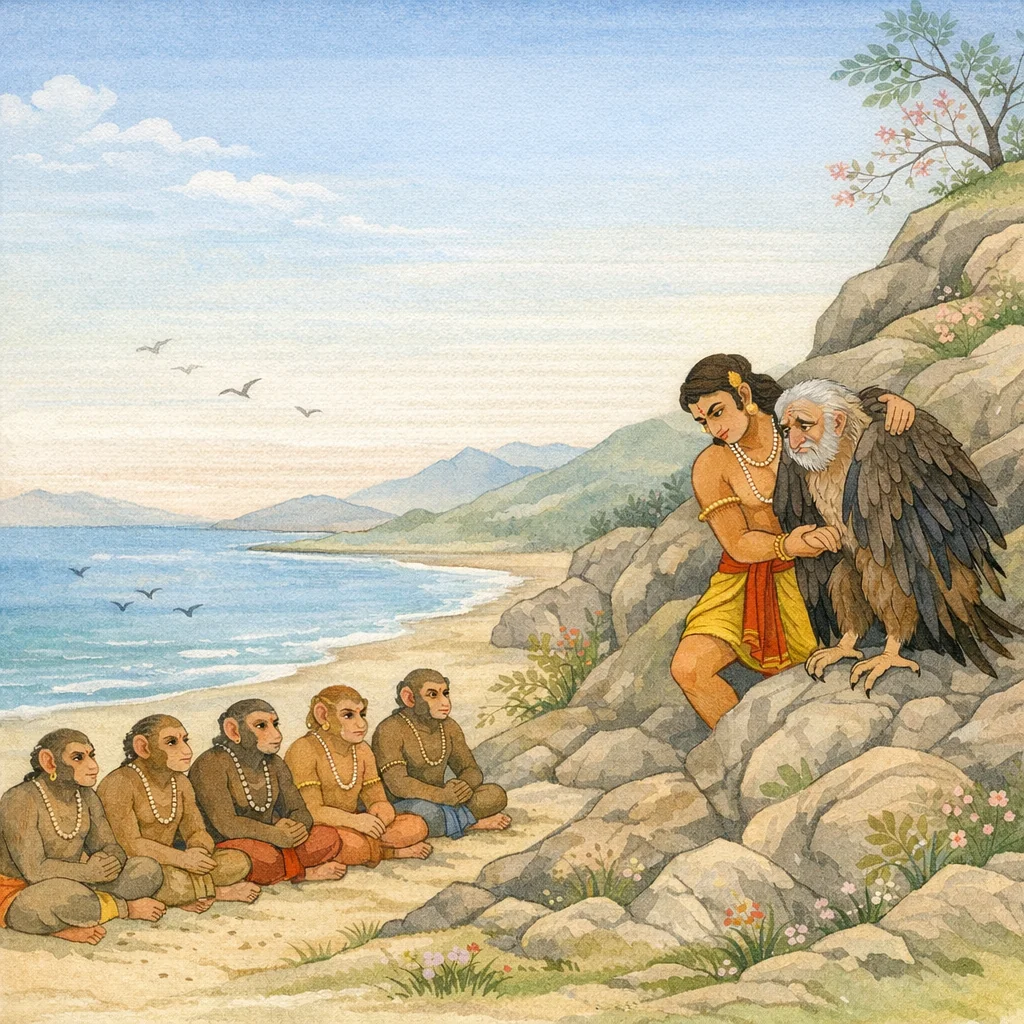
This sarga pivots from the Vānara party’s despair to a structured exchange of identity and memory. Hearing Angada’s words, the vulture Sampāti—sharp-beaked and loud-voiced—responds with grief upon the mention of his brother Jatāyu, requesting details of the Janasthāna encounter and asking to be helped down from the mountain due to wings burnt by the sun’s rays. The monkeys initially distrust him, fearing he may devour them while they fast unto death, and even rationalize that being eaten would ‘complete’ their objective by ending fear of returning late. Angada then brings Sampāti down and narrates lineage and alliances: Ṛkṣarāja as ancestral monkey-king; Sugrīva and Vālī as his sons; Angada’s filial link to Vālī; and Rama as the Ikṣvāku scion who entered Daṇḍaka with Lakshmana and Sītā under paternal command. Angada recounts Sītā’s abduction from Janasthāna, Jatāyu’s combat with Rāvaṇa, his death, and Rama’s funerary rites for him, before summarizing Rama’s friendship with Sugrīva, Vālī’s death, Sugrīva’s coronation, and the current search mission whose deadline has been exceeded—explaining why the party has undertaken prāya (fast unto death).
Shlokas
Verse 1
तत्तु श्रुत्वा तथा वाक्यमङ्गदस्य मुखोद्गतम्।अब्रवीद्वचनं गृध्रस्तीक्ष्णतुण्डो महास्वनः।।।।
After hearing those words spoken by Aṅgada, the vulture—sharp-beaked and loud-voiced—replied.
Verse 2
कोऽयं गिरा घोषयति प्राणैः प्रियतमस्य मे।जटायुषो वधं भ्रातुः कम्पयन्निव मे मनः।।।।
Who is this that proclaims aloud, by his very voice, the death of my dearest brother Jatāyu—shaking my heart as though it were trembling?
Verse 3
कथमासीज्जनस्थाने युद्धं राक्षसगृध्रयोः।नामधेयमिदं भ्रातुश्चिरस्याद्य मया श्रुतम्।।।।
After so long, I have heard my brother’s name today. Tell me—how did the battle between the demon and the vulture take place at Janasthāna?
Verse 4
इच्छेयं गिरिदुर्गाच्च भवद्भिरवतारितुम्।यवीयसो गुणज्ञस्य श्लाघनीयस्य विक्रमैः।।।।अतिदीर्घस्य कालस्य परितुष्टोऽस्मि परिकीर्तनात्।
I wish to be helped down from this inaccessible mountain. And I am deeply gratified—after a very long time—to hear the name of my younger brother, that discerning and virtuous one, praised for his valor.
Verse 5
तदिच्छेयमहं श्रोतुं विनाशं वानरर्षभाः।।।।भ्रातुर्जटायुषस्तस्य जनस्थाननिवासिनः।
Therefore, O best of vānaras, I wish to hear of the death of my brother Jaṭāyu, who lived at Janasthāna.
Verse 6
तस्यैव च मम भ्रातुस्सखा दशरथः कथम्।।।।यस्य रामः प्रियः पुत्रो ज्येष्ठो गुरुजनप्रियः।
And how did Daśaratha become a friend of that very brother of mine—Daśaratha whose beloved eldest son is Rāma, dear to all elders?
Verse 7
सूर्यांशुदग्धपक्षत्वान्न शक्नोम्युपसर्पितुम्।।।।इच्छेयं पर्वतादस्मादवतर्तु मरिन्दमाः।
O subduers of foes, because my wings have been scorched by the sun’s rays, I cannot move forward. I wish to descend from this mountain.
Verse 8
शोकाद्भ्रष्टस्वरमपि श्रुत्वा ते हरियूथपाः।श्रद्दधुर्नैव तद्वाक्यं कर्मणा तस्य शङ्किताः।।।।
Even though his voice was broken by grief, the monkey-leaders, on hearing him, did not trust his words; they suspected his intention.
Verse 9
ते प्रायमुपविष्टास्तु दृष्ट्वा गृध्रं प्लवङ्गमाः।चक्रुर्बुद्धिं तदा रौद्रां सर्वान्नो भक्षयिष्यति।।।।
Those monkeys, seated in their resolve to fast unto death, saw the vulture and formed a dreadful thought: “He will devour all of us.”
Verse 10
सर्वथा प्रायमासीनान्यदि नो भक्षयिष्यति।कृतकृत्या भविष्यामः क्षिप्रं सिद्धिमितो गताः।।।।
If he devours us while we have resolved to die, then in every way our purpose will be fulfilled—we shall quickly attain ‘completion’ by leaving this place.
Verse 11
एतां बुद्धिं ततश्चक्रुस्सर्वे ते वानरर्षभाः।अवतार्य गिरेश्शृङ्गाद्गृध्रमाहाङ्गदस्तदा।।।।
Having formed this resolve, all those foremost of monkeys then helped the vulture down from the mountain peak; and at that moment Aṅgada addressed him.
Verse 12
बभूवर्क्षरजा नाम वानरेन्द्रः प्रतापवान्।ममार्यः पार्थिवः पक्षिन् धार्मिक स्तस्य चात्मजौ।।।सुग्रीवश्चैव वाली च पुत्रावोघबलावुभौ।लोकेविश्रुतकर्माभूद्राजा वाली पिता मम।।।।
O bird, my revered forebear was the mighty monkey-king named Ṛkṣaraja, a righteous ruler. He had two sons—Sugrīva and Vālī—both of immense strength. My father, King Vālī, became famed in the world for his great deeds.
Verse 13
बभूवर्क्षरजा नाम वानरेन्द्रः प्रतापवान्।ममार्यः पार्थिवः पक्षिन् धार्मिक स्तस्य चात्मजौ।।4.57.12।सुग्रीवश्चैव वाली च पुत्रावोघबलावुभौ।लोकेविश्रुतकर्माभूद्राजा वाली पिता मम।।4.57.13।।
This verse reiterates the same statement: Aṅgada tells the bird Sampāti of his forebear Ṛkṣaraja, of Sugrīva and Vālī as his sons, and of Vālī—Aṅgada’s father—renowned for his deeds.
Verse 14
राजा कृत्स्नस्य जगत इक्ष्वाकूणां महारथः।रामो दाशरथिः श्रीमान्प्रविष्टो दण्डकावनम्।।।।लक्ष्मणेन सह भ्रात्रा वैदेह्या चापि भार्यया।पितुर्निदेशनिरतो धर्म्यं पन्थानमाश्रितः।।।।
Rāma—illustrious son of Daśaratha, great warrior of the Ikṣvāku line, ruler renowned to the world—entered the Daṇḍaka forest with his brother Lakṣmaṇa and his wife Vaidehī, intent on obeying his father’s command and walking the righteous path.
Verse 15
राजा कृत्स्नस्य जगत इक्ष्वाकूणां महारथः।रामो दाशरथिः श्रीमान्प्रविष्टो दण्डकावनम्।।4.57.14।।लक्ष्मणेन सह भ्रात्रा वैदेह्या चापि भार्यया।पितुर्निदेशनिरतो धर्म्यं पन्थानमाश्रितः।।4.57.15।।
This repeats the account of Rāma’s entry into the Daṇḍaka forest with Lakṣmaṇa and Vaidehī, emphasizing his obedience to his father’s command and adherence to the righteous path.
Verse 16
तस्य भार्या जनस्थानाद्रावणेन हृता बलात्।रामस्य तु पितुर्मित्रं जटायुर्नाम गृध्रराट्।।।।ददर्श सीतां वैदेहीं ह्रियमाणां विहायसा।
From Jana-sthāna, his wife was seized by force by Rāvaṇa. Jatāyu, the king of vultures and a friend of Rāma’s father, saw Sītā of Videha being carried away through the sky.
Verse 17
रावणं विरथं कृत्वा स्थापयित्वा च मैथिलीम्।परिश्रान्तश्च वृद्धश्च रावणेन हतो रणे।।।।
After stripping Rāvaṇa of his chariot and setting Maithilī down, Jatāyu—old and exhausted—was slain by Rāvaṇa in battle.
Verse 18
एवं गृध्रो हतस्तेन रावणेन बलीयसा।संस्कृतश्चापि रामेण गतश्च गतिमुत्तमाम्।।।।
Thus that vulture (Jatāyu) was slain by the mightier Rāvaṇa; and having been duly cremated by Rāma with the proper rites, he attained the highest state.
Verse 19
ततो मम पितृव्येण सुग्रीवेण महात्मना।चकार राघवस्सख्यं सोऽवधीत्पितरं मम।।।।
Then Rāghava (Rāma) formed a friendship with my paternal uncle, the great-souled Sugrīva; and he (Rāma) slew my father.
Verse 20
मम पित्रा विरुद्धो हि सुग्रीवस्सचिवैस्सह।निहत्य वालिनं रामस्ततस्तमभिषेचयत्।।।।
Sugrīva, together with his ministers, had indeed become hostile to my father; then Rāma, having slain Vālin, installed Sugrīva (as king).
Verse 21
स राज्ये स्थापितस्तेन सुग्रीवो वानराधिपः।राजा वानरमुख्यानां येन प्रस्थापिता वयम्।।।।
By him (Rāma), Sugrīva—the lord of the vānaras—was established in the kingdom; and by that king of the foremost monkeys, we were dispatched (on this mission).
Verse 22
एवं रामप्रयुक्तास्तु मार्गमाणास्ततस्ततः।वैदेहीं नाधिगच्छामो रात्रौ सूर्यप्रभामिव।।।।
Thus, though commissioned by Rāma, searching here and there, we could not find Vaidehī—like the sun’s radiance cannot be found in the night.
Verse 23
ते वयं दण्डकारण्यं विचित्य सुसमाहिताः।।।।अज्ञानात्तु प्रविष्टास्स्म धर्मिण्या विवृतं बिलम्।
After carefully searching the Daṇḍaka forest, we—fully attentive—unknowingly entered a cave that had been opened by a righteous female ascetic.
Verse 24
मयस्य मायाविहितं तद्बिलं च विचिन्वताम्।।।।व्यतीतस्तत्र नो मासो यो राज्ञा समयः कृतः।
While we were exploring that cave fashioned by Māyā (the architect) through magic, the month—set by the king as our deadline—elapsed there for us.
Verse 25
ते वयं कपिराजस्य सर्वे वचनकारिणः।।।।कृतां संस्थामतिक्रान्ता भयात्प्रायमुपास्महे।
We, all obedient to the monkey-king’s command, have exceeded the fixed term; therefore, out of fear, we have resolved to undertake prāya (fasting unto death).
Verse 26
क्रुद्धे तस्मिंस्तु काकुत्स्थे सुग्रीवे च सलक्ष्मणे।।।।गतानामपि सर्वेषां तत्र नो नास्ति जीवितम्।
For if that Kakutstha (Rāma) is enraged—and Sugrīva too, along with Lakṣmaṇa—then even should we return, there will be no life left for any of us.
Frequently Asked Questions
The Vānara leaders face a duty-versus-fear crisis: having exceeded Sugrīva’s deadline, they choose prāya (fasting unto death) rather than return in perceived dishonor, and they must also judge whether Sampāti is a mourner or a predator—testing trust under survival pressure.
The dialogue teaches disciplined discernment: grief can be acknowledged without surrendering to it, suspicion must be tempered by inquiry, and moral order is sustained through remembered obligations—friendship, lineage, and proper rites—especially when outcomes appear uncertain.
Janasthāna (site of abduction and combat), Daṇḍakāraṇya (the search terrain), the mountain peak where Sampāti is stranded, and the māyā-constructed cave attributed to Maya—each functioning as a navigational node in the search narrative and as a marker of cultural memory (exile, battle, and ritual closure).