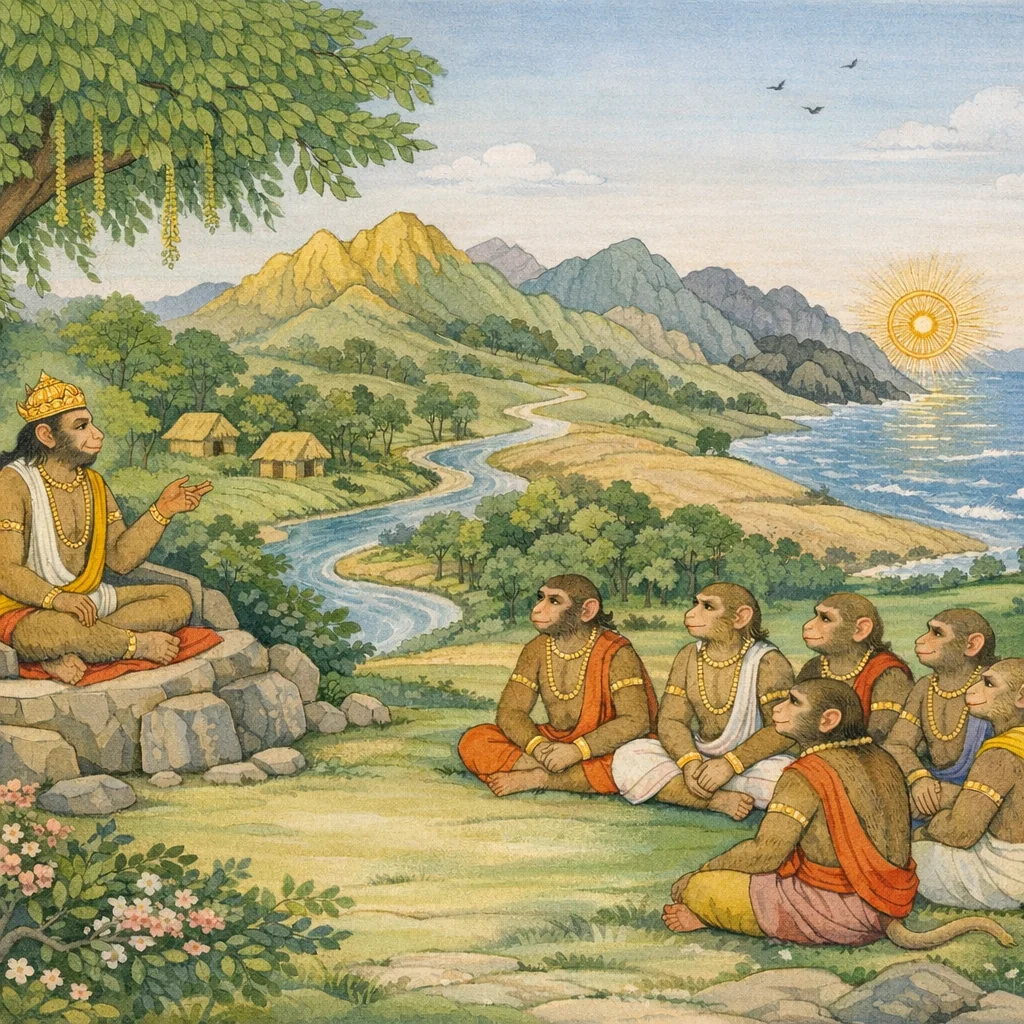
Sarga 42
पश्चिमदिशि अन्वेषणादेशः (Instructions for the Western Search Party)
किष्किन्धाकाण्ड
In this chapter, Sugriva formalizes the western expedition within the broader, multi-directional search for Sita. After dispatching forces elsewhere, he addresses troop-leaders and assigns a disciplined reconnaissance route through western-flowing rivers, ascetic groves, forests, mountains, deserts, and inaccessible ranges, culminating at the western ocean described as turbulent with aquatic dangers. The discourse functions as a logistical map: it lists regions, towns, and ecological markers (ketaka, tamāla, coconut groves), and then escalates into mytho-geographic nodes—Hemagiri at the Sindhu–ocean confluence, the Pariyātra peak, the Vajra mountain with caves, and Chakravān with Viśvakarmā’s thousand-spoked wheel and Viṣṇu’s recovery of conch and discus. It further names Varāha mountain in the deep sea as Varuṇa’s domain and locates Pragjyotiṣa, home of the demon Naraka. The narrative includes operational cautions (avoid provoking powerful gandharvas; do not take protected fruits), behavioral guidance (remain ‘as normal monkeys’ to avoid conflict), and a strict time boundary: return within one month to the Asta mountain region. The sarga thus integrates ethical restraint, command hierarchy, and a layered sacred geography into a coherent search protocol.
Shlokas
Verse 1
अथ प्रस्थाप्य सुग्रीवस्तान्हरीन्दक्षिणां दिशम्।अब्रवीन्मेघसङ्काशं सुषेणं नाम यूथपम्।।4.42.1।।
After sending those monkeys toward the southern direction, Sugrīva spoke to the troop-leader named Suṣeṇa, who was cloud-like in appearance.
Verse 2
तारायाः पितरं राजा श्वशुरं भीमविक्रमम्।अब्रवीत्प्राञ्जलिर्वाक्यमभिगम्य प्रणम्य च।।4.42.2।।
Then King Sugrīva approached Tārā’s father—his own formidable father-in-law—saluted him with folded hands, and spoke these words.
Verse 3
मरीचिपुत्रं मारीचमर्चिष्मन्तं महाकपिम्।वृतं कपिवरै श्शूरैर्महेन्द्रसदृशद्युतिम्।।4.42.3।।बुद्धिविक्रमसम्पन्नं वैनतेयसमद्युतिम्।मरीचिपुत्रान्मारीचानर्चिर्मालान्महाबलान्।।4.42.4।।ऋषिपुत्रांश्चतांत्सर्वान्प्रतीचीमादिशद्दिशम्।
Sugrīva addressed the great monkey Arcismān, son of Marīci—radiant like Indra and surrounded by heroic leaders of the Vānara hosts. He also instructed the mighty Marīcas—sons of Marīci, famed as Arcirmālās, endowed with intellect and valor and shining like Vainateya (Garuḍa).
Verse 4
मरीचिपुत्रं मारीचमर्चिष्मन्तं महाकपिम्।वृतं कपिवरै श्शूरैर्महेन्द्रसदृशद्युतिम्।।4.42.3।।बुद्धिविक्रमसम्पन्नं वैनतेयसमद्युतिम्।मरीचिपुत्रान्मारीचानर्चिर्मालान्महाबलान्।।4.42.4।।ऋषिपुत्रांश्चतांत्सर्वान्प्रतीचीमादिशद्दिशम्।
Sugrīva addressed the great monkey Arcismān, son of Marīci—radiant like Indra and surrounded by heroic leaders of the Vānara hosts. He also instructed the mighty Marīcas—sons of Marīci, famed as Arcirmālās, endowed with intellect and valor and shining like Vainateya (Garuḍa).
Verse 5
द्वाभ्यां शतसहस्राभ्यां कपीनां कपिसत्तमाः।।4.42.5।।सुषेणप्रमुखा यूयं वैदेहीं परिमार्गतः।
O best of monkeys—let you, led by Suṣeṇa, along with two hundred thousand vānaras, search everywhere for Vaidehī (Sītā).
Verse 6
सुराष्ट्रान्सहबाह्लीकान् श्चन्द्रचित्रांस्तथैव च।।4.42.6।।स्फीताञ्जनपदान्रम्यान्विपुलानि पुराणि च।पुन्नागगहनं कुक्षिं वकुलोद्दालकाकुलम्।।4.42.7।।तथा केतकषण्डांश्च मार्गध्वं हरियूथपाः।
O leaders of the monkey troops, search for Sītā in Surāṣṭra, in Bāhlīka, and likewise in Candra-citrā; in prosperous and delightful settlements and in extensive towns; in Kukṣi thick with puṃnāga groves and crowded with vakula and uddālaka trees; and also among thickets of ketaka.
Verse 7
सुराष्ट्रान्सहबाह्लीकान् श्चन्द्रचित्रांस्तथैव च।।4.42.6।।स्फीताञ्जनपदान्रम्यान्विपुलानि पुराणि च।पुन्नागगहनं कुक्षिं वकुलोद्दालकाकुलम्।।4.42.7।।तथा केतकषण्डांश्च मार्गध्वं हरियूथपाः।
O monkeys, there are auspicious rivers with cool waters that flow westward. Search the hermits’ forests, the wild tracts and mountains there; the arid stretches of land and the rocky heights with lofty peaks. Having searched that difficult western region encircled by mountain ranges, you should then reach and behold the western ocean—its waters teeming with whales and crocodiles, and hard to stir.
Verse 8
प्रत्यक्स्रोतोगमाश्चैव नद्यश्शीतजलाश्शिवाः।।4.42.8।।तापसानामरण्यानि कान्तारा गिरयश्च ये।तत्रस्थलीं मरुप्रायामत्युच्चशिरसश्शिलाः।।4.42.9।।गिरिजालावृतां दुर्गां मार्गित्वा पश्चिमां दिशम्।ततः पश्चिममासाद्य समुद्रं द्रष्टुमर्हथ।।4.42.10।।तिमिनक्रायुतजलमक्षोभ्यमथ वानराः।
O monkeys, there are auspicious rivers with cool waters that flow westward. Search the hermits’ forests, the wild tracts and mountains there; the arid stretches of land and the rocky heights with lofty peaks. Having searched that difficult western region encircled by mountain ranges, you should then reach and behold the western ocean—its waters teeming with whales and crocodiles, and hard to stir.
Verse 9
प्रत्यक्स्रोतोगमाश्चैव नद्यश्शीतजलाश्शिवाः।।4.42.8।।तापसानामरण्यानि कान्तारा गिरयश्च ये।तत्रस्थलीं मरुप्रायामत्युच्चशिरसश्शिलाः।।4.42.9।।गिरिजालावृतां दुर्गां मार्गित्वा पश्चिमां दिशम्।ततः पश्चिममासाद्य समुद्रं द्रष्टुमर्हथ।।4.42.10।।तिमिनक्रायुतजलमक्षोभ्यमथ वानराः।
Endowed with wisdom and valor, you should thoroughly search these forest-fastnesses, the rivers, and the mountain ranges.
Verse 10
प्रत्यक्स्रोतोगमाश्चैव नद्यश्शीतजलाश्शिवाः।।4.42.8।।तापसानामरण्यानि कान्तारा गिरयश्च ये।तत्रस्थलीं मरुप्रायामत्युच्चशिरसश्शिलाः।।4.42.9।।गिरिजालावृतां दुर्गां मार्गित्वा पश्चिमां दिशम्।ततः पश्चिममासाद्य समुद्रं द्रष्टुमर्हथ।।4.42.10।।तिमिनक्रायुतजलमक्षोभ्यमथ वानराः।
Having searched the difficult western quarter, enclosed by networks of mountains, you should then reach the western ocean and behold it—its waters teeming with whales and crocodiles, and hard to disturb, O monkeys.
Verse 11
ततः केतकषण्डेषु तमालगहनेषु च।।4.42.11।।कपयो विहरिष्यन्ति नारिकेलवनेषु च।
Thereafter, the monkeys will roam through clumps of ketaka shrubs, dense tamāla thickets, and also coconut groves (as they continue the search).
Verse 12
तत्र सीतां च मार्गध्वं निलयं रावणस्य च।।4.42.12।।वेलातलनिविष्टेषु पर्वतेषु वनेषु च।मुरचीपत्तनं चैव रम्यं चैव जटीपुरम्।।4.42.13।।अवन्तीमङ्गलोपां च तथा चालक्षितं वनम्।राष्ट्राणि च विशालानि पत्तनानि ततस्ततः।।4.42.14।।
There, search for Sītā—and also for Rāvaṇa’s dwelling—among the mountains and forests situated along the seashore tracts.
Verse 13
तत्र सीतां च मार्गध्वं निलयं रावणस्य च।।4.42.12।।वेलातलनिविष्टेषु पर्वतेषु वनेषु च।मुरचीपत्तनं चैव रम्यं चैव जटीपुरम्।।4.42.13।।अवन्तीमङ्गलोपां च तथा चालक्षितं वनम्।राष्ट्राणि च विशालानि पत्तनानि ततस्ततः।।4.42.14।।
Search also in Muracī-pattana, and in the lovely city called Jaṭīpura.
Verse 14
तत्र सीतां च मार्गध्वं निलयं रावणस्य च।।4.42.12।।वेलातलनिविष्टेषु पर्वतेषु वनेषु च।मुरचीपत्तनं चैव रम्यं चैव जटीपुरम्।।4.42.13।।अवन्तीमङ्गलोपां च तथा चालक्षितं वनम्।राष्ट्राणि च विशालानि पत्तनानि ततस्ततः।।4.42.14।।
Search in Avantī and in Maṅgalopā, and likewise in that unmarked (hard-to-notice) forest; and look through vast kingdoms and cities here and there as well.
Verse 15
सिन्धुसागरयोश्चैव सङ्गमे तत्र पर्वतः।महान्हेमगिरिर्नाम शतशृङ्गो महाद्रुमः।।4.42.15।।
At the confluence of the Sindhu river and the sea stands a great mountain called Hemagiri, with a hundred peaks and mighty trees.
Verse 16
तस्य प्रस्थेषु रम्येषु सिंहाः पक्षगमाः स्थिताः।तिमिमत्स्यगजांश्चैव नीडान्यारोपयन्ति ते।।4.42.16।।
On its lovely slopes dwell lions called Pakṣagamā—winged lions—who carry whales, fish, and even elephants from the sea up into their lairs.
Verse 17
तानि नीडानि सिंहानां गिरिशृङ्गगताश्च ये।दृप्तास्तृप्ताश्च मातङ्गास्तोयदस्वननिस्वनाः।।4.42.17।।विचरन्ति विशालेऽस्मिंस्तोयपूर्णे समन्ततः।
In those lion-dens upon the mountain peaks roam proud and well-sated elephants, resounding like thunderclouds, moving about on every side across that vast, water-filled expanse.
Verse 18
तस्य शृङ्गं दिवस्पर्शं काञ्चनं चित्रपादपम्।।4.42.18।।सर्वमाशु विचेतव्यं कपिभिः कामरूपिभिः।
That sky-touching golden peak, filled with variegated trees—let it all be swiftly and carefully searched by the monkeys who can assume forms at will.
Verse 19
कोटिं तत्र समुद्रे तु काञ्चनीं शतयोजनाम्।।4.42.19।।दुर्दर्शां पारियात्रस्य गतां द्रक्ष्यथ वानराः।
O monkeys, there—at the sea’s end—you will behold the dazzling golden extremity of Pariyātra, stretching a hundred yojanas, hard to gaze upon because of its brilliance.
Verse 20
कोट्यस्तत्र चतुर्विंशद्गन्धर्वाणां तपस्विनाम्।।4.42.20।।वसन्त्यग्निनिकाशानां घोराणां कामरूपिणाम्।
There dwell twenty-four crores of Gandharvas, living an austere life—terrifying in aspect, blazing like fire, and able to assume forms at will.
Verse 21
पावकार्चिः प्रतीकाशास्समवेतास्सहस्रशः।।4.42.21।।नात्यासादयितव्यास्ते वानरैर्भीमविक्रमैः।
Gathered there in thousands and radiant with a fire-like glow, they should not be approached too closely—even by monkeys of fearsome valor.
Verse 22
नादेयं च फलं तस्माद्देशात्किञ्चित् प्लवङ्गमैः।।4.42.22।।दुरासदा हि ते वीरा स्सत्त्ववन्तो महाबलाः।फलमूलानि ते तत्र रक्षन्ते भीमविक्रमाः।।4.42.23।।
From that region you must not take even a little fruit; for those heroes are difficult to approach—courageous and mighty in strength.
Verse 23
नादेयं च फलं तस्माद्देशात्किञ्चित् प्लवङ्गमैः।।4.42.22।।दुरासदा हि ते वीरा स्सत्त्ववन्तो महाबलाः।फलमूलानि ते तत्र रक्षन्ते भीमविक्रमाः।।4.42.23।।
There those of dreadful prowess guard the fruits and roots.
Verse 24
तत्र यत्नश्च कर्तव्यो मार्गितव्या च जानकी।न हि तेभ्यो भयं किञ्चित्कपित्वमनुवर्तताम्।।4.42.24।।
There you must make your effort and continue the search for Jānakī; for there is no danger from them, so long as you keep to natural monkey-like behavior.
Verse 25
तत्र वैढूर्यवर्णाभो वज्रसंस्थानसंस्थितः।नानाद्रुमलताकीर्णो वज्रो नाम महागिरिः।।4.42.25।।श्रीमान्समुदितस्तत्र योजनानां शतं समम्।गुहास्तत्र विचेतव्या प्रयत्नेन प्लवङ्गमाः ।।4.42.26।।
Beyond that lies the great mountain named Vajra—gleaming with the hue of vaidūrya, firm as a diamond in its formation, and thickly covered with diverse trees and creepers.
Verse 26
तत्र वैढूर्यवर्णाभो वज्रसंस्थानसंस्थितः।नानाद्रुमलताकीर्णो वज्रो नाम महागिरिः।।4.42.25।।श्रीमान्समुदितस्तत्र योजनानां शतं समम्।गुहास्तत्र विचेतव्या प्रयत्नेन प्लवङ्गमाः ।।4.42.26।।
That splendid mountain rises there, stretching evenly for a hundred yojanas; and there, O monkeys, its caves must be searched with careful effort.
Verse 27
चतुर्भागे समुद्रस्य चक्रवान्नाम पर्वतः।तत्र चक्रं सहस्रारं निर्मितं विश्वकर्मणा।।4.42.27।।
In the western sea’s quarter-region stands a mountain called Cakravan; there is a thousand-spoked wheel fashioned by Viśvakarman.
Verse 28
तत्र पञ्चजनं हत्वा हयग्रीवं च दानवम्।आजहार ततश्चक्रं शङ्खं च पुरुषोत्तमः।।4.42.28।।
There the Supreme Lord, having slain the demon Hayagrīva and Pañcajana, recovered for himself the discus and the conch.
Verse 29
तस्य सानुषु चित्रेषु विशालासु गुहासु च।रावण स्सह वैदेह्या मार्गितव्यस्तत स्ततः।।4.42.29।।
On its variegated slopes and within its broad caves, search here and there for Rāvaṇa together with Vaidehī.
Verse 30
योजनानां चतुष्षष्टिर्वराहो नाम पर्वतः।सुवर्णशृङ्गस्सुश्रीमा नगाधे वरुणालये।।4.42.30।।
Plunging into the deep ocean—the abode of Varuṇa—you will find a splendid mountain named Varāha, golden-peaked and stretching for sixty-four yojanas.
Verse 31
तत्र प्राग्ज्योतिषं नाम जातरूपमयं पुरम्।यस्मिन्वसति दुष्टात्मा नरको नाम दानवः।।4.42.31।।
There is a city called Prāgjyotiṣa, made of gold; in it dwells the evil-souled Dānava named Naraka.
Verse 32
तत्र सानुषु चित्रेषु विशालासु गुहासु च।रावणस्सह वैदेह्या मार्गितव्यस्ततस्ततः।।4.42.32।।
There, on the wondrous slopes and in the vast caves, you must search everywhere for Rāvaṇa together with Vaidehī.
Verse 33
तमतिक्रम्य शैलेन्द्रं काञ्चनान्तरनिर्दरः।पर्वत स्सर्वसौवर्णो धाराप्रस्रवणायुतः।।4.42.33।।
After crossing that lordly mountain with inner caves gleaming with gold, you will come to another mountain wholly golden, abundant with cascades and streams.
Verse 34
तं गजाश्च वराहाश्च सिंह व्याघ्राश्च सर्वतः।अभिगर्जन्ति सततं तेन शब्देन दर्पिताः।।4.42.34।।
There, elephants and boars, lions and tigers roar on all sides—ever emboldened by their own resounding cries.
Verse 35
यस्मिन्हरिहय्शीमान्महेन्द्रः पाकशासनः।अभिषिक्तः सुरै राजा मेघवान्नाम पर्वतः।।4.42.35।।
On that mountain, the splendid Mahendra—Pākaśāsana, king of the gods—was consecrated; therefore the mountain is called Meghavān.
Verse 36
तमतिक्रम्य शैलेन्द्रं महेन्द्रपरिपालितम्।षष्टि र्गिरिसहस्राणि काञ्चनानि गमिष्यथ।।4.42.36।।तरुणादित्यवर्णानि भ्राजमानानि सर्वतः।जातरूपमयैर्वृक्षै शोभितानि सुपुष्पितैः।।4.42.37।।
After crossing that lord of mountains guarded by Indra, you will reach sixty thousand golden peaks, shining everywhere like the hue of the rising sun—adorned with golden trees in full bloom.
Verse 37
तमतिक्रम्य शैलेन्द्रं महेन्द्रपरिपालितम्।षष्टि र्गिरिसहस्राणि काञ्चनानि गमिष्यथ।।4.42.36।।तरुणादित्यवर्णानि भ्राजमानानि सर्वतः।जातरूपमयैर्वृक्षै शोभितानि सुपुष्पितैः।।4.42.37।।
After crossing that lord of mountains guarded by Indra, you will reach sixty thousand golden peaks, shining everywhere like the hue of the rising sun—adorned with golden trees in full bloom.
Verse 38
तेषां मध्ये स्थितो राजा मेरुरुत्तरपर्वतः।आदित्येन प्रसन्नेन शैलो दत्तवरः पुरा।।4.42.38।।
Among those peaks stands Meru, king of mountains—the northern mountain—once granted a boon by the gracious Sun (Āditya).
Verse 39
तेनैव मुक्तश्शैलेन्द्रस्सर्व एव त्वदाश्रयाः।मत्प्रसादाद्भविष्यन्ति दिवा रात्रं च काञ्चनाः।।4.42.39।।त्वयि ये चापि वत्स्यन्ति देवगन्धर्वदानवाः।ते भविष्यन्ति रक्ताश्च प्रभया काञ्चनप्रभाः।।4.42.40।।
Thus addressed, the lordly mountain (Meru was told): by my grace, all who take shelter in you will become golden—by day and by night.
Verse 40
तेनैव मुक्तश्शैलेन्द्रस्सर्व एव त्वदाश्रयाः।मत्प्रसादाद्भविष्यन्ति दिवा रात्रं च काञ्चनाः।।4.42.39।।त्वयि ये चापि वत्स्यन्ति देवगन्धर्वदानवाः।ते भविष्यन्ति रक्ताश्च प्रभया काञ्चनप्रभाः।।4.42.40।।
And those gods, Gandharvas, and Dānavas who dwell upon you will, by that radiance, appear crimson-tinged and yet shining with a golden luster.
Verse 41
विश्वे देवाश्च मरूतो वसवश्च दिवौकसः।आगम्य पश्चिमां सन्ध्यां मेरुमुत्तमपर्वतम्।।4.42.41।।आदित्यमुपतिष्ठन्ति तैश्च सूर्योऽभिपूजितः।अदृश्यस्सर्वभूतानामस्तं गच्छतिपर्वतम्।।4.42.42।।
At evening twilight, the Viśvedevas, the Maruts, the Vasus, and other celestial beings come to Meru, the most excellent of mountains.
Verse 42
विश्वे देवाश्च मरूतो वसवश्च दिवौकसः।आगम्य पश्चिमां सन्ध्यां मेरुमुत्तमपर्वतम्।।4.42.41।।आदित्यमुपतिष्ठन्ति तैश्च सूर्योऽभिपूजितः।अदृश्यस्सर्वभूतानामस्तं गच्छतिपर्वतम्।।4.42.42।।
They attend upon Āditya; and the Sun, duly worshipped by them, goes to the mountain of setting and becomes invisible to all beings.
Verse 43
योजनानां सहस्राणि दश तानि दिवाकरः।मुहूर्तार्धेन तं शीघ्रमभियाति शिलोच्चयम्।।4.42.43।।
The Sun swiftly reaches that mountain mass—covering ten thousand yojanas in half a muhūrta.
Verse 44
शृङ्गे तस्य महद्दिव्यं भवनं सूर्यसन्निभम्।प्रासादगणसम्बाधं विहितं विश्वकर्मणा।।4.42.44।।
On that mountain’s peak stands a vast, divine abode, radiant like the Sun—densely adorned with many palatial structures, fashioned by Viśvakarman.
Verse 45
शोभितं तरुभिश्चित्रैर्नानापक्षिसमाकुलैः।निकेतं पाशहस्तस्य वरुणस्य महात्मनः।।4.42.45।।
That enchanting place—adorned with variegated trees and crowded with many kinds of birds—is the residence of the great-souled Varuṇa, bearer of the noose.
Verse 46
अन्तरा मेरुमस्तं च तालो दशशिरा महान्।जातरूपमय्शीमान्भ्राजते चित्रवेदिकः।।4.42.46।।
Between Meru and the mountain of sunset (Asta) shines a magnificent palm-tree—golden in substance, glorious, with ten lofty ‘heads’ (summits), and adorned with wondrous altars.
Verse 47
तेषु सर्वेषु दुर्गेषु सरस्सु च सरित्सु च।रावणस्सह वैदेह्या मार्गितव्यस्तत स्ततः।।4.42.47।।
Between Meru and the mountain of sunset (Asta) shines a magnificent palm-tree—golden in substance, glorious, with ten lofty ‘heads’ (summits), and adorned with wondrous altars.
Verse 48
यत्र तिष्ठति धर्मज्ञस्तपसा स्वेन भावितः।मेरुसावर्णिरित्येव ख्यातो वै ब्रह्मणा समः।।4.42.48।।
There dwells Merusāvarṇi—one who knows dharma, refined by his own austerities—renowned indeed as being equal to Brahmā.
Verse 49
प्रष्टव्यो मेरुसावर्णिर्महर्षिः सूर्यसन्निभः।प्रणम्य शिरसा भूमौ प्रवृत्तिं मैथिलीं प्रति।।4.42.49।।
That great seer Merusāvarṇi, radiant like the sun, should be questioned—after bowing with your head to the ground—about news concerning Maithilī (Sītā).
Verse 50
एताव ज्जीवलोकस्य भास्करो रजनीक्ष्ये।कृत्वा वितिमिरं सर्वमस्तं गच्छति पर्वतम्।।4.42.50।।
Only up to this extent lies the realm of living beings: at the end of the night, the Sun makes all things free of darkness, and then proceeds to the mountain of his setting.
Verse 51
एतावद्वानरैश्शक्यं गन्तुं वानरपुङ्गवाः।अभास्करममर्यादं न जानीमस्ततः परम्।।4.42.51।।
O leaders among monkeys, only up to this point can vānaras go; beyond it is sunless and without discernible bounds—we do not know what lies further.
Verse 52
अधिगम्य तु वैदेहीं निलयं रावणस्य च।अस्त पर्वतमासाद्य पूर्णे मासे निवर्तत।।4.42.52।।
Having ascertained Vaidehī (Sītā) and also Rāvaṇa’s dwelling-place, reach the mountain of sunset and return when a full month is completed.
Verse 53
ऊर्ध्वं मासान्न वस्तव्यं वसन् वध्यो भवेन्मम।सहैव शूरो युष्माभिश्श्वशुरो मे गमिष्यति।।4.42.53।।
Do not remain beyond a month; if you stay on, you would become liable to punishment by me. Along with you, my brave father-in-law will also go.
Verse 54
श्रोतव्यं सर्वमेतस्य भवद्भिर्दिष्टकारिभिः।गुरुरेष महाबाहुश्श्वशुरो मे महाबलः।।4.42.54।।
You, who are appointed to carry out orders, should heed everything he says. This mighty-armed, very powerful man—my father-in-law—is your elder and guide.
Verse 55
भवन्तश्चापि विक्रान्ताः प्रमाणं सर्व कर्मसु।प्रमाणमेनं संस्थाप्य पश्यध्वं पश्चिमां दिशम्।।4.42.55।।
You too are valiant, and in all undertakings you require an authority: establish him as the decisive authority and then proceed to search in the western direction.
Verse 56
When the wife of that king of immeasurable splendor is seen, we shall have accomplished our purpose—by repaying in return the help that was done.
Verse 57
अथ प्रस्थाप्य सुग्रीवस्तान्हरीन्दक्षिणां दिशम्।अब्रवीन्मेघसङ्काशं सुषेणं नाम यूथपम्।।4.42.1।।
Therefore, whatever further action is to be done—if it is beneficial to this mission—should be undertaken by you only after careful deliberation, and in a way that accords with place, time, and purpose.
Verse 58
अथ प्रस्थाप्य सुग्रीवस्तान्हरीन्दक्षिणां दिशम्।अब्रवीन्मेघसङ्काशं सुषेणं नाम यूथपम्।।4.42.1।।
Then the monkeys led by Suṣeṇa, having attentively heard Sugrīva’s skillful instructions, took leave of the lord of the monkeys and set out toward that direction protected by Varuṇa.
Frequently Asked Questions
The key action is Sugriva’s imposition of disciplined conduct during reconnaissance: the vanaras must search rigorously yet avoid unethical appropriation (e.g., not plucking protected fruits) and must not provoke formidable ascetics/gandharvas—balancing mission success with restraint.
Purposeful action must be governed by deśa–kāla–artha (place–time–objective suitability): success in a righteous mission depends not only on courage but also on measured behavior, respect for guarded domains, and adherence to command structure and deadlines.
The sarga foregrounds a western itinerary: west-flowing rivers; ascetic groves; deserts and inaccessible mountain-rings; the western ocean under Varuṇa; and mytho-geographic sites such as Hemagiri (Sindhu–sea confluence), Pariyātra’s golden tip, Vajra mountain caves, Chakravān with Viśvakarmā’s wheel, Varāha mountain (Varuṇa’s realm), and Pragjyotiṣa (Naraka’s city).