Sarga 19
ताराविलापः — Tara’s Lament and Counsel after Vali’s Fall
किष्किन्धाकाण्ड
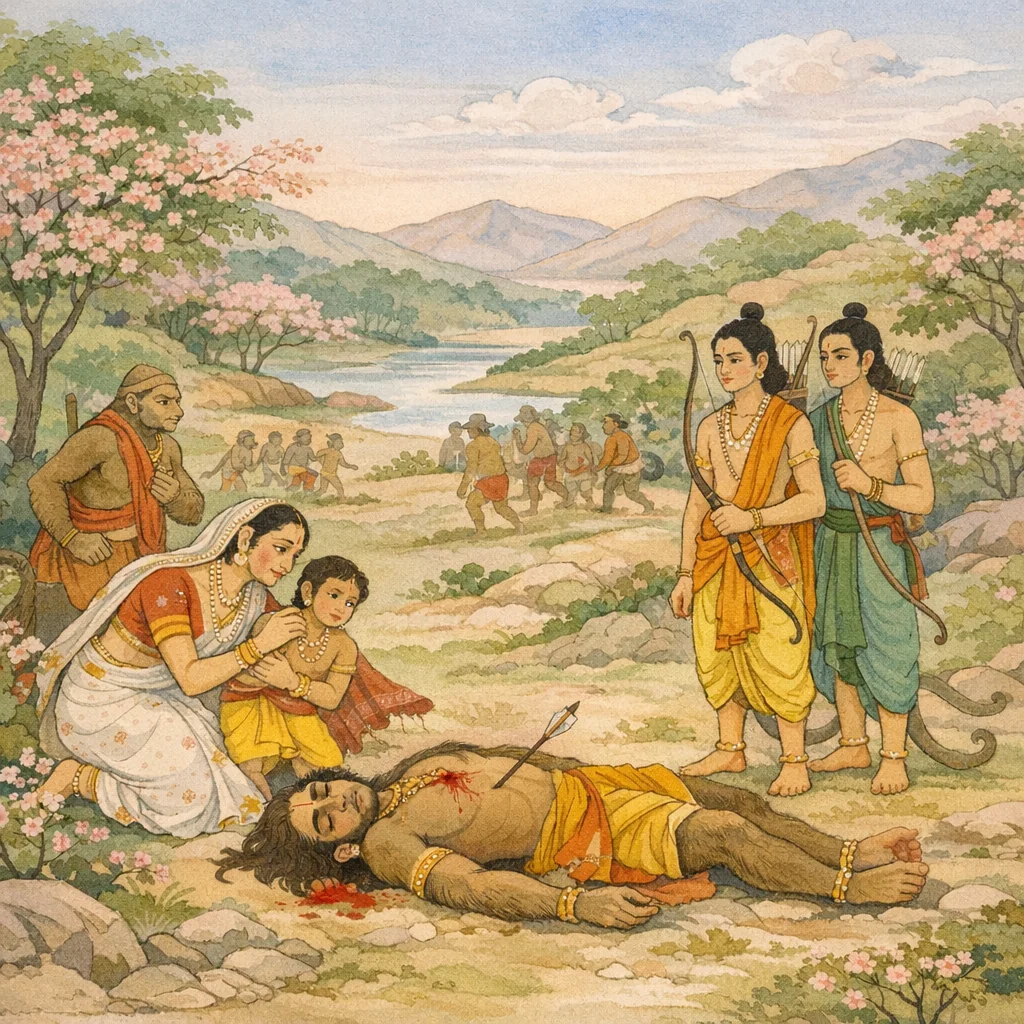
This sarga stages the immediate aftermath of Vāli’s mortal wounding by Rāma’s arrow. Vāli, lying on the ground and nearing death, is unable to respond further to Rāma’s reasoned replies (4.19.1–2), marking a rhetorical closure to the dispute and a transition into public mourning. Tārā hears of Vāli’s death, rushes out with Aṅgada, and witnesses the vanara troops scattering in fear at the sight of bow-bearing Rāma (4.19.3–6). She confronts the fleeing monkeys, questioning their desertion of their king and framing the event within the politics of kingship and fraternal rivalry (4.19.7–9). The vanaras answer with urgent, pragmatic counsel: protect Aṅgada, secure the city gate, and perform consecration to stabilize succession; they also warn of internal disorder from displaced forest-wandering monkeys (4.19.10–16). Tārā rejects purely political consolation, declaring that without her husband neither son, kingdom, nor life has meaning, and she resolves to approach the dying Vāli (4.19.18–20). She then beholds Vāli in a sequence of elevated similes (cloud, lion, chaitya destroyed by Garuḍa), and also sees Rāma, Lakṣmaṇa, and Sugrīva nearby (4.19.21–25). Overcome by grief, she collapses, rises lamenting “Āryaputra,” and her wailing affects Sugrīva, especially as Aṅgada arrives in despair (4.19.26–28). The chapter’s thematic core is the collision of राजधर्म (succession, security) with शोक-धर्म (mourning, conjugal fidelity), presented through dialogue plus high-poetic imagery.
Shlokas
Verse 1
स वानरमहाराजश्शयानश्शरविक्षतः।प्रत्युक्तो हेतुमद्वाक्यैर्नोत्तरं प्रत्यपद्यत।।
That great king of monkeys, lying on the ground and pierced by the arrow, though answered with reasoned words, found no reply to give.
Verse 2
अश्मभिः प्रविभिन्नाङ्गः पादपैराहतो भृशम्।रामबाणेन चाक्रान्तो जीवितान्ते मुमोह सः।।
His limbs torn by stones, struck hard with trees, and overwhelmed by Rāma’s arrow, he lost consciousness as life drew to its end.
Verse 3
तं भार्या बाणमोक्षेण रामदत्तेन संयुगे।हतं प्लवगशार्दूलं तारा शुश्राव वालिनम्।।
Tārā, Vāli’s wife, heard that Vāli—the tiger among the monkeys—had been slain in battle by the arrow released by Rāma.
Verse 4
सा सपुत्राप्रियं श्रुत्वा वधं भर्तुस्सुदारुणम्।निष्पपात भृशं तस्माद्विविधा गिरिगह्वरात्।।
Hearing the grievous, unwelcome tidings—her husband’s terrible slaying—Tārā rushed out in great distress from that mountain cave, together with her son.
Verse 5
ये त्वङ्गदपरीवारा वानरा भीमविक्रमाः।ते सकार्मुकमालोक्य रामं त्रस्ताः प्रदुद्रुवुः।।
But the mighty monkey-warriors who formed Aṅgada’s escort, seeing Rāma with his bow, were terrified and fled in all directions.
Verse 6
सा ददर्श ततस्त्रस्तान्हरीनापततो भृशम्।यूथादिव परिभ्रष्टान्मृगान्निहतयूथपान्।।
Then she saw the monkeys, panic-stricken, rushing wildly—like deer scattered from their herd when their leader has been slain.
Verse 7
तानुवाच समासाद्य दुःखितान्दुखिता सती।रामवित्रासितान्सर्वाननुबद्धानिवेषुभिः।।
Tārā herself, grieving, approached those grief-stricken monkeys—who were all terrified of Rāma, fleeing as though arrows were pursuing them from behind—and spoke to them.
Verse 8
वानराः राजसिंहस्य यस्य यूयं पुरस्सराः।तं विहाय सुसन्त्रस्ताः कस्माद्द्रवथ दुर्गताः।।
“O monkeys! You who go before the lion among kings—why, abandoning him, do you run in misery, utterly frightened?”
Verse 9
राज्यहेतोस्स चेद्भ्राता भ्रात्रा रौद्रेण पातितः।रामेण प्रहितैरौद्रैर्मार्गणैर्दूरपातिभिः।।
“If, for the sake of kingship, that brother has indeed been struck down by his own brother in wrath—by Rāma’s fierce, far-flying arrows—why do you run?”
Verse 10
कपिपत्न्या वचश्श्रुत्वा कपयः कामरूपिणः।प्राप्तकालमविक्लिष्टमूचुर्वचनमङ्गनाम्।।
Hearing the words of the monkey-king’s wife (Tārā), the monkeys—able to assume forms at will—spoke to the lady with clear words suited to the moment.
Verse 11
जीवपुत्रे निवर्तस्व पुत्रं रक्षस्व चाङ्गदम्।अन्तको रामरूपेण हत्वा नयति वालिनम्।।
“O mother whose son yet lives, turn back; protect your son Aṅgada. Death himself, in the form of Rāma, has slain Vāli and is carrying him away.”
Verse 12
क्षिप्तान् वृक्षान्समाविध्य विपुलाश्च शिलास्तथा।वाली वज्रसमैर्बाणै रामेण विनिपातितः।।
After striking down the trees that were hurled and the massive rocks as well, Vāli was felled by Rāma with arrows like thunderbolts.
Verse 13
अभिद्रुतमिदं सर्वं विद्रुतं प्रसृतं बलम्।अस्मिन् प्लवगशार्दूले हते शक्रसमप्रभे।।
When that tiger among monkeys—radiant like Śakra (Indra)—was slain, the entire monkey host became terrified, scattered, and fled in all directions.
Verse 14
रक्ष्यतां नगरद्वारमङ्गदश्चाभिषिच्यताम्।पदस्थं वालिनः पुत्रं भजिष्यन्ति प्लवङ्गमाः।।
“Let the city-gate be secured, and let Aṅgada be consecrated. When Vāli’s son is established in the royal station, the monkeys will serve him.”
Verse 15
अथवाऽरुचितं स्थानमिह ते रुचिरानने।आविशन्ति हि दुर्गाणि क्षिप्रमन्यानि वानराः।।
“Or else, O lovely-faced one, if this arrangement is not acceptable to you, other monkeys will quickly seize these strongholds.”
Verse 16
अभार्याश्च सभार्याश्च सन्त्यत्र वनचारिणः।लुब्धेभ्यो विप्रयुक्तेभ्यस्तेभ्यो नस्तुमुलं भयम्।।
“Here are forest-roaming monkeys—some without wives and some with wives; some are covetous and some are separated from their wives. From such men we face fierce danger.”
Verse 17
अल्पान्तरगतानां तु श्रुत्वा वचनमङ्गना।आत्मनः प्रतिरूपं सा बभाषे चारुहासिनी।।
Hearing the words of those of petty-minded intent, that lady—smiling gently—spoke in a manner true to herself.
Verse 18
पुत्रेण मम किं कार्यं राज्येनच किमात्मना।कपिसिंहे महाभागे तस्मिन्भर्तरि नश्यति।।
“When that glorious husband of mine—Vāli, the lion among monkeys—is perishing, what use to me are a son, a kingdom, or even my own life?”
Verse 19
पादमूलं गमिष्यामि तस्यैवाहं महात्मनः।योऽसौ रामप्रयुक्तेन शरेण विनिपातितः।।
“I will go to the feet of that great-souled one—he who has been struck down by the arrow released by Rāma.”
Verse 20
एवमुक्त्वा प्रदुद्राव रुदन्ती शोककर्शिता।शिरश्चोरश्च बाहुभ्यां दुःखेन समभिध्नती।।
Having spoken thus, grief-wasted Tārā ran forward, weeping, striking her head and chest with both arms in sorrow.
Verse 21
आव्रजन्ती ददर्शाथ पतिं निपतितं भुवि।हन्तारं दानवेन्द्राणां समरेष्वनिवर्तिनम्।।
As she came near, she then saw her husband fallen on the ground—one who had slain the foremost of Dānavas and never turned back in battle.
Verse 22
क्षेप्तारं पर्वतेन्द्राणां वज्राणामिव वासवम्।महावातसमाविष्टं महामेघौघनिस्स्वनम्।।
He was like Vāsava (Indra) hurling thunderbolts—one who could fling mighty mountains, swift as a great wind, roaring like the rumbling of massed storm-clouds.
Verse 23
क्रतुल्यपराक्रान्तं वृष्टवेवोपरतं घनम्।नर्दन्तं नर्दतां भीमं शूरं शूरेण पातितम्।।शार्दूलेनामिषस्यार्थे मृगराजं यथाहतम्।
Vāli—whose prowess was like Indra’s—lay fallen like a massive cloud stilled after it has poured down its rain; the dreadful hero, famed among roarers, had been brought down by another hero—like a lion slain by a tiger for the sake of flesh.
Verse 24
अर्चितं सर्वलोकस्य सपताकं सवेदिकम्।।नागहेतोस्सुपर्णेन चैत्यमुन्मथितं यथा।
He seemed like a sacred shrine revered by all the worlds, complete with banner and altar—yet torn up by Garuḍa because of a serpent (within).
Verse 25
अवष्टभ्य च तिष्ठन्तं ददर्श धनुरुत्तम्।।रामं रामानुजं चैव भर्तुश्चैवानुजं शुभा।
That noble lady (Tārā) saw Rāma standing firm, leaning upon his excellent bow—along with Rāma’s younger brother, and also her husband’s younger brother (Sugrīva).
Verse 26
तावतीत्य समासाद्य भर्तारं निहतं रणे।।समीक्ष्य व्यथिता भूमौ सम्भ्रान्ता निपपात ह।
Passing by those two (Rāma and Lakṣmaṇa), she reached her husband, slain in battle; seeing him, overwhelmed with pain and agitation, she fell upon the ground.
Verse 27
सुप्त्वेव पुनरुत्थाय आर्यपुत्रेति शोचती।।रुरोद सा पतिं दृष्ट्वा संवीतं मृत्युदामभिः।
Then, as if waking from sleep, she rose again; crying “O noble husband!”, she wept on seeing her lord encompassed by the garlands of death.
Verse 28
तामवेक्ष्य तु सुग्रीवः क्रोशन्तीं कुररीमिव।विषादमगमत्कष्टं दृष्ट्वा चाङ्गदमागतम्।।
Seeing her crying like an osprey, and seeing Aṅgada come in despair, Sugrīva was seized by a harsh and painful dejection.
Frequently Asked Questions
The sarga presents a post-conflict dharmic crisis: how a polity should respond immediately after the king’s fall—whether to prioritize grief and loyalty to Vāli or to secure Kishkindha through gate-protection and Aṅgada’s consecration, preventing opportunistic takeover and civic collapse.
It juxtaposes two valid imperatives: pragmatic राजधर्म (continuity of rule, protection of the vulnerable) and the integrity of personal devotion expressed in Tārā’s refusal to treat power as compensation for loss. The implied upadeśa is that ethical life must hold together public order and inner truth, even when they pull in different directions.
Kishkindha’s civic infrastructure is foregrounded—its city gate and citadels as symbols of sovereignty and security—along with the mountain cave from which Tārā emerges. Culturally, the proposed अभिषेक (consecration) for Aṅgada and the chaitya simile frame kingship and sacred authority in recognizably ritual terms.