Sarga 13
Saptajana-āśrama Darśana and the Approach to Kiṣkindhā (Hermitage of Seven Sages; March toward Vāli’s Capital)
किष्किन्धाकाण्ड
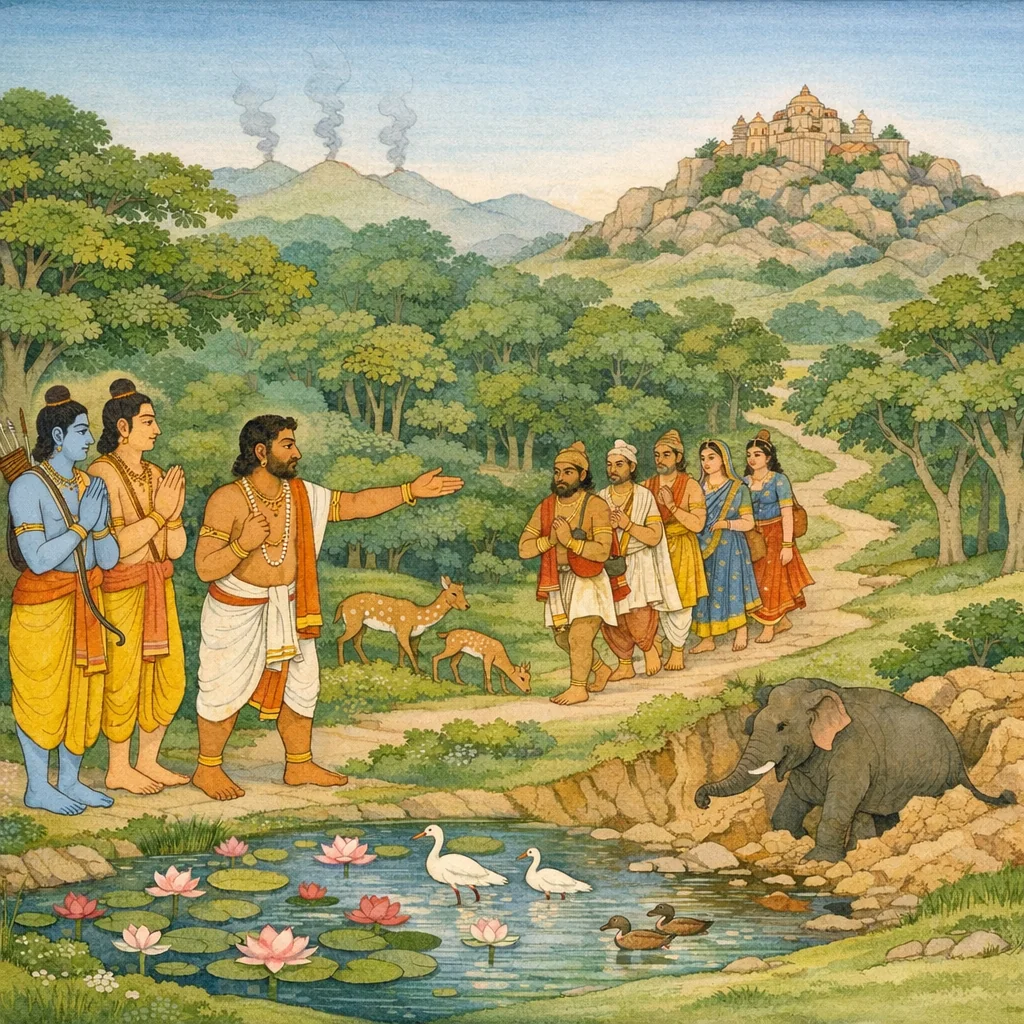
Sarga 13 narrates the rapid advance from Ṛṣyamūka toward Kiṣkindhā, framed by detailed ecological observation that functions as both travel-log and ethical atmosphere. Sugrīva and Lakṣmaṇa move ahead of Rāma, with Hanumān, Nala, Nīla, and Tārā following, forming an organized procession. The party observes rivers, lotus-filled tanks, melodious birds, fearless deer, and formidable lone elephants that break embankments—marking the wilderness as both abundant and dangerous. Rāma then notices a cloud-like mass of trees ringed with plantain groves and asks Sugrīva to clarify the site. Sugrīva identifies it as the vast Saptajana hermitage, a fatigue-relieving āśrama rich in roots, fruits, and water, guarded by the tapas of seven ascetics who live on air, practice extreme discipline (head-down, water-immersed), and attain heaven with their bodies. The hermitage is described as ritually potent and perilous to the uninitiated: birds and animals avoid it; those who enter ignorantly do not return; divine sounds, fragrances, and the three sacred fires’ smoke crown the treetops. Following Sugrīva’s counsel, Rāma and Lakṣmaṇa offer mental salutations with folded hands and proceed, eventually beholding the unassailable Kiṣkindhā protected by Vāli’s valor, with weapons readied for the coming confrontation.
Shlokas
Verse 1
ऋष्यमूकात्स धर्मात्मा किष्किन्धां लक्ष्मणाग्रजः।जगाम सहसुग्रीवो वालिविक्रमपालिताम्।।
From Ṛṣyamūka, the righteous elder brother of Lakṣmaṇa went along with Sugrīva to Kiṣkindhā—protected by the might of Vāli.
Verse 2
समुद्यम्य महच्चापं रामः काञ्चनभूषितम्।शरांश्चादित्यसङ्काशान्गृहीत्वा रणसाधकान्।।
Preparing to proceed, Rāma lifted his great bow adorned with gold, and took up arrows radiant like the sun—mighty instruments for battle.
Verse 3
अग्रतस्तु ययौ तस्य राघवस्य महात्मनः।सुग्रीवः संहतग्रीवो लक्ष्मणश्च महाबलः।।
In front of that great-souled Rāghava went Sugrīva, thick-necked and firm, and mighty Lakṣmaṇa as well.
Verse 4
पृष्ठतो हनुमान्वीरो नलो नीलश्च वानरः।तारश्चैव महातेजा हरियूथपयूथपः।।
Behind them went the heroic Hanumān, and the monkeys Nala and Nīla; and Tārā too, of great brilliance, a leader among leaders of monkey troops.
Verse 5
ते वीक्षमाणा वृक्षांश्च पुष्पभारावलम्बिनः।प्रसन्नाम्बुवहाश्चैव सरितस्सागरङ्गमाः।।
As they went, they looked upon trees bending under the weight of blossoms, and upon rivers bearing clear waters, flowing onward to the sea.
Verse 6
कन्दराणि च शैलांश्च निर्दराणि गुहास्तथा।शिखराणि च मुख्यानि दरीश्च प्रियदर्शनाः।।
They also saw valleys and mountains, caverns and caves, and prominent peaks, with ravines that were pleasing to behold.
Verse 7
वैढूर्यविमलै:पर्णै पद्मैश्चाकोशकुट्मलैः।शोभितांत्सजलान्मार्गे तटाकांश्च व्यलोकयन्।।
Along the way they observed lotus ponds filled with water, beautified by lotuses—some still in bud—and by leaves clear and lustrous like vaidūrya-gems.
Verse 8
कारण्डैस्सारसैर्हंसैर्वञ्जुलैर्जलकुक्कुटैः।चक्रवाकै स्तथा चान्यैश्शकुनैः रुपनादितान्।।
They saw the waters made musical by karandas (ducks), cranes, swans, vañjula-birds, waterfowl, cakravākas, and many other birds, all warbling with beautiful calls.
Verse 9
मृदुशष्पाङ्कुराहारान्निर्भयान्वनगोचरान्।चरतस्सर्वतौऽपश्यन् स्थलीषु हरिणान् स्थितान्।।
All around they observed deer—forest-roamers, fearless—feeding on tender grass-shoots, some standing on open ground and others moving about.
Verse 10
तटाकवैरिणश्चापि शुक्लदन्तविभूषितान्।घोरानेकचरान्वन्यान्द्विरदान्कूलघातिनः।।
They observed wild elephants—terrifying, solitary wanderers—adorned with white tusks, enemies of ponds, and smashers of riverbanks.
Verse 11
मत्तान्गिरितटोत्कृष्टान्पर्वतानिव जङ्गमान्।वारणान्वारिदप्रख्यान्महीरेणुसमुक्षितान्।।
They saw rut-maddened elephants, heaving against mountain slopes—moving like mountains themselves—dark as rain-clouds and dusted over with the earth’s powder.
Verse 12
वने वनचरांश्चान्यान्खेचरांश्च विहङ्गमान्।पश्यन्तस्त्वरिता जग्मुस्सुग्रीववशवर्तिनः।।
Loyal to Sugrīva’s lead, they moved swiftly on, watching the forest-dwellers and other creatures, and the birds that ranged through the sky.
Verse 13
तेषां तु गच्छतां तत्र त्वरितं रघुनन्दनः।द्रुमषण्डं वनं दृष्ट्वा रामस्सुग्रीवमब्रवीत्।।
As they were moving swiftly along, Rāma—the joy of the Raghu line—seeing a dense grove-like stretch of forest, spoke to Sugrīva.
Verse 14
एष मेघ इवाकाशे वृक्षषण्डः प्रकाशते।मेघसङ्घातविपुलः पर्यन्तकदलीवृतः।।
This cluster of trees shines forth like a cloud in the sky—vast as a mass of clouds, and ringed all around with plantain groves.
Verse 15
किमेतत् ज्ञातुमिच्छामि सखे कौतूहलं हि मे।कौतूहलापनयनं कर्तुमिच्छाम्यहं त्वया।।
Friend, I wish to know what this is—for I am curious. I want you to dispel my curiosity and make it clear.
Verse 16
तस्य तद्वचनं श्रुत्वा राघवस्य महात्मनः।गच्छन्नेवाचचक्षेऽथ सुग्रीवस्तन्महद्वनम्।।
Hearing those words of the great-souled Rāghava, Sugrīva—still walking—then began to explain that vast forest.
Verse 17
एतद्राघव विस्तीर्णमाश्रमं श्रमनाशनम्।उद्यानवनसम्पन्नं स्वादुमूलफलोदकम्।।
O Rāghava, this is a spacious hermitage that dispels fatigue—rich with groves and gardens, and provided with sweet roots, fruits, and water.
Verse 18
अत्र सप्तजना नाम मुनय स्संश्रितव्रताः।सप्तैवासन्नधशशीर्षा नियतं जलशायिनः4.13.18।।
Here lived seven sages, known as the Saptajana, devoted to firm vows—each of the seven disciplined, dwelling in water with heads held downward.
Verse 19
सप्तरात्रकृताहारा वायुनाचलवासिनः।दिवं वर्षशतैर्याताः सप्तभिः सकलेबराः।।
They took food only once in seven nights, lived unmoving and sustained by air; after seven hundred years they attained heaven, going with their bodies intact.
Verse 20
तेषामेवं प्रभावानां द्रुमप्राकारसंवृतम्।आश्रमस्सुदुराधर्ष अपि सेन्द्रैस्सुरासुरैः।।
Such is the power of those ascetics that this hermitage—ringed as if by a rampart of trees—is exceedingly hard to assail, even for gods and demons, Indra included.
Verse 21
पक्षिणो वर्जयन्त्येतत्तथाऽन्ये वनचारिणः।विशन्ति मोहाद्येऽप्यत्र निवर्तन्ते न ते पुनः।।
Birds avoid this place, and so do other creatures of the forest; even those who enter here out of delusion do not return again.
Verse 22
विभूषणरवास्तत्र श्रूयन्ते सकलाक्षराः।तूर्यगीतस्वनाश्चात्र गन्धो दिव्यश्च राघव।।
Here, O Rāghava, one hears the clear sounds of jingling ornaments, and also the notes of songs and instruments; a divine fragrance too is present.
Verse 23
त्रेताग्नयोऽपि दीप्यन्ते दूमो ह्यत्र प्रकाशते।वेष्टयन्निव वृक्षाग्रान्कपोताङ्गारुणो घनः।।
The three sacred fires are blazing here; and the smoke shines forth—thick and reddish like a pigeon’s feet—as though it were wrapping the treetops.
Verse 24
एते वृक्षाः प्रकाशन्ते धूमसंसक्तमस्तकाः।मेघजालप्रतिच्छन्ना वैढूर्यगिरयो यथा।।
These trees, their crowns clinging with smoke, gleam like Vaidūrya mountains veiled by a net of clouds.
Verse 25
कुरु प्रणामं धर्मात्मंस्तेषामुद्दिश्य राघव।लक्ष्मणेव सह भ्रात्रा प्रयन्तस्सयताञ्जलिः।।
O righteous Rāghava, offer obeisance to them in your mind; and you, together with your brother Lakṣmaṇa, proceed with restraint—hands folded in reverence.
Verse 26
प्रणमन्ति हि ये तेषां मुनीनां भावितात्मनाम्।न तेषामशुभं किञ्चिच्छरीरे राम दृश्यते।।
O Rāma, for those who bow down to those sages—whose selves are disciplined and sanctified—no inauspicious mark is seen in their body at all.
Verse 27
ततो रामस्सह भ्रात्रा लक्ष्मणेन कृताञ्जलिः।समुद्दिश्य महात्मानस्तानृषीनभ्यवादयत्।।
Then Rāma, together with his brother Lakṣmaṇa and with hands folded, mentally invoking those great-souled seers, offered them reverent salutations.
Verse 28
अभिवाद्य तु धर्मात्मा रामो भ्राता च लक्ष्मणः।सुग्रीवो वानराश्चैव जग्मुसंहृष्टमानसाः।।
Having thus paid their respects, righteous Rāma, his brother Lakṣmaṇa, Sugrīva, and the monkeys went on, their hearts uplifted with joy.
Verse 29
ते गत्वा दूरमध्वानं तस्मात्सप्तजनाश्रमात्।ददृशुस्तां दुराधर्षां किष्किन्धां वालिपालिताम्।।
After traveling a long stretch from the Saptajana hermitage, they beheld Kiṣkindhā—hard to assail—ruled and guarded by Vāli.
Verse 30
ततस्तु रामानुजरामवानराःप्रगृह्य शस्त्राण्युदिताग्र्यतेजसः।पुरीं सुरेशात्मजवीर्यपालितांवधाय शत्रोः पुनरागतास्सह।।
Then Rāma, Lakṣmaṇa, and the monkeys—ablaze with rising, foremost splendor—grasped their weapons and together came again to the city, protected by the valor of Indra’s son, intent on the slaying of the enemy.
Frequently Asked Questions
The pivotal action is dharmic restraint and reverence: despite being on a war-path toward Vāli’s stronghold, Rāma and Lakṣmaṇa pause to honor the Saptajana sages mentally and ritually (añjali, praṇāma), acknowledging that sacred power (tapas) governs access and safety in the landscape.
Sugrīva’s instruction teaches that spiritual authority is a real agency in the epic world: tapas creates protective boundaries, and humility toward realized ascetics removes inauspiciousness. The chapter links political action to ritual propriety—effective leadership must remain accountable to dharma and sacred order.
Key landmarks include Ṛṣyamūka (departure point), the Saptajana āśrama (a ritually charged hermitage with trētāgni fires and divine sensory signs), and Kiṣkindhā (Vāli’s fortified capital), alongside ecological markers such as lotus tanks, rivers to the sea, and elephant corridors.