Sarga 68
जनकदूतागमनम् — The Arrival of Janaka’s Messengers in Ayodhya
बालकाण्ड
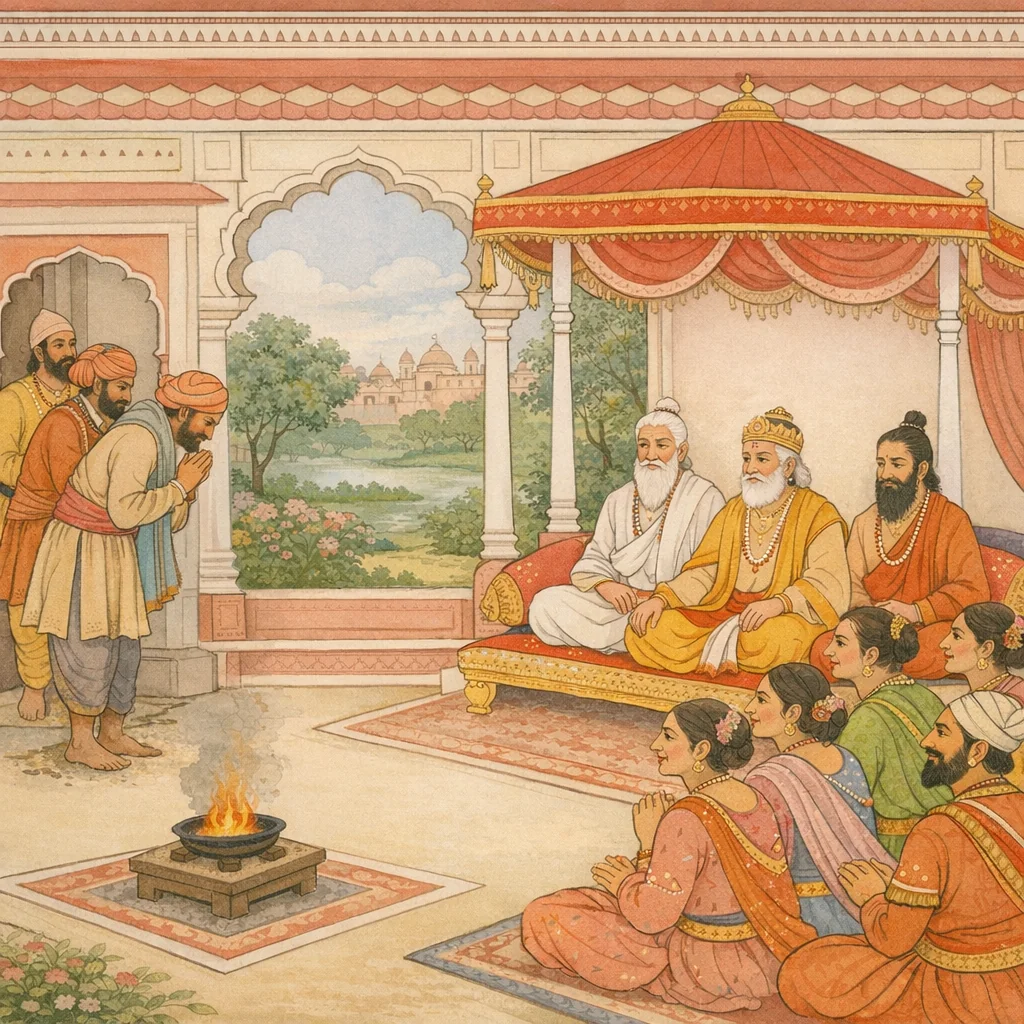
Sarga 68 functions as a diplomatic and procedural bridge between Mithilā’s bow-event and Ayodhyā’s royal decision-making. Janaka’s messengers, fatigued after three days’ travel and three nights on the road, enter Ayodhyā and formally request audience through the palace gatekeepers. Admitted to the court, they address the aged Daśaratha with respectful, sweetly framed speech, first conveying Janaka’s repeated inquiries about the king’s welfare and the well-being of his preceptors and priests, with ritual propriety symbolized by the sacred fire placed foremost. They then report the decisive public fact: Rāma has broken the divine bow in the great assembly, fulfilling the criterion implicit in Janaka’s earlier vow that Sītā be given as vīrya-śulka (“reward for prowess”). Janaka seeks Daśaratha’s consent to complete his vow, invites him to come swiftly with preceptors and the family priest, and assures mutual joy in seeing the princes. After the messengers conclude, Daśaratha rejoices, consults Vasiṣṭha, Vāmadeva, other ministers, and the assembled sages; all agree, and the king declares departure for Mithilā on the next day—marking the transition from report to royal action.
Shlokas
Verse 1
जनकेन समादिष्टा दूतास्ते क्लान्तवाहना:।त्रिरात्रमुषिता मार्गे तेऽयोध्यां प्राविशन् पुरीम्।।1.68.1।।
Commanded by Janaka, those messengers—whose mounts were weary—spent three nights on the road and then entered the city of Ayodhyā.
Verse 2
राज्ञो भवनमासाद्य द्वारस्थानिदमब्रुवन्।शीघ्रं निवेद्यतां राज्ञे दूतान्नो जनकस्य च।।1.68.2।।
Reaching the king’s palace, the messengers addressed the gatekeepers: “Inform the king at once that we—messengers of Janaka—have arrived.”
Verse 3
इत्युक्ता द्वारपालास्ते राघवाय न्यवेदयन्।ते राजवचनाद्दूता राजवेश्मप्रवेशिता:।ददृशुर्देवसङ्काशं वृद्धं दशरथं नृपम्।।1.68.3।।
Thus addressed, the gatekeepers reported the matter to the Raghu-line king. By the king’s command the messengers were admitted into the palace, where they beheld aged King Daśaratha, radiant like a god.
Verse 4
बद्धाञ्जलिपुटा स्सर्वे दूता विगतसाध्वसा:।राजानं प्रयता वाक्यमब्रुवन्मधुराक्षरम्।।1.68.4।।
All the messengers, with palms joined and fear dispelled, respectfully addressed the king with courteous, sweetly chosen words.
Verse 5
मैथिलो जनको राजा साग्निहोत्रपुरस्कृतम् ।कुशलं चाव्ययं चैव सोपाध्यायपुरोहितम्।।1.68.5।।मुहुर्मुहुर्मधुरया स्नेहसंयुक्तया गिरा।जनकस्त्वां महाराज पृच्छते सपुरस्सरम्।।1.68.6।।
“O great king, Janaka of Mithilā—placing the sacred fire and its rites foremost—repeatedly enquires, in sweet words filled with affection, after your welfare and lasting prosperity, as well as that of your teachers and household priests, together with your attendants.”
Verse 6
मैथिलो जनको राजा साग्निहोत्रपुरस्कृतम् ।कुशलं चाव्ययं चैव सोपाध्यायपुरोहितम्।।1.68.5।।मुहुर्मुहुर्मधुरया स्नेहसंयुक्तया गिरा।जनकस्त्वां महाराज पृच्छते सपुरस्सरम्।।1.68.6।।
“O great king, Janaka of Mithilā—placing the sacred fire and its rites foremost—repeatedly enquires, in sweet words filled with affection, after your welfare and lasting prosperity, as well as that of your teachers and household priests, together with your attendants.”
Verse 7
पृष्ट्वा कुशलमव्यग्रं वैदेहो मिथिलाधिप:।कौशिकानुमते वाक्यं भवन्तमिदमब्रवीत्।।1.68.7।।
Having attentively enquired after your welfare, Vaideha Janaka, lord of Mithilā, with the approval of Kauśika (Viśvāmitra), conveyed this message to you.
Verse 8
पूर्वं प्रतिज्ञा विदिता वीर्यशुल्का ममात्मजा।राजानश्च कृतामर्षानिर्वीर्या विमुखीकृता:।।1.68.8।।
O King, it was formerly known everywhere that I had vowed to give my daughter in marriage as the prize of prowess. When the kings proved powerless, they became resentful and were turned back in disappointment.
Verse 9
सेयं मम सुता राजन् विश्वामित्रपुरस्सरै:।यदृच्छयागतैर्वीरैर्निर्जिता तव पुत्रकै:।।1.68.9।।
O King, this daughter of mine has been won by your heroic sons, who arrived here as it were by chance, with Viśvāmitra at their head.
Verse 10
तच्च राजन् धनुर्दिव्यं मध्ये भग्नं महात्मना।रामेण हि महाराज महत्यां जनसंसदि।।1.68.10।।
And, O King—O great monarch—the divine bow was indeed broken in the middle by the great-souled Rāma, in that vast assembly of people.
Verse 11
अस्मै देया मया सीता वीर्यशुल्का महात्मने।प्रतिज्ञां कर्तुमिच्छामि तदनुज्ञातुमर्हसि।।1.68.11।।
To this great-souled one, Sītā must be given by me—she whose bride-price is prowess. I wish to fulfill my vow; you ought to grant consent for that.
Verse 12
सोपाध्यायो महाराज पुरोहितपुरस्सर:।शीघ्रमागच्छ भद्रं ते द्रष्टुमर्हसि राघवौ ।।1.68.12।।
O great king, come quickly—together with your teachers, with your royal priest at the fore. May it be well with you. You ought to see the two Rāghavas (Rāma and Lakṣmaṇa).
Verse 13
प्रीतिं च मम राजेन्द्र निर्वर्तयितुमर्हसि।पुत्रयोरुभयोरेव प्रीतिं त्वमपि लप्स्यसे।।1.68.13।।
O best of kings, you ought to bring about my joy; and you yourself, indeed, will also obtain joy in regard to both your sons.
Verse 14
एवं विदेहाधिपतिर्मधुरं वाक्यमब्रवीत्।।1.68.14।।विश्वामित्राभ्यनुज्ञात श्शतानन्दमते स्थित:।इत्युक्त्वा विरता दूता राजगौरवशङ्किता:।।1.68.15।।
Thus spoke the lord of Videha in sweet words. With Viśvāmitra’s approval, and in accordance with Śatānanda’s counsel, the messengers—having said this—ceased, restrained by reverence for their king.
Verse 15
एवं विदेहाधिपतिर्मधुरं वाक्यमब्रवीत्।।1.68.14।।विश्वामित्राभ्यनुज्ञात श्शतानन्दमते स्थित:।इत्युक्त्वा विरता दूता राजगौरवशङ्किता:।।1.68.15।।
Having heard that message from the envoys, the king—overjoyed—addressed Vasiṣṭha, Vāmadeva, and the other ministers.
Verse 16
दूतवाक्यं च तच्छ्रुत्वा राजा परमहर्षित:।वसिष्ठं वामदेवं च मन्त्रिणोऽन्यांश्च सोऽब्रवीत्।।1.68.16।।
Having heard that message from the envoys, the king—overjoyed—addressed Vasiṣṭha, Vāmadeva, and the other ministers.
Verse 17
गुप्त: कुशिकपुत्रेण कौसल्यानन्दवर्धन:।लक्ष्मणेन सह भ्रात्रा विदेहेषु वसत्यसौ।।1.68.17।।
He who increases Kausalyā’s joy (Rāma), protected by the son of Kuśika (Viśvāmitra), is staying in the land of Videha together with his brother Lakṣmaṇa.
Verse 18
दृष्टवीर्यस्तु काकुत्स्थो जनकेन महात्मना।सम्प्रदानं सुतायास्तु राघवे कर्तुमिच्छति।।1.68.18।।
Having witnessed the prowess of Kakutstha (Rāma), the great-souled Janaka desires to bestow his daughter upon Rāghava in marriage.
Verse 19
यदि वो रोचते वृत्तं जनकस्य महात्मन:।पुरीं गच्छामहे शीघ्रं मा भूत्कालस्य पर्यय:।।1.68.19।।
“If this intention of the great-souled Janaka meets with your approval, let us go swiftly to the city—let there be no delay of time.”
Verse 20
Together with all the great sages, the ministers replied, “So be it.” Delighted, the king then said to his ministers, “Let the journey begin tomorrow.”
Verse 21
जनकेन समादिष्टा दूतास्ते क्लान्तवाहना:।त्रिरात्रमुषिता मार्गे तेऽयोध्यां प्राविशन् पुरीम्।।1.68.1।।
The king’s counsellors, greatly honored, spent the night in gladness—each endowed with every excellent quality.
Frequently Asked Questions
The pivotal action is Janaka’s activation of his public vow: having witnessed Rāma’s prowess, he declares Sītā “fit to be given” as vīrya-śulka and seeks Daśaratha’s consent to fulfill the pledge. The ethical emphasis is on vow-keeping under public scrutiny and on ensuring legitimacy through proper royal consent rather than unilateral action.
The chapter models dharma as institutionally mediated truth: extraordinary personal capability (Rāma’s feat) must be translated into socially valid outcomes through respectful speech, ritual propriety, and consultation with sages and ministers. Right action is shown as both principled and procedurally sound.
Geographically, the movement from Mithilā/Videha to Ayodhyā frames inter-kingdom alliance-making. Culturally, the court protocol (gatekeepers, formal audience), the prominence of agnihotra (sacred fire), and the public assembly (janasamsad) highlight how ritual and civic institutions certify major decisions like marriage and succession-linked alliances.