Sarga 61
शुनःशेफविक्रयः — The Sale of Śunaḥśepa for the Sacrifice
बालकाण्ड
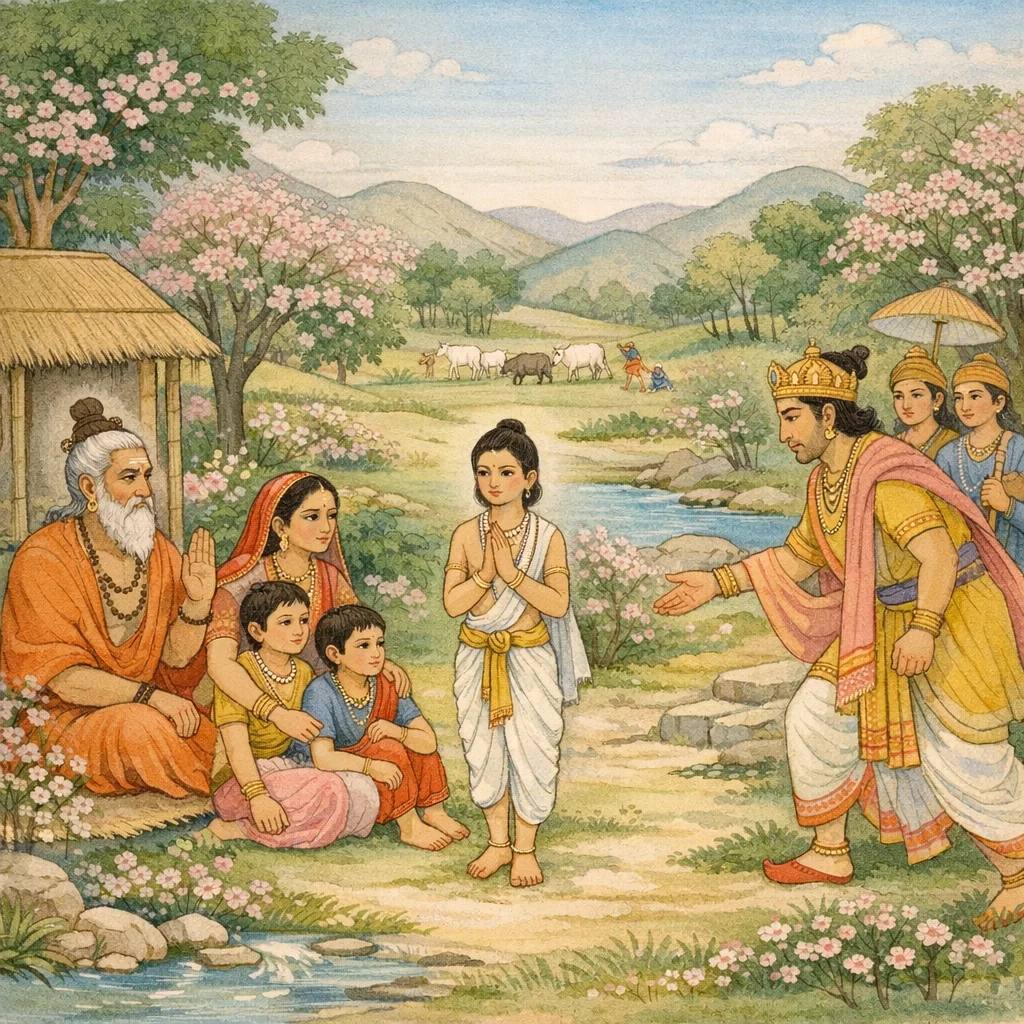
This sarga interweaves ascetic relocation and royal ritual crisis. Viśvāmitra, observing forest-sages departing, redirects the group away from a southern obstruction and selects Puṣkara in the western expanse as an ideal tapovana for intense austerities. Parallelly, King Ambarīṣa of Ayodhyā initiates a yajña, but Indra removes the designated sacrificial animal, threatening ritual completion. The officiating priest frames the loss as a governance fault and demands urgent substitution—animal or human—so the rite may proceed. Ambarīṣa searches widely, offering vast cattle as price, and reaches Bhṛgutunda where the brahmarṣi Ṛcīka sits with family. The king requests a son as purchasable victim. Ṛcīka refuses to sell the eldest; the mother refuses to part with the youngest, Śunaka, citing parental partialities. The middle son, Śunaḥśepa, interprets their refusals as an implicit sale of the middle and volunteers himself. Ambarīṣa purchases Śunaḥśepa for a hundred thousand cows and departs swiftly, closing the episode with a stark view of vow-bound ritual, familial attachment, and the moral pressure created by sacrificial imperatives.
Shlokas
Verse 1
विश्वामित्रो महात्माथ प्रस्थितान् प्रेक्ष्य तानृषीन्।अब्रवीन्नरशार्दूलस्सर्वांस्तान्वनवासिन:।।।।
Then the great-souled Viśvāmitra, seeing those forest-dwelling sages setting out, spoke—addressing Rāma, the tiger among men.
Verse 2
महान्विघ्न: प्रवृत्तोऽयं दक्षिणामास्थितो दिशम्।दिशमन्यां प्रपत्स्यामस्तत्र तप्स्यामहे तप:।।1.61.2।।
A great obstacle has arisen, coming from the southern quarter. Let us therefore go to another region; there we shall undertake our austerities.
Verse 3
पश्चिमायां विशालायां पुष्करेषु महात्मन:।सुखं तपश्चरिष्याम: परं तद्धि तपोवनम्।।।।
O great-souled ones, in the vast western region—at Puṣkara—we shall practise austerity in peace; for that indeed is an excellent forest of penance.
Verse 4
एवमुक्त्वा महातेजा: पुष्करेषु महामुनि:।तप उग्रं दुराधर्षं तेपे मूलफलाशन:।।।।
Having spoken thus, the mighty great sage, dwelling at Puṣkara, performed fierce and unassailable austerities, sustaining himself on roots and fruits.
Verse 5
एतस्मिन्नेव काले तु अयोध्याधिपतिर्नृप:।अम्बरीष इति ख्यातो यष्टुं समुपचक्रमे।।।।
Just at that time, the king who ruled Ayodhyā—renowned as Ambarīṣa—began the undertaking of a sacrificial rite.
Verse 6
तस्य वै यजमानस्य पशुमिन्द्रो जहार ह।प्रणष्टे तु पशौ विप्रो राजानमिदमब्रवीत्।।।।
As the king served as sacrificer, Indra carried off the sacrificial animal. When the victim could not be found, the priest addressed the king with these words.
Verse 7
पशुरद्य हृतो राजन् प्रणष्टस्तव दुर्नयात् ।अरक्षितारं राजानं घ्नन्ति दोषा नरेश्वर ।।।।
"O King, the victim has today been taken away, and through your failure of governance it has vanished beyond recovery. O lord of men, faults strike down a king who does not protect."
Verse 8
प्रायश्चित्तं महद्ध्येतन्नरं वा पुरुषर्षभ ।आनयस्व पशुं शीघ्रं यावत्कर्म प्रवर्तते।।।।
"O best of men, this calls for a grave expiation: bring at once either the animal—or a human substitute—so that the sacrificial work may proceed."
Verse 9
उपाध्यायवचश्श्रुत्वा स राजा पुरुषर्षभ।अन्वियेष महाबुद्धि: पशुं गोभिस्सहस्रश:।।।।
Hearing the preceptor’s words, that king—keen-minded—went in search of a victim, offering thousands of cows in exchange.
Verse 10
देशान् जनपदांस्तां स्तान्नगराणि वनानि च।आश्रमाणि च पुण्यानि मार्गमाणो महीपति: ।।।।स पुत्रसहितं तात सभार्यं रघुनन्दन ।भृगुतुंदे समासीनमृचीकं सन्ददर्श ह।।।।
O child, O Rāma—delight of the Raghu line—while searching through many lands, settlements, cities, forests, and sacred hermitages, that king finally beheld the sage Ṛcīka seated on Bhṛgutuṇḍa, together with his sons and his wife.
Verse 11
देशान् जनपदांस्तां स्तान्नगराणि वनानि च।आश्रमाणि च पुण्यानि मार्गमाणो महीपति: ।।1.61.10।। स पुत्रसहितं तात सभार्यं रघुनन्दन ।भृगुतुंदे समासीनमृचीकं सन्ददर्श ह।।1.61.11।।
This verse is a duplicate transmission of 1.61.10 in the provided Southern Recension snippet; its sense remains: the king, after searching widely, sees Ṛcīka on Bhṛgutuṇḍa with his family.
Verse 12
तमुवाच महातेजा: प्रणम्याभिप्रसाद्य च।ब्रह्मर्षिं तपसा दीप्तं राजर्षिरमितप्रभ:।।।।पृष्ट्वा सर्वत्र कुशलमृचीकं तमिदं वच:।
Then the exceedingly radiant royal sage, after bowing and duly pleasing that brahmarṣi Ṛcīka—who shone with the power of austerity—and after inquiring about the welfare of all, spoke these words to him.
Verse 13
गवां शतसहस्रेण विक्रीणीषे सुतं यदि।।।।पशोरर्थे महाभाग कृतकृत्योऽस्मि भार्गव।
O fortunate Bhārgava, if you would sell one of your sons for a hundred thousand cows to serve as the sacrificial animal, then my purpose will be fulfilled.
Verse 14
सर्वे परिसृता देशा याज्ञीयं न लभे पशुम्।।।।दातुमर्हसि मूल्येन सुतमेकमितो मम।4
I have wandered through all regions, yet I have not found a fit sacrificial animal; therefore, please grant me—at a price—one son from among yours.
Verse 15
एवमुक्तो महातेजा ऋचीकस्त्वब्रवीद्वच:।।।।नाहं ज्येष्ठं नरश्रेष्ठ विक्रीणीयां कथञ्चन।
Thus addressed, the radiant Ṛcīka replied: “O best of men, I will not sell my eldest son—under any circumstances.”
Verse 16
ऋचीकस्य वचश्श्रुत्वा तेषां माता महात्मनाम्।।।।उवाच नरशार्दूलमम्बरीषं तपस्विनी।
Hearing Ṛcīka’s words, the ascetic mother of those noble sons spoke to Ambarīṣa, the tiger among men.
Verse 17
अविक्रेयं सुतं ज्येष्ठं भगवानाह भार्गव:।।।।ममापि दयितं विद्धि कनिष्ठं शुनकं नृप।तस्मात्कनीयसं पुत्रं न दास्ये तव पार्थिव ।।।।
The venerable Bhārgava (Ṛcīka) said: “The eldest son is not to be sold. And know, O king, that the youngest—Śunaka—is dear to me. Therefore, O ruler, I will not give you my youngest son.”
Verse 18
अविक्रेयं सुतं ज्येष्ठं भगवानाह भार्गव:।।1.61.17।।ममापि दयितं विद्धि कनिष्ठं शुनकं नृप।तस्मात्कनीयसं पुत्रं न दास्ये तव पार्थिव ।।1.61.18।।
The venerable Bhārgava (Ṛcīka) said: “The eldest son is not to be sold. And know, O king, that the youngest—Śunaka—is dear to me. Therefore, O ruler, I will not give you my youngest son.”
Verse 19
प्रायेण हि नरश्रेष्ठ ज्येष्ठा: पितृषु वल्लभा:।मातृ़णां तु कनीयांसस्तस्माद्रक्षे कनीयसम् ।।।।
“O best of men, generally the eldest sons are dear to their fathers, while the youngest are dear to their mothers. Therefore I shall protect the youngest.”
Verse 20
उक्तवाक्ये मुनौ तस्मिन् मुनिपत्न्यां तथैव च।शुनश्शेफस्स्वयं राम मध्यमो वाक्यमब्रवीत्।।।।
When the sage had spoken thus—and likewise the sage’s wife—then Śunaḥśepa, the middle son, spoke of his own accord, O Rāma.
Verse 21
पिता ज्येष्ठमविक्रेयं माता चाह कनीयसम्।विक्रीतं मध्यमं मन्ये राजन् पुत्रं नयस्व माम्।।।।
“My father says the eldest is not to be sold; my mother says the youngest cannot be given up. Therefore, O king, I consider the middle one as already sold—take me as your son.”
Verse 22
गवां शतसहस्रेण शुनश्शेफं नरेश्वर:।गृहीत्वा परमप्रीतो जगाम रघुनन्दन ।।।।
O Raghunandana, the king, having taken Śunaḥśepa in exchange for a hundred thousand cows, departed exceedingly pleased.
Verse 23
अम्बरीषस्तु राजर्षी रथमारोप्य सत्वर:।शुनश्शेफं महातेजा जगामाशु महायशा:।।।।
The illustrious and radiant king-sage Ambarīṣa, placing Śunaḥśepa upon his chariot, quickly departed.
Frequently Asked Questions
A ritual emergency forces a substitution for a missing sacrificial animal, culminating in the morally fraught act of purchasing a human (Śunaḥśepa) as yajña-victim—testing the boundaries between ritual necessity, royal duty, and human dignity.
The sarga highlights how dharma can become complex when multiple obligations collide: a king’s duty to complete vowed rites, a family’s protective attachments, and an individual’s agency. It implicitly warns that ritual goals, if pursued without ethical discernment, generate suffering and coercive structures.
Puṣkara is presented as a premier western tapovana for austerities, while Bhṛgutunda serves as the Bhārgava-associated mountain-hermitage where Ṛcīka’s family resides; culturally, the yajña framework and cattle-as-wealth economy structure the episode’s transactions.