Sarga 91
भरद्वाजाश्रमे भरतसैन्यस्य दिव्यात्मिथ्यम् / Divine Hospitality to Bharata’s Army at Bharadvaja’s Hermitage
अयोध्याकाण्ड
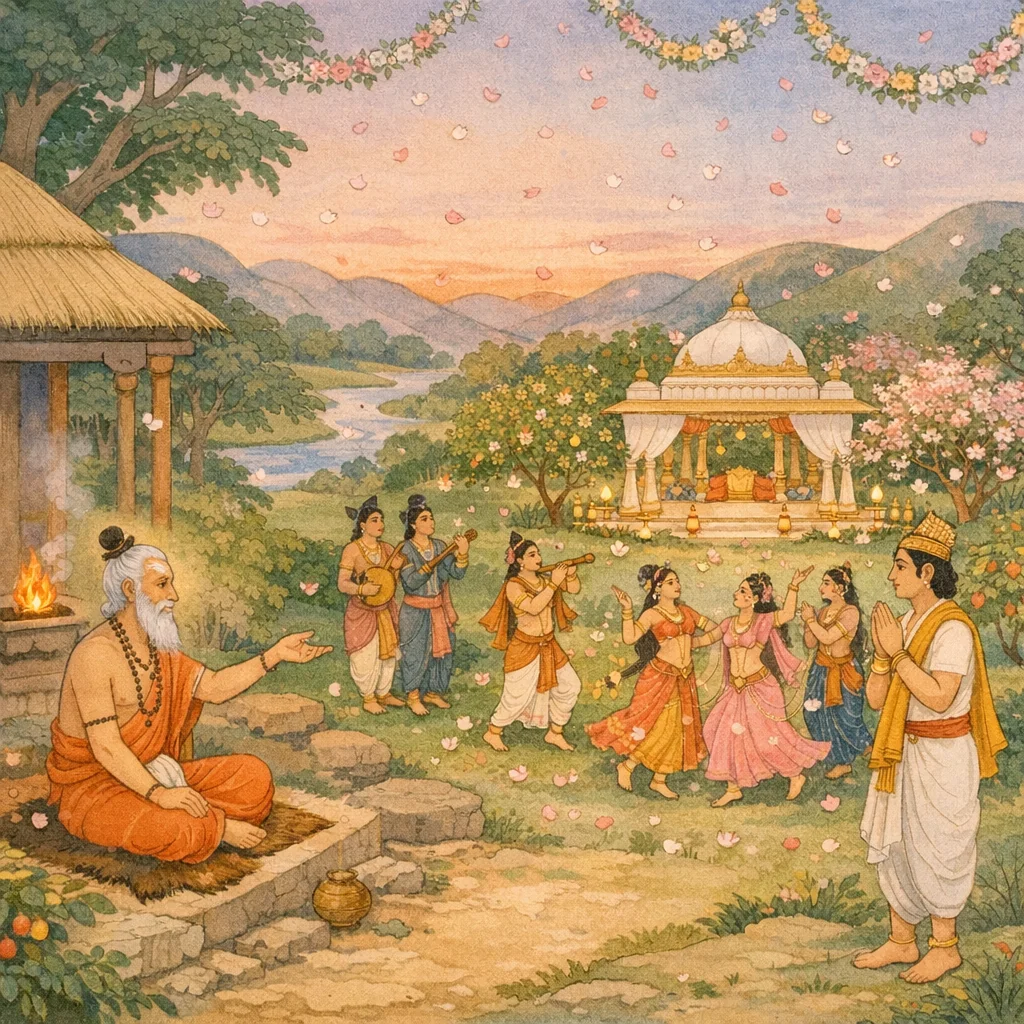
Sarga 91 stages a ritualized encounter between polity and ascetic space. Bharata resolves to stay at Bharadvāja’s āśrama for the night, and the sage extends hospitality (2.91.1–4). Bharadvāja questions Bharata’s decision to keep the army at a distance; Bharata replies that he feared disturbance to the hermitage—trees, water, land, and huts—and therefore approached alone, articulating a principle of royal restraint near tapasvin communities (2.91.5–9). At the sage’s command, the army is summoned (2.91.10). Bharadvāja enters the agniśālā, performs purification, and invokes Viśvakarman and Tvaṣṭṛ for logistical creation, along with guardians of directions, rivers, Gandharvas, Apsarases, Kubera’s divine forest, and Soma for abundant food and drink (2.91.11–21). Celestial signs follow—cooling breezes, flower-rain, music, and rhythmic sound—after which the army beholds Viśvakarman’s engineered landscape: level ground, fruit-laden trees, divine river, stables, archways, and a jewel-filled royal mansion (2.91.24–39). The narrative then expands into a catalog of provisioning: rivers of payasa, houses, thousands of women and Apsarases, music by Gandharva kings, bathing and anointing, feeding of animals, and vast stores of food, utensils, clothing, and equipment (2.91.41–80). The soldiers, astonished as if in a dream, revel through the night; by morning the summoned beings depart with permission, leaving behind traces of fragrance and garlands (2.91.81–84). The chapter’s thematic lesson is that hospitality (ātithya) can operate as a dharmic technology—binding warrior-force to discipline—while also highlighting the sanctity of ascetic habitats and the king’s duty not to harm them.
Shlokas
Verse 1
कृतबुद्धिं निवासाय तत्रैव स मुनिस्तदा।भरतं कैकयीपुत्रमातिथ्येनन्यमन्त्रयत्।।।।
When Bharata, Kaikeyī’s son, resolved to stay there itself for the night, the sage then invited him with due hospitality.
Verse 2
अब्रवीद्भरतस्त्वेनं नन्विदं भवता कृतम्।पाद्यमर्घ्यं तथाऽतिथ्यं वने यदुपपद्यते।।।।
Bharata said to him (Bharadvāja): “Indeed, you have already shown hospitality—offering foot-water, the arghya offering, and whatever welcome is possible here in the forest.”
Verse 3
अथोवाच भरद्वाजो भरतं प्रहसन्निव।जाने त्वां प्रीतिसंयुक्तं तुष्येस्त्वं येन केनचित्।।।।
Then Bharadvāja said to Bharata with a gentle, smiling air: “I know you are filled with affection, and that you are satisfied with whatever is offered.”
Verse 4
सेनायास्तु तवैतस्याः कर्तुमिच्छामि भोजनम्।मम प्रीतिर्यथारूपा तथार्हो मनुजर्षभ।।।।
I wish to provide a feast for this entire army of yours; it would be a true joy to me—so, O best of men, please accept it as is fitting.
Verse 5
किमर्थं चापि निक्षिप्य दूरे बलमिहागतः।कस्मान्नेहोपयातोऽसि सबलः पुरुषर्षभः।।।।
Why have you come here after leaving your army stationed at a distance? Why did you not approach here together with your forces, O best of men?
Verse 6
भरतः प्रत्युवाचेदं प्राञ्जलिस्तं तपोधनम्।ससैन्यो नोपयातोऽस्मि भगवन्भगवद्भयात्।।।।
With palms joined, Bharata replied to that sage whose wealth was austerity: “Venerable sir, I did not come near you together with my army, out of reverence and fear of offending you.”
Verse 7
राज्ञा च भगवन्नित्यं राजपुत्रेण वा सदा।यत्नतः परिहर्तव्या विषयेषु तपस्विनः।।।।
O venerable one, whether by a king or by a prince, ascetics dwelling in their own domains should always be avoided with care—so that their austerities are not disturbed.
Verse 8
वाजिमुख्या मनुष्याश्च मत्ताश्च वरवारणाः।प्रच्छाद्य भगवन्भूमिं महतीमनुयान्ति माम्।।।।
“O venerable one, spirited horses, men, and mighty rutting elephants follow behind me, spreading out and covering a vast stretch of ground.”
Verse 9
ते वृक्षानुदकं भूमिमाश्रमेषूटजां स्तथा।न हिंस्युरिति तेनाऽहमेक एव समागतः।।।।
Thinking, “They should not harm the trees, the water, the land, or the huts in the hermitages,” I therefore came here alone.
Verse 10
आनीयतामितस्सेनेत्याज्ञप्तः परमर्षिणा।ततस्तु चक्रे भरतस्सेनायास्समुपागमम्।।।।
Commanded by the great sage—“Let the army be brought here”—Bharata then arranged for the army to come in.
Verse 11
अग्निशालां प्रविश्याथ पीत्वाऽपः परिमृज्य च।आतिथ्यस्य क्रियाहेतोर्विश्वकर्माणमाह्वयत्।।।।
Then, entering the fire-sanctuary, he sipped water and cleansed himself; and for the purpose of arranging hospitality, he invoked Viśvakarman.
Verse 12
आह्वये विश्वकर्माणमहं त्वष्टारमेव च।आतिथ्यं कर्तुमिच्छामि तत्र मे संविधीयताम्।।।।
“I invoke Viśvakarman, and also Tvaṣṭṛ. I wish to provide hospitality—let what is needed for that be duly arranged for me.”
Verse 13
आह्वये लोकपालांस्त्रीन् देवान् शक्रमुखांस्तथा।आतिथ्यं कर्तुमिच्छामि तत्र मे संविधीयताम्।।।।
“I invoke the three divine guardians of the worlds, headed by Śakra (Indra). I wish to offer hospitality—let the arrangements be made accordingly.”
Verse 14
प्राक्स्रोतसश्च या नद्यः प्रत्यक्स्रोतस एव च।पृथिव्यामन्तरिक्षे च समायान्त्वद्य सर्वशः।।।।
“Let the rivers—those flowing eastward and those flowing westward—whether on earth or in the sky, come here today from every direction.”
Verse 15
अन्या स्रवन्तु मैरेयं सुरामन्यास्सुविष्ठिताम्।अपरा श्चोदकं शीतमिक्षुकाण्डरसोपमम्।।।।
“Let some streams flow with maireya liquor; let others flow with well-prepared surā; and let still others flow with cool water, sweet as sugarcane-juice.”
Verse 16
आह्वये देवगन्धर्वान्विश्वावसुहहाहुहून्।तथैवाप्सरसो देवीर्गन्धर्वीश्चापि सर्वशः।।।।
“I invoke the celestial Gandharvas—Viśvāvasu, Hahā, and Huhū—and likewise the Apsarases and divine Gandharvīs from every quarter.”
Verse 17
घृताचीमथ विश्वाचीं मिश्रकेशीमलंबुसाम्।नागदन्तां च हेमां च हिमामद्रिकृतस्थलाम्।।।।
“And I summon Ghṛtācī, Viśvācī, Miśrakeśī, Alambusā, and also Nāgadantā, Hemā, and Himā—whose dwelling is among the mountains.”
Verse 18
शक्रं याश्चोपतिष्ठन्ति ब्रह्माणं याश्च योषितः।सर्वास्तुम्बुरुणा सार्धमाह्वये सपरिच्छदाः।।।।
“I summon all those celestial women who attend upon Indra, and those who attend upon Brahmā—together with Tumburu—bringing their full musical retinue.”
Verse 19
वनं कुरुषु यद्दिव्यं वासोभूषणपत्रवत्।दिव्यनारीफलं शश्वत्तत्कौबेरमिहैतु च।।।।
“Let that divine forest of Kubera in the land of the Kurus come here—where leaves themselves serve as garments and ornaments, and where celestial maidens are as its ever-present ‘fruits’.”
Verse 20
इह मे भगवान् सोमो विधत्तामन्नमुत्तमम्।भक्ष्यंभोज्यं च चोष्यं च लेह्यं च विविधं बहु।।।।
“Here, may the revered Soma provide excellent food for me—many and varied: that which is eaten, chewed, sucked, and licked.”
Verse 21
विचित्राणि च माल्यानि पादपप्रच्युतानि च।सुरादीनि च पेयानि मांसानि विविधानि च।।।।
“And let there be many-colored garlands fallen fresh from the trees, wines and other drinks, and meats of various kinds as well.”
Verse 22
एवं समाधिना युक्तस्तेजसाऽप्रतिमेन च।शीक्षास्वरसमायुक्तं तपसा चाब्रवीन्मुनिः।।।।
Thus endowed with deep concentration, with incomparable radiance and the force of austerity, the sage spoke—his utterance marked by the accents prescribed in Vedic instruction.
Verse 23
मनसा ध्यायतस्तस्य प्राङ्मुखस्य कृताञ्जलेः।आजग्मुस्तानि सर्वाणि दैवतानि पृथक्पृथक्।।।।
As he meditated in his mind, facing east with hands joined in reverence, all those deities arrived—each in turn.
Verse 24
मलयं दर्दुरं चैव ततस्स्वेदनुदोऽनिलः।उपस्पृश्य ववौ युक्त्या सुप्रियात्मा सुखश्शिवः।।।।
Then a wind that cools away sweat, having touched Malaya and Dardura, began to blow in fitting measure—most pleasing, soothing, and auspicious.
Verse 25
ततोऽभ्यवर्षन्त घना दिव्याः कुसुमवृष्टयः।दिव्यदुन्दुभिघोषश्च दिक्षु सर्वासु शुश्रुवे।।।।
Then dense, divine clouds poured down a rain of flowers, and the sound of heavenly kettledrums was heard in every direction.
Verse 26
प्रववुश्चोत्तमा वाता ननृतुश्चाप्सरोगणाः।जगुश्च देवगन्धर्वा वीणाः प्रमुमुचुस्स्वरान्।।।।
Excellent breezes blew; companies of Apsarases danced; divine Gandharvas sang; and vīṇās released their resonant notes.
Verse 27
स शब्दो द्यां च भूमिं च प्राणिनां श्रवणानि च।विवेशोच्चरितश्श्लक्ष्णस्समो लयसमन्वितः।।।।
That sound—soft in utterance, even in modulation, and endowed with rhythm—pervaded the sky and the earth, and entered the ears of living beings.
Verse 28
तस्मिन्नुपरते शब्दे दिव्ये श्रोत्र सुखे नृणाम्।ददर्श भारतं सैन्यं विधानं विश्वकर्मणः।।।।
When that celestial sound—pleasing to human ears—had subsided, Bharata’s army beheld arrangements like the wondrous craftsmanship of Viśvakarman.
Verse 29
बभूव हि समा भूमिस्समन्तात्पञ्चयोजना।शाद्वलैर्भहुभिश्चन्ना नीलवैढूर्यसन्निभैः।।।।
Indeed, the land was made level all around for five yojanas, and it was covered with many grassy lawns, gleaming like blue vaidūrya gems.
Verse 30
तस्मिन्बिल्वाः कपित्थाश्च पनसा बीजपूरकाः।आमलक्यो बभूवुश्च चूताश्च फलभूषणाः।।।।
There, fruit-laden trees sprang up—bilva, kapittha, jackfruit, citron, āmalakī, and mango—adorned as though with fruits as ornaments.
Verse 31
उत्तरेभ्यः कुरुभ्यश्च वनं दिव्योपभोगवत्।आजगाम नदी दिव्या तीरजैर्भहुभिर्वृता।।।।
From the forests of the Northern Kurus—abounding in heavenly enjoyments—a divine river came into being, surrounded by countless trees growing along its banks.
Verse 32
चतुश्शालानि शुभ्राणि शालाश्च गजवाजिनाम्।हर्म्यप्रासादसम्बाधास्तोरणानि शुभानि च।।।।
Bright quadrangles appeared, along with stables for elephants and horses, and auspicious gateways closely set among mansions and palaces.
Verse 33
सितमेघनिभं चापि राजवेश्म सुतोरणम्।दिव्यमाल्यकृताकारं दिव्यगन्धसमुक्षितम्।।।।चतुरश्रमसंबाधं शयनासनयानवत्।दिव्यैस्सर्वरसैर्युक्तं दिव्यभोजनवस्त्रवत्।।।।उपकल्पितसर्वान्नं धौतनिर्मलभाजनम्।क्लुप्तसर्वासनं श्रीमत्स्वास्तीर्णशयनोत्तमम्।।।।
An auspicious royal residence also appeared, its fine gateways like white clouds—adorned with celestial garlands and sprinkled with heavenly fragrance. Spacious and quadrangular, it was furnished with beds, seats, and vehicles; supplied with every kind of divine drink, along with heavenly food and garments. It was fully provisioned with all varieties of food in washed, spotless vessels, with seating arranged for all, and with magnificent couches beautifully spread.
Verse 34
सितमेघनिभं चापि राजवेश्म सुतोरणम्।दिव्यमाल्यकृताकारं दिव्यगन्धसमुक्षितम्।।2.91.33।।चतुरश्रमसंबाधं शयनासनयानवत्।दिव्यैस्सर्वरसैर्युक्तं दिव्यभोजनवस्त्रवत्।।2.91.34।।उपकल्पितसर्वान्नं धौतनिर्मलभाजनम्।क्लुप्तसर्वासनं श्रीमत्स्वास्तीर्णशयनोत्तमम्।।2.91.35।।
An auspicious royal residence also appeared, its fine gateways like white clouds—adorned with celestial garlands and sprinkled with heavenly fragrance. Spacious and quadrangular, it was furnished with beds, seats, and vehicles; supplied with every kind of divine drink, along with heavenly food and garments. It was fully provisioned with all varieties of food in washed, spotless vessels, with seating arranged for all, and with magnificent couches beautifully spread.
Verse 35
सितमेघनिभं चापि राजवेश्म सुतोरणम्।दिव्यमाल्यकृताकारं दिव्यगन्धसमुक्षितम्।।2.91.33।।चतुरश्रमसंबाधं शयनासनयानवत्।दिव्यैस्सर्वरसैर्युक्तं दिव्यभोजनवस्त्रवत्।।2.91.34।।उपकल्पितसर्वान्नं धौतनिर्मलभाजनम्।क्लुप्तसर्वासनं श्रीमत्स्वास्तीर्णशयनोत्तमम्।।2.91.35।।
An auspicious royal residence also appeared, its fine gateways like white clouds—adorned with celestial garlands and sprinkled with heavenly fragrance. Spacious and quadrangular, it was furnished with beds, seats, and vehicles; supplied with every kind of divine drink, along with heavenly food and garments. It was fully provisioned with all varieties of food in washed, spotless vessels, with seating arranged for all, and with magnificent couches beautifully spread.
Verse 36
प्रविवेश महाबाहुरनुज्ञातो महर्षिणा।वेश्म तद्रत्नसम्पूर्णं भरतः कैकयीसुतः।।।।
Permitted by the great sage, long-armed Bharata—Kaikeyī’s son—entered that palace, overflowing with jewels.
Verse 37
अनुजग्मुश्च तं सर्वे मन्त्रिणस्सपुरोहिताः।बभूवुश्च मुदा युक्ता दृष्ट्वा तं वेश्मसंविधिम्।।।।
All the ministers, along with the priests, followed him; and seeing the splendid arrangements of that residence, they became filled with joy.
Verse 38
तत्र राजासनं दिव्यं व्यजनं छत्रमेव च।भरतो मन्त्रिभिस्सार्धमभ्यवर्तत राजवत्।।।।
There, with an exquisite royal throne, a fan, and a parasol set in place, Bharata—accompanied by his ministers—took his position as befits a king.
Verse 39
आसनं पूजयामास रामायाभिप्रणम्य च।वालव्यजनमादाय न्यषीदत्सचिवासने।।।।
He bowed in reverence to Rāma and honored the throne as though it belonged to him; then, taking up the yak-tail fan, he sat instead upon a minister’s seat.
Verse 40
आनुपूर्व्यान्निषेदुश्च सर्वे मन्त्रिपुरोहिताः।ततस्सेनापतिः पश्चात्प्रशास्ताच निषेदतुः।।।।
All the ministers and priests sat down in due order; after them the commander of the army, and then the overseer, took their seats.
Verse 41
तत स्तत्र मुहूर्तेन नद्यः पायसकर्दमाः।उपातिष्ठन्त भरतं भरद्वाजस्य शासनात्।।।।
Then, in that very place and within a moment, rivers whose ‘mud’ was sweet pāyasa came forth and waited upon Bharata—by Bharadvāja’s command.
Verse 42
तासामुभयतः कूलं पाण्डुमृत्तिकलेपनाः।रम्याश्चावसधा दिव्या ब्रह्मणस्तु प्रसादजा:।।।।
Along both banks of those rivers, charming celestial dwellings—plastered with pale white clay—appeared, born of Brahmā’s grace.
Verse 43
तेनैव च मूहूर्तेन दिव्याऽभरणभूषिताः।आगुर्विंशतिसाहस्राः ब्रह्मणा प्रहिताः स्त्रियः।।।।
At that very moment, twenty thousand women—adorned with celestial ornaments—arrived, sent by Brahmā.
Verse 44
सुवर्णमणिमुक्तेन प्रवालेन च शोभिताः।आगुर्विंशतिसाहास्राः कुबेरप्रहिताः स्त्रियः।।।।
Twenty thousand women, radiant with gold, gems, pearls, and corals, arrived—sent by Kubera.
Verse 45
याभिर्गृहीतः पुरुषस्सोन्माद इव लक्ष्यते।आगुर्विंशतिसाहस्रा नन्दनादप्सरोगणाः।।।।
From Nandana came twenty thousand companies of apsarases—those by whose embrace a man would appear as if maddened with overpowering desire.
Verse 46
नारदस्तुम्भुरुर्गोपः प्रवरास्सूर्यवर्चसः।एते गन्धर्वराजानो भरतस्याग्रतो जगुः।।।।
Nārada, Tumburu, and Gopa—eminent kings among the gandharvas, radiant like the sun—sang before Bharata.
Verse 47
अलम्बुसा मिश्रकेशी पुण्डरीकाऽथ वामना।उपानृत्यंस्तु भरतं भरद्वाजस्य शासनात्।।।।
Then Alambusā, Miśrakeśī, Puṇḍarīkā, and Vāmanā danced near Bharata, in accordance with Bharadvāja’s command.
Verse 48
यानि माल्यानि देवेषु यानि चैत्ररथे वने।प्रयागे तान्यदृश्यन्त भरद्वाजस्य शासनात्।।।।
The very garlands that are found among the gods and in the Caitraratha grove appeared here at Prayāga, by Bharadvāja’s command.
Verse 49
बिल्वा मार्दङ्गिका आसन् शम्याग्राहा विभीतकाः।अश्वत्था नर्तकाश्चासन्भरद्वाजस्य शासनात्।।।।
By Bharadvāja’s command, bilva trees became drummers, vibhītaka trees became cymbal-players, and aśvattha trees became dancers.
Verse 50
ततस्सरलतालाश्च तिलका नक्तमालकाः।प्रहृष्टास्तत्र सम्पेतुः कुब्जा भूत्वाऽथ वामनाः।।।।
Then the sarala and tāla trees, the tilaka, and the naktamāla trees—delighted—moved about there after taking the forms of hunchbacks and dwarfs.
Verse 51
शिंशुपामलकीजम्ब्वो याश्चान्याः काननेषु ताःमालती मल्लिका जातिर्याश्चान्याः कानने लताः।प्रमदाविग्रहं कृत्वा भरद्वाजाश्रमेऽवदन्।।।।
Śiṃśupā, āmalakī, jambu, and other forest trees—and mālatī, mallikā, jāti, and other woodland creepers—took on the forms of women and spoke in Bharadvāja’s hermitage.
Verse 52
सुरास्सुरापाः पिबत पायसं च बुभुक्षिताः।।।।मांसानि च सुमेध्यानि भक्ष्यन्तां यावदिच्छथ।।।।
“Let those who drink wine drink liquor; let the hungry partake of pāyasa; and let them eat the well-consecrated meats—each as much as they desire.”
Verse 53
सुरास्सुरापाः पिबत पायसं च बुभुक्षिताः।।2.91.52।।मांसानि च सुमेध्यानि भक्ष्यन्तां यावदिच्छथ।।2.91.53।।
“Let those who drink wine drink liquor; let the hungry partake of pāyasa; and let them eat the well-consecrated meats—each as much as they desire.”
Verse 54
उच्छाद्य स्नापयन्ति स्म नदीतीरेष वल्गुषु।अप्येकमेकं पुरषं प्रमदास्सप्त चाष्ट च।।।।
On the lovely banks of the river, seven or eight women attended each man in turn—anointing and massaging him, and then bathing him.
Verse 55
संवाहन्त्यस्समापेतुर्नार्यो रुचिरलोचनाः।परिमृज्य तथाऽन्योन्यं पाययन्ति वराङ्गनाः।।।।
Women with lovely eyes came forward to massage them; and the finest ladies, wiping them dry, also made them drink—each serving the other in turn.
Verse 56
हयान् गजान् खारानुष्ट्रान्तथैव सुरभेस्सुतान्।अभोजयन्वाहनपास्तेषां भोज्यं यथाविधि।।।।
The keepers of the transport animals duly fed them—horses, elephants, donkeys, camels, and the offspring of Surabhī (cattle/oxen)—with food suited to each.
Verse 57
इक्षूंश्च मधुलाजांश्च भोजयन्ति स्म वाहनान्।इक्ष्वाकुवरयोधानां चोदयन्तो महाबला:।।।।
Powerful attendants urged the transport animals of the Ikṣvāku princes’ warriors to eat, feeding them sugarcane and sweet parched grain mixed with honey.
Verse 58
नाश्वबन्धोऽश्वमाजानान्नगजं कुञ्जरग्रहः।मत्तप्रमत्तमुदिता चमूः सा तत्र संबभौ।।।।
There the host grew radiant in drunken, heedless delight: the horseman no longer recognized his horse, nor the elephant-keeper his elephant.
Verse 59
तर्पितास्सर्वकामैस्ते रक्तचन्दनरूषिताः।अप्सरोगणसंयुक्तास्सैन्या वाचमुदैरयन्।।।।
Gratified in every desire, smeared with red sandal paste, and accompanied by groups of apsarases, the soldiers raised their voices and spoke out.
Verse 60
नैवायोध्यां गमिष्यामो नगमिष्याम दण्डकान्।कुशलं भरतस्यास्तु रामस्यास्तु तथा सुखम्।।।।
“We will not go back to Ayodhyā, nor will we go on to Daṇḍaka. Let Bharata fare well—and let Rāma likewise be happy.”
Verse 61
इति पादातयोधाश्च हस्त्यश्वारोहबन्धकाः।अनाथास्तं विधिं लब्ध्वा वाचमेतामुदीरयन्।।।।
Thus spoke the foot-soldiers as well as the elephant- and horse-men; having received that hospitality, they talked on like men without guardians—heedless of their leaders.
Verse 62
संम्प्रहृष्टा विनेदुस्ते नरास्तत्र सहस्रशः।भरतस्यानुयातारस्स्वर्गोऽयमिति चाब्रुवन्।।।।
There, Bharata’s followers—thrilled in their thousands—shouted aloud, saying, “This is heaven indeed!”
Verse 63
नृत्यन्ति स्म हसन्ति स्म गायन्ति स्म च सैनिकाःसमन्तात्परिधावन्ति माल्योपेतास्सहस्रशः।।।।
Thousands of soldiers, adorned with garlands, ran about on all sides—dancing, laughing, and singing.
Verse 64
ततो भुक्तवतां तेषां तदन्नममृतोपमम्।दिव्यानुद्वीक्ष्य भक्ष्यां स्तानभवद्भक्षणे मतिः।।।।
Then, though they had already eaten, on seeing those heavenly dishes—food like nectar—the desire to partake again arose in them.
Verse 65
प्रेष्याश्चेट्यश्च वध्वश्च बलस्थाश्च सहस्रशः।बभूवुस्ते भृशं दृप्तास्सर्वे चाहतवाससः।।।।
Messengers, maidservants, women attendants, and camp-followers—numbering in the thousands—were all clad in fresh garments and felt greatly elated.
Verse 66
कुञ्जराश्च खरोष्ट्राश्च गोऽश्वाश्च मृगपक्षिणः।बभूवुस्सुभृतास्तत्र नान्यो ह्यन्यमकल्पयत्।।।।
There, elephants, donkeys and camels, cows and horses, and even beasts and birds were well-fed; none caused trouble to another.
Verse 67
नाऽशुक्लवासा स्तत्राऽसीत्क्षुधितो मलिनोऽपि वा।रजसा ध्वस्तकेशो वा नरः कश्चिददृश्यत।।।।
In that host, no man was seen in soiled clothing, nor hungry, nor dirty, nor with hair ruined by dust.
Verse 68
आजैश्चापि च वाराहैर्निष्ठानवरस़ञ्चयैः।फलनिर्यूह संसिद्दैस्सूपैर्गन्ध रसान्वितैः।।।।पुष्पध्वजवतीः पूर्णाश्शुक्लस्यान्नस्य चाभितः।ददृशुर्विस्मितास्तत्रनरा लौहीस्सहस्रशः।।।।
There the men looked on in amazement at thousands of iron vessels, decked with flower-garlands and banners, filled on every side with white rice, along with mutton and pork, the finest seasonings, fruit-preparations, and fragrant, flavorful soups.
Verse 69
आजैश्चापि च वाराहैर्निष्ठानवरस़ञ्चयैः।फलनिर्यूह संसिद्दैस्सूपैर्गन्ध रसान्वितैः।।2.91.68।।पुष्पध्वजवतीः पूर्णाश्शुक्लस्यान्नस्य चाभितः।ददृशुर्विस्मितास्तत्रनरा लौहीस्सहस्रशः।।2.91.69।।
There the men looked on in amazement at thousands of iron vessels, decked with flower-garlands and banners, filled on every side with white rice, along with mutton and pork, the finest seasonings, fruit-preparations, and fragrant, flavorful soups.
Verse 70
बभूवुर्वनपार्श्वेषु कूपाः पायसकर्दमाः।ताश्चकामदुघा गावो द्रुमाश्चासन्मधुश्च्युतः।।।।
Along the forest’s edge, wells appeared brimming with thick sweet payāsa; there were wish-fulfilling cows, and trees that dripped with honey.
Verse 71
वाप्यो मैरेयपूर्णाश्च मृष्टमांसचयैर्वृताः।प्रतप्तपिठरैश्चापि मार्गमायूरकौक्कुटैः।।।।
Ponds were found filled with maireya liquor, and ringed with heaps of choice meats; there were also heated pots prepared with venison, peacock, and fowl.
Verse 72
पात्रीणां च सहस्राणि स्थालीनां नियुतानि च।न्यर्बुधानि च पात्राणि शातकुम्भमयानि च।।।।स्थाल्यः कुम्भ्य करम्भ्य श्च दधिपूर्णास्सुसंस्कृताः।यौवनस्थस्य गौरस्य कपित्थस्य सुगन्धिनः।।।।ह्रदाः पूर्णा रसालस्य दध्नश्श्वेतस्य चापरे।बभूवुः पायसस्यान्ये शर्करायावसञ्चयाः।।।।
There were thousands of vessels and lakhs of plates; and countless other containers too—made of pure gold—set out in abundance (for the needs of those travelling).
Verse 73
पात्रीणां च सहस्राणि स्थालीनां नियुतानि च।न्यर्बुधानि च पात्राणि शातकुम्भमयानि च।।2.91.72।।स्थाल्यः कुम्भ्य करम्भ्य श्च दधिपूर्णास्सुसंस्कृताः।यौवनस्थस्य गौरस्य कपित्थस्य सुगन्धिनः।।2.91.73।।ह्रदाः पूर्णा रसालस्य दध्नश्श्वेतस्य चापरे।बभूवुः पायसस्यान्ये शर्करायावसञ्चयाः।।2.91.74।।
Earthen jugs, jars, and wide-mouthed pots—well prepared and neatly set—were filled with fragrant curd: fresh, pale, and of the wood-apple hue.
Verse 74
पात्रीणां च सहस्राणि स्थालीनां नियुतानि च।न्यर्बुधानि च पात्राणि शातकुम्भमयानि च।।2.91.72।।स्थाल्यः कुम्भ्य करम्भ्य श्च दधिपूर्णास्सुसंस्कृताः।यौवनस्थस्य गौरस्य कपित्थस्य सुगन्धिनः।।2.91.73।।ह्रदाः पूर्णा रसालस्य दध्नश्श्वेतस्य चापरे।बभूवुः पायसस्यान्ये शर्करायावसञ्चयाः।।2.91.74।।
Some tanks were filled with spiced curd, and others with white curd; elsewhere there were tanks of sweet milk-rice (pāyasa), and heaps of barley mixed with sugar.
Verse 75
कल्कान्चूर्णकषायांश्च स्नानानि विविधानि च।ददृशुर्भाजनस्थानि तीर्थेषु सरतां नराः।।।।
At the river landings, the men saw containers set out with bathing materials of many kinds—pastes, powders, and aromatic decoctions.
Verse 76
शुक्लानंशुमतश्चापि दन्तधावनसञ्चयान्।शुक्लांश्चन्दनकल्कांश्च समुद्गेष्ववतिष्ठतः।।।।दर्पणापरिमृष्टांश्च वाससां चापि सञ्चयान्।पादुकोपानहां चैव युग्मानिच सहस्रशः।।।।आञ्जनीः कङ्कतान्कूर्चान् शस्त्राणि च धनूंषि च।मर्मत्राणानि चित्राणि शयनान्यासनानि च।।।।प्रतिपानह्रदान्पूर्णन्खरोष्ट्रगजवाजिनाम्।अवगाह्यसुतीर्थांश्चह्रदान् सोत्पलपुष्करान्।।।आकाश वर्णप्रतिमान् स्वच्छतोयान्सुखप्लवान्।नीपवैडूर्यवर्णांश्च मृदून्यवससञ्चयान्।निर्वापार्थान् पशूनां ते ददृशुस्तत्र सर्वशः।।।।
There, on every side, they saw heaps of white bristly tooth-sticks; white lumps of sandal paste set in leaf-dishes; bright, well-polished mirrors; stores of garments; and thousands of pairs of sandals and shoes. They also saw collyrium-boxes, combs, moustache-brushes, weapons and bows, protective armour for vital parts, as well as beds and seats. There were pools of drinking water for donkeys, camels, elephants, and horses; and excellent bathing-fords with lotus and lily-filled waters. They beheld clear lakes, sky-blue in hue and pleasant for swimming, and soft heaps of fodder—green like kadamba and sapphire—laid out everywhere to refresh the animals.
Verse 77
शुक्लानंशुमतश्चापि दन्तधावनसञ्चयान्।शुक्लांश्चन्दनकल्कांश्च समुद्गेष्ववतिष्ठतः।।2.91.76।।दर्पणापरिमृष्टांश्च वाससां चापि सञ्चयान्।पादुकोपानहां चैव युग्मानिच सहस्रशः।।2.91.77।।आञ्जनीः कङ्कतान्कूर्चान् शस्त्राणि च धनूंषि च।मर्मत्राणानि चित्राणि शयनान्यासनानि च।।2.91.78।।प्रतिपानह्रदान्पूर्णन्खरोष्ट्रगजवाजिनाम्।अवगाह्यसुतीर्थांश्चह्रदान् सोत्पलपुष्करान्।2.91.79।।आकाश वर्णप्रतिमान् स्वच्छतोयान्सुखप्लवान्।नीपवैडूर्यवर्णांश्च मृदून्यवससञ्चयान्।निर्वापार्थान् पशूनां ते ददृशुस्तत्र सर्वशः।।2.91.80।।
There, on every side, they saw heaps of white bristly tooth-sticks; white lumps of sandal paste set in leaf-dishes; bright, well-polished mirrors; stores of garments; and thousands of pairs of sandals and shoes. They also saw collyrium-boxes, combs, moustache-brushes, weapons and bows, protective armour for vital parts, as well as beds and seats. There were pools of drinking water for donkeys, camels, elephants, and horses; and excellent bathing-fords with lotus and lily-filled waters. They beheld clear lakes, sky-blue in hue and pleasant for swimming, and soft heaps of fodder—green like kadamba and sapphire—laid out everywhere to refresh the animals.
Verse 78
शुक्लानंशुमतश्चापि दन्तधावनसञ्चयान्।शुक्लांश्चन्दनकल्कांश्च समुद्गेष्ववतिष्ठतः।।2.91.76।।दर्पणापरिमृष्टांश्च वाससां चापि सञ्चयान्।पादुकोपानहां चैव युग्मानिच सहस्रशः।।2.91.77।।आञ्जनीः कङ्कतान्कूर्चान् शस्त्राणि च धनूंषि च।मर्मत्राणानि चित्राणि शयनान्यासनानि च।।2.91.78।।प्रतिपानह्रदान्पूर्णन्खरोष्ट्रगजवाजिनाम्।अवगाह्यसुतीर्थांश्चह्रदान् सोत्पलपुष्करान्।2.91.79।।आकाश वर्णप्रतिमान् स्वच्छतोयान्सुखप्लवान्।नीपवैडूर्यवर्णांश्च मृदून्यवससञ्चयान्।निर्वापार्थान् पशूनां ते ददृशुस्तत्र सर्वशः।।2.91.80।।
There, on every side, they saw heaps of white bristly tooth-sticks; white lumps of sandal paste set in leaf-dishes; bright, well-polished mirrors; stores of garments; and thousands of pairs of sandals and shoes. They also saw collyrium-boxes, combs, moustache-brushes, weapons and bows, protective armour for vital parts, as well as beds and seats. There were pools of drinking water for donkeys, camels, elephants, and horses; and excellent bathing-fords with lotus and lily-filled waters. They beheld clear lakes, sky-blue in hue and pleasant for swimming, and soft heaps of fodder—green like kadamba and sapphire—laid out everywhere to refresh the animals.
Verse 79
शुक्लानंशुमतश्चापि दन्तधावनसञ्चयान्।शुक्लांश्चन्दनकल्कांश्च समुद्गेष्ववतिष्ठतः।।2.91.76।।दर्पणापरिमृष्टांश्च वाससां चापि सञ्चयान्।पादुकोपानहां चैव युग्मानिच सहस्रशः।।2.91.77।।आञ्जनीः कङ्कतान्कूर्चान् शस्त्राणि च धनूंषि च।मर्मत्राणानि चित्राणि शयनान्यासनानि च।।2.91.78।।प्रतिपानह्रदान्पूर्णन्खरोष्ट्रगजवाजिनाम्।अवगाह्यसुतीर्थांश्चह्रदान् सोत्पलपुष्करान्।2.91.79।।आकाश वर्णप्रतिमान् स्वच्छतोयान्सुखप्लवान्।नीपवैडूर्यवर्णांश्च मृदून्यवससञ्चयान्।निर्वापार्थान् पशूनां ते ददृशुस्तत्र सर्वशः।।2.91.80।।
There, on every side, they saw heaps of white bristly tooth-sticks; white lumps of sandal paste set in leaf-dishes; bright, well-polished mirrors; stores of garments; and thousands of pairs of sandals and shoes. They also saw collyrium-boxes, combs, moustache-brushes, weapons and bows, protective armour for vital parts, as well as beds and seats. There were pools of drinking water for donkeys, camels, elephants, and horses; and excellent bathing-fords with lotus and lily-filled waters. They beheld clear lakes, sky-blue in hue and pleasant for swimming, and soft heaps of fodder—green like kadamba and sapphire—laid out everywhere to refresh the animals.
Verse 80
शुक्लानंशुमतश्चापि दन्तधावनसञ्चयान्।शुक्लांश्चन्दनकल्कांश्च समुद्गेष्ववतिष्ठतः।।2.91.76।।दर्पणापरिमृष्टांश्च वाससां चापि सञ्चयान्।पादुकोपानहां चैव युग्मानिच सहस्रशः।।2.91.77।।आञ्जनीः कङ्कतान्कूर्चान् शस्त्राणि च धनूंषि च।मर्मत्राणानि चित्राणि शयनान्यासनानि च।।2.91.78।।प्रतिपानह्रदान्पूर्णन्खरोष्ट्रगजवाजिनाम्।अवगाह्यसुतीर्थांश्चह्रदान् सोत्पलपुष्करान्।2.91.79।।आकाश वर्णप्रतिमान् स्वच्छतोयान्सुखप्लवान्।नीपवैडूर्यवर्णांश्च मृदून्यवससञ्चयान्।निर्वापार्थान् पशूनां ते ददृशुस्तत्र सर्वशः।।2.91.80।।
There, on every side, they saw heaps of white bristly tooth-sticks; white lumps of sandal paste set in leaf-dishes; bright, well-polished mirrors; stores of garments; and thousands of pairs of sandals and shoes. They also saw collyrium-boxes, combs, moustache-brushes, weapons and bows, protective armour for vital parts, as well as beds and seats. There were pools of drinking water for donkeys, camels, elephants, and horses; and excellent bathing-fords with lotus and lily-filled waters. They beheld clear lakes, sky-blue in hue and pleasant for swimming, and soft heaps of fodder—green like kadamba and sapphire—laid out everywhere to refresh the animals.
Verse 81
व्यस्मयन्त मनुष्यास्ते स्वप्नकल्पं तदद्भुतम्।दृष्ट्वाऽतिथ्यं कृतं तादृग्भरतस्य महर्षिणा।।।।
Those men were astonished on seeing the wondrous hospitality that the great sage had arranged for Bharata—so extraordinary that it seemed like a dream.
Verse 82
इत्येवं रममाणानां देवानामिव नन्दने।भरद्वाजाश्रमे रम्ये सा रात्रिर्व्यत्यवर्तत।।।।
Thus, as they delighted themselves in that lovely hermitage of Bharadvāja—like the gods in Indra’s Nandana garden—the night passed away.
Verse 83
प्रतिजग्मुश्च ता नद्यो गन्धर्वाश्च यथागतम्।भरद्वाजमनुज्ञाप्य ताश्च सर्वा वराङ्गनाः।।।।
Those rivers, the Gandharvas, and all the lovely women—having taken leave of Bharadvāja—returned each to the place from which they had come.
Verse 84
तथैव मत्ता मदिरोत्कटा नरास्तथैव दिव्यागरुचन्दनोक्षिताः।तथैव दिव्या विविधास्स्रगुत्तमाः पृथक्प्रकीर्णा मनुजैः प्रमर्दिताः।।।।
Even after the Gandharvas had gone, the men—overpowered by abundant drink—still remained intoxicated; their bodies were still anointed with divine agaru and sandal. And splendid garlands of many kinds, crushed by the people, lay scattered here and there.
Frequently Asked Questions
Bharata must balance military necessity with āśrama-safety: he deliberately keeps the army away to prevent harm to huts, trees, land, and water, embodying rājadharma as non-intrusion into ascetic domains (2.91.5–9).
Hospitality is presented as a disciplined, dharmic institution: the sage’s ātithya transforms a potentially disruptive force into an ordered community, while Bharata’s deference shows that power gains legitimacy through restraint and reverence for tapas.
The setting is Bharadvāja’s hermitage (traditionally associated with Prayāga), with invoked cosmic geographies such as Kubera’s forest in Kuru land and the directional guardians; culturally, the chapter highlights Vedic-style purification, agniśālā rites, and formal guest-offerings (pādya, arghya).