Sarga 76
दशरथस्य अन्त्येष्टि-विधानम् — Dasaratha’s Funeral Rites and Ayodhya’s Mourning
अयोध्याकाण्ड
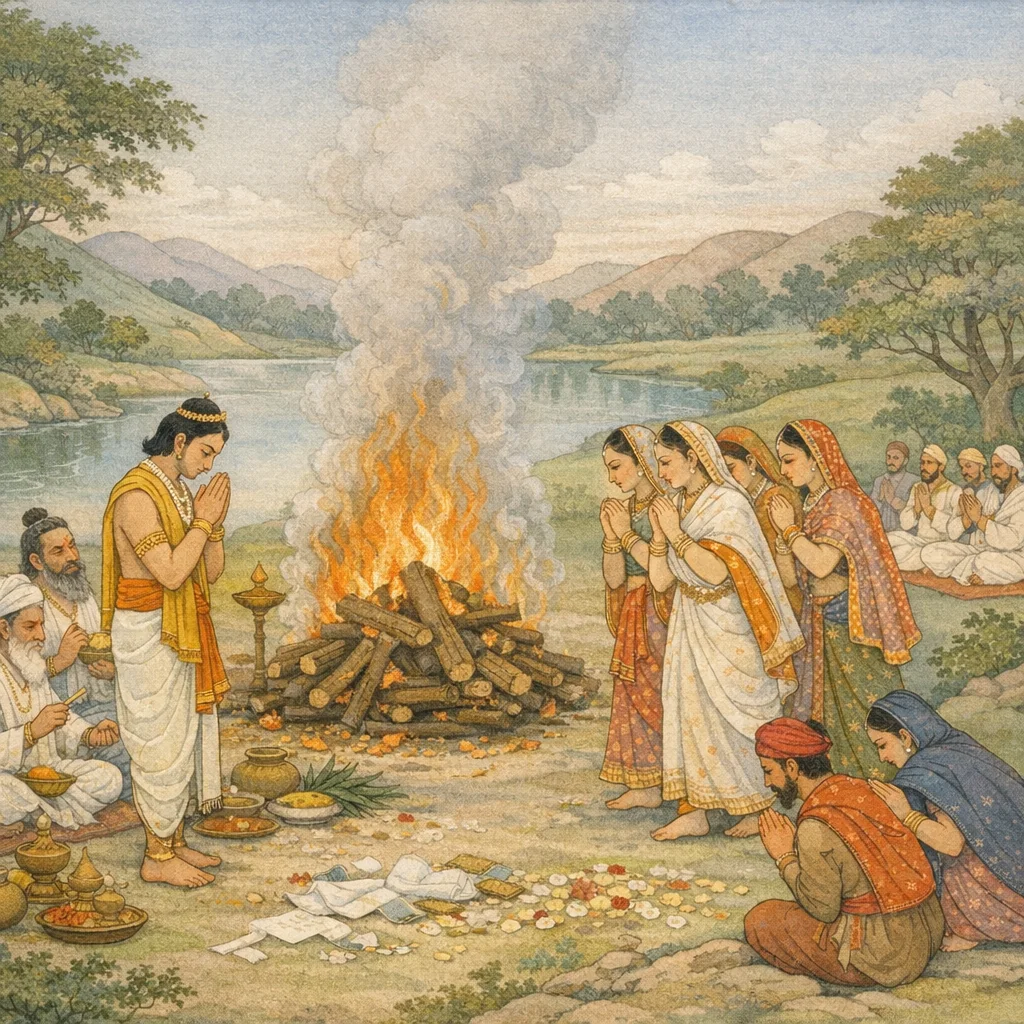
Sarga 76 shifts from Bharata’s intense lament to the administrative-ritual necessities of royal death. Vasiṣṭha, characterized as the foremost among eloquent sages, counsels Bharata to restrain grief and perform the king’s antyeṣṭi (funeral rites) at the proper time. Bharata regains composure and mobilizes ṛtviks, purohitas, and ācāryas to execute the prescribed procedures: the royal fires are duly handled, the body is removed from its preservative oil enclosure and placed upon an ornamented couch, and attendants carry the remains on a śibikā (litter). The procession is marked by offerings and strewing of gold and garments, followed by construction of a fragrant pyre using sandalwood, agaru, guggal resin, and other woods. Priests offer oblations, chant prayers, and Sāma-chanters sing hymns according to śāstra. The queens, led by Kausalyā, arrive and perform reverse circumambulation (prasavya) around the burning pyre; the soundscape becomes a public lament likened to the cries of krauñcī birds. Water-libations are offered with Bharata, and the city re-enters a structured ten-day mourning period, sleeping on the ground—an integration of grief, rite, and civic order.
Shlokas
Verse 1
तमेवं शोकसन्तप्तं भरतं कैकयी सुतम्।उवाच वदतां श्रेष्ठो वसिष्ठ श्श्रेष्ठवागृषिः।।2.76.1।।
Seeing Bharata—Kaikeyī’s son—thus scorched by grief, the sage Vasiṣṭha, foremost among eloquent speakers and a master of noble speech, addressed him.
Verse 2
अलं शोकेन भद्रं ते राजपुत्र महायशः।प्राप्तकालं नरपतेः कुरु संयानमुत्तमम्।।2.76.2।।
O illustrious prince, enough of grief—may you be blessed. The time has come: perform the king’s funeral rites in the best and proper manner.
Verse 3
वसिष्ठस्य वच श्शृत्वा भरतो धारणां गतः।प्रेतकार्याणि सर्वाणि कारयामास धर्मवित्।।2.76.3।।
Hearing Vasiṣṭha’s words, Bharata regained composure; as one who knew his duty, he set in motion all the rites to be done for the departed.
Verse 4
उद्धृतं तैलसंरोधात्सतु भूमौ निवेशितम्।आपीतवर्णवदनं प्रसुप्तमिव भूमिपम्।।2.76.4।।संवेश्य शयने चाग्य्रे नानारत्नपरिष्कृते।ततो दशरथं पुत्रो विललाप सुदुःखितः।।2.76.5।।
Daśaratha, the king, was taken out from the oil-preserving vessel and placed upon the ground; his face, pale-yellow in hue, looked as though he were asleep. Then, after laying him on a splendid couch adorned with many kinds of jewels, his son—overwhelmed with grief—lamented.
Verse 5
उद्धृतं तैलसंरोधात्सतु भूमौ निवेशितम्।आपीतवर्णवदनं प्रसुप्तमिव भूमिपम्।।2.76.4।।संवेश्य शयने चाग्य्रे नानारत्नपरिष्कृते।ततो दशरथं पुत्रो विललाप सुदुःखितः।।2.76.5।।
After offering the water-libations along with Bharata, the king’s wives—together with the ministers and priests—re-entered the city, their eyes brimming with tears; and for ten days, they passed the period of mourning in sorrow, lying on the ground.
Verse 6
किं ते व्यवसितं राजन् प्रोषिते मय्यनागते।विवास्य रामं धर्मज्ञं लक्ष्मणं च महाबलम्।।2.76.6।।
O King, what resolve did you take while I was away and before I had returned—that you banished righteous Rāma, and Lakṣmaṇa too, the mighty one?
Verse 7
क्व यास्यसि महाराज हित्वेमं दुःखितं जनम्।हीनं पुरुषसिंहेन रामेणाक्लिष्टकर्मणा।।2.76.7।।
O great king, where have you gone, leaving this grief-stricken one—abandoned by Rāma, the lion among men, whose deeds are ever untainted by hardship?
Verse 8
योगक्षेमं तु ते राजन् कोऽस्मिन्कल्पयिता पुरेत्वयि प्रयाते स्वस्तात रामे च वनमाश्रिते।।2.76.8।।
O king, dear father—now that you have departed to heaven and Rāma has taken refuge in the forest, who in this city will now provide its welfare and security?
Verse 9
विधवा पृथिवी राजन् स्त्वया हीना न राजते।हीनचन्द्रेव रजनी नगरी प्रतिभाति मा।।2.76.9।।
O king, the earth—bereft of you—shines no more, like a widow; and this city appears to me like a night robbed of its moon.
Verse 10
एवं विलपमानं तं भरतं दीनमानसम्।अब्रवीद्वचनं भूयो वसिष्ठस्तु महामुनिः।।2.76.10।।
As Bharata lamented in this way, his mind cast down, the great sage Vasiṣṭha spoke to him once again.
Verse 11
प्रेतकार्याणि यान्यस्य कर्तव्यानि विशां पतेः।तान्यव्यग्रं महाबाहो क्रियान्तामविचारितम्।।2.76.11।।
O mighty-armed prince, the funeral duties that must be performed for this lord of the people should be carried out with full attention and without wavering.
Verse 12
तथेति भरतो वाक्यं वसिष्ठस्याभिपूज्य तत्।ऋत्विक्पुरोहिताचार्यान् स्त्वरयामास सर्वशः।।2.76.12।।
Bharata assented, saying “So be it,” honoring Vasiṣṭha’s instruction, and he urged the priests, household chaplains, and teachers to hasten in every way.
Verse 13
ये त्वग्नयो नरेन्द्रेस्य चाग्न्यगाराद्बहिष्कृताः।ऋत्विग्भिर्याजकैश्चैव ते आह्रियन्त यथाविधि।।2.76.13।।
The sacred fires of the king, which had been brought out from the fire-sanctuary, were duly carried and arranged according to rule by the officiating priests and attendants.
Verse 14
शिबिकायामथा़ऽरोप्य राजानं गतचेतसम्।बाष्पकण्ठा विमनसस्तमूहुः परिचारकाः।।2.76.14।।
Then the attendants placed the king—lifeless—upon a bier, and with hearts heavy and throats choked with tears, they carried him away.
Verse 15
हिरण्यं च सुवर्णं च वासांसि विविधानि च।प्रकिरन्तो जना मार्गं नृपतेरग्रतो ययुः।।2.76.15।।
People went before the king’s body, strewing the road with gold and bright ornaments, and with garments of many kinds.
Verse 16
चन्दनागरुनिर्यासान् सरलं पद्मकं तथा।देवदारूणि चाहृत्य क्षेपयन्ति तथापरे।।2.76.16।।गन्धानुच्चावचांश्चान्यां स्तत्र गत्वाथ भूमिपम्।तत्र संवेशयामासुश्चितामध्ये तमृत्विजः।।2.76.17।।
Others brought sandalwood, agaru, fragrant resins, and woods such as sarala, padmaka, and deodāra, and they strewed them there. Having gone to the spot with many other perfumes besides, the priests then laid the king’s body in the middle of the pyre.
Verse 17
चन्दनागरुनिर्यासान् सरलं पद्मकं तथा।देवदारूणि चाहृत्य क्षेपयन्ति तथापरे।।2.76.16।।गन्धानुच्चावचांश्चान्यां स्तत्र गत्वाथ भूमिपम्।तत्र संवेशयामासुश्चितामध्ये तमृत्विजः।।2.76.17।।
Then, having offered oblations into the sacred fire, his priests recited the prescribed formulas; and there the chanters of the Sāma Veda sang the hymns according to scripture.
Verse 18
तदा हुताशनं हुत्वा जेपुस्तस्य तदृत्विजः।जगुश्च ते यथाशास्त्र तत्र सामानि सामगाः।।2.76.18।।
Then, having offered oblations into the sacred fire, his priests recited the prescribed formulas; and there the chanters of the Sāma Veda sang the hymns according to scripture.
Verse 19
शिबिकाभिश्च यानैश्च यथार्हं तस्य योषितः।नगरा न्निर्ययुस्तत्र वृद्धैः परिवृता स्तदा।।2.76.19।।
Then the king’s womenfolk, arranged according to rank, set out from the city for that place—surrounded by aged attendants—some in palanquins and others in vehicles.
Verse 20
प्रसव्यं चापि तं चकुः ऋत्विजोऽग्निचितं नृपम्।स्त्रियश्च शोकसन्तप्ताः कौसल्याप्रमुखास्तदा।।2.76.20।।
Then the priests, and the women—burning with grief and led by Kausalyā—circumambulated the king’s blazing pyre in the reverse direction.
Verse 21
क्रौञ्चीनामिव नारीणां निनादस्तत्र शुश्रुवे।आर्तानां करुणं काले क्रोशन्तीनां सहस्रशः।।2.76.21।।
At that time, there was heard the wailing sound of women—thousands of distressed voices crying pitifully—like the piercing calls of female krauñca birds.
Verse 22
ततो रुदन्त्यो विवशाविलप्य च पुनः पुनः।यानेभ्यस्सरयूतीरमवतेरुर्वराङ्गनाः।।2.76.22।।
Then the courtesans, weeping and helpless, lamenting again and again, alighted from their vehicles onto the bank of the Sarayū.
Verse 23
कृत्वोदकं ते भरतेन सार्धं नृपाङ्गना मन्त्रिपुरोहिता श्च।पुरंप्रविश्याश्रुपरीतनेत्राः भूमौ दशाहं व्यनयन्त दुःखम्।।2.76.23।।
After offering the water-libations along with Bharata, the king’s wives—together with the ministers and priests—re-entered the city, their eyes brimming with tears; and for ten days, they passed the period of mourning in sorrow, lying on the ground.
Frequently Asked Questions
The pivotal action is Bharata’s transition from incapacitating grief to dharmic execution of royal funeral duties. Vasiṣṭha frames restraint not as denial of emotion but as timely responsibility—performing the king’s prescribed rites without negligence.
The sarga teaches that dharma is enacted through correct timing (kāla) and procedure (vidhi): sorrow is acknowledged, yet social order is preserved by ritual competence and collective participation. Grief becomes ethically meaningful when directed into duties that honor the deceased and stabilize the community.
The Sarayū riverbank functions as the ritual landscape for water-libations and cremation-related observances, while Ayodhyā is depicted as a civic body entering formal mourning. Cultural markers include the śibikā procession, fragrant pyre materials (sandal, agaru, guggal), Sāma-chanting, and prasavya circumambulation around the pyre.