Sarga 69
भरतस्य दुःस्वप्नदर्शनम् — Bharata’s Ominous Dream
अयोध्याकाण्ड
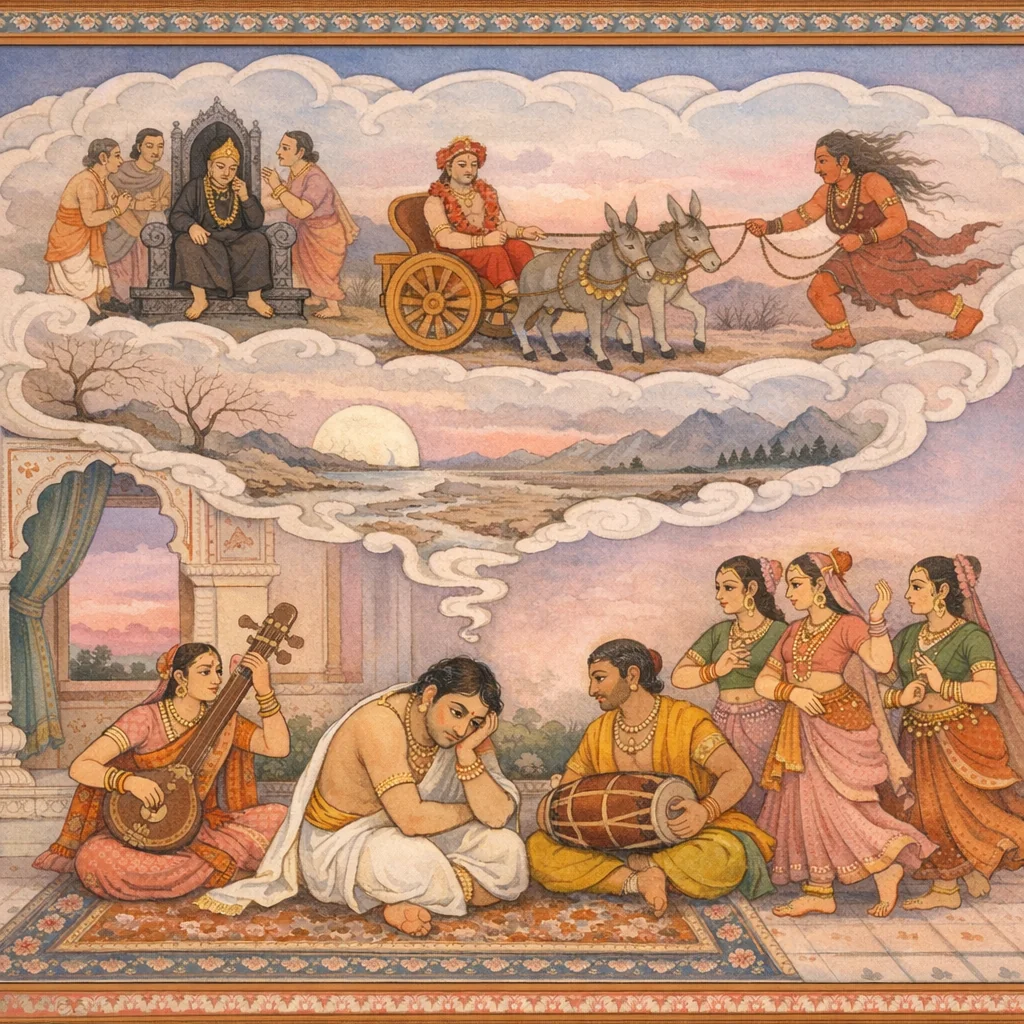
Sarga 69 presents Bharata’s interior crisis through a sequence of nightmare-omens coinciding with the messengers’ arrival at the city. At dawn, Bharata is distressed by a dream in which he sees his father Daśaratha in polluted settings and inauspicious actions: falling from a mountain into a cow-dung pool, floating while drinking oil, eating sesame-rice, and repeatedly plunging headfirst into oil while his body is smeared. The dream escalates into cosmic and royal-symbolic inversions—sea dried up, moon fallen, earth darkened, a royal elephant’s tusk shattered, fire suddenly extinguished, earth split, trees dried, smoky ruined mountains—signaling disorder in both nature and polity. Further images show the king clad in black on an iron seat, mocked by dark-complexioned women; then the monarch, adorned in red garlands and red unguents, hastens south on a donkey-yoked chariot, finally dragged by a grotesque rākṣasī in red. Bharata interprets the dream as a death-omen, fears for himself, Rāma, the king, or Lakṣmaṇa, and cites a specific oneiric rule: seeing a person ride a donkey-yoked conveyance portends imminent funeral smoke. Friends attempt diversion through music, dance, drama, and humor, but Bharata remains physiologically and mentally unsettled—parched throat, broken voice, haggard appearance, self-disgust without clear cause—while fear persists due to the king’s “incomprehensible” presence in the vision.
Shlokas
Verse 1
यामेव रात्रिं ते दूताः प्रविशन्ति स्म तां पुरीम्।भरतेनापि तां रात्रिं स्वप्नो दृष्टोऽयमप्रियः।।।।
On that very night when those messengers entered the city, Bharata too saw a distressing dream.
Verse 2
व्युष्टामेव तु तां रात्रिं दृष्ट्वा तं स्वप्नमप्रियम्।पुत्रो राजाधिराजस्य सुभृशं पर्यतप्यत।।।।
When that night had just turned to dawn, the son of the emperor, having seen that unpleasant dream, was intensely afflicted.
Verse 3
तप्यमानं समाज्ञाय वयस्याः प्रियवादिनः।आयासं हि विनेष्यन्त स्सभायां चक्रिरे कथाः।।।।
Noticing him afflicted with grief, his peers—ever gentle in speech—started various conversations in the assembly, intending to dispel his distress.
Verse 4
वादयन्ति तथा शान्तिं लास यन्त्यपि चापरे।नाटकान्यपरे प्राहुर्हास्यानि विविधानि च।।।।
To soothe him, some played instruments, others danced; some staged dramatic performances, and others told many kinds of humorous tales.
Verse 5
स तैर्महात्मा भरतस्सखिभिः प्रियवादिभिः।गोष्ठीहास्यानि कुर्वद्भिर्न प्राहृष्यत राघवः।।।।
Yet that noble Bharata, a scion of the Raghus, found no joy in the friendly banter and jokes, even though they were offered by sweet-speaking companions.
Verse 6
तमब्रवीत्प्रियसखो भरतं सखिभिर्वृतम्।सुहृद्भिः पर्युपासीनः किं सखे नानुमोदसे।।।।
Then a dear friend, seated close among the well-wishers while Bharata was surrounded by companions, said to him: “Why, friend, do you not feel glad?”
Verse 7
एवं ब्रुवाणं सुहृदं भरतः प्रत्युवाच ह।श्रुणु त्वं यन्निमित्तं मे दैन्यमेतदुपागतम्।।।।
Thus addressed by his friend, Bharata replied: “Listen—this is the reason why such desolation has come upon me.”
Verse 8
स्वप्ने पितरमद्राक्षं मलिनं मुक्त मूर्धजम्।पतन्तमद्रिशिखरात्कलुषे गोमयह्रदे।।।।
In a dream I saw my father—pale and unkempt, his hair dishevelled—falling from a mountain peak into a foul pool filled with cow-dung.
Verse 9
प्लवमानश्च मे दृष्टस्स तस्मिन्गोमयह्रदे।पिबन्नञ्जलिना तैलं हसन्नपि मुहुर्मुहुः।।।।
I saw him floating in that cow-dung pool, drinking oil with cupped hands, and laughing again and again.
Verse 10
ततस्तिलौदनं भुक्त्वा पुनः पुनरधश्शिराः।तैलेनाभ्यक्तसर्वाङ्गः तैलमेवान्वगाहत।।।।
Then I saw him eating rice cooked with sesame; his whole body smeared with oil, he plunged headlong again and again into oil itself.
Verse 11
स्वप्नेऽपि सागरं शुष्कं चन्द्रं च पतितं भवि।उपरुद्धां च जगतीं तमसेव समावृताम्।।।।औपवाह्यस्य नागस्य विषाणं शकलीकृतम्।सहसाचापि संशान्तं ज्वलितं जातवेदसम्।।।।अवतीर्णां च पृथिवीं शुष्कां श्च विविधान् द्रुमान्।अहं पश्यामि विध्वस्तान् सधूमांश्चापि पर्वतान्।।।।
Even in the dream I saw the sea dried up and the moon fallen to the ground; the world seemed choked and wrapped in darkness. I saw the tusk of a royal riding-elephant shattered; a blazing fire suddenly extinguished; the earth split, many kinds of trees dried up, and mountains ruined and smoking.
Verse 12
स्वप्नेऽपि सागरं शुष्कं चन्द्रं च पतितं भवि।उपरुद्धां च जगतीं तमसेव समावृताम्।।2.69.11।।औपवाह्यस्य नागस्य विषाणं शकलीकृतम्।सहसाचापि संशान्तं ज्वलितं जातवेदसम्।।2.69.12।।अवतीर्णां च पृथिवीं शुष्कां श्च विविधान् द्रुमान्।अहं पश्यामि विध्वस्तान् सधूमांश्चापि पर्वतान्।।2.69.13।।
In that dream I saw the tusk of a royal, ride-worthy elephant shattered into fragments, and a blazing fire suddenly quenched—portents that seemed to announce the collapse of strength and auspicious order.
Verse 13
स्वप्नेऽपि सागरं शुष्कं चन्द्रं च पतितं भवि।उपरुद्धां च जगतीं तमसेव समावृताम्।।2.69.11।।औपवाह्यस्य नागस्य विषाणं शकलीकृतम्।सहसाचापि संशान्तं ज्वलितं जातवेदसम्।।2.69.12।।अवतीर्णां च पृथिवीं शुष्कां श्च विविधान् द्रुमान्।अहं पश्यामि विध्वस्तान् सधूमांश्चापि पर्वतान्।।2.69.13।।
I saw the earth as though it had sunk and split, many kinds of trees dried up, and even mountains ruined and smoking—visions of a world losing stability and auspiciousness.
Verse 14
पीठे कार्ष्णायसे चैनं निषण्णं कृष्णवाससम्।प्रहसन्ति स्म राजानं प्रमदाः कृष्णपिङ्गलाः।।।।
I saw the king seated on an iron bench, clad in black; and dark, tawny women were laughing at him—an image of humiliation and the stripping away of royal dignity.
Verse 15
त्वरमाणश्च धर्मात्मा रक्तमाल्यानुलेपनः।रथेन खरयुक्तेन प्रयातो दक्षिणामुखः।।।।
I saw that righteous king, hastening—adorned with red garlands and red unguent—departing southward on a chariot yoked with asses, as though driven toward the realm of death.
Verse 16
प्रहसन्तीव राजानं प्रमदा रक्तवासिनी।प्रकर्षन्ती मया दृष्टा राक्षसी विकृतानना।।।।
I saw a hideous rākṣasī-woman, clothed in red, dragging the king away while seeming to mock him—an emblem of hostile forces overpowering rightful sovereignty.
Verse 17
एवमेतन्मया दृष्टमिमां रात्रिं भयावहम्।अहं रामोऽथवा राजा लक्ष्मणो वा मरिष्यति।।।।
Such was the terrifying dream I saw last night: either I, or Rāma, or the king, or Lakṣmaṇa will die.
Verse 18
नरो यानेन य स्स्वप्ने स्वरयुक्तेन याति हि।अचिरात्तस्य धूमाग्रं चितायां सम्प्रदृश्यते।।।।
For if a man is seen in a dream traveling in a carriage yoked with asses, before long the curling smoke rising from his funeral pyre is seen—such is the omen.
Verse 19
एतन्निमित्तं दीनोऽहं तन्नवः प्रतिपूजये।शुष्यतीव च मे कण्ठः न स्वस्थमिव मे मनः।।।।
Because of this, I am despondent and cannot properly respond to you. My throat feels as if it is drying up, and my mind seems as though it is not at ease.
Verse 20
न पश्यामि भयस्थानं भयं चैवोपधारयेभ्रष्टश्च स्वरयोगो मे छाया चोपहता मम।जुगुप्सन्निव चाऽत्मानं न पश्यमि च कारणम्।।।।
I do not see any definite ground for fear, yet I feel fear alone. My voice has faltered, my very look has grown haggard; I seem to loathe myself, and I cannot find the reason why.
Verse 21
इमां च दुस्स्वप्नगतिं निशाम्यतामनेकरूपामवितर्कितां पुरा।भयं महत्तद्धृदयान्नयाति मे विचिन्त्य राजानमचिन्तदर्शनम्।।।।
Having recognized this course of a dreadful dream—manifold in its forms and never imagined before—and reflecting on the king whose condition is beyond comprehension, a great fear does not leave my heart.
Frequently Asked Questions
The dilemma is interpretive and moral: Bharata must process foreboding signs without clear evidence, while remaining responsible in speech and conduct; he fears imminent death within the royal family and struggles to respond appropriately to companions and circumstance.
The chapter emphasizes the epic’s moral psychology: fear can arise without visible cause, and omens function as narrative instruments linking inner apprehension to public catastrophe; companionship may console, yet dharma requires steadiness when signs suggest impermanence and loss.
Ayodhyā and the sabhā (assembly) frame the social setting, while dream-landmarks—adriśikhara (mountain peak), gomaya-hrada (cow-dung pool), citā (funeral pyre), and the southward direction—encode cultural notions of impurity, death-portents, and inauspicious transit.