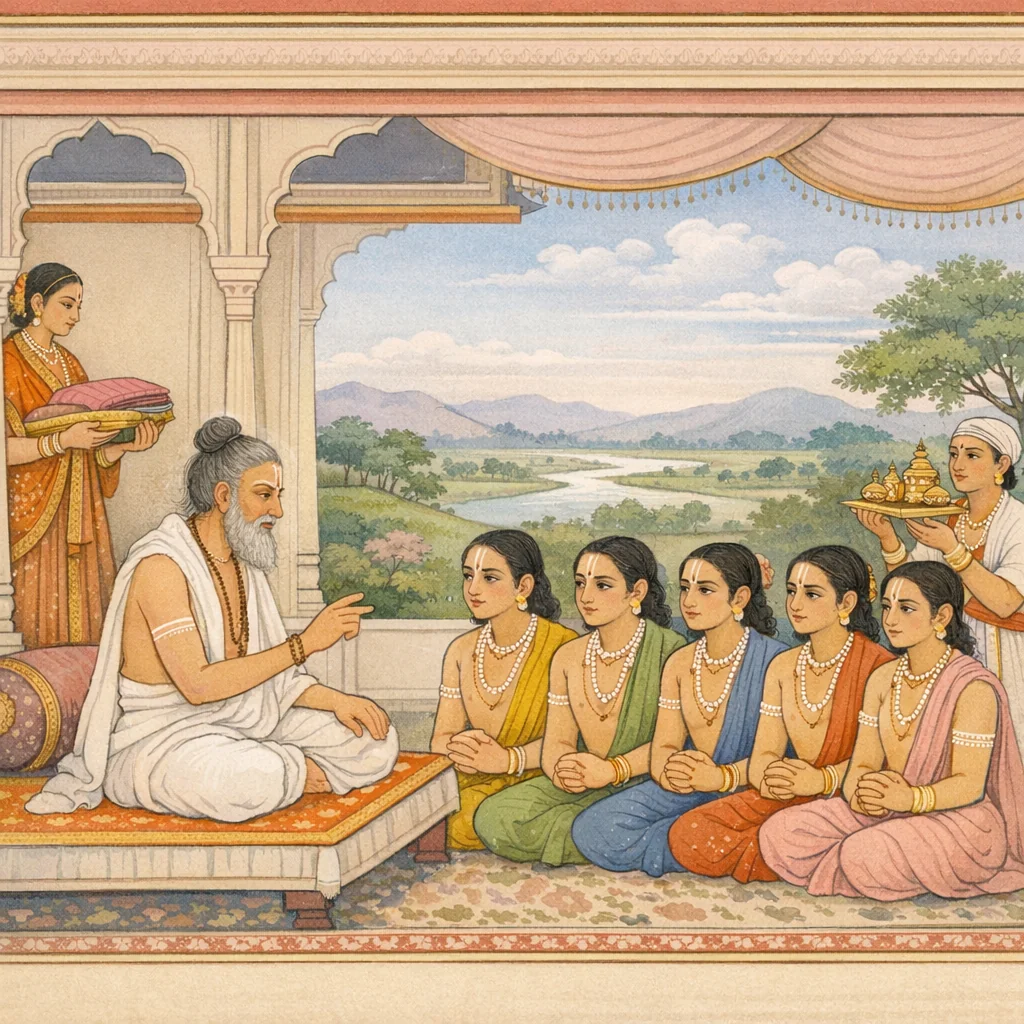
Sarga 68
दूतप्रेषणम् — Dispatch of Messengers to Kekaya (Bharata’s Recall)
अयोध्याकाण्ड
This sarga documents the court’s operational response after deliberation: Vasiṣṭha, having heard the ministers and brahmins, authorizes an urgent embassy to recall Bharata and Śatrughna from their maternal uncle’s kingdom (Kekaya). He summons identified messengers (Siddhārtha, Vijaya, Jayanta, Aśoka, Nandana) and issues a precise protocol: travel swiftly to Rājagṛha (Kekaya’s capital), conceal signs of grief, convey welfare from the purohita and ministers, and insist on immediate return for an “urgent task.” A key communicative constraint is imposed—do not disclose to Bharata either Rāma’s forest exile or Daśaratha’s death, nor the broader decline afflicting the Raghus—indicating a strategy of controlled information to prevent shock and preserve political stability. The messengers are provisioned with travel necessities and gifts (silk garments and ornaments) for both the Kekaya king and Bharata, reflecting diplomatic etiquette. The chapter then maps their route through notable North Indian landmarks—crossing the Gaṅgā at Hastināpura, moving through Kuru-jāṅgala to Pāñcāla, traversing rivers (Mālinī, Śaradandā, Ikṣumatī, Vipāśā, Śālmalī), and passing Sudāmā mountain where Viṣṇu’s footprints are observed—before arriving at Girivraja by night, emphasizing duty, speed, and geographic specificity.
Shlokas
Verse 1
तेषां हि वचनं श्रुत्वा वसिष्ठः प्रत्युवाच ह।मित्रामात्यगणान्सर्वान्ब्राह्मणांस्तानिदं वचः।।2.68.1।।
Having heard their words, Vasiṣṭha replied with these words to all those groups of friends and ministers, and to the brāhmaṇas as well.
Verse 2
यदसौ मातुलकुले दत्तराज्यं परं सुखी।भरतो वसति भ्रात्रा शत्रुघ्नेन समन्वितः।।2.68.2।।तच्छीघ्रं जवना दूता गच्छन्तु त्वरितैर्हयैः।आनेतुं भ्रातरौ वीरौ किं समीक्षामहे वयम्।।2.68.3।।
Since Bharata—upon whom the kingdom has been conferred—dwells very happily in his maternal uncle’s household together with his brother Śatrughna,
Verse 3
यदसौ मातुलकुले दत्तराज्यं परं सुखी।भरतो वसति भ्रात्रा शत्रुघ्नेन समन्वितः।।2.68.2।।तच्छीघ्रं जवना दूता गच्छन्तु त्वरितैर्हयैः।आनेतुं भ्रातरौ वीरौ किं समीक्षामहे वयम्।।2.68.3।।
therefore let swift messengers go at once on fast horses to bring back the two valiant brothers; what is there for us to deliberate further?
Verse 4
गच्छन्त्विति तत स्सर्वे वसिष्ठं वाक्यमब्रुवन्।तेषां तद्वचनं श्रूत्वा वसिष्ठो वाक्यमब्रवीत्।।2.68.4।।
“Let them go,”—thus all of them addressed Vasiṣṭha. Hearing their words, Vasiṣṭha spoke in reply.
Verse 5
एहि सिद्धार्थ विजय जयन्ताशोक नन्दन।श्रूयतामिति कर्तव्यं सर्वानेव ब्रवीमि वः।।2.68.5।।
“Come—Siddhārtha, Vijaya, Jayanta, Aśoka, Nandana. Listen: I shall tell all of you what must be done.”
Verse 6
पुरं राजगृहं गत्वा शीघ्रं शीघ्रजवै र्हयैः।त्यक्तशोकैरिदं वाच्य श्शासनाद्भरतो मम।।2.68.6।।
“Go quickly on swift horses to the city of Rājagṛha; and, without showing grief, convey these words to Bharata as my directive.”
Verse 7
पुरोहित स्त्वां कुशलं प्राह सर्वे च मन्त्रिणः।त्वरमाणश्च निर्याहि कृत्यमात्ययिकं त्वया।।2.68.7।।
“The family priest and all the ministers send you their blessings for your welfare. Return at once in haste; an urgent duty awaits you.”
Verse 8
मा चास्मै प्रोषितं रामं मा चास्मै पितरं मृतम्।भवन्त श्शंसिषुर्गत्वा राघवाणामिमं क्षयम्।।2.68.8।।
“And when you reach him, do not tell him that Rāma has been sent away, nor that his father has died—do not disclose this calamity that has fallen upon the house of the Rāghavas.”
Verse 9
कौशेयानि च वस्त्राणि भूषणानि वराणि च।क्षिप्रमादय राज्ञश्च भरतस्य च गच्छत।।2.68.9।।
“Take at once silk garments and fine ornaments—gifts for the king and for Bharata—and depart without delay.”
Verse 10
दत्तपथ्यशना दूता जग्मुस्स्वं स्वं निवेशनम्।केकयां स्ते गमिष्यन्तो हयानारुह्य संमतान्।।2.68.10।।
The messengers, provided with provisions for the road, went each to his own lodging; and, preparing to depart for Kekaya, mounted excellent horses.
Verse 11
ततः प्रास्थानिकं कृत्वा कार्यशेषमनन्तरम्।वसिष्ठेनाभ्यनुज्ञाता दूता स्संत्वरिता ययुः।।2.68.11।।
Then, having completed the remaining arrangements required for departure, and having received Vasiṣṭha’s permission, the messengers went forth in haste.
Verse 12
न्यन्तेनापरतालस्य प्रलम्बस्योत्तरं प्रति।निषेवमाणा स्ते जग्मुर्नदीं मध्येन मालिनीम्।।2.68.12।।
Those messengers went on, keeping to the west of Aparatāla and toward the north of Pralamba, travelling along the Mālinī river that flows between them.
Verse 13
ते हस्तिनापुरे गङ्गां तीर्त्वा प्रत्यङ्मुखा ययुः।पाञ्चालदेशमासाद्य मध्येन कुरुजाङ्गलम्।।2.68.13।।सरांसि च सुपूर्णानि नदीश्च विमलोदकाः।निरीक्षमाणा स्ते जग्मुर्दूताः कार्यवशाद्द्रुतम्।।2.68.14।।
Crossing the Gaṅgā at Hastināpura, they proceeded westward; and, passing through the heart of Kuru-jāṅgala, they reached the land of Pāñcāla.
Verse 14
ते हस्तिनापुरे गङ्गां तीर्त्वा प्रत्यङ्मुखा ययुः।पाञ्चालदेशमासाद्य मध्येन कुरुजाङ्गलम्।।2.68.13।।सरांसि च सुपूर्णानि नदीश्च विमलोदकाः।निरीक्षमाणा स्ते जग्मुर्दूताः कार्यवशाद्द्रुतम्।।2.68.14।।
Beholding lakes brimming with water and rivers of clear, pure streams, those messengers hastened on—driven by the urgency of their task.
Verse 15
ते प्रसन्नोदकां दिव्यां नानाविहगसेविताम्।उपातिजग्मुर्वेगेन शरदण्डां जनाकुलाम्।।2.68.15।।
They swiftly passed the divine Śaradaṇḍā—its waters calm, frequented by many kinds of birds, and crowded with people.
Verse 16
निकूलवृक्षमासाद्य दिव्यं सत्योपयाचनम्।अभिगम्याभिवाद्यं तं कुलिङ्गां प्राविशन्पुरीम्।।2.68.16।।
Reaching the divine bank-side tree called Satyopayācana—worthy of reverence—they approached it, paid homage, and then entered the city of Kuliṅgā.
Verse 17
आभिकालं ततः प्राप्य ते बोधिभवनाच्च्युताम्।पितृपैतामहीं पुण्यां तेरुरिक्षुमतीं नदीम्।।2.68.17।।
From there they reached Ābhikāla, and crossed the sacred Ikṣumatī, flowing down from Bodhibhavana—a land long cherished by Daśaratha’s fathers and forefathers.
Verse 18
अवेक्ष्याञ्जलिपानांश्च ब्राह्मणान्वेदपारगान्।ययुर्मध्येन बाह्लीकान् सुदामानं च पर्वतम्।।2.68.18।।
Seeing brāhmaṇas—masters of the Vedas—who drank water with cupped palms, they journeyed on through the heart of Bāhlīka and toward Mount Sudāmān.
Verse 19
विष्णोः पदं प्रेक्षमाणा विपाशांचापि शाल्मलीम्।नदीर्वापी स्तटाकानि पल्वलानि सरांसि च।।2.68.19।।पश्यन्तो विविधांश्चापि सिंहाव्याघ्रमृग द्विपान्।ययुः पथाऽतिमहता शासनं भर्तुरीप्सवः।।2.68.20।।
Beholding Viṣṇu’s footprints, and also seeing the Vipāśā and Śālmalī rivers—along with rivers, stepped wells, tanks, pools, and lakes—and observing diverse lions, tigers, deer, and elephants, they travelled a very long road, intent on fulfilling their master’s command.
Verse 20
विष्णोः पदं प्रेक्षमाणा विपाशांचापि शाल्मलीम्।नदीर्वापी स्तटाकानि पल्वलानि सरांसि च।।2.68.19।।पश्यन्तो विविधांश्चापि सिंहाव्याघ्रमृग द्विपान्।ययुः पथाऽतिमहता शासनं भर्तुरीप्सवः।।2.68.20।।
Beholding Viṣṇu’s footprints, and also seeing the Vipāśā and Śālmalī rivers—along with rivers, stepped wells, tanks, pools, and lakes—and observing diverse lions, tigers, deer, and elephants, they travelled a very long road, intent on fulfilling their master’s command.
Verse 21
ते श्रान्तवाहना दूता विकृष्णेन पथा ततः।गिरिव्रजं पुरवरं शीघ्रमासेदुरञ्जसा।।2.68.21।।
After that long and taxing route, the messengers—whose mounts were weary—soon reached, straightway, Girivraja, the foremost of cities.
Verse 22
भर्तुः प्रियार्थं कुलरक्षणार्थं भर्तुश्च वंशस्य परिग्रहार्थम्।अहेडमाना स्त्वरया स्म दूता रात्र्यान्तु ते तत्पुरमेव याताः।।2.68.22।।
To please their master, to safeguard the royal line, and to uphold the honor and continuity of the king’s dynasty, the messengers—without negligence—made haste and reached that very city by night.
Frequently Asked Questions
The pivotal action is Vasiṣṭha’s decision to recall Bharata urgently while instructing the envoys to withhold traumatic truths (Rāma’s exile and Daśaratha’s death), balancing compassion, political stability, and dynastic continuity.
The sarga frames governance as disciplined execution: dharma is upheld not only by ideals but by timely action, proper delegation, and prudent speech that prevents harm while enabling rightful responsibility.
Key landmarks include Gaṅgā at Hastināpura; regions Kuru-jāṅgala and Pāñcāla; rivers Mālinī, Śaradandā, Ikṣumatī, Vipāśā, Śālmalī; Sudāmā mountain with Viṣṇu’s footprints; and the destination cities Rājagṛha/Girivraja in Kekaya.